From Surf Wiki (app.surf) — the open knowledge base
Coogan's Bluff
Promontory in Manhattan, New York
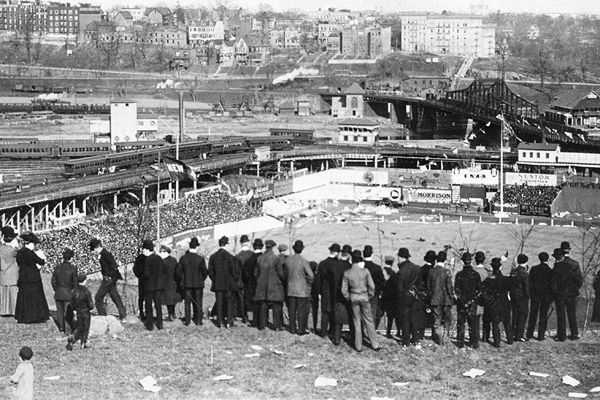
Promontory in Manhattan, New York
Coogan's Bluff is a promontory near the western shore of the Harlem River in the Washington Heights neighborhood of Upper Manhattan in New York City. Its boundaries extend approximately from 155th Street and the Macombs Dam Bridge viaduct to 160th Street, between Edgecombe Avenue and the river. A deep escarpment descends 175 ft from Edgecombe Avenue to the river, creating a sheltered area between the bluff and river known as Coogan's Hollow. From 1890 to 1964, the hollow was home to the Polo Grounds sports stadium.
Namesake
The promontory is named for James J. Coogan (1846–1915), a real estate developer and one-term Manhattan Borough President, who owned the land during the late 19th and early 20th centuries. The earliest known published reference to "Coogan's Bluff" appeared in The New York Times in 1893.
Polo Grounds

From 1890 until April 1964, the bluff overlooked the Polo Grounds, a stadium that served as the home field of Major League Baseball's New York Giants from 1891 until the franchise's move to San Francisco after the 1957 season. Sportswriters commonly used Coogan's Bluff as a sobriquet for the Polo Grounds. The stadium was actually situated in Coogan's Hollow, the bottomland between the bluff and the river. The Coogan heirs continued to own the land on which the Polo Grounds stood even though the Giants owned the stadium. This stymied the Giants' efforts to maintain the stadium and was a factor in their decision to move to San Francisco after the 1957 season.
Before the opening of the first Yankee Stadium in 1923, the New York Yankees shared the Polo Grounds with the Giants for ten seasons (1913–1922). For their first 31 years, the football Giants of the National Football League (NFL) played home games at the Polo Grounds (1925–1955), then went to Yankee Stadium. After four seasons without a baseball team (1958–1961), the expansion New York Mets were tenants in 1962 and 1963, then moved to the new Shea Stadium in northern Queens in 1964. The New York Titans/Jets of the American Football League (AFL) played their first four seasons at the venue (1960–1963), then also left for Shea in 1964.
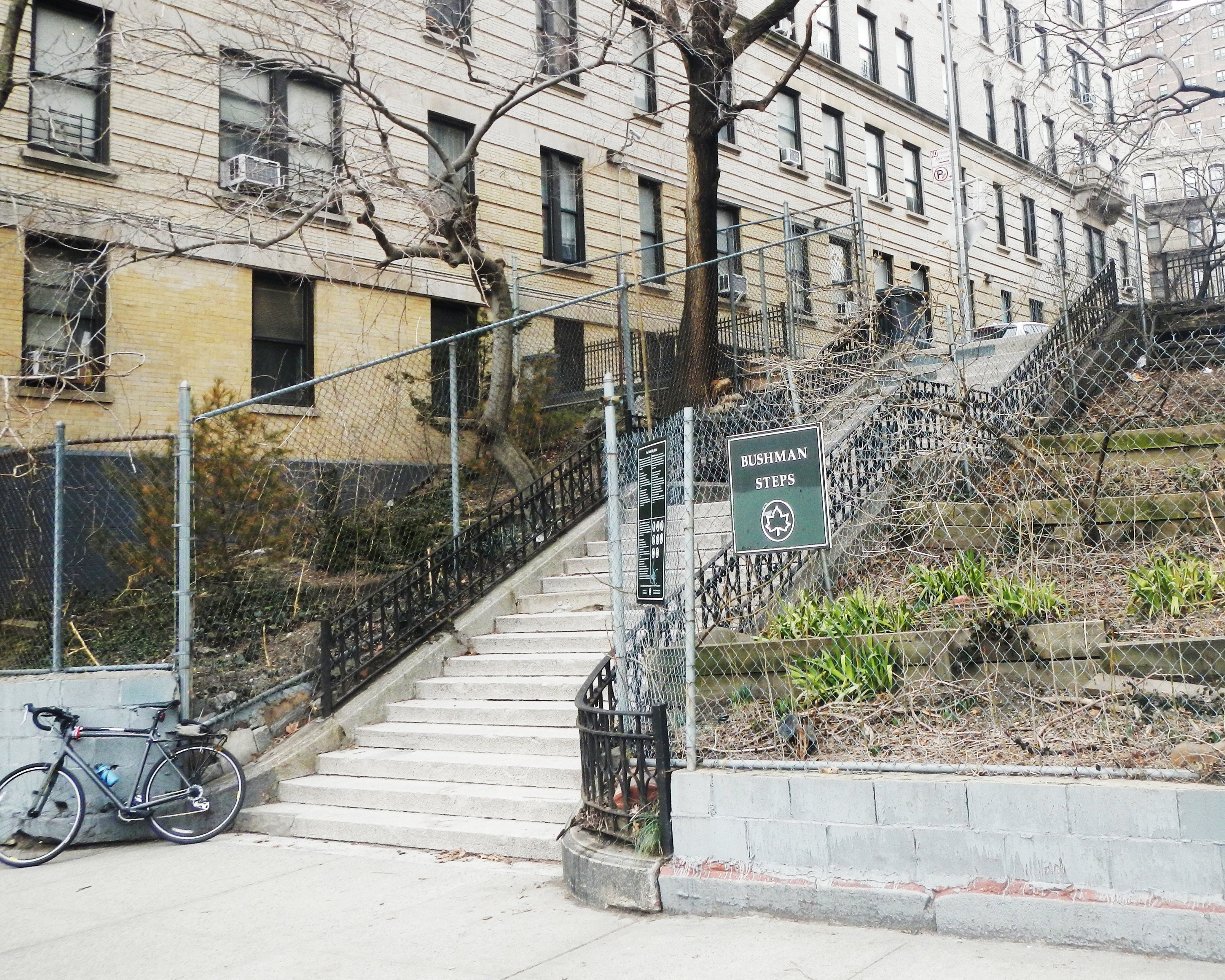
Bushman Steps The Bushman Steps, located just west of Coogan's Bluff in Sugar Hill/Hamilton Heights, led from the 155th Street subway station to the Polo Grounds ticket booths; the John T. Brush Stairway, on West 157th Street between St Nicholas Avenue and Edgecombe Avenue, then carried fans the rest of the way down to the stadium. The two stairways are the only intact structures that remain from the Polo Grounds era. The Brush Stairway was named in honor of the owner of the Giants franchise from 1890 until his death in 1912. The identity of the namesake of the Bushman Steps has apparently been lost.
Housing complex


The 15.15 acre hollow, bordered by Frederick Douglass Boulevard, West 155th Street and Harlem River Drive, is currently home to the Polo Grounds Towers housing complex: four 30-story buildings containing a total of 1,616 apartments. The complex was completed on June 30, 1968, and is run by the New York City Housing Authority. Attached to Tower #2 is the Polo Grounds Community Center, run by Children's Village, which hosts such programs as the Polo Grounds Youth Conference. A plaque on the property marks the approximate location of home plate within the demolished ballpark.
Transportation
Coogan's Bluff can be reached via the New York City Subway's 155th Street station, on the IND Concourse Line (). City bus routes service the area as well.
Nearby points of interest
The Morris-Jumel Mansion, the oldest house in Manhattan still standing (built in 1765 and now a museum) is located nearby, in Washington Heights. South of 155th Street, Coogan's Bluff becomes a smaller cliff within Jackie Robinson Park.
Immediately across the Harlem River, in the Bronx, is Yankee Stadium, home of Major League Baseball's New York Yankees.
References
References
- Pollak, Michael. (April 25, 2004). "F.Y.I.". The New York Times.
- (December 1, 1893). "The Orange Above the Blue". The New York Times.
- (April 9, 1964). "Historic old Polo Grounds to be torn down–finally". Lewiston Morning Tribune.
- (April 10, 1964). "Walls tumble down at Polo Grounds". Pittsburgh Press.
-
- [http://cityroom.blogs.nytimes.com/2008/02/19/a-stairway-to-sports-history-from-the-polo-grounds/ John T. Brush Stairway at Coogan's Bluff]
- (July 9, 1913). "Miller's Homer Beats Phillies". The New York Times.
- Williams, Timothy. (February 19, 2008). "A Stairway to Sports History From the Polo Grounds". The New York Times.
- [http://www.nycgovparks.org/parks/M127/highlights/11962 NYC Parks Bushman Steps Highlights]
- "Polo Grounds Towers". New York City Housing Authority.
- [http://www.pologroundsyouthconference.org "Polo Ground's Youth Conference"] {{webarchive. link. (March 28, 2012 Children's Village. Retrieved June 1, 2011.)
- Spector, Jesse. (September 21, 2008). "Yankees had homes before becoming Bronx Bombers". Daily News.
- {{cite NYC bus map. M
- (January 14, 1992). "Macomb's Dam Bridge". [[New York City Landmarks Preservation Commission]].
This article was imported from Wikipedia and is available under the Creative Commons Attribution-ShareAlike 4.0 License. Content has been adapted to SurfDoc format. Original contributors can be found on the article history page.
Ask Mako anything about Coogan's Bluff — get instant answers, deeper analysis, and related topics.
Research with MakoFree with your Surf account
Create a free account to save articles, ask Mako questions, and organize your research.
Sign up freeThis content may have been generated or modified by AI. CloudSurf Software LLC is not responsible for the accuracy, completeness, or reliability of AI-generated content. Always verify important information from primary sources.
Report