From Surf Wiki (app.surf) — the open knowledge base
Coober Pedy
.jpg)
| Field | Value | |
|---|---|---|
| type | town | |
| name | Coober Pedy | |
| native_name | Umoona | |
| state | sa | |
| image | Coober Pedy - panoramio (4).jpg | |
| caption | Town centre | |
| coordinates | ||
| relief | yes | |
| pushpin_map_caption | Location in South Australia | |
| pop | ||
| established | 1915 | |
| postcode | 5723 | |
| dist1 | 846 | |
| dir1 | NW | |
| location1 | Adelaide | |
| dist2 | 688 | |
| dir2 | S | |
| location2 | Alice Springs | |
| lga | District Council of Coober Pedy | |
| region | Far North | |
| stategov | Giles | |
| fedgov | Grey | |
| maxtemp | 27.8 | |
| maxtemp_footnotes | {{cite web | |
| url | http://www.bom.gov.au/climate/averages/tables/cw_016090_All.shtml | title = Coober Pedy Airport Climate Statistics (1994-2024) |
| publisher | Bureau of Meteorology | access-date = August 18, 2024}} |
| mintemp | 14.2 | |
| mintemp_footnotes | ||
| rainfall | 144.2 | |
| rainfall_footnotes | ||
| near-n | Mount Willoughby | |
| Mount Barry | ||
| near-ne | Anna Creek | |
| near-e | Anna Creek | |
| near-se | Mount Douall | |
| near-s | Ingomar | |
| near-sw | Mount Clarence Station | |
| Ingomar | ||
| near-w | Mount Clarence Station | |
| near-nw | Mount Willoughby | |
| footnotes | Adjoining localities |
| timezone-dst = | utc-dst = | near-n = Mount Willoughby Mount Barry | near-ne = Anna Creek | near-e = Anna Creek | near-se = Mount Douall | near-s = Ingomar | near-sw = Mount Clarence Station Ingomar | near-w = Mount Clarence Station | near-nw = Mount Willoughby Coober Pedy () is a town in northern South Australia, 846 km north of Adelaide on the Stuart Highway. The town is sometimes referred to as the "opal capital of the world" because of the quantity of precious opals mined there. A blower truck is raised above the town sign, representing the importance of opal mining to the town's history. Coober Pedy is also renowned for its below-ground dwellings, called "dugouts", which are built in this fashion due to the scorching daytime heat.
The name "Coober Pedy" is thought to derive from the Kokatha-Barngarla term kupa-piti, which translates to "whitefellas' hole", but in 1975 the local Aboriginal people of the town adopted the name Umoona, which means "long life" and is also their name for the mulga tree.
History
Aboriginal people have a longstanding connection with the area,}} Further investigation into the words by linguists shows that kupa may have originated from the Parnkalla language and that piti may be the Kokatha word specifically created for "quarry" (a white man's activity).
In 1858, Scottish-born John McDouall Stuart was the first European explorer to pass near the site of Coober Pedy.
On 1 February 1915, Wille Hutchison discovered the first opal in the area, after which the town was established. Opal miners started moving in around 1916.
In 1920, five years later, a meeting settled on the name of Coober Pedy, when a post office was established.
In July 1975, the local Aboriginal people of Coober Pedy adopted the name Umoona, which means "long life" and is also their name for the Acacia aneura, or mulga tree, which is plentiful in the area. The name has since been used for various establishments in the town (Umoona Opal Mine and Museum, Umoona Community Art Centre, Umoona Tjutagku Health Service Aboriginal Corporation).
Location and governance
Coober Pedy is about halfway between Adelaide and Alice Springs, in the Far North region of South Australia.
It falls within the electoral district of Giles for the state government elections, and in the federal government Division of Grey.
Geography
Coober Pedy is situated on the edge of the erosional scarp of the Stuart Ranges, on beds of sandstone and siltstone 30 m deep and topped with a stony, treeless desert. Very little plant life exists in town due to the region's low rainfall, the high cost of water, and lack of topsoil.

The harsh summer desert temperatures mean that many residents prefer to live in caves bored into the hillsides (known as "dugouts"). A standard three-bedroom cave home with lounge, kitchen, and bathroom can be excavated out of the rock in the hillside for a price similar to building a house on the surface. However, dugouts remain at a constant temperature, while surface buildings need air conditioning, especially during the summer months, when temperatures often exceed 40 C. The relative humidity rarely exceeds 20% on these hot days, and the skies are usually cloud-free. The average maximum temperature is 30 -, but it can get quite cool in the winter.
The town's water supply, managed by the District Council which operates a bore and associated treatment plant, comes from the Great Artesian Basin. Problems with ageing pipes, high water loss, and lack of subsidies contribute to consumer water charges being the highest in South Australia.
Climate
.jpg)
Coober Pedy has a hot desert climate (Köppen: BWh), with very hot summers and mild winters. There is great seasonal variation due to the town's inland location. Average maxima vary between 36.7 C in January and 18.4 C in June; average minima range between 22.2 C in January and 6.3 C in July.{{cite web
Coober Pedy was flooded when 115 mm – more than three-quarters of the mean annual rainfall – was recorded in 24 hours on 10 April 2014.
|Jan record high C = 48.3 |Feb record high C = 48.1 |Mar record high C = 44.4 |Apr record high C = 41.5 |May record high C = 33.5 |Jun record high C = 32.1 |Jul record high C = 32.0 |Aug record high C = 36.4 |Sep record high C = 39.4 |Oct record high C = 44.8 |Nov record high C = 45.9 |Dec record high C = 48.3 |Jan record low C = 9.4 |Feb record low C = 10.6 |Mar record low C = 9.2 |Apr record low C = 5.0 |May record low C = 1.4 |Jun record low C = -0.1 |Jul record low C = -2.0 |Aug record low C = 0.6 |Sep record low C = 1.7 |Oct record low C = 3.9 |Nov record low C = 6.7 |Dec record low C = 10.0 |Jan dew point C = 4.0 |Feb dew point C = 5.7 |Mar dew point C = 3.5 |Apr dew point C = 3.1 |May dew point C = 3.5 |Jun dew point C = 3.4 |Jul dew point C = 1.7 |Aug dew point C = -0.1 |Sep dew point C = 0.1 |Oct dew point C = 0.1 |Nov dew point C = 1.7 |Dec dew point C = 3.3 |access-date = August 18, 2024}}
Mining
Opals
Oral history suggests that Aboriginal people knew where opals were in the Coober Pedy area, but did not value them because food was more important. In 1915, the first opals near Coober Pedy were found by a gold prospector. Earlier opal mining in Australia was mainly concentrated in New South Wales in towns such as Lightning Ridge and White Cliffs, and nearby Andamooka in South Australia.
Following World War I, returning soldiers sought employment in the opal mines, which were expanding rapidly, and following World War II many refugees, veterans, and immigrants from Southern and Eastern Europe found employment in the mines as well. At some points in the post-war period, up to 60 per cent of miners at Coober Pedy had Southern or Eastern European ancestry. Aboriginal people were also employed in the industry from the 1940s.
In August 1956 at the Eight Mile opal field, the Olympic Australis opal was found approximately 30 feet below the ground. It is the largest and one of the most valuable opals mined to date, consisting of 99 per cent gem opal (the other 1 per cent being soil). The Olympic Australis measures 280 x and weighs 17000 carat. It was valued at AU$2,500,000 (roughly US$1,708,000) in both 1997 and 2005, and is currently held in the offices of Altmann & Cherny Ltd, one of Australia's most prominent vendors and authorities on opals.
Starting around the 1970s, mechanized opal mining became more common, allowing for faster and comparatively less dangerous shaft digging, tunnelling, and tailings removal.
By 1999, there were more than 250,000 mine shaft entrances in the area. Fossicking and mining laws discouraged large-scale mining by allowing each prospector a 165 sqft claim. These laws were also enacted in response to the hazards of walking around the town, with many mine shafts unmarked, abandoned, or merely dangerous to navigate. Coober Pedy supplies most of the world's gem-quality opal; it has over 70 opal fields. An opalized fossil skeleton of an Umoonasaurus, nicknamed "Eric", was discovered in the Zorba Extension Opal Field near to Coober Pedy. The fossil is now in the Westpac Long Gallery of the Australian Museum.
Around 95 per cent of the opals mined today are gray, white potch, or common opals, which are less valuable as they do not have opalescence. Black opals and other precious opals are rarer, but much more valuable for their opalescence and other desirable optical properties.
Other minerals
In May 2009, South Australian Premier Mike Rann opened the $1.15 billion Prominent Hill Mine, 130 km southeast of Coober Pedy. The copper-gold mine is operated by OZ Minerals.
In August 2010, Rann opened the Cairn Hill iron ore/copper/gold mine operated by IMX Resources near Coober Pedy. It was the first new iron ore mining area opened in South Australia since the 19th century. Due to low iron ore prices, the Cairn Hill mine was closed in June 2014. It was sold to Cu-River Mining who reopened the mine in 2016.
Oil reserves
In 2013, a potentially significant tight oil (oil trapped in oil-bearing shales) resource was found near the outskirts of Coober Pedy in the Arckaringa Basin. This resource was estimated to hold between 3.5 and of oil, providing the potential for Australia to become a net oil exporter.
Tourism
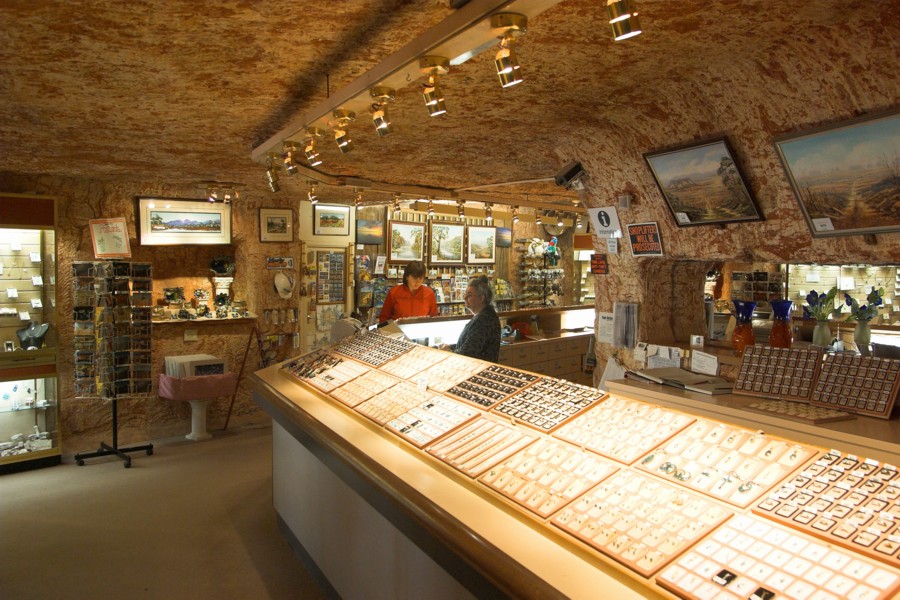


Coober Pedy is famous for its underground accommodation. The town has become a popular stopover point and tourist destination, especially since 1987, when the sealing of the Stuart Highway was completed.
Coober Pedy today relies as much on tourism as the opal mining industry to provide the community with employment and sustainability.
Visitor attractions in Coober Pedy include the mines, the graveyard and the underground churches (the Serbian Orthodox Church and the Catholic Church). There are several motels offering underground accommodation, ranging from a few rooms to the entire motel being a dug-out. The hybrid Coober Pedy Solar Power Station supplies power to the off-grid area.
The dugout of crocodile hunter and WWII Latvian National Armed Forces soldier (or "Crocodile Harry") is a famous tourist spot, known as "Crocodile Harry's Underground Nest". It is known for its bone collection, art and graffiti, and messages written by tourists. The dugout is featured as a set in movies, including Pitch Black and Mad Max Beyond Thunderdome.
The Umoona Opal Mine and Museum is a popular attraction.
The annual Coober Pedy Opal Festival takes place in June, with the 35th festival occurring in 2024.
Heritage sites

Coober Pedy has a number of heritage-listed sites, including:
- 13 Hutchison Street: Three-Roomed Dugout
- 9 Hutchison Street: Coober Pedy Catholic Church and Presbytery
Amenities and services
The Umoona Tjutagku Health Service Aboriginal Corporation was established in 2005 to provide health services for local Aboriginal people.
Local media
Coober Pedy is home to the Coober Pedy Regional Times, a free community publication released fortnightly since 15 March 2001. Under a previous name, it had begun as a newsletter called the Coober Pedy Times, which was first issued in August 1982, itself continuing from a publication known as Opal Chips. After some financial difficulties, the Times was bought by its editor, Margaret McKay, in 2006 and now includes online versions.
Coober Pedy is served by both local and national radio and television services. The government-owned Australian Broadcasting Corporation provides three broadcast radio stations — local radio ABC North & West SA 106.1FM and the national networks ABC Radio National 107.7FM and Triple J 101.3FM.
Community radio is provided by indigenous broadcaster CAAMA Radio 102.9FM and Coober Pedy's own Dusty Radio 104.5FM. Commercial radio is provided by Flow FM 99.7.
Five broadcast television services operate in Coober Pedy: commercial stations Imparja Television, Southern Cross Central (now branded as Seven Central) and 10 Central, and the government-owned ABC and SBS.
Sport and recreation
The local golf course – mostly played at night with glowing balls, to avoid daytime heat – is completely free of grass, and golfers take a small piece of "turf" around to use for teeing off. As a result of correspondence between the two clubs, the Coober Pedy Golf Club is the only club in the world to enjoy reciprocal rights at The Royal and Ancient Golf Club of St Andrews.
The town also has an Australian rules football club, the Coober Pedy Saints, established in 2004, which competes in the Far North Football League (formerly the Woomera & Districts Football League). Due to the town's isolation, to play matches the Saints must make round trips of over 900 km to Roxby Downs, where the rest of the league's teams are located.
The town has a drive-in theatre. It opened in 1965, but became less popular after 1980 with the arrival of television to the town, and ceased regular operation in 1984. It was re-opened in 1996, and with the closure of the Mainline Drive-in at Gepps Cross in February 2022, became the last drive-in in the state.
Art centre
A board for the Umoona Community Art Centre was established in 2021, but needs government funding to establish a permanent location in the town. A group of artists has joined the APY Art Centre Collective, which helps to create employment opportunities for Indigenous artists in the region. An exhibition in the Adelaide gallery of the collective in September 2021 featured the work of 24 of these artists.
In philately
A rare exhibition cachet, signed by Coober Pedy postmaster Alfred P. North, was discovered in Memphis, Tennessee, by philatelist David Saks on 3 February 2016. To date, it is the only known example of this cachet in the world.
In popular culture
Both the town and its hinterland, for different reasons, are photogenic and have attracted filmmakers. The town itself is the setting for several films, and its environment has also attracted movie producers. These include:
Films
- Fire in the Stone (1984)
- Mad Max Beyond Thunderdome (1985)
- Ground Zero (1987)
- The Blood of Heroes (1989)
- Until the End of the World (1991)
- Stark (1993), a TV miniseries
- The Adventures of Priscilla, Queen of the Desert (1994)
- Siam Sunset (1999)
- Pitch Black (2000)
- Red Planet (2000)
- Kangaroo Jack (2003)
- Opal Dream (2006)
- The Osiris Child: Science Fiction Volume One (2016)
- Instant Hotel Season 2 (2018)
- Mortal Kombat (2021)
- Stars on Mars (2023)
- Limbo (2023)
Video game
- Forza Horizon 3
Transport

The town is served by daily coach services from Adelaide by Greyhound Australia. The Ghan train serves the town through the Manguri Siding, 42 km from Coober Pedy, which is served by trains once weekly in each direction. Passengers on The Ghan are not usually allowed to disembark at Manguri unless they have prearranged transport, due to the siding's isolation and the extremely low temperatures at night.
Coober Pedy is a gateway to the outback communities of Oodnadatta and William Creek, which are both located on the Oodnadatta Track. There is a twice-a-week mail run from Coober Pedy to these communities and other outback homesteads. It carries the mail, general freight and passengers.
Rex Airlines also has direct flights to Adelaide, from Coober Pedy Airport.
Notes
References
References
- "Search result for "Coober Pedy (LOCB)" (Record no SA0015214) with the following layers selected - "Suburbs and Localities", "Place names (gazetteer)" and "Road Labels"". Government of South Australia.
- Manning, Geoffrey H.. (2012). "A compendium of the place names of South Australia".
- [http://www.slsa.sa.gov.au/manning/pn/c/c10.htm#cooberPedy Place Names of South Australia] {{webarchive. link. (28 July 2012)
- Naessan, Petter. (2010). "The etymology of Coober Pedy, South Australia". [[Aboriginal History]].
- Henderson Henderson. "District Council of Coober Pedy - Welcome to the Opal Capital of the World".
- "The History of Coober Pedy".
- Klein, Steve. (14 July 2023). "Adelaide to Alice Springs Drive & Stops Along the Way".
- "Far North SA government region". The Government of South Australia.
- "District of Giles Background Profile". Electoral Commission SA.
- "Federal electoral division of Grey, boundary gazetted 16 December 2011". Australian Electoral Commission.
- Government of South Australia Department for Environment and Water. (2022). "South Australian Arid Lands: Districts and bioregions". Department for Environment and Water.
- [https://www.abc.net.au/news/2019-03-06/coober-pedy-water-supply-concerns-opal-capital/10867894 Opal capital Coober Pedy 'on knife-edge' as desert town faces big water problem] ''ABC News'', 6 March 2019. Retrieved 29 October 2020.
- [http://www.cooberpedy.sa.gov.au/page.aspx?u=368 Coober Pedy Visitor Information Centre > Climate] Accessed 13 July 2014.
- [http://www.cooberpedy.com.au/coober-pedy-weather/ CooberPedy.com.au > Coober Pedy weather] Accessed 15 July 2014.
- (10 April 2014). "'Hopping mad' residents hit by outback flooding at Coober Pedy".
- Higgins, Kate. (17 August 2024). "The 'very, very untold history' of Coober Pedy's Aboriginal opal miners".
- Shang, GG, Phoebe. (n.d.). "Opal Mining in Coober Pedy: History and Methods".
- Harding, Michael Albert. (August 2016). "'Plenty of opal back then: Opal Pulkah': a history of Aboriginal engagement in the Northern South Australian opal industry c.1940–1980". [[University of Adelaide]].
- (2010-08-22). "Famous Opals".
- Smith, R. ''Australia: Journey Through a Timeless Land''. National Geographic Society, 1999. p 118.
- "Opals - The Gem of the Outback".
- Shepherd, Tory. (13 May 2023). "White Cliffs NSW: where life is lived underground and the desert 'does all sorts of strange things'". The Guardian.
- Yi Zhen, Yong. (4 April 2017). "A National Treasure".
- Christopher Russell. (25 May 2009). "Prominent Hill open for business". The Advertiser.
- (26 August 2010). "IMX Celebrates Opening of SA's First Iron Ore Mining District Since 19th Century". IMX Resources.
- [http://www.adelaidenow.com.au/business/cairn-hill-iron-ore-miner-imx-resources-to-close-south-australian-office-focus-on-tanzanian-exploration/story-fni6uma6-1227046288110 Cairn Hill iron ore miner IMX Resources to close South Australian office, focus on Tanzanian exploration] ''The Advertiser'', 3 September 2014. Accessed 4 September 2014.
- "Overview". Cu-River Mining.
- (24 January 2013). "Major oil discovery in outback SA". Yahoo7 Finance Australia.
- England, Cameron. (24 January 2013). "$20 trillion shale oil find surrounding Coober Pedy 'can fuel Australia'". Herald Sun.
- "$20 trillion shale oil find surrounding Coober Pedy 'can fuel Australia'". NewsComAu.
- "The Australian town where people live underground".
- "Coober Pedy Attractions". Coober Pedy Visitors Information Center.
- "Experience Underground".
- (5 September 2019). "EDL's Coober Pedy Hybrid Renewable Project wins at 2019 Asia Power Awards".
- (2018-04-04). "Crocodile Harry: The Man Who Inspired Crocodile Dundee".
- "Crocodile Harry's Underground Nest & Dugout".
- "Umoona Opal Mine And Museum". Government of South Australia.
- "Home".
- "Three-roomed dugout, including the ground within two metres of the dugout space". Department of Environment, Water and Natural Resources.
- "Coober Pedy Catholic Church & Presbytery". Department of Environment, Water and Natural Resources.
- "Hohme".
- (2001). "Coober Pedy regional times [newspaper: microform]". Coober Pedy Regional Times.
- "Coober Pedy times".
- Laube, Anthony. "LibGuides: SA Newspapers: Far North".
- "Coober Pedy Regional Times".
- Lane, James M.. (2008). "Moon Living Abroad in Australia". Seal Press.
- "History of the Coober Pedy Drive-in".
- Patrick Martin. (7 April 2019). "Coober Pedy's desert drive-in cinema a feast for the eyes — and not just on-screen". Australian Broadcasting Corporation.
- (22 November 2021). "Adelaide's last suburban drive-in cinema, the Mainline, to close after more than 65 years". [[Australian Broadcasting Corporation]].
- "About Us".
- Sulda, Dixie. (21 May 2023). "Australia's drive-in culture fading to black as outdoor cinema numbers drop from 330 to just 15 venues".
- Roberts, Georgia. (9 October 2021). "Umoona Art Centre plan to fill 'major gap' and create opportunities in Coober Pedy -". Australian Broadcasting Corporation.
- "Jennifer Davison - The Royal Coober Pedy Historical Society".
- Owens, David. "Connecting Wynne to the World". Wynne Progress.
- Gluckman, Ron. "Home Under the Range". Ron Gluckman in Cyberspace.
- "Coober Pedy". RockWalk Park.
- "Movies Filmed in Coober Pedy".
- [https://www.distractify.com/p/razz-and-mark-instant-hotel Razz and Mark's 'Instant Hotel' Is Like Staying at the Flintstones'] Distractify 20 April 2020
- Knox, David. (2 May 2023). "Coober Pedy home to Stars on Mars series".
- Hobday, Liz. (May 2023). "Coober Pedy becomes Red Planet in Stars On Mars".
- Debelle, Penelope. (12 May 2023). "Coober Pedy provides a dramatic backdrop for new film Limbo".
- (14 June 2021). "Environments, Landmarks, Weather".
- Concepcion, Miguel. (14 April 2022). "Forza Horizon 3 Barn Find locations guide".
- "Q & A".
- "The Mail Run Tour".
This article was imported from Wikipedia and is available under the Creative Commons Attribution-ShareAlike 4.0 License. Content has been adapted to SurfDoc format. Original contributors can be found on the article history page.
Ask Mako anything about Coober Pedy — get instant answers, deeper analysis, and related topics.
Research with MakoFree with your Surf account
Create a free account to save articles, ask Mako questions, and organize your research.
Sign up freeThis content may have been generated or modified by AI. CloudSurf Software LLC is not responsible for the accuracy, completeness, or reliability of AI-generated content. Always verify important information from primary sources.
Report