From Surf Wiki (app.surf) — the open knowledge base
Conversion to Islam
Religious conversion
Religious conversion
Conversion to Islam, also known within Islam as reversion, is adopting Islam as a religion or faith. Conversion requires a formal statement of the shahādah, the credo of Islam, whereby the prospective convert must state that "there is none worthy of worship in truth except Allah and Muhammad is the messenger of Allah". Proselytism of the faith is referred to as "dawah", and missionary efforts have been promoted since the dawn of the religion in the 7th century.
Terminology
Converts to Islam may be referred to as "converts", "reverts", or "new Muslims". Many people who have converted to Islam prefer to call themselves "reverts", in reference to a hadith that says that all people are Muslims at birth, but only come to "leave" the faith due to the environment they are raised in. The belief in the innate condition of Islam in all people is referred to as "fitra".
Requirements
Converting to Islam requires one to declare the shahādah, the Muslim profession of faith ("there is none worthy of worship except Allah and Muhammad is the messenger of Allah", Classical Arabic: أَشْهَدُ أَن لا إِلٰهَ إلَّا الله و أَشْهَدُ أَنَ مُحَمَّدًا رَسُول الله)
In Islam, circumcision (khitan) is considered a sunnah custom that is not mentioned in the Quran but is mentioned in hadith. The majority of clerical opinions holds that circumcision is not required upon entering the Muslim faith.
Islamic missionary activities
Dawah (, ) is the act of inviting or calling people to embrace Islam. In Islamic theology, the purpose of da‘wah is to invite people, Muslims and non-Muslims, to understand the worship of God as expressed in the Qur'an and the sunnah of Muhammad and to inform them about Muhammad.
Dawah as the "Call towards God" is the means by which Muhammad began spreading the message of the Quran to mankind. After Muhammad, his followers and the Muslim community assumed responsibility for it. They convey the message of the Qur'an by providing information on why and how the Qur'an preaches monotheism.
Conversion rate
Counting the number of converts to a religion is difficult, because some national censuses ask people about their religion, but they do not ask if they have converted to their present faith, and, in some countries, legal and social consequences make conversion difficult, such as the death sentence for leaving Islam in some Muslim countries. Statistical data on conversion to and from Islam are scarce. An expert on Islamic law, M. Cherif Bassiouni, states "The Quran contains a provision that says ‘he who has embraced Islam and then abandons it will receive punishment in hell after Judgment Day'."{{cite web | access-date = 10 October 2024 | access-date = 10 October 2024 According to a study published in 2011 by Pew Research, what little information is available suggests that religious conversion has no net impact on the global Muslim population as the number of people who convert to Islam is roughly similar to those who leave Islam. According to another study published on 2015 by Pew research center, Islam is expected to experience a modest gain of 3.22 million adherents through religious conversion between 2010 and 2050, although this modest impact will make Islam, compared with other religions, the second largest religion in terms of net gains through religious conversion after religiously unaffiliated, which is expected to have the largest net gains through religious conversion.
According to The New York Times, an estimated 25% of American Muslims are converts. In Britain, around 6,000 people convert to Islam per year and, according to a June 2000 article in the British Muslims Monthly Survey, the majority of new Muslim converts in Britain were women. According to The Huffington Post, "Though exact numbers are difficult to tally, observers estimate that as many as 20,000 Americans convert to Islam annually." In the Philippines, approximately 220,000 people converted to Islam in 2011, known as Balik Islam. The number is increasing year by year, and a surge in conversions is expected in the coming years.
According to Pew Research, the number of U.S. converts to Islam is roughly equal to the number of U.S. Muslims who leave the religion, unlike other religions, in which the number of those leaving is greater than the number of converts. 77% of new converts to Islam are from Christianity, whereas 19% were from non-religion. Meanwhile, among American-born Muslims who have left Islam, about 55% now identify with no religion, 22% identify as Christian, and another 21% identify with other faiths.
According to Guinness, approximately 12.5 million more people converted to Islam than people converted to Christianity between 1990 and 2000.
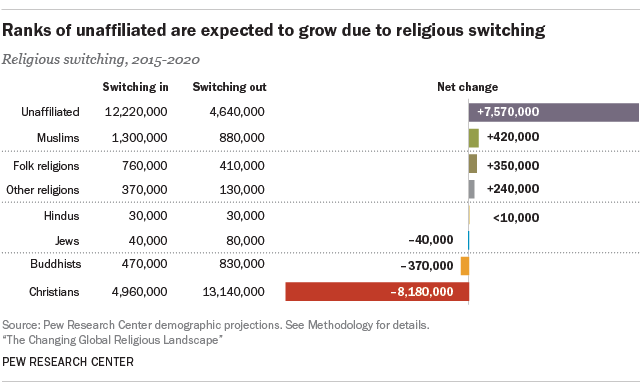
Despite this, Islam remains, on the global level, the second religion with the second largest number of net converts into the religion, with about 420,000 more people converting to Islam than leaving Islam between 2015 and 2020, this number being surpassed by the number of people (7,570,000) switching from "religious" to "unaffiliated".
In 2010, the Pew Forum found "that statistical data for Muslim conversions is scarce and as per their little available information, there is no substantial net gain or loss of Muslims due to religious conversion. It also stated that "the number of people who embrace Islam and the number of those who leave Islam are roughly equal. Thus, this report excludes religious conversion as a direct factor from the projection of Muslim population growth." People switching their religions will likely have no effect on the growth of the Muslim population, as the number of people who convert to Islam is roughly similar to those who leave Islam. Another study found that the number of people who will leave Islam is 9,400,000 and the number of converts to Islam is 12,620,000 so the net gain to Islam through conversion should be 3 million between 2010 and 2050, mostly from Sub Saharan Africa (2.9 million).
According to a 2017 Pew Research Center survey, between 2010 and 2015 "an estimated 213 million babies were born to Muslim mothers and roughly 61 million Muslims died, meaning that the natural increase in the Muslim population – i.e., the number of births minus the number of deaths – was 152 million over this period", and it added small net gains through religious conversion into Islam (420,000). According to a 2017 Pew Research Center survey, by 2060 Muslims will remain the second world's largest religion; and if current trends continue, the number of Muslims will reach 2.9 billion (or 31.1%).
It was reported in 2013 that around 5,000 British people convert to Islam every year, with most of them being women. According to an earlier 2001 census, surveys found that there was an increase of 60,000 conversions to Islam in the United Kingdom. Many converts to Islam said that they suffered from hostility from their families. According to a report by CNN, "Islam has drawn converts from all walks of life, most notably African Americans". Studies estimated about 30,000 converting to Islam annually in the United States. According to The New York Times, an estimated 25% of American Muslims are converts, these converts are mostly African American. According to The Huffington Post, "observers estimate that as many as 20,000 Americans convert to Islam annually.", most of them are women and African Americans. Experts say that conversions to Islam have doubled in the past 25 years in France, among the six million Muslims in France, about 100,000 are converts. On the other hand, according to Pew Research, the number of American converts to Islam is roughly equal to the number of American Muslims who leave Islam and this is unlike other religions in the United States where the number of those who leave these religions is greater than the number of those who convert to it, and most people who leave Islam become unaffiliated. According to the same study, ex-Muslims were more likely to be Christians compared to ex-Hindus or ex-Jews.
According to the religious forecast for 2050 by Pew Research Center, between 2010 and 2050 modest net gains through religious conversion are expected for Muslims (3 million) and most of the net gains through religious conversion for Muslims found in the Sub Saharan Africa (2.9 million).
References
References
- Allison, Safwaan Zamakda. (26 December 2025). "Conviction or convenience? conversion to Islam in the west, Korea, and Southeast Asia". IJORESH Indonesian Journal of Religion Spirituality and Humanity.
- (17 June 2013). "Counseling Muslims: Handbook of Mental Health Issues and Interventions". Routledge.
- Zebiri, Kate. (1 October 2014). "British Muslim Converts: Choosing Alternative Lives". Simon and Schuster.
- Sealy, Thomas. (2 September 2021). "British converts to Islam: continuity, change, and religiosity in religious identity". Journal of Contemporary Religion.
- (2015). "The Bloomsbury Companion to Islamic Studies". [[Bloomsbury Academic]].
- (17 November 2018). "Becoming a Muslim: A Step-by-Step Guide - How To Become Muslim".
- (2004). "Bible and Qurʼān: Essays in Scriptural Intertextuality". [[Brill Publishers]].
- (2012). "K̲h̲itān". [[Brill Publishers]].
- (1994). "To Mutilate in the Name of Jehovah or Allah: Legitimization of Male and Female Circumcision". [[World Association for Medical Law]].
- "''Da‘wah'' produces converts to Islam, which in turn [increases] the size of the Muslim ''[[Ummah]]'' [community of Muslims]."
- See entry for ''da‘wah'' in the ''[[Encyclopaedia of Islam]]''.
- See, for example, Qur'an ''[[Ayah. ayat]]'' (verses) 6:19 and 16:36.
- "The Future of World Religions p.182".
- (27 January 2011). "The Future of the Global Muslim Population".
- [https://www.loc.gov/law/help/apostasy/apostasy.pdf Laws Criminalizing Apostasy] {{webarchive. link. (11 October 2017 Library of Congress (2014))
- [http://www.oxfordislamicstudies.com/article/opr/t125/e174 Apostasy] {{webarchive. link. (4 September 2014 Oxford Islamic Studies Online, Oxford University Press (2012))
- (7 May 2017). "The countries where apostasy is punishable by death".
- (27 January 2011). "The Future of the Global Muslim Population".
- "Cumulative Change Due to Religious Switching, 2010–2050, p.43".
- Elliott, Andrea. (30 April 2005). "Muslim Converts Face Discrimination". [[The New York Times]].
- "British Muslims Monthly Survey for June 2000, Vol. VIII, No. 6".
- Sacirbey, Omar. (24 August 2011). "Conversion To Islam One Result Of Post-9/11 Curiosity". [[Huffington Post]].
- Yoshizawa, Ashuna. (2024). "Religious Conversion as a 'Winding Pathway': Experience of Balik-Islam and Muslim–Christian Relations in the Southern Philippines". Taylor & Francis Online.
- (26 January 2018). "The share of Americans who leave Islam is offset by those who become Muslim". [[Pew Research Center]].
- (22 December 2014). "Guinness World Records 2003 - Google Books". Bantam Books.
- (5 April 2017). "The Changing Global Religious Land scape".
- "Ranks of unaffiliated are expected to grow due to religious switching". [[Pew Research Center]].
- [http://www.pewforum.org/future-of-the-global-muslim-population-related-factors-conversion.aspx "The Future of the Global Muslim Population, Related Factors: Conversion"] {{Webarchive. link. (30 July 2013 , The Pew Forum on Religion and Public Life, 27 January 2011)
- (23 April 2015). "Why Muslims are the world's fastest-growing religious group". [[Pew Research Center]].
- (27 January 2011). "The Future of the Global Muslim Population". [[Pew Research Center]].
- (5 April 2017). "The Changing Global Religious Landscape". Pew Research Center.
- (11 October 2013). "Converting to Islam: British women on prayer, peace and prejudice". [[The Guardian]].
- (4 January 2011). "Converting to Islam - the white Britons becoming Muslims". BBC News.
- "Fast-growing Islam winning converts in Western world". [[CNN]].
- (26 April 2010). "Why do Western Women Convert?". [[Standpoint (magazine).
- Elliott, Andrea. (30 April 2005). "Muslim Converts Face Discrimination (Published 2005)". The New York Times.
- (26 April 2001). "The Mosque in America: A National Portrait". Council on American-Islamic Relations.
- (24 August 2011). "Conversion To Islam One Result Of Post-9/11 Curiosity".
- Baume, Maïa de la. (4 February 2013). "More in France Are Turning to Islam, Challenging a Nation's Idea of Itself (Published 2013)". The New York Times.
- (12 May 2015). "America's Changing Religious Landscape". [[Pew Research Center]]: Religion & Public Life.
- "Projected Cumulative Change Due to Religious Switching, 2010–2050, p.11".
This article was imported from Wikipedia and is available under the Creative Commons Attribution-ShareAlike 4.0 License. Content has been adapted to SurfDoc format. Original contributors can be found on the article history page.
Ask Mako anything about Conversion to Islam — get instant answers, deeper analysis, and related topics.
Research with MakoFree with your Surf account
Create a free account to save articles, ask Mako questions, and organize your research.
Sign up freeThis content may have been generated or modified by AI. CloudSurf Software LLC is not responsible for the accuracy, completeness, or reliability of AI-generated content. Always verify important information from primary sources.
Report