From Surf Wiki (app.surf) — the open knowledge base
Conradin
Duke of Swabia, King of Jerusalem and Sicily (1252–1268)
Duke of Swabia, King of Jerusalem and Sicily (1252–1268)
| Field | Value |
|---|---|
| image | Konradin.jpg |
| caption | King Conrad the Younger, from the |
| Codex Manesse (Folio 7r), | |
| succession | King of Jerusalem |
| predecessor | Conrad II |
| successor | Hugh I |
| reign | 21 May 1254 – 29 October 1268 |
| succession1 | King of Sicily |
| predecessor1 | Conrad I |
| successor1 | Manfred of Sicily |
| reign1 | 21 May 1254 – 1258 |
| succession2 | Duke of Swabia |
| predecessor2 | Conrad III |
| successor2 | Rudolph II of Austria (titular) |
| reign2 | 21 May 1254 – 29 October 1268 |
| father | Conrad IV of Germany |
| mother | Elisabeth of Bavaria |
| birth_date | 25 March 1252 |
| birth_place | Wolfstein Castle near Landshut, Bavaria, Holy Roman Empire |
| death_date | |
| death_place | Naples, Kingdom of Sicily |
| burial_place | Basilica di Santa Maria del Carmine, Naples |
| house | Hohenstaufen |
Codex Manesse (Folio 7r), Conrad III (25 March 1252 – 29 October 1268), called the Younger or the Boy, but usually known by the diminutive Conradin (, ), was the last direct heir of the House of Hohenstaufen. He was Duke of Swabia (1254–1268) and nominal King of Jerusalem (1254–1268) and Sicily (1254–1258). After his attempt to reclaim the Kingdom of Sicily for the Hohenstaufen dynasty failed, he was captured and beheaded.
Early childhood
Conradin was born in Wolfstein, Bavaria, to Conrad IV of Germany and Elisabeth of Bavaria. Though he never succeeded his father as Roman-German king, he was recognized as king of Sicily and Jerusalem by supporters of the Hohenstaufens in 1254.
Having lost his father in 1254, he grew up at the court of his uncle and guardian, Louis II, Duke of Bavaria. His guardians were able to hold Swabia for him. Jerusalem was held by a relative from the royal house of Cyprus as regent. In Sicily, his father's half-brother Manfred continued as regent, but began to develop plans to usurp the kingship.
Little is known of his appearance and character except that he was as "beautiful as Absalom, and spoke good Latin".
Political and military career
Having assumed the title of King of Jerusalem and Sicily, Conradin took possession of the Duchy of Swabia in 1262, and remained for some time in his duchy. Conradin's first invitation to Italy came from the Guelphs of Florence: they asked him to take arms against Manfred, who had been crowned king of Sicily in 1258 on a false rumor of Conradin's death. Louis refused this invitation on his nephew's behalf. In 1266 count Charles I of Anjou, called by the new pope Clement IV, defeated and killed Manfred at Benevento, taking possession of southern Italy: envoys from the Ghibelline cities went then to Bavaria and urged Conradin to come and free Italy. Count Guido de Montefeltro representing Henry of Castile, Senator of Rome, offered him the support of the eternal city. Pledging his lands, Conradin crossed the Alps and issued a manifesto at Verona setting forth his claim on Sicily.
Notwithstanding the defection of his uncle Louis and of other companions who returned to Germany, the threats of Clement IV, and a lack of funds, his cause seemed to prosper. Proclaiming him King of Sicily, his partisans, among them Prince Henry of Castile, both in the north and south of Italy took up arms. Rome received his envoy with enthusiasm; and the young king himself received welcomes at Pavia, Pisa and Siena. In September 1267 a Spanish fleet under Frederick of Castile, and a number of knights from Pisa, and Spanish knights soldiering from Tunis, disembarked in the Sicilian city of Sciacca, and most of the island rebelled against the Angevin rule. Only Palermo and Messina remained loyal to Charles. The revolt spread to Calabria and Apulia. In November of the same year the Pope excommunicated him. His fleet won a victory over that of Charles I of Anjou, and in July 1268, Conradin himself entered Rome to a great and popular reception.
Having strengthened his forces, he marched towards Lucera to join the Siculo Muslims
Legacy
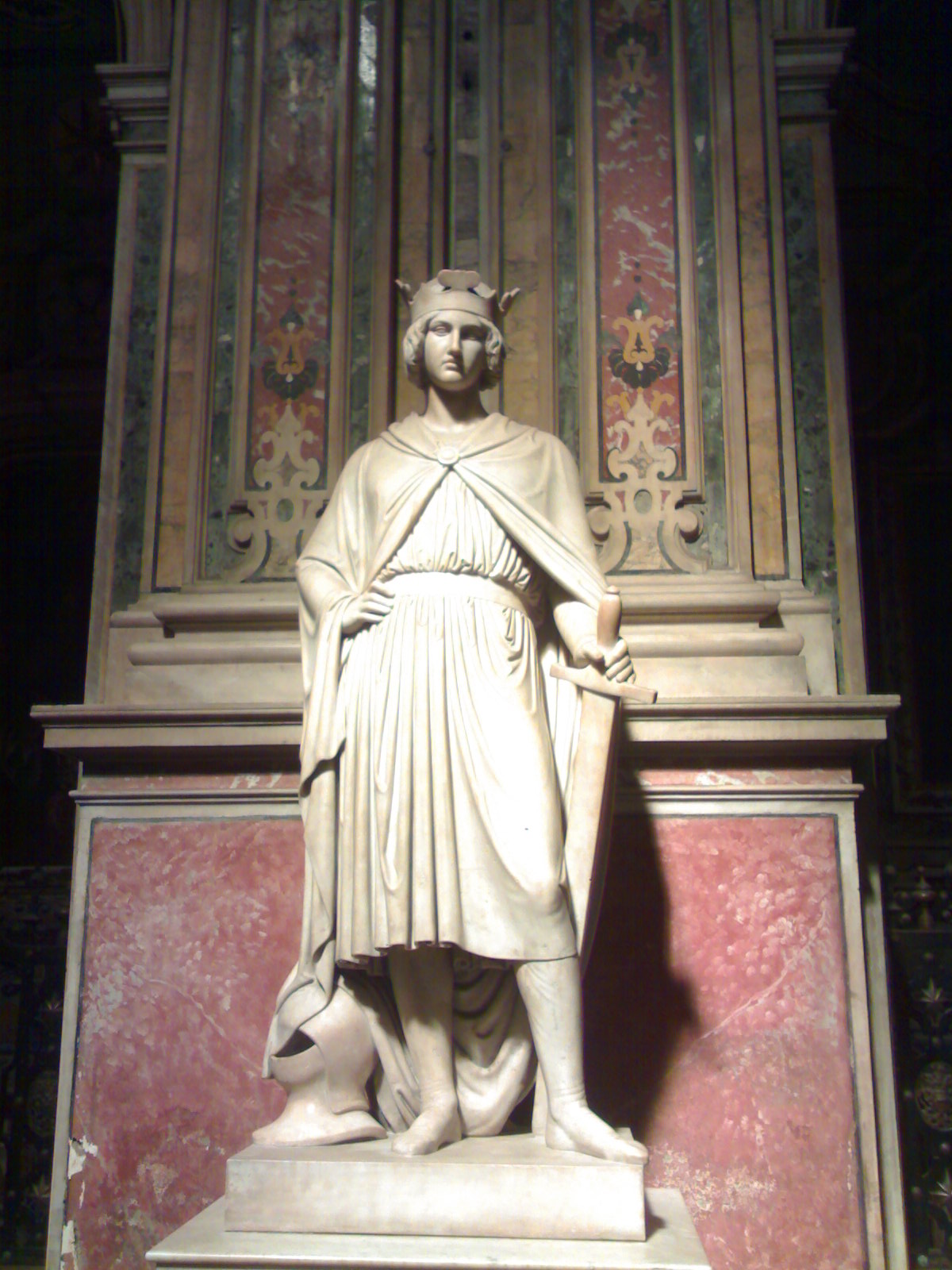
With Conradin's death at 16, the direct (male) line of the Hohenstaufen dynasty became extinct. His remains, with those of Frederick of Baden, lie in the church of the monastery of Our Lady of Mt. Carmel at Naples, founded by his mother for the good of his soul; and here in 1847 Maximilian, crown prince of Bavaria, erected a marble statue by Bertel Thorvaldsen to his memory. In the 14th-century Codex Manesse, a collection of medieval German lyrics, preserved at Heidelberg, there appear two songs written by Conradin, and his fate has formed the subject of several dramas.
His hereditary Kingdom of Jerusalem passed to the heirs of his great-great-grandmother Isabella I of Jerusalem, among whom a succession dispute arose. The senior heir in primogeniture was Hugh of Brienne, a second cousin of Conradin's father, but another second cousin Hugh III of Cyprus already held the office of regent and managed to keep the kingdom as Hugh I of Jerusalem. Conradin's grandmother's first cousin Mary of Antioch also staked her claim on basis of proximity of blood, which she later sold to Conradin's executioner Charles of Anjou.
According to a strict sense of legitimacy, the general heiress of his Kingdom of Sicily and the Duchy of Swabia was his aunt Margaret, half-sister of his father Conrad IV (the youngest but only surviving child of Frederick II and his third wife, Isabella of England) and married with Albert, Landgrave of Thuringia since 1255. Their son Frederick claimed Sicily and Swabia on her right.
However, these claims met with little favor. Swabia, pawned by Conradin before his last expedition, was disintegrating as a territorial unit. He went unrecognized in Outremer, and Charles of Anjou was deeply entrenched in power in Southern Italy. Margrave Frederick proposed an invasion of Italy in 1269, and attracted some support from the Lombard Ghibellines, but his plans were never carried out, and he played no further part in Italian affairs.
Finally, Sicily passed to Charles of Anjou, but the Sicilian Vespers in 1282 resulted in dual claims on the Kingdom; the Aragonese heirs of Manfred retaining the island of Sicily and the Angevin party retaining the southern part of Italy, popularly called the Kingdom of Naples.
In literature
Conradin was the subject of artistic interpretation in the nineteenth and early twentieth century. Several paintings and works of literature, especially poetry, depicted his military campaign and his execution. Felicia Hemans, best known for "The boy stood on the burning deck", wrote in 1824 "The Death of Conradin". Charles Swain wrote "Conradin" in 1832, a poem which inspired the first of "Three Tone Poems for Solo Piano" by Justin Henry Rubin. Conradin : a philosophical ballad was written by C. R. Ashbee, dedicated to his patron and friend Colonel Shaw Hellier, and published in 1908 by Essex House Press, "one of the most significant private presses at work during the Arts and Crafts movement"
The novel Põlev lipp (The Burning Banner) by Karl Ristikivi (1961; in Estonian) depicts Conradin's Italian campaign. A translation into the French by L'étendard en flammes, was published in Paris in 2005.
Notes
References
Bibliography
- F. W. Schirrmacher, Die letzten Hohenstaufen (Göttingen, 1871)
- K. Hampe, Geschichte Konradins von Hohenstaufen (Berlin, 1893)
- del Giudice, Il Giudizio e la condanna di Corradino (Naples, 1876)
- G. Cattaneo, Federico II di Svevia (Rome, 1992)
- E. Miller, Konradin von Hohenstaufen (Berlin, 1897)
References
- {{EB1911
- Sandra Benjamin. (20 April 2010). "Sicily: Three Thousand Years of Human History - 7 - Hohenstaufens". Steerforth Press.
- Christopher Kleinhenz. (2 August 2004). "Medieval Italy: An Encyclopedia". Routledge.
- [[Ferdinand Gregorovius. Gregorovius, Ferdinand]] (2010) [1897], ''History of the City of Rome in the Middle Ages'', Vol. 5, Part 2, Cambridge University Press.
- "Three Tone Poems for Solo Piano".
- Conservation, Icon-The Institute of. "Assessment of The Essex House Press collection, Court Barn Museum".
- [[Karl Ristikivi]]. [http://www.passiondulivre.com/livre-17185-l-etendard-en-flammes.htm L'étendard en flammes] {{Webarchive. link. (5 June 2016 . Traduit de l'estonien par Jean Pascal Ollivry. Paris: Alvik, 2005.)
This article was imported from Wikipedia and is available under the Creative Commons Attribution-ShareAlike 4.0 License. Content has been adapted to SurfDoc format. Original contributors can be found on the article history page.
Ask Mako anything about Conradin — get instant answers, deeper analysis, and related topics.
Research with MakoFree with your Surf account
Create a free account to save articles, ask Mako questions, and organize your research.
Sign up freeThis content may have been generated or modified by AI. CloudSurf Software LLC is not responsible for the accuracy, completeness, or reliability of AI-generated content. Always verify important information from primary sources.
Report