From Surf Wiki (app.surf) — the open knowledge base
Conquest of California
1846–1847 U.S. invasion of Alta California during the Mexican–American War
1846–1847 U.S. invasion of Alta California during the Mexican–American War
| Field | Value | ||
|---|---|---|---|
| conflict | Conquest of California | ||
| partof | the Mexican–American War | ||
| image | {{Photomontage | ||
| photo1a | Battle of Río San Gabriel.jpg | ||
| photo2a | SanPasqual.jpg | ||
| spacing | 2 | ||
| position | center | ||
| color_border | white | ||
| color | white | ||
| size | 280 | ||
| foot_montage | Top: Battle of Río San Gabriel | ||
| Bottom: Battle of San Pasqual | |||
| date | |||
| place | Northern Theatre: | ||
| Bay Area, Monterey Bay, Salinas Valley | |||
| coordinates | |||
| territory | Mexican Cession (1848) | ||
| result | American victory | ||
| Treaty of Cahuenga{{Collapsible list | title=Full results | titlestyle=font-weight:normal;background:transparent;text-align:left; | |
| combatant1 | {{Unbulleted list | ||
| combatant2 | Mexico Mexico | ||
| commander1 | USA John C. Frémont | ||
| USA Robert F. Stockton | |||
| USA Stephen W. Kearny | |||
| California Republic William B. Ide | |||
| USA John D. Sloat | |||
| USA John B. Montgomery | |||
| USA Archibald Gillespie | |||
| USA William Mervine | |||
| USA James F. Reed | |||
| commander2 | Mexico José Castro | ||
| Mexico José María Flores | |||
| Mexico Andrés Pico | |||
| Mexico Mariano Vallejo | |||
| Mexico Pío Pico | |||
| Mexico Joaquín de la Torre | |||
| Mexico José de Jesús Noé | |||
| Mexico José del C. Lugo | |||
| Mexico José Antonio Carrillo | |||
| Mexico Francisco Sánchez | |||
| units1 | {{Collapsible list | ||
| title | Units | ||
| units2 | {{Collapsible list | ||
| title | Units | ||
| strength1 | {{plainlist | ||
| strength2 | {{plainlist | ||
| casualties1 | {{plainlist | ||
| casualties2 | {{plainlist | ||
| campaignbox |
Bottom: Battle of San Pasqual Bay Area, Monterey Bay, Salinas Valley
Southern Theatre: San Diego Bay, Los Angeles Basin, Pomona Valley, Santa Barbara, San Pasqual Valley Treaty of Cahuenga{{Collapsible list|title=Full results|titlestyle=font-weight:normal;background:transparent;text-align:left;|
- American military government installed in Alta California
- Californio loss of power and influence
- Beginning of the California genocide
- Major American migration to the West
- Displacement of Mexican Calfornios and Native Americans
- Constitution of California, 1849
- Eventual Californian statehood |USA |California Republic (until July 9, 1846) USA Robert F. Stockton USA Stephen W. Kearny California Republic William B. Ide USA John D. Sloat USA John B. Montgomery USA Archibald Gillespie USA William Mervine USA James F. Reed Mexico José María Flores Mexico Andrés Pico Mexico Mariano Vallejo Mexico Pío Pico Mexico Joaquín de la Torre Mexico José de Jesús Noé Mexico José del C. Lugo Mexico José Antonio Carrillo Mexico Francisco Sánchez |California Republic
California Republic Bear Flag Rebels |United States
USA California Battalion
USA Army of the West ----Naval units USA Pacific Squadron ----Occupation units USA Mormon Battalion USA 7th Regiment of New York Volunteers |Mexico
Mexico Castro Battalion
Mexico P. Pico Battalion
Mexico Flores Battalion
Mexico Local Town Militias ----Cavalry units Mexico A. Pico Lanceros Mexico Lugo Lanceros Mexico Carrillo Lanceros
- USA USA Initial strength:
- 30–300 militia
- Horses and Mules
- Native American Scouts Peak strength:
- 2,000+ personnel (1847)}}
- Mexico Mexico
Initial strength:
- 260–500 militiamen
- 1 swivel Canon
- Horses and Mules Peak strength:
- 500 personnel (Jan. 1847)}}
- California Republic California Republic:
- 1–2 killed
- 3–7 wounded
- 2 captured or missing
- United States United States:
- ~35–40 killed
- ~53–64 wounded
- 25 captured or missing}}
- Mexico Mexico:
- ~11–14 killed
- ~40–60 wounded
- 2–3 captured or missing}} The Conquest of California, also known as the Conquest of Alta California or the California Campaign, was a military campaign during the Mexican–American War carried out by the United States in Alta California (modern-day California), then part of Mexico, lasting from 1846 to 1847, and ending with signing of the Treaty of Cahuenga by military leaders from both the Californios and Americans.
Background
When war was declared on May 13, 1846, between the United States and Mexico, it took almost three months for definitive word of Congress' declaration of war to reach the Pacific coast. U.S. consul Thomas O. Larkin, stationed in the pueblo of Monterey, was concerned about the increasing possibility of war and worked to prevent bloodshed between the Americans and the small Mexican military garrison at the Presidio of Monterey, commanded by José Castro.
United States Army Captain John C. Frémont, on a U.S. Army Corps of Topographical Engineers expedition with about 60 well-armed men, crossed the Sierra Nevada range in December 1845. They reached the Oregon Territory by May 1846, when Frémont received word that war was imminent.
Bear Flag Revolt
Main article: Bear Flag Revolt
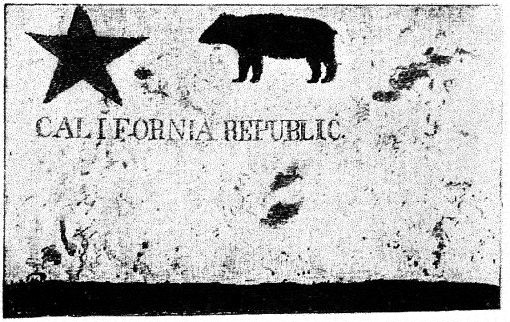
On June 14, 1846, the Bear Flag Revolt occurred when some 30 rebels, mostly American pioneers, staged a revolt in response to government threats of expulsion and seized the small Mexican Sonoma Barracks garrison, in the pueblo of Sonoma north of San Francisco Bay. There they formed the California Republic, created the "Bear Flag", and raised it over Sonoma. Eleven days later, troops led by Frémont, who had acted on his own authority, arrived from Sutter's Fort to support the rebels. No government was ever organized, but the Bear Flag Revolt has become part of the state's folklore. The present-day California state flag is based on this original Bear Flag, and continues to display the words "California Republic."
Northern California
Prior to the Mexican–American War, preparations for a possible conflict led to the U.S. Pacific Squadron being extensively reinforced until it had roughly half of the ships in the United States Navy. Since it took 120 to over 200 days to sail from Atlantic ports on the east coast, around Cape Horn, to the Pacific ports in the Sandwich Islands and then the mainland west coast, these movements had to be made well in advance of any possible conflict to be effective. Initially, with no United States ports in the Pacific, the squadron's ships operated out of storeships that provided naval supplies, purchased food and obtained water from local ports of call in the Sandwich Islands and on the Pacific coast. Their orders were, upon determining "beyond a doubt" that war had been declared, to capture the ports and cities of Alta California.
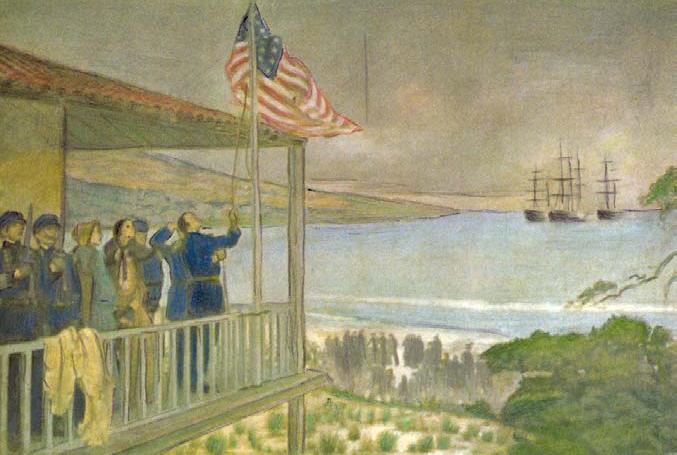
Commodore John Drake Sloat, commander of the Pacific Squadron, on being informed of an outbreak of hostilities between Mexico and the United States, as well as the Bear Flag Revolt in Sonoma, ordered his naval forces to occupy ports in northern Alta California. Sloat's ships already in the Monterey harbor, the , , and , captured the Alta Californian capital city in the Battle of Monterey on July 7, 1846, without firing a shot. Two days later on July 9, , which had been berthed at Sausalito, captured Yerba Buena (present-day San Francisco) in the Battle of Yerba Buena, again without firing a shot. On July 29, Sloat transferred his command to Commodore Robert F. Stockton, a more aggressive leader. The 400 to 650 marines and bluejackets (sailors) of Stockton's Pacific Squadron were the largest U.S. ground force in California. The rest of Stockton's troops were needed to man his vessels.
.jpg)
To supplement this remaining force, Commodore Stockton ordered Captain John C. Frémont, on the U.S. Army Corps of Topographical Engineers survey, to secure 100 volunteers in addition to the California Battalion he had organized earlier. He received 160, exceeding his order. The volunteers were to act primarily as occupation forces to free up Stockton's marines and sailors. The core of the California Battalion was the approximately 30 army personnel and 30 scouts, guards, ex-fur trappers, Indians, geographers, topographers and cartographers in Frémont's exploration force, which was joined by about 150 Bear Flaggers. The American marines, sailors, and militia easily took over the cities and ports of northern California; within days they controlled Monterey, San Francisco, Sonoma, Sutter's Fort, New Helvetia, and other small pueblos in northern Alta California. Nearly all were occupied without a shot being fired. Some of the southern pueblos and ports were also rapidly occupied, with almost no bloodshed.
Southern California
Californios and the war
Prior to the U.S. occupation, the population of Spanish and Mexican people in Alta California was approximately 1500 men and 6500 women and children, who were known as Californios. Many lived in or near the small Pueblo of Los Angeles (present-day Los Angeles). Many other Californios lived on the 455 ranchos of Alta California, which contained slightly more than 8600000 acre, nearly all bestowed by the Spanish and then Mexican governors with an average of about 18900 acre each.
Most of the approximately 800 American and other immigrants were adult males, and lived in northern California. They approved of breaking from the Mexican government, and gave only token or no resistance to the forces of Stockton and Frémont.
Siege of Los Angeles
Main article: Siege of Los Angeles

In Southern California, Mexican General José Castro and Alta California Governor Pío Pico fled the Pueblo of Los Angeles before the arrival of American forces. On August 13, 1846, when Stockton's forces entered Los Angeles with no resistance, the nearly bloodless conquest of California seemed complete. The force of 36 that Stockton left in Los Angeles was too small, and enforced a tyrannical control over the people of the city. On September 29, in the Siege of Los Angeles, the independent Californios, led by José María Flores, forced the small American garrison to retire to the harbor. Soon afterward, 200 reinforcements sent by Stockton and led by U.S. Navy Captain William Mervine were repulsed on October 8 in the one-hour Battle of Dominguez Rancho on Rancho San Pedro, with four Americans killed.
.jpg)
In late November, General Stephen W. Kearny, with a squadron of 100 dragoons, finally reached the Colorado River at the present-day California border after a grueling march across the province of Santa Fe de Nuevo México and the Sonoran Desert. Then, on December 6, they fought in the botched half-hour Battle of San Pasqual east of San Diego pueblo. 21 of Kearny's troops were killed in the botched engagement, the largest number of American casualties in the battles of the California Campaign.
Stockton rescued Kearny's surrounded forces and, with their combined force totaling 660 troops, they moved northward from San Diego, entering the Los Angeles Basin on January 8, 1847. On that day they fought the Californios in the Battle of Rio San Gabriel and the next day in the Battle of La Mesa. The last significant body of Californios surrendered to American forces on January 12, marking the end of hostilities in Alta California.
Aftermath

Treaty of Cahuenga
Main article: Treaty of Cahuenga
The Treaty of Cahuenga was signed on January 13, 1847, and terminated hostilities in Alta California. The treaty was drafted in English and Spanish by José Antonio Carrillo and approved by American Brigadier General John C. Frémont and Californio General Andrés Pico at Campo de Cahuenga in the Cahuenga Pass of Los Angeles. It was later ratified by Frémont's superiors, Commodore Robert F. Stockton and General Stephen Kearny (brevet rank).
Pacific Coast Campaign
Main article: Pacific Coast Campaign

In July 1846, Colonel Jonathan D. Stevenson of New York was asked to raise a volunteer regiment of ten companies of 77 men each to go to California with the understanding that they would muster out and stay in California. They were designated the 1st Regiment of New York Volunteers and took part in the Pacific Coast Campaign. In August and September 1846 the regiment trained and prepared for the trip to California.
Three private merchant ships, Thomas H Perkins, Loo Choo, and Susan Drew, were chartered, and the sloop was assigned convoy detail. On September 26, the four ships sailed for California. Fifty men who had been left behind for various reasons sailed on November 13, 1846, on the small storeship USS Brutus. The Susan Drew and Loo Choo reached Valparaíso, Chile by January 20, 1847, and they were on their way again by January 23. The Perkins did not stop until San Francisco, reaching port on March 6, 1847. The Susan Drew arrived on March 20 and the Loo Choo arrived on March 26, 1847, 183 days after leaving New York. The Brutus finally arrived on April 17.
.jpg)
After desertions and deaths in transit, the four ships brought 648 men to California. The companies were then deployed throughout Upper Alta California and Lower Baja California on the Baja California Peninsula (captured by the Navy and later returned to Mexico), from San Francisco to La Paz. The ship Isabella sailed from Philadelphia on August 16, 1846, with a detachment of one hundred soldiers, and arrived in California on February 18, 1847, at about the same time that the ship Sweden arrived with another detachment of soldiers. These soldiers were added to the existing companies of Stevenson's 1st New York Volunteer Regiment. These troops assumed nearly all onshore military and garrison of both the Pacific Squadron and the California Battalion.
In January 1847, Lieutenant William Tecumseh Sherman and about 100 regular U.S. Army soldiers arrived in Monterey. American forces in the pipeline continued to dribble into California.
;Mormon Battalion Main article: Mormon Battalion

The Mormon Battalion served from July 1846 to July 1847 during the Mexican–American War. It was a volunteer unit of 534 to 559 men from The Church of Jesus Christ of Latter-day Saints, who were led by Mormon company officers and commanded by regular United States Army senior officers. The battalion embarked on a grueling march of approximately 1,900 miles from Council Bluffs, Iowa to San Diego, making it one of the longest single military marches in U.S. history.
The Mormon Battalion arrived in San Diego on January 29, 1847. Over the next five months, until their discharge on July 16, 1847, in Los Angeles, they trained and performed garrison duties at several locations in southern California. After their discharge, some of the former members helped build a sawmill for John Sutter, where gold was discovered in January 1848, sparking the California Gold Rush.
Treaty of Guadalupe Hidalgo

The Treaty of Guadalupe Hidalgo, signed in February 1848, marked the end of the Mexican–American War. By the terms of the treaty, Mexico formally ceded Alta California along with its other northern territories east through Texas, receiving in exchange. This largely unsettled territory constituted nearly half of its claimed territory with about 1% of its then population of about 4,500,000.
California Genocide
Main article: California Genocide
The conquest and California officially becoming part of the United States set off a genocide against the indigenous peoples of California. The United States federal government and the newly created state government of California incited, aided, and financed the violence against the Native Americans, including massacres, cultural genocide, and forced enslavement. On January 6, 1851, at his State of the State address to the California Senate, the first Governor Peter Burnett said: "That a war of extermination will continue to be waged between the races until the Indian race becomes extinct must be expected. While we cannot anticipate this result but with painful regret, the inevitable destiny of the race is beyond the power or wisdom of man to avert." Between 1846 and 1873, it is estimated that non-Natives killed between 9,492 and 16,094 California Natives. Hundreds to thousands were additionally starved or worked to death. Acts of enslavement, kidnapping, rape, child separation and displacement were widespread. These acts were encouraged, tolerated, and carried out by state authorities and militias.
Timeline of events
| 2 Feb 1848 | Treaty of Guadalupe Hidalgo was signed in Mexico City. |
|---|
Notes
References
- "Captain John Charles Fremont and the Bear Flag Revolt".
- Castelo, Eugene. (2015). "Californians Before the Gold Rush". CreateSpace Independent Publishing Platform.
- Hittell, Theodore Henry. (1885). "History of California". Pacific Press Publishing House and Occidental Publishing Company.
- Walker pp. 215–219
- Seventy-five Years in San Francisco; Appendix L [http://www.sfgenealogy.com/sf/history/hb75yap4.htm] {{Webarchive. link. (2017-03-18 Accessed 18 Mar 2009)
- "Mormon Battalion". utah.gov.
- "Mormon Battalion « California Pioneer Heritage Foundation". californiapioneer.org.
- (6 June 1992). "LDS Church News – Monument honoring Mormon Battalion to regain its luster". [[Church News]].
- Note: A new international boundary was drawn; [[San Diego Bay]] is one of the only two main natural harbors in California south of [[San Francisco Bay]]; the border was aligned from one Spanish league south of San Diego Bay east to the [[Gila River]] – [[Colorado River]] confluence, to include strategic San Diego and its harbor.
- Two years after the Treaty of Guadalupe Hidalgo, U.S. statehood was granted in 1850.
- Coffer, William E.. (1977). "Genocide of the California Indians, with a Comparative Study of Other Minorities". San Francisco.
- Norton, Jack. ''Genocide in Northwestern California: 'When our worlds cried'.'' Indian Historian Press, 1979.
- (1981). "Genocide and Vendetta: The Round Valley Wars of Northern California". University of Oklahoma Press.
- Lindsay, Brendan C.. (2012). "Murder State: California's Native American Genocide, 1846–1873". University of Nebraska Press.
- Johnston-Dodds, Kimberly. (2002). "Early California Laws and Policies Related to California Indians". California State Library, California Research Bureau.
- (2014). "Silencing California Indian Genocide in Social Studies Texts". American Behavioral Scientist.
- Madley, Benjamin. (22 May 2016). "Op-Ed: It's time to acknowledge the genocide of California's Indians". Los Angeles Times.
- (2004). "Patterns of frontier genocide 1803–1910: the aboriginal Tasmanians, the Yuki of California, and the Herero of Namibia". Journal of Genocide Research.
- (2004). ""They will be hunted down like wild beasts and destroyed!": a comparative study of genocide in California and Tasmania". Journal of Genocide Research.
- Burnett, Peter. (6 January 1851). "State of the State Address". California State Library.
- Madley, Benjamin. (2016). "An American Genocide, The United States and the California Catastrophe, 1846–1873". Yale University Press.
- Adhikari, Mohamed. (25 July 2022). "Destroying to Replace: Settler Genocides of Indigenous Peoples". Hackett Publishing Company.
- (1914). "The Early Sentiment for the Annexation of California: An Account of the Growth of American Interest in California, 1835–1846, I". The Southwestern Historical Quarterly.
- Bancroft, Hubert Howe. (1886). "Bancroft's Works: History of California, Vol IV". A.L. Bancroft & Company.
- Walker, Dale L.. (1999). "Bear Flag Rising: The Conquest of California, 1846". Macmillan.
- {{Cite Appletons'. (1900)
- Walker p. 76
- Walker p. 78
- Walker p. 79
- Walker p. 57
- Walker p. 62
- Walker p. 63
- Walker p. 81
- Walker p. 98
- Walker p. 84
- Walker p. 66, 84
- Walker pp. 64–65
- Walker p. 66
- Walker p. 86
- Walker p. 87
- Walker p. 101
- Walker p. 72
- Walker p. 68
- Walker p. 91
- Walker pp. 91–92
- Walker p. 92
- Walker pp. 93–94
- Walker pp. 95, 109
- Walker p. 95
- Walker p. 96
- Walker p. 99
- Walker p. 97
- Walker p. 111
- Walker p. 100
- Breckenridge, Thomas E.. (1894). "Thomas E. Breckenridge Memoirs". University of Missouri at Columbia: Western Historical Manuscripts Collection.
- Madley, Benjamin. (2016). "An American Genocide: The United States and the California Indian Catastrophe, 1846–1873". Yale University Press.
- Walker p. 109
- Walker pp. 110, 112
- Walker p. 102
- Walker p. 112
- Walker p. 103
- Walker p. 113
- Walker p. 106
- Walker p. 107
- Walker p. 104
- Walker p. 115
- Walker p. 141
- Walker pp. 108, 116
- Walker p. 116
- Frémont, John Charles. (1887). "Memoirs of My Life". Belford, Clark.
- Walker p. 117
- Walker p. 118
- Walker p. 120
- Walker p. 142
- Bauer, K. Jack. (1974). "The Mexican War 1846-1848". University of Nebraska Press.
- "Congress IV (Frigate)".
- Walker pp. 120, 122
- Walker p. 121
- Walker pp. 122–123
- Walker pp. 123–125, 128
- Walker p. 131
- Walker p. 60
- Walker p. 129
- Walker p. 132
- Walker p. 126
- Walker pp. 128–129
- Walker pp. 129–130
- Bancroft V: 155–159
- Bancroft V: 132–136
- Walker p. 133
- Walker pp. 133–134
- Walker p. 134
- Walker pp. 134–135
- Walker pp. 135, 137–138
- Walker p. 138
- Walker pp. 138–139
- Walker pp. 139–140
- Walker p. 143
- Walker p. 140
- Walker pp. 143–144
- Walker p. 144
- Walker p. 148
- Walker p. 149
- Walker pp. 151, 154
- Walker pp. 155–156
- Walker pp. 149–151
- Walker p. 154
- Walker p. 156
- Walker pp. 154–155
- Walker p. 157
- Walker p. 127
- Walker p. 158
- Walker p. 159
- Walker p. 160
- Walker p. 161
- Walker p. 196
- Walker p. 188
- "Mexican-American War Timeline".
- Walker p. 197
- Walker p. 162
- Walker p. 198
- Walker p. 189
- Walker p. 199
- Walker p. 200
- Walker p. 201
- Walker p. 202
- Walker p. 203
- Walker p. 204
- Walker p. 209
- Walker p. 210
- Walker p. 211
- Walker p. 213
- Walker p. 221
- Walker p. 222
- Walker p. 223
- Walker p. 247
- Walker p. 224
- Walker p. 225
- Walker p. 234
- Walker p. 235
- Walker p. 233
- "Campo de Cahuenga, the Birthplace of California".
- (5 May 2002). "L.A. Then and Now: Woman Helped Bring a Peaceful End to Mexican-American War". Los Angeles Times.
- Walker p. 236
- Walker p. 248
- Marley, David; ''Wars of the Americas: a chronology of armed conflict in the New World, 1492 to present'' [1998); p. 510
- Walker p. 237
- Walker pp. 237–238
- Walker p. 239
- Walker pp. 240–241
- Walker p. 242
- Walker p. 245
- Walker p. 246
- Meares, Hadley. (11 July 2014). "In a State of Peace and Tranquility: Campo de Cahuenga and the Birth of American California".
- Walker p. 249
This article was imported from Wikipedia and is available under the Creative Commons Attribution-ShareAlike 4.0 License. Content has been adapted to SurfDoc format. Original contributors can be found on the article history page.
Ask Mako anything about Conquest of California — get instant answers, deeper analysis, and related topics.
Research with MakoFree with your Surf account
Create a free account to save articles, ask Mako questions, and organize your research.
Sign up freeThis content may have been generated or modified by AI. CloudSurf Software LLC is not responsible for the accuracy, completeness, or reliability of AI-generated content. Always verify important information from primary sources.
Report