From Surf Wiki (app.surf) — the open knowledge base
Congressional Baseball Game
Annual baseball game played by members of the United States Congress

Annual baseball game played by members of the United States Congress
| Field | Value | ||
|---|---|---|---|
| name | The Congressional Baseball Game for Charity | ||
| other names | |||
| image | [[File:Republican Disc.svg | 50px]] vs. [[File:Democratic Disc.svg | 50px]] |
| caption | |||
| city or region | Washington, DC | ||
| first contested | 1909 | ||
| teams involved | Democratic Party | ||
| Republican Party | |||
| most wins | Republicans: 47 | ||
| most player appearances | |||
| mostrecent | 2025: Republicans (13–2) | ||
| alltimerecord | 47–42 (Republicans lead) | ||
| largestvictory | 1928: Democrats (36–4) | ||
| smallestvictory | 1983: none (17–17) | ||
| broadcasters | C-SPAN | ||
| Fox Sports 1 | |||
| stadiums | 1909: American League Park II | ||
| 1911: Georgetown Field | |||
| 1912–1919: National Park | |||
| 1926–1957: Griffith Stadium | |||
| 1962–1968: D.C. Stadium | |||
| 1969–1972: RFK Stadium | |||
| 1973–1976: Memorial Stadium | |||
| 1977: Langley High School | |||
| 1978–1994: Four Mile Run Park | |||
| 1995–2004: Prince George's Stadium | |||
| 2005–2007: RFK Stadium | |||
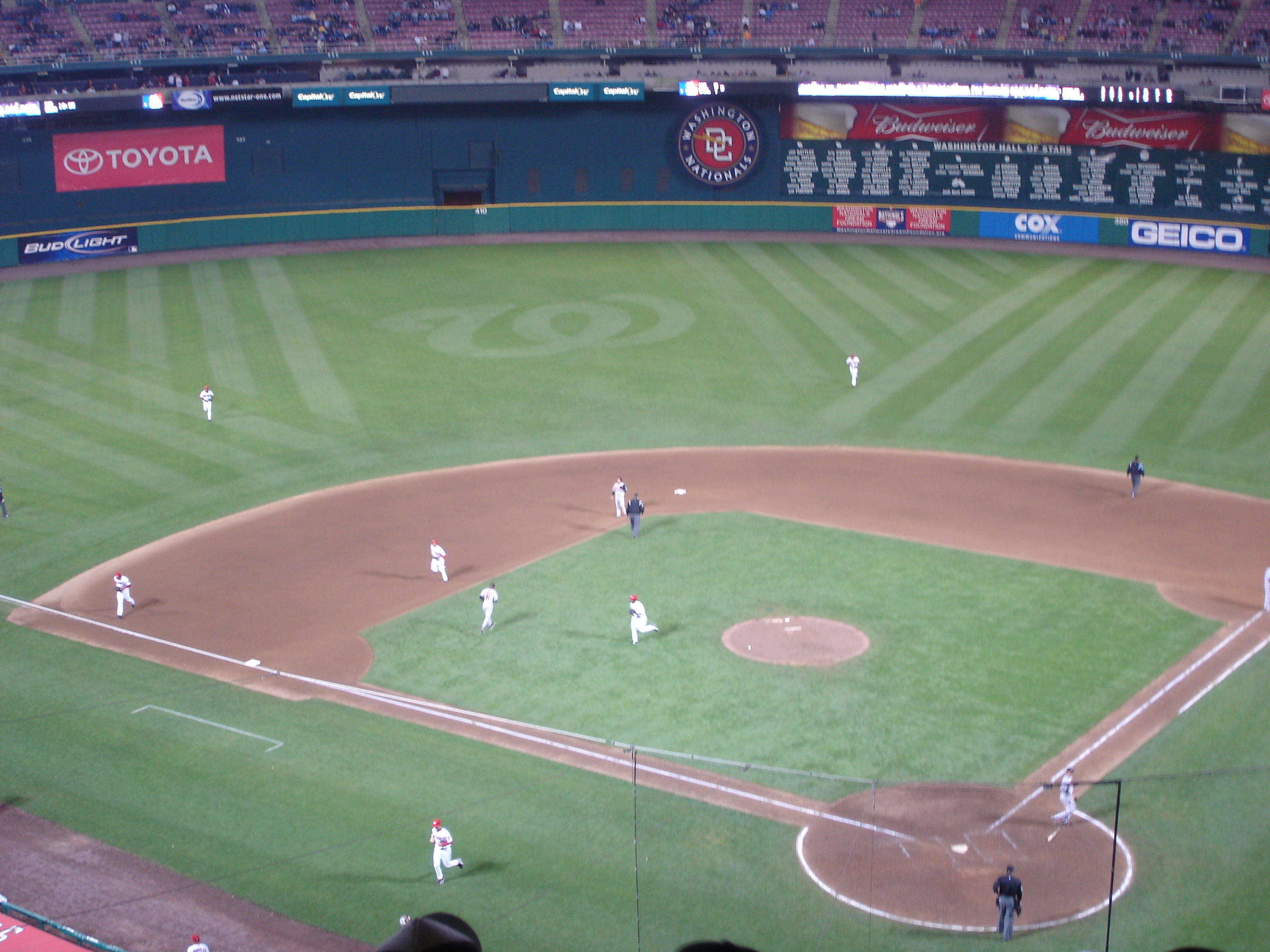
| 2008–present: Nationals Park | |||
| map_location | |||
| map_label1 | |||
| map_label1_position | |||
| <!-- Coordinates corresponding to | team1 | , | team2= and so forth -- |
| coordinates1 | |||
| website |
Republican Party Fox Sports 1 1911: Georgetown Field 1912–1919: National Park 1926–1957: Griffith Stadium 1962–1968: D.C. Stadium 1969–1972: RFK Stadium 1973–1976: Memorial Stadium 1977: Langley High School 1978–1994: Four Mile Run Park 1995–2004: Prince George's Stadium 2005–2007: RFK Stadium 2008–present: Nationals Park
The Congressional Baseball Game for Charity is an annual baseball game played each summer by members of the United States Congress. The game began as a casual event among colleagues in 1909 and eventually evolved into one of Washington, D.C.'s most anticipated annual pastimes, according to the House of Representatives Office of the Historian. In the game, Republicans and Democrats form separate teams and play against each other.
Today, the game raises money for four charities: the Boys and Girls Clubs of Greater Washington, the Washington Nationals Dream Foundation, the Washington Literacy Center, and—following a pre-game practice shooting in 2017—the US Capitol Police Memorial Fund. The game is usually attended by crowds of congressional staffers, congressional families and, occasionally, even dignitaries and US presidents.
History
The 1909 game was organized by Representative John Tener of Pennsylvania, a former professional baseball player. The Boston Daily Globe observed, "The game was brewing for weeks and the members of the house were keyed up a high pitch of enthusiasm. Deep, dark rumors were in circulation that 'ringers' would be introduced, but when they lined up at 4 o'clock the nine Republicans were stalwart, grand old party men, while the Democrats were of the pure Jeffersonian strain."
The Democrats beat their Republican opponents, 26–16 in the first game, and continued their winning streak for the first six games. Republicans won their first game in 1916. Due to its growing popularity, the Congressional Baseball Game was first covered via radio in 1928. The radio broadcast continued in succeeding years.
The event has, at times, interrupted the workflow of Congress. In 1914, Speaker James Beauchamp "Champ" Clark of Missouri became frustrated with the Congressional Baseball Game interfering with legislative business. Once, the House was to debate an appropriations bill on Civil War cotton damage, but a quorum was not present because of the game.
Despite its appeal, the annual game occurred intermittently because of interruptions due to the Great Depression, the Second World War, and intervention by the House leadership. The game was held biennially until the Washington Evening Star newspaper sponsored it annually from 1946 to 1958. Despite the sponsorship, Speaker Sam Rayburn of Texas ended the game in 1958, saying it had become too physically straining on the members and was causing injuries. With the new sponsor, the Roll Call Trophy was created, for the team that wins each best-of-five series. It was first awarded in 1965—to the Republican team, the first team to win three games since Roll Call had begun its sponsorship. Since 1965, a new trophy is awarded to the next team to win three games (over the next three, four, or five years), following the year in which the most recent trophy was awarded. As of the 2017 game, 14 trophies have been awarded—ten to the Republicans' team and four to the Democrats' team.
On June 14, 2017, one day before the annual event, a gunman opened fire on Republican members of Congress who were practicing for the next day's game. Four people were shot including House Majority Whip Steve Scalise. The gunman was killed by Capitol Police. The Federal Bureau of Investigation classified the shooting as an act of domestic terrorism. Despite discussions about postponing the game, it was held as scheduled. The shooting resulted in a dramatic increase in interest for the game; it was reported that revenue from ticket sales and online donations had exceeded $1 million, and organizers stated that 24,959 people were in attendance. C-SPAN announced that it would televise the game, and the 2021 game was televised by FS1 as well.
Locations


The game was initially played at American League Park II. However, after the park's destruction in a fire in March 1911, it was played at the Griffith Stadium built on the same site in Northwest Washington, D.C. In 1962, it was moved to the new District Stadium (later renamed Robert F. Kennedy Stadium). It remained there until 1972 when the Washington Senators moved to Texas, becoming the Texas Rangers as RFK did not need a long-term baseball seating layout or field. It moved for the next two decades to the Memorial Stadium in Baltimore, Maryland, then to Langley High School in McLean, Virginia for 1977; and Four Mile Run Park in Alexandria, Virginia. From 1995 to 2004, the game was played in Prince George's Stadium in Bowie, Maryland. From 2005 to 2007, the event returned to RFK Stadium when the Montreal Expos moved to Washington to become the Washington Nationals. In 2008, Nationals Park was completed, and the Nationals moved there along with the Congressional Baseball Game.
In the late 1960s, a post-game reception for members of Congress and their staff was organized and sponsored by Sears, Roebuck and Company. However, attendance was meager until 1972 when Sears' Washington office Public Information Officer Larry Horist took over the management of the event and established the Most Valuable Player awards to be voted by each team and presented by the Speaker of the House and the Majority Leader of the Senate. He also obtained photos of the players in their hometown uniforms, producing baseball cards packaged in gum wrappers. A limited number of autographed master sheets of the cards occasionally appear for sale on Internet auction sites. The cards included such personalities as Senator Eugene McCarthy (D-MN), Barry Goldwater, Jr. (R-AZ), and professional player "Vinegar Bend" Mizell (R-NC). The cards were publicized in The Washington Post and became part of the permanent collection of the Baseball Hall of Fame.
Rosters
While the modern Congressional Baseball Game comprises both House and Senate Members, this was not always the case. From 1909 to 1949, House Members exclusively filled the rosters—although there appears to have been no prohibition against Senators. Bicameral baseball was inaugurated in 1950, when Senator Harry P. Cain of Washington joined the Republican team and Senator-elect George Smathers of Florida, a former Representative, joined the Democratic team.
In a few cases, former professional baseball players were elected to Congress and impacted the game. In the case of Wilmer "Vinegar Bend" Mizell of North Carolina, a former professional pitcher, the Republican team was victorious for each year that he played. Fielding a once-a-year team presented some problems for members, who often grew rusty when it came to batting. Strong pitching proved decisive in most games but, in 1963, neither team could field a pitcher. As a result, relief pitcher George Susce of the Washington Senators pitched for both teams.
In 1917, Representative Jeannette Rankin of Montana tossed out the first pitch and kept score, becoming the first woman to participate in the annual event. More than 70 years later, in 1993, Representatives Ileana Ros-Lehtinen of Florida, Maria Cantwell of Washington, and Blanche Lincoln of Arkansas became the first women to break into the starting lineup.
In 1971, the first African Americans joined the game. Delegate Walter E. Fauntroy of the District of Columbia and Rep. Ron Dellums of California joined the Democratic roster. Despite Fauntroy's hitting prowess, the Democrats lost their eighth straight annual game, 7–3.
In 1909, Rep. Joseph F. O'Connell of Massachusetts hit the first home run, gaining three runs for the Democrats. In the same year, Republican representative Edward B. Vreeland of New York was the first player to be withdrawn due to an injury. In 1957, Rep. Gerald Ford of Michigan hit the first known grand slam, while playing for the Republicans. In 1979, Republican representative Ron Paul of Texas hit what is believed to be the first home run hit over the fence. Reps. John Shimkus of Illinois and Greg Steube of Florida are the only other players to hit out-of-the-park home runs, doing so in 1997 and 2021, respectively. Paul was inducted into the Congressional Baseball Hall of Fame before the 2012 game.
Hall of Fame
The Roll Call Congressional Baseball Hall of Fame was founded in 1993 and a brief description of each of the inductees through 2011 is available via the sponsor's website.
| Year | Inductee | Notes | |
|---|---|---|---|
| 1993 | John Tener | Organized the first Congressional Baseball Game | |
| Wilmer Mizell | |||
| William M. Wheeler | |||
| Ron Mottl | |||
| Silvio Conte | |||
| Robert H. Michel | |||
| Marty Russo | |||
| 1995 | Dave McCurdy | ||
| 1996 | Mike Synar | ||
| 1997 | Bill Richardson | ||
| 1998 | Sid Yudain | Founder of Roll Call | |
| 1999 | Dan Schaefer | ||
| 2000 | Carl Pursell | ||
| 2002 | Steve Largent | ||
| 2003 | David Bonior | ||
| 2004 | Charlie Brotman | Helped Sid Yudain revive Congressional baseball in the 1960s | |
| 2006 | Martin Sabo | ||
| 2007 | Mike Oxley | ||
| 2008 | Lou Frey | ||
| 2009 | Kenny Hulshof | ||
| 2011 | Mel Watt | ||
| 2012 | Ron Paul | Hit first over-the-wall home run in 1979 | |
| 2013 | Zach Wamp | ||
| 2014 | Bart Stupak | ||
| 2015 | Skip Maraney | Pioneered ''Roll Call'''s sports coverage | |
| 2021 | Joe Biden | ||
| 2023 | Mike Doyle | ||
| Kevin Brady |
In the early years of the game, each team wore a uniform that was either plain or had the words "Republicans" or "Democrats" embroidered on it. In modern games, members typically wear uniforms of the professional baseball teams or college baseball teams in their congressional district or home state. In the 1920s, pomp and fanfare preceded each game. The United States Navy Band and United States Marine Corps Band traditionally kicked off the festivities with patriotic tunes. In 1926, the Republicans paraded into American League Field on a live elephant, while in 1932, both teams had costumed mascots entertain the crowds. During the 1960s, the teams had cheerleaders dressed in uniforms.
File:Members of the Republican baseball team of the House of Representatives parading around the field at American League Park... LCCN92514672.jpg|Members of the Republican team in 1926 File:Baseball LCCN2016887985.jpg|The Republican Team in the 1920s File:Baseball LCCN2016887978.jpg|Representatives Clyde Kelly (left) and Thomas McMillan in the 1920s File:Congressional Baseball Game 2017 (35213567481).jpg|Participants in the 2017 game wearing various baseball jerseys File:President Biden visits 2021 Congressional Baseball Game.webm|President Joe Biden at the 2021 Game File:Mike Johnson - 2025 Congressional Baseball Game 04.jpg|House Speaker Mike Johnson at the 2025 Game
Game results
As of the 2025 game, Republicans lead the series, 47–42–1. The official website of the Congressional Baseball Game for Charity seemingly does not count three of those Republican wins because its History page listed (in 2017, but before the 2017 game) the series record as 39–39–1 (in a blue, red, white, and black bar near the bottom of the page). However, the same page states—in reference to the Roll Call Trophy—that "[t]o date, 10 of these coveted trophies have been awarded, eight to the Republicans and two to the Democrats." That statement indicates that the paragraphs of the History page were probably written after the 2002 game and before the 2005 game because the tenth trophy was awarded in 2002 and the eleventh trophy was awarded in 2005.
The Republicans won their 35th game in 2002 and then won seven more games after that (in 2003 to 2008, plus 2016). As of 2002, the Democrats had won 32 games; from 2003 to 2016, the Democrats won seven more games, for 39 wins (as of the 2016 game). Although the series record outlined in the bar near the bottom of the page includes the Democrats' seven wins between 2003 and 2016, the bar includes only four of the Republicans' seven wins during that same period. Scores, locations, and other details of past games are available here to the extent they are known. Democrats enjoyed consistent success throughout the 2010s as Congressman Cedric Richmond was the Democrats' reliable starting pitcher in addition to being the best hitter of the decade. The Republicans have won every game since Richmond's 2021 before-game retirement from Congress, including a 31–11 blowout in 2024, which saw the highest number of runs scored by a single team since 1928.
| Year | Date | Location | Winner | Score | Notes | ||||
|---|---|---|---|---|---|---|---|---|---|
| 1909 | July 16 | American League Park II | Democrats | 26–16 | 'Sunny Jim' Sherman was the umpire for the Republicans. As of July 11, it was not clear who the Democrats' umpire would be. | ||||
| 1910 | No game | – | – | ||||||
| 1911 | newspaper=The Washington Times | date=August 8, 1911 | department=Last Edition | page=3 | title=(title missing) }} | Georgetown Field | Democrats | 12–9 | Game ended in the fourth inning by unanimous consent. Most players were sore. |
| 1912 | June 22 | National Park | Democrats | 21–20 | Scheduled for Saturday June 15, 1912, it was rescheduled to the following Saturday, June 22, 1912. | ||||
| 1913 | National Park | Democrats | 29–4 | Game was called due to rain in the 4th inning. Members disputed whether it counted as a full game. Congressman Victor Murdock(R) umpired. Game benefiting the Washington Playground Association. | |||||
| 1914 | newspaper=The Washington Times | date=August 2, 1914 | department=Sunday Evening Edition | page=4 | title=(title missing) }} | National Park | Democrats | 16–9 | Originally scheduled for June 27, it was rescheduled to August 26, 1914, due to rain. In the end it was played on August 1, 1914. Congressman "Walt" Elder(D) of Louisiana lost his shoes and pitched in his socks. |
| 1915 | National Park | Democrats | – | ||||||
| 1916 | National Park | Republicans | 18–13 | ||||||
| 1917 | newspaper=The Washington Herald | date=July 1, 1917 | page=1 | title=(title missing) }} | National Park | Democrats | 22–21 | President Woodrow Wilson had to throw the first ball twice as Washington Senators manager Clark Griffith was unable to catch it. Suffragettes were in the stands but no banners were displayed. Sydney Mudd(R) of Maryland scored the only home-run of the game. | |
| 1918 | newspaper=The Washington Times | date=June 9, 1918 | department=National Edition | page=3 | title=(title missing) }} | National Park | Republicans | 19–5 | President Woodrow Wilson, Vice-President Thomas R. Marshall were present. The President tossed the first ball to Congressman James V. McClintic(D). Speaker Champ Clark was honorary umpire wearing a beaver hat of the seven-inning game. Sales of tickets and flowers were expected to bring in $1,200 for the Red Cross to provide bandages to the soldiers. |
| 1919 | National Park | Republicans | – | ||||||
| 1920–1925 | No information | – | – | Newspaper accounts refer to the 1926 game as the first game in years. | |||||
| 1926 | Griffith Stadium | Democrats | 12–9 | ||||||
| 1927 | No game | – | – | ||||||
| 1928 | Griffith Stadium | Democrats | 36–4 | ||||||
| 1929 | No game | – | – | ||||||
| 1930 | No information | – | – | Newspaper accounts refer to the game during this period as "biennial." | |||||
| 1931 | No game | – | – | ||||||
| 1932 | Griffith Stadium | Republicans | 19–5 | The official score of this game is disputed. Umpire Tunney ruled a high fly ball hit in the last inning by Republicans an out instead of a home run. | |||||
| 1933 | Griffith Stadium | Republicans | 18–16 | ||||||
| 1934–1944 | No information | – | – | In lieu of a traditional Congressional Baseball Game, ballgames between members and the press were played in 1935, 1938, 1939, and 1941. | |||||
| 1945 | Griffith Stadium | Democrats | – | ||||||
| 1946 | Griffith Stadium | Democrats | – | ||||||
| 1947 | Griffith Stadium | Republicans | 16–13 | ||||||
| 1948 | Griffith Stadium | Democrats | 23–14 | ||||||
| 1949 | Griffith Stadium | Democrats | 16–10 | ||||||
| 1950 | Griffith Stadium | Democrats | 8–4 | ||||||
| 1951 | Griffith Stadium | Democrats | 7–3 | ||||||
| 1952 | Griffith Stadium | Democrats | 6–3 | ||||||
| 1953 | June 5 | Griffith Stadium | Democrats | 3–2 | |||||
| 1954 | Griffith Stadium | Democrats | 2–1 | ||||||
| 1955 | Griffith Stadium | Republicans | 12–4 | ||||||
| 1956 | Griffith Stadium | Republicans | 8–7 | ||||||
| 1957 | Griffith Stadium | Democrats | 10–9 | ||||||
| 1958–1961 | No game | – | – | ||||||
| 1962 | D.C. Stadium | Republicans | 4–0 | ||||||
| 1963 | D.C. Stadium | Democrats | 11–0 | ||||||
| 1964 | D.C. Stadium | Republicans | 6–5 | ||||||
| 1965 | D.C. Stadium | Republicans | 3–1 | Roll Call Trophy | |||||
| 1966 | D.C. Stadium | Republicans | 14–7 | ||||||
| 1967 | D.C. Stadium | Republicans | 9–7 | ||||||
| 1968 | D.C. Stadium | Republicans | 16–1 | Roll Call Trophy | |||||
| 1969 | RFK Stadium | Republicans | 6–2 | ||||||
| 1970 | RFK Stadium | Republicans | 6–4 | ||||||
| 1971 | RFK Stadium | Republicans | 7–3 | Roll Call Trophy | |||||
| 1972 | RFK Stadium | Republicans | 7–2 | ||||||
| 1973 | July 30 | Memorial Stadium | Republicans | 12–4 | |||||
| 1974 | Memorial Stadium | Republicans | 7–3 | Roll Call Trophy | |||||
| 1975 | Memorial Stadium | Democrats | 3–2 | ||||||
| 1976 | Memorial Stadium | Democrats | 5–4 | ||||||
| 1977 | Langley High School, McLean, Virginia | Republicans | 7–6 | A rainout forced the game to an alternative field. | |||||
| 1978 | Four Mile Run Park | Republicans | 4–3 | ||||||
| 1979 | Four Mile Run Park | Democrats | 7–3 | Roll Call Trophy | |||||
| 1980 | Four Mile Run Park | Democrats | 21–9 | ||||||
| 1981 | Four Mile Run Park | Republicans | 6–4 | ||||||
| 1982 | Four Mile Run Park | Democrats | 7–5 | Video of the entire 1982 game, C-SPAN | |||||
| 1983 | Four Mile Run Park | Tied | 17–17 | Called after 9 innings. | |||||
| Video of the entire 1983 game, C-SPAN | |||||||||
| 1984 | Four Mile Run Park | Republicans | 13–4 | ||||||
| 1985 | Four Mile Run Park | Republicans | 9–3 | Roll Call Trophy | |||||
| 1986 | Four Mile Run Park | Democrats | 8–6 | ||||||
| 1987 | Four Mile Run Park | Democrats | 15–14 | ||||||
| 1988 | Four Mile Run Park | Republicans | 14–13 | ||||||
| 1989 | Four Mile Run Park | Republicans | 8–2 | ||||||
| 1990 | Four Mile Run Park | Republicans | 9–6 | Roll Call Trophy | |||||
| 1991 | Four Mile Run Park | Democrats | 13–9 | ||||||
| 1992 | Four Mile Run Park | Republicans | 11–7 | ||||||
| 1993 | Four Mile Run Park | Democrats | 13–1 | ||||||
| 1994 | Four Mile Run Park | Democrats | 9–2 | Roll Call Trophy | |||||
| Rep. Mike Oxley (R-OH) broke his arm when colliding with Rep. Sherrod Brown (D-OH) at first base. | |||||||||
| Highlights of the 1994 game, C-SPAN | |||||||||
| 1995 | August 1 | Prince George's Stadium | Republicans | 6–0 | Highlights of the 1995 game, C-SPAN | ||||
| 1996 | Prince George's Stadium | Democrats | 16–14 | ||||||
| 1997 | Prince George's Stadium | Republicans | 10–9 | ||||||
| 1998 | Prince George's Stadium | Republicans | 4–1 | Roll Call Trophy | |||||
| 1999 | Prince George's Stadium | Republicans | 17–1 | ||||||
| 2000 | Prince George's Stadium | Democrats | 13–8 | ||||||
| 2001 | Prince George's Stadium | Republicans | 9–1 | ||||||
| 2002 | Prince George's Stadium | Republicans | 9–2 | Roll Call Trophy | |||||
| 2003 | Prince George's Stadium | Republicans | 5–3 | ||||||
| 2004 | Prince George's Stadium | Republicans | 14–7 | ||||||
| 2005 | RFK Stadium | Republicans | 19–10 | Roll Call Trophy | |||||
| 2006 | RFK Stadium | Republicans | 12–1 | ||||||
| 2007 | RFK Stadium | Republicans | 5–2 | ||||||
| 2008 | Nationals Park | Republicans | 11–10 | Roll Call Trophy | |||||
| 2009 | Nationals Park | Democrats | 15–10 | ||||||
| 2010 | June 29 | Nationals Park | Democrats | 13–5 | |||||
| 2011 | July 14 | Nationals Park | Democrats | 8–2 | Roll Call Trophy | ||||
| 2012 | June 28 | Nationals Park | Democrats | 18–5 | |||||
| 2013 | June 14 | Nationals Park | Democrats | 22–0 | |||||
| 2014 | June 25 | Nationals Park | Democrats | 15–6 | Roll Call Trophy | ||||
| 2015 | June 11 | Nationals Park | Democrats | 5–2 | Interview with team managers Joe Barton (R-TX) and Mike Doyle (D-PA) about the tradition of the Congressional Baseball Game, Washington Journal, C-SPAN | ||||
| 2016 | June 23Roll Call, Republicans Turn Back Democrats in Thriller, 8–7, June 23, | Republicans | 8–7 | ||||||
| 2017 | June 15 | Nationals Park | Democrats | 11–2 | Shooting occurred at Republican practice on June 14 | ||||
| Video of the entire game | |||||||||
| 2018 | June 14 | Nationals Park | Democrats | 21–5 | House Majority Whip Steve Scalise (R-LA) returned to the field after being critically injured from a gunshot at a practice in 2017. | ||||
| Video of the entire game; Roll Call Trophy | |||||||||
| 2019 | June 26 | Nationals Park | Democrats | 14–7 | Video of the entire game | ||||
| 2020 | No game | – | – | Game canceled due to the COVID-19 pandemic | |||||
| 2021 | September 29 | Nationals Park | Republicans | 13–12 | Video of the entire game; President Biden attended | ||||
| 2022 | July 28 | Nationals Park | Republicans | 10–0 | Video of the entire game | ||||
| 2023 | June 14 | Nationals Park | Republicans | 16–6 | Video of the entire game; Roll Call Trophy | ||||
| 2024 | June 12 | Nationals Park | Republicans | 31–11 | Eight protesters arrested after storming the field during game | ||||
| Video of the entire game | |||||||||
| 2025 | June 11 | Nationals Park | Republicans | 13–2 | Video of the entire game |
References
References
- "The Congressional Baseball Game for Charity homepage". The Congressional Baseball Game for Charity.
- "History of the Congressional Baseball Game". The Congressional Baseball Game for Charity.
- (June 26, 2019 }}{{dead link). "Lawmakers at bat for annual charity baseball game". The Washington Post.
- (June 26, 2019). "Democrats win annual Congressional Baseball Game 14–7". WTOP.
- The Congressional Baseball Game for Charity. (June 14, 2017). "The Capitol Police Memorial Fund will be added to the list of this year's beneficiaries.".
- "The Congressional Baseball Game: Statistics". Office of the Historian, and Office of the Clerk, U.S. House of Representatives.
- "History of the Game". US House of Representatives: History, Art & Archives.
- "Congressional Baseball Game: History". Office of the Historian, and Office of the Clerk, U.S. House of Representatives.
- (June 14, 2017). "GOP baseball shooting: Lawmaker Scalise wounded, one person in custody". The Washington Post.
- Tovey, Josephine. (June 14, 2021). "US Congressman Steve Scalise hit in shooting in Washington DC suburb". The Sydney Morning Herald.
- Rebecca Beitsch. "[https://thehill.com/policy/national-security/553958-fbi-reclassifies-2017-baseball-field-shooting-as-domestic-terror FBI reclassifies 2017 baseball field shooting as domestic terror]". ''The Hill'' (May 17, 2021).
- (June 14, 2017). "What's the history behind the annual congressional baseball game?". NBC News.
- (June 14, 2017). "Congressional Baseball Game Will Go On After Shooting". Huffington Post.
- (June 15, 2017). "Congressional Baseball-related donations exceed $1 million".
- de Moraes, Lisa. (June 14, 2017). "C-Span To Air Congressional Baseball Game For Charity On Thursday".
- (September 28, 2021). "Playbook". Politico.
- "Congressional Baseball Game Location". Office of the Historian, and Office of the Clerk, U.S. House of Representatives.
- Stern, Seth. (July 12, 2011). "Hall of Fame: Mel Watt Lives His Dream". Roll Call.
- "Congressional Baseball Game: Rosters". Office of the Historian, and Office of the Clerk, U.S. House of Representatives.
- "Baseball Firsts & Notables".
- Meyers, David. (June 27, 2012). "Home Run Lands Ron Paul in Hall of Fame". CQ Roll Call.
- Weyrich, Matt. (September 30, 2021). "GOP rep. hits HR at Nats Park in Congressional Baseball Game". NBC Sports.
- Rivera, Francis. (June 28, 2012). "Ron Paul inducted into Congressional Baseball Hall of Fame – in Astros garb". The Houston Chronicle.
- Zilbermints, Regina. (2021-09-29). "Biden attends Congressional Baseball Game amid push to save his economic agenda".
- Saksa, Jim. (June 13, 2023). "Retired Reps. Mike Doyle, Kevin Brady win their greatest elections yet – into the Congressional Baseball Hall of Fame". Roll Call.
- "Congressional Baseball Game: Fanfare". Office of the Historian, and Office of the Clerk, U.S. House of Representatives.
- [http://www.congressionalbaseball.org/history/ History of the Congressional Baseball Game] {{Webarchive. link. (June 15, 2017 (The Congressional Baseball Game for Charity. Retrieved 2017-06-16).)
- [http://www.history.house.gov/Exhibitions-and-Publications/Baseball-Game/Statistics/ Wins & Losses Through the Years] {{Webarchive. link. (July 1, 2017 (''History, Art & Archives / U.S. House of Representatives''. Office of the Historian, Office of Art & Archives, and Office of the Clerk / U.S. House of Representatives. Retrieved 2017-06-16.).)
- "Wins & Losses Through the Years". Office of the Historian, Office of Art & Archives, and Office of the Clerk / U.S. House of Representatives.
- (June 25, 2019). "We Calculated Advanced Stats For The Congressional Baseball Game". [[FiveThirtyEight]].
- (July 16, 1909). "(title missing)". The Washington Times.
- (July 11, 1909). "(title missing)". The Washington times.
- (August 8, 1911). "(title missing)". The Washington Times.
- (June 23, 1912). "(title missing)". The Washington Herald.
- (June 17, 1912). "(title missing)". The Washington Times.
- "Wins & Losses Through the Years". United States House of Representatives, Office of the Historian.
- (May 2, 1913). "(title missing)". The Washington Times.
- (August 2, 1914). "(title missing)". The Washington Times.
- (June 28, 1914). "(title missing)". The Washington Times.
- (July 1, 1917). "(title missing)". The Washington Herald.
- (June 9, 1918). "(title missing)". The Washington Times.
- When ''[[Roll Call]]'' assumed sponsorship of the game in 1962, a best of five game trophy series was created. ''Roll Call'' awards a trophy when a team wins 3 games of a series.
- (July 31, 1973). "Congressional Game Won Again by G.O.P.". [[The New York Times]].
- (11 June 2013). "The Fiercest Battle in D.C. Is on the Baseball Diamond". The Atlantic.
- SB Nation DC, [http://dc.sbnation.com/2010/6/30/1545352/2010-congressional-baseball-game-democrats-win-13-5 The 2010 Congressional Baseball Game, Starring Older Gentlemen In Ill-Fitting Jerseys And Pitching Miscues], June 30, 2010.
- Heim, Joe. (July 15, 2011). "Congressional Baseball Game a show of sportsmanship between Dems, GOP". The Washington Post.
- (June 29, 2012). "Congressional Baseball Game Ends In Republican Slaughter".
- (June 14, 2013). "GOP loses congressional baseball game in 22-run shutout".
- (June 26, 2014). "Republicans Lose To Democrats For Sixth Straight Year In Congressional Baseball Game".
- (June 12, 2016). ["Democrats snag series lead in Congressional Baseball Game]"](http://wtop.com/local-sports/2015/06/democrats-snag-series-lead-in-congressional-baseball-game/slide/1/).
- Politico Staff. "Obama attends the Congressional Baseball game".
- CNN, [http://www.cnn.com/2017/06/14/politics/congressional-baseball-game/index.html The Congressional baseball game is a long-running, bipartisan tradition], June 14, 2017.
- (June 26, 2019). "Democrats win annual Congressional Baseball Game 14-7".
- Watson, Kathryn. (September 29, 2021). "Biden attends Congressional Baseball Game with his legislative agenda on the line". CBS News.
This article was imported from Wikipedia and is available under the Creative Commons Attribution-ShareAlike 4.0 License. Content has been adapted to SurfDoc format. Original contributors can be found on the article history page.
Ask Mako anything about Congressional Baseball Game — get instant answers, deeper analysis, and related topics.
Research with MakoFree with your Surf account
Create a free account to save articles, ask Mako questions, and organize your research.
Sign up freeThis content may have been generated or modified by AI. CloudSurf Software LLC is not responsible for the accuracy, completeness, or reliability of AI-generated content. Always verify important information from primary sources.
Report