From Surf Wiki (app.surf) — the open knowledge base
Congress of Deputies
Lower house of the Cortes Generales
Lower house of the Cortes Generales
| Field | Value |
|---|---|
| name | Congress of Deputies |
| native_name | Congreso de los Diputados |
| legislature | 15th Congress of Deputies |
| background_color | #900000 |
| coa_pic | File:Congreso de los Diputados logo 2021.svg |
| coa_res | 250px |
| house_type | Lower house of the Cortes Generales of the Kingdom of Spain |
| foundation | 1810 |
| leader1_type | President |
| leader1 | Francina Armengol |
| party1 | PSOE |
| election1 | 17 August 2023 |
| leader2_type | First Vice President |
| leader2 | Alfonso Rodríguez Gómez de Celis |
| party2 | PSOE |
| election2 | 3 December 2019 |
| leader3_type | Second Vice President |
| leader3 | José Antonio Bermúdez de Castro |
| party3 | PP |
| election3 | 17 August 2023 |
| leader4_type | Third Vice President |
| leader4 | Esther Gil de Reboleño Lastortres |
| party4 | SMR |
| election4 | 17 August 2023 |
| leader5_type | Fourth Vice President |
| leader5 | Marta González Vázquez |
| party5 | PP |
| election5 | 17 August 2023 |
| members | 350 |
| structure1 | Congreso de los Diputados de la XV Legislatura de España.svg |
| structure1_res | 250px |
| voting_system1 | Closed list proportional representation, |
| D'Hondt method | |
| last_election1 | 23 July 2023 |
| next_election1 | No later than 22 August 2027 |
| session_room | Conmemoración_del_40_Aniversario_de_la_Constitución_Española_05.jpg |
| meeting_place | Palacio de las Cortes |
| Madrid, Community of Madrid | |
| Kingdom of Spain | |
| political_groups1 | Government (147) |
| website | |
| rules | Standing Orders of the Congress of Deputies (English) |
| coa-pic = | coa-res = D'Hondt method Madrid, Community of Madrid Kingdom of Spain
- PSOE (121)
- Sumar (26){{efn|
- SMR (10)
- Comuns (6)
- IU (5)
- MM (2)
- CHA (1)
- Compromís (1)
- Més (1)}}
Supported by (25)
- ERC (7)
- EH Bildu (6)
- EAJ/PNV (5)
- Podemos (4)
- BNG (1)
- CCa (1)
- Compromís (1)
Opposition (178)
- PP (137)
- Vox (33)
- Junts (7)
- UPN (1) The Congress of Deputies () is the lower house of the Cortes Generales, Spain's legislative branch, the upper house being the Senate. The Congress meets in the Palace of the Parliament (Palacio de las Cortes) in Madrid.
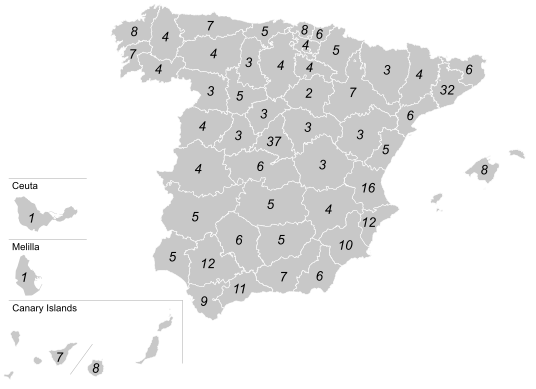
Congress has 350 members elected from fifty-two constituencies (the fifty provinces and two autonomous cities) using closed list D'Hondt proportional representation. Deputies serve four-year terms. The presiding officer and speaker is the President of the Congress of Deputies, who is elected by the members at the first sitting of Congress after an election.
The two principal bodies in Congress are parliamentary groups and parliamentary committees (). All MPs are required to be members of a parliamentary group, the institutionalised form of political parties. Groups act with one voice represented by their spokesperson. In other words, the Spanish Parliament is a parliament of groups, not individual MPs who are constrained to act only as part of the group. MPs can only act autonomously when submitting oral or written questions.
As a result of the 2019 general election, there were 168 female deputies or 48% of all members, making Spain the European country with the highest percentage of women in parliament, surpassing Sweden and Finland; however, the share decreased to a 44.3% after the elections in 2023.
Constitutional position
House makeup
Composition
Section 68.1 of the Spanish Constitution establishes that the Congress of Deputies must be composed of at least 300, and no more than 400 deputies. At present, the house has 350 deputies which is determined by the 1985 Electoral Act.
Electoral system
The Spanish Constitution establishes that the deputies are chosen by universal, free, equal, direct, and secret suffrage. The election is held every four years or earlier in case of snap election. The members of the Congress are elected by proportional representation with closed lists in each constituency.
There are 52 constituencies for the Congress of Deputies corresponding to the 50 provinces of Spain and two autonomous cities (Ceuta and Melilla). According to Spanish electoral law, the number of seats in each constituency can change in each election and it is specified when writs of election are issued. Each province is guaranteed a minimum allocation of two seats, and one seat each for Ceuta and Melilla for a total of 102 seats. The remaining 248 seats are allocated proportionally according to the population using the Hare quota.
After the General Election, seats are assigned to the electoral lists in each constituency separately, using the D'Hondt method; parties receive seats in approximate proportion to the number of votes each received in the constituency. A strictly proportional system would result in fractional seats; the D'Hondt method resolves this by favoring parties receiving larger votes.
For provinces that elect at least 24 deputies, the 1985 Electoral Act establishes a 3% minimum valid votes by constituency requirement (blank votes count towards the total votes, but invalid ballots do not count) for a party to participate in the seat distribution for a constituency. At present, this condition applies only to Madrid and Barcelona.
In March 2011, the Electoral Act was modified to require parties that are not represented either in Congress or in the Senate to collect signatures to support their candidacy to be able to run in the election. One-tenth of a percent of those registered to vote in a constituency are required to be on the ballot and each citizen can sign only once for a party candidacy. The Electoral Board establishes the regulations for the collection of signatures.
Mandate
The deputies' term of office finishes four years after their election or when the Cortes are dissolved, which can take place jointly or separately with the dissolution of the Senate. Only the Monarch can dissolve Parliament on the request of the President of the Government after the deliberation of the Council of Ministers. The dissolution of the Cortes also takes place if there is a failed legislature or two months after a failed investiture session, in this case, the Monarch dissolves the house with the countersign of the President of the Congress of Deputies. During their mandate, the deputies have some guarantees and privileges to carry their responsibilities out according to Section 97 of the Spanish Constitution.
Bodies of the Congress
_heute_Palacio_de_las_Cortes_span_Parlament_Madrid_España_-_Foto_Wolfgang_Pehlemann_P1250289.jpg)
Exercising the autonomy recognised by the Constitution to the Congress of Deputies, the house is regulated by some internal rules established by itself in 1982 and it configures different government bodies to carry the pertinent competencies out.
Governing bodies
The governing bodies of the Congress of Deputies are the bodies which under their authority the House is manage. Those bodies are the President, the Bureau and the Board of Spokespersons.
The President of the Congress of Deputies is the highest authority and it represents the House and it is, de facto, the whole parliament leader. As head of the Congress, it also chairs the Bureau, the Board of Spokespersons and the Permanent Deputation, and is the maximum responsible authority of the Congress's Police.
The Bureau of the Congress of Deputies is the collective body that represents the House and manages the day-to-day of the Chamber, preparing the budget and making all the necessary decisions to allow the proper functioning of the functions of the Congress.
The Board of Spokespersons of the Congress of Deputies is the collective body formed by representatives of the parliamentary groups and normally, government representatives, that establishes the agenda of the House.
Working bodies
The working bodies of the Congress of Deputies are the Plenary, the Committees, the Permanent Deputation and the Parliamentary Groups.
The Plenary is the central body of the Congress of Deputies which allows the house to exercise their choices. It is the sitting of all the members of the Parliament when half plus one of its members are attending the house. This body represents the unity of the house and it works through the plenary sessions which can be ordinary or extraordinary.
The ordinary sessions take place during the two meeting terms: September to December and February to June. The extraordinary sessions are convened at the request of the Prime Minister of Spain, the Permanent Council or the absolute majority of the house. In this kind of session a particular agenda is presented, and the session ends when all items have been discussed.
The Committees are the basic working bodies of the Congress designed to facilitate the work of the house. The committees have the same powers as the Plenary: to legislate by delegation of the plenary or at the request of the Bureau, and to check the Government by requesting information of the Administration or by requesting the appearance of any member of the Government or Administration.
There are two types of committees: standing and non-standing. The standing committees are defined by the Congress's standing orders and non-standing committees, created by the Plenary. The standing committees examine bills and make amendments. The Plenary of the Congress can confer upon them full legislative power in relation to a matter, so they can approve or reject any bill. There are 23 permanent (standing) legislative committees and 8 permanent (standing) non-legislative committees which have responsibilities for House administration. The Plenary can create additional non-legislative committees at the beginning of each legislature. The non-standing committees are created with a specific purpose and their themes and duration are determined by the Plenary.
The members of the committees are chosen by the Parliamentary Groups with the number of members proportional to the number of seats in the House, which means they are not effective checks on the Government when the party in office has a parliamentary majority. Once the committees are created they must elect in their first meeting the bureau of the committee, composed of a chair, two deputy chairs and two secretaries. In practice, the largest party always enjoys a clear over-representation in the distribution of chairpersons.
Subcommittees can also be created by the Plenary at the request of the committees. There are two types of subcommittees, the ordinary subcommittees, the purpose of which is to discuss and report on a specific issue, and the reporting subcommittees, the purpose of which is to write a draft bill to be discussed in the committee. The members of the subcommittees are designated by the committee.
The Permanent Deputation is a body created in order to have a permanent constituted legislative power. It is responsible for safeguarding the powers of the house between the legislative sessions (January, July and August) or when their term has finished because of termination or dissolution. In these three cases, the Permanent Deputation is a temporary extension of the house. The Permanent Deputation is presided by the President of the Congress. It is composed of a proportional number of deputies depending on the numerical importance of the different Parliamentary Groups.
All members of the house are assigned to one of the Parliamentary Groups reflecting their party affiliation or ideology. The formation of the parliamentary groups takes place at the beginning of each legislature. The deputies (members) who cannot satisfy the rules for forming a group are placed together in their own group (called the Mixed Group) so that they can still participate in the functions of Parliament.
Composition of the XV legislature
Main article: 15th Cortes Generales, 2023 Spanish general election
The XV legislature of Spain started on 17 August 2023 when the Cortes Generales were constituted, once the 2023 general election was held.
Bureau of the Congress of Deputies
| Position | Holder | Party | |
|---|---|---|---|
| President | Francina Armengol Socias | PSOE | |
| First Vice President | Alfonso Rodríguez Gómez de Celis | PSOE | |
| Second Vice President | José Antonio Bermúdez de Castro | PP | |
| Third Vice President | Esther Gil de Reboleño Lastortres | SMR | |
| Fourth Vice President | Marta González Vázquez | PP | |
| First Secretary | Gerardo Pisarello Prados | SMR | |
| Second Secretary | Isaura Leal Fernández | PSOE | |
| Third Secretary | Guillermo Mariscal Anaya | PP | |
| Fourth Secretary | María del Carmen Navarro Lacoba | PP |
Current Committees (XV legislature, 2023–present)
Permanent Legislative Committees
| Committee | Chair(s) | Term | |
|---|---|---|---|
| Constitutional | José Zaragoza Alonso | PSOE | |
| Foreign Affairs | Juan Carlos Ruiz Boix | PSOE | |
| Justice | Francisco Lucas Ayala | PSOE | |
| Defence | Alberto Fabra Part | PP | |
| Finance and Civil Service | Alejandro Soler Mur | PSOE | |
| Budgets | Carlos Martín Urriza | SMR | |
| Interior | José Luis Ábalos Meco | PSOE | |
| Transport and Sustainable Mobility | José Ramón Gómez Besteiro | PSOE | |
| Education, Vocational Training and Sports | Mercedes González Fernández | PSOE | |
| Labour, Social Economy, Inclusion, Social Security and Migration | Aina Vidal Sáez | SMR (CatComú) | |
| Industry and Tourism | Inés Granollers i Cunillera | ERC | |
| Social Rights and Consumer Affairs | Luis Carlos Sahuquillo García | PSOE | |
| Agriculture, Fisheries and Food | Joseba Andoni Agirretxea Urresti | EAJ–PNV | |
| Territorial Policy | Rafaela Crespín Rubio | PSOE | |
| Ecological Transition and the Demographic Challenge | Cristina Narbona Ruiz | PSOE | |
| Housing and Urban Agenda | Isabel María Borrego Cortés | PP | |
| Culture | Gerardo Pisarello Prados | SMR (CatComú) | |
| Economy, Trade and Digital Transformation | Pedro Puy Fraga | PP | |
| Health | Agustín Santos Maraver | SMR | |
| Science, Innovation and Universities | María Sandra Moneo Díez | PP | |
| International Cooperation for Development | Susana Ros Martínez | PSOE | |
| Equality | Carmen Calvo Poyato | PSOE | |
| Youth and Children | Jordi Salvador i Duch | ERC |
Permanent non-Legislative Committees
| Committee | Chair(s) | Term | |
|---|---|---|---|
| Rules | Francina Armengol Socias | PSOE | |
| Deputies' Statute | Manuel Cobo Vega | PP | |
| Petitions | Carlos Aragonés Mendiguchía | PP | |
| Monitoring and Evaluation of the Agreements of the Toledo Pact | María Mercè Perea i Conillas | PSOE | |
| Monitoring and Evaluation of the Agreements of the State Pact against Gender Violence | Adriana Lastra Fernández | PSOE | |
| Comprehensive Disability Policies | María Mercedes Fernández González | PP | |
| Democratic Quality, Fight Against Corruption and Institutional and Legal Reforms | Antidio Fagúndez Campo | PSOE | |
| Road Safety | Marta Madrenas i Mir | Junts |
Presidency of the Congress of Deputies
Main article: President of the Congress of Deputies
| Legislature | President | Party | Start | End | ||
|---|---|---|---|---|---|---|
| Constituent | Union of the Democratic Centre (Spain)}}" | Fernando Álvarez de Miranda | [[File:Logo UCD.svg | 20px]] UCD | 13 July 1977 | |
| I legislature | Union of the Democratic Centre (Spain)}}" | Landelino Lavilla Alsina | [[File:Logo UCD.svg | 20px]] UCD | 23 March 1979 | |
| II legislature | Gregorio Peces-Barba | [[File:Logo PSOE, 1976-2001.svg | Logo PSOE, 1976–2001 | 27x27px]] PSOE | 18 November 1982 | |
| III legislature | Félix Pons Irazazábal | [[File:Logo PSOE, 1976-2001.svg | Logo PSOE, 1976–2001 | 27x27px]] PSOE | 15 July 1986 | |
| IV legislature | ||||||
| V legislature | ||||||
| VI legislature | Federico Trillo-Figueroa | [[File:People's Party (Spain) Logo (1993-2000).svg | 23x23px]] PP | 27 March 1996 | ||
| VII legislature | Luisa Fernanda Rudi Úbeda | [[File:People's Party (Spain) Logo (2000-2007).svg | 23x23px]] PP | 5 April 2000 | ||
| VIII legislature | Manuel Marín González | [[File:Logotipo del PSOE.svg | 20px]] PSOE | 2 April 2004 | ||
| IX legislature | José Bono Martínez | [[File:Logotipo del PSOE.svg | 20px]] PSOE | 1 April 2008 | ||
| X legislature | Jesús Posada Moreno | [[File:People's Party (Spain) Logo (2008-2015).svg | 23x23px]] PP | 13 December 2011 | ||
| XI legislature | Patxi López Álvarez | [[File:Logotipo del PSOE.svg | 20px]] PSOE | 13 January 2016 | ||
| XII legislature | Ana Pastor Julián | [[File:People's Party (Spain) Logo.svg | sinmarco | 23x23px]] PP | 19 July 2016 | |
| XIII legislature | Meritxell Batet Lamaña | [[File:Logotip del PSC.svg | alt= | 20x20px]] PSC | 21 May 2019 | |
| XIV legislature | ||||||
| XV legislature | Francina Armengol Socias | [[File:Logotipo del PSOE.svg | 20px]] PSOE | 17 August 2023 |
Congress of Deputies building
_02.jpg)
The building, Palacio de las Cortes, has a neoclassical style. It was designed by Narciso Pascual Colomer, and built between 1843 and 1850. It sits by the Carrera de San Jerónimo, in Madrid. The relief on the facade by sculptor Ponciano Ponzano centers on a sculpture of Spain embracing the constitutional state, represented by a woman with her arm around a young girl. Surrounding the pair are figures that represent in allegorical form Justice and Peace, Science, Agriculture, Fine Arts, Navigation, Industry, Commerce and so on. Ponzano also executed two bronze lions for the building's access stairway in a more realistic manner.
Notes
References
Bibliography
References
- (3 May 2019). "Which European country has the most female politicians?". The Economist.
- "8.2 Mujeres en el Congreso de los Diputados y en el Senado Fichero PDF". Instituto Nacional de Estadística.
- "What is the Congress of Deputies?".
- "The President of the Congress of Deputies".
- "Current membership of Bureau".
- "Current membership of Board of Spokespersons".
- "Parliamentary Groups".
- Congress of Deputies. "Comisiones - Congreso de los Diputados".
- "Ponzano y Gascón, Ponciano". Gran Enciclopedia Aragonesa.
This article was imported from Wikipedia and is available under the Creative Commons Attribution-ShareAlike 4.0 License. Content has been adapted to SurfDoc format. Original contributors can be found on the article history page.
Ask Mako anything about Congress of Deputies — get instant answers, deeper analysis, and related topics.
Research with MakoFree with your Surf account
Create a free account to save articles, ask Mako questions, and organize your research.
Sign up freeThis content may have been generated or modified by AI. CloudSurf Software LLC is not responsible for the accuracy, completeness, or reliability of AI-generated content. Always verify important information from primary sources.
Report