From Surf Wiki (app.surf) — the open knowledge base
Concha bullosa
Anatomical feature of the human nose
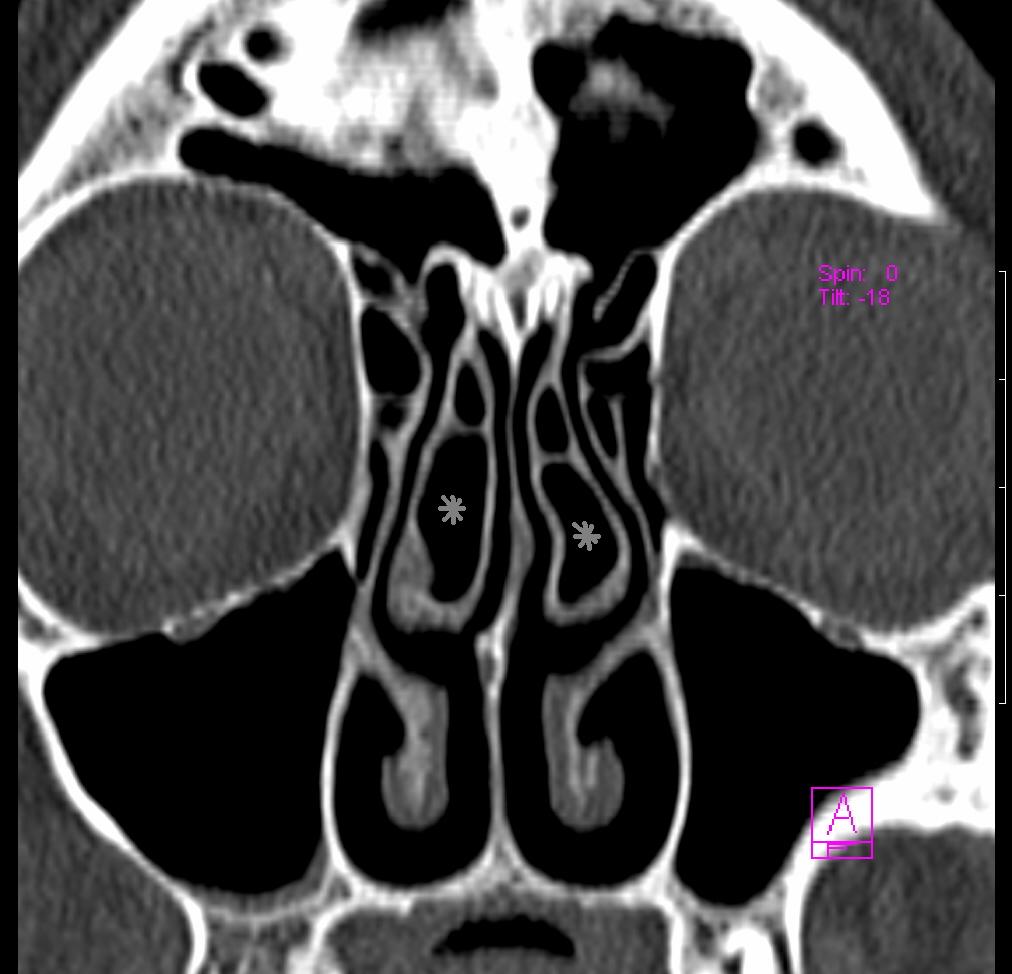
Anatomical feature of the human nose
A concha bullosa is a pneumatized (air-filled) cavity within a nasal concha, also known as a turbinate. Bullosa refers to the air-filled cavity within the turbinate. It is a normal anatomic variant seen in up to half the population. Concha bullosa can occur in the inferior, middle, and superior turbinates. It is most frequently observed in the middle turbinate. Occasionally, a large concha bullosa may cause it to bulge sufficiently to obstruct the opening of an adjacent sinus, possibly leading to sleeping apnea or breathing disorder related to areas innervated by the trigeminal nerve. In such a case the turbinate can be reduced in size by endoscopic nasal surgery (turbinectomy). The presence of a concha bullosa is often associated with deviation of the nasal septum toward the opposite side of the nasal cavity.
One review of the septal surgery shows that some relief of breathing difficulty and sleeping apnea occurs in 65%-85% of surgeries. Screening of patients can cover presence of breathing difficulty when it is too large, because nasal airways are blocked by inflammation.
Some experts call pain associated with enlarged concha bullosa " will not go away with surgery when concha bullosa small in size and not blocking the airway, surgery can help for breathing improvement." In a review article of fifteen other journal articles of surgeries, not much improvements occurred after surgical treatment with a reduction from 88 to 4 (4%) patients for GRADE 3–4 MIDAS scores, and a corresponding increase in milder symptoms from GRADE 1–2 in 32 (27%) patients at 91 (76%) (p
References
References
- Hatipoğlu, HG. (Sep 2005). "Concha bullosa types: their relationship with sinusitis, ostiomeatal and frontal recess disease.". Diagnostic and Interventional Radiology.
- Koo, SK. (October 2017). "The incidence of concha bullosa, unusual anatomic variation and its relationship to nasal septal deviation: A retrospective radiologic study". Auris Nasus Larynx.
- Cantone, E. (Jul 2015). "Concha bullosa related breathing disorder disability". European Review for Medical and Pharmacologic Sciences.
- Stallman, JS. (Oct 2004). "The incidence of concha bullosa and its relationship to nasal septal deviation and paranasal sinus disease". American Journal of Neuroradiology.
- ePainAssist, Team. (November 6, 2015). "|Causes|Symptoms|Signs|Treatment|Diagnosis".
- "MIDAS (Migraine Disability Assessment) | QxMD".
This article was imported from Wikipedia and is available under the Creative Commons Attribution-ShareAlike 4.0 License. Content has been adapted to SurfDoc format. Original contributors can be found on the article history page.
Ask Mako anything about Concha bullosa — get instant answers, deeper analysis, and related topics.
Research with MakoFree with your Surf account
Create a free account to save articles, ask Mako questions, and organize your research.
Sign up freeThis content may have been generated or modified by AI. CloudSurf Software LLC is not responsible for the accuracy, completeness, or reliability of AI-generated content. Always verify important information from primary sources.
Report