From Surf Wiki (app.surf) — the open knowledge base
Compton edge
Greatest energy a photon scattered on an electron can transfer to it
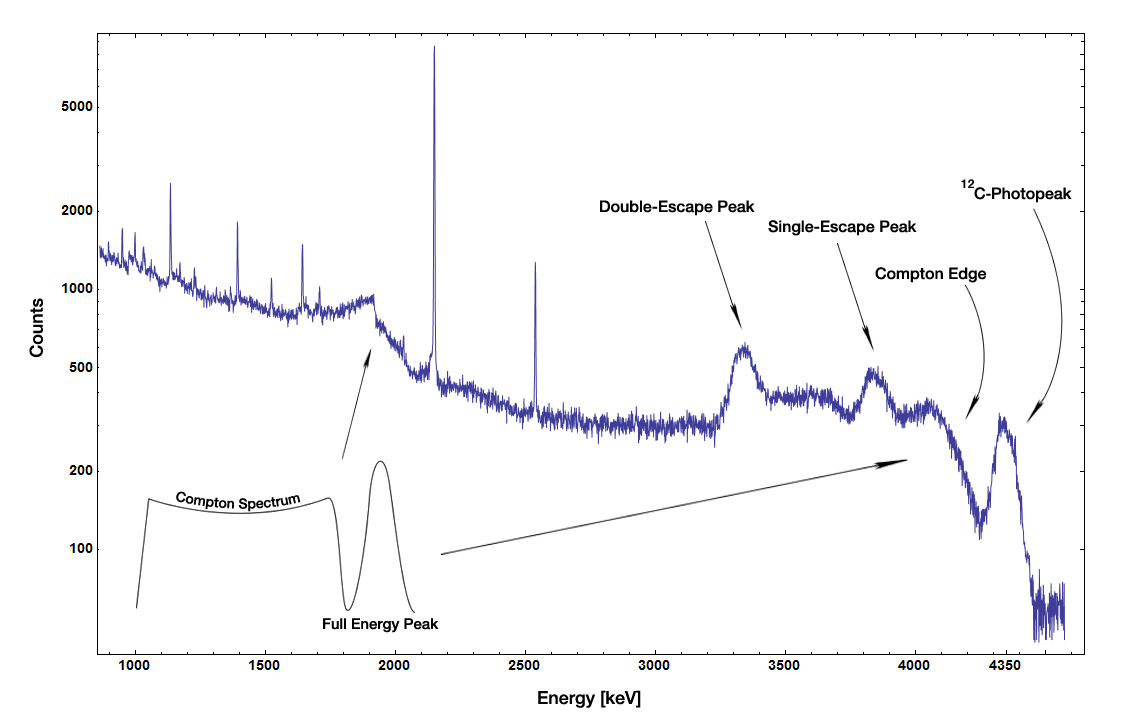
Greatest energy a photon scattered on an electron can transfer to it
In gamma-ray spectrometry, the Compton edge is a feature of the measured gamma-ray energy spectrum that results from Compton scattering in the detector material. It corresponds to the highest energy that can be transferred to a weakly bound electron of a detector's atom by an incident photon in a single scattering process, and manifests itself as a ridge in the measured gamma-ray energy spectrum. It is a measurement phenomenon (meaning that the incident radiation does not possess this feature), which is particularly evident in gamma-ray energy spectra of monoenergetic photons.
When a gamma ray scatters within a scintillator or a semiconductor detector and the scattered photon escapes from the detector's volume, only a fraction of the incident energy is deposited in the detector. This fraction depends on the scattering angle of the photon, leading to a spectrum of energies corresponding to the entire range of possible scattering angles. The highest energy that can be deposited, corresponding to full backscatter, is called the Compton edge. In mathematical terms, the Compton edge is the inflection point of the high-energy side of the Compton region.
Background
In a Compton scattering process, an incident photon collides with a weakly bound electron, leading to its release from the atomic shell. The energy of the outgoing photon, *E' *, is given by the formula:
: E^\prime = \frac{E}{1 + \frac{E}{m_{\text{e}} c^2}(1-\cos\theta)}
- E is the energy of the incident photon.
- m_{\text{e}} is the mass of the electron.
- c is the speed of light.
- \theta is the angle of deflection of the photon.
(note that the above formula does not account for the electron binding energy, which can play a non-negligible role for low-energy gamma rays).
The energy transferred to the electron, E_T, varies with the photon's scattering angle. For \theta equal to zero there is no energy transfer, while the maximum energy transfer occurs for \theta equal to 180 degrees (backscattering).
: E_T = E - E^\prime
: E_{\text{ComptonEdge}} = E_T (\text{max}) = E \left(1-\frac{1}{1 + \frac{2E}{m_{\text{e}} c^2}} \right)
In a single scattering act, it is impossible for the photon to transfer any more energy via this process. Thus, there is a sharp cutoff at this energy, leading to the name Compton edge. If multiple photopeaks are present in the spectrum, each of them will have its own Compton edge. The part of the spectrum between the Compton edge and the photopeak is due to multiple subsequent Compton-scattering processes.
The continuum of energies corresponding to Compton scattered electrons is known as the Compton continuum.
References
References
- Knoll, Glenn F. ''Radiation Detection and Measurement'' 2000. John Wiley & Sons, Inc.
- (2010). "Nuclear medicine instrumentation". Jones and Bartlett Publishers.
This article was imported from Wikipedia and is available under the Creative Commons Attribution-ShareAlike 4.0 License. Content has been adapted to SurfDoc format. Original contributors can be found on the article history page.
Ask Mako anything about Compton edge — get instant answers, deeper analysis, and related topics.
Research with MakoFree with your Surf account
Create a free account to save articles, ask Mako questions, and organize your research.
Sign up freeThis content may have been generated or modified by AI. CloudSurf Software LLC is not responsible for the accuracy, completeness, or reliability of AI-generated content. Always verify important information from primary sources.
Report