From Surf Wiki (app.surf) — the open knowledge base
Composite order
Architectural order

Architectural order
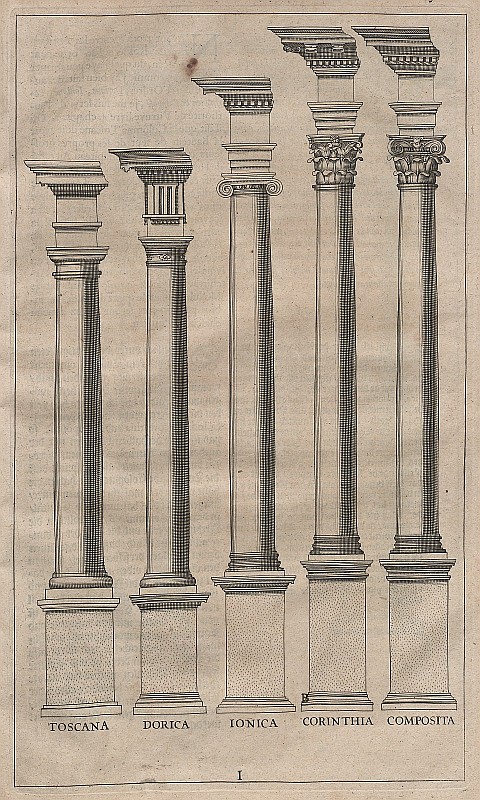
The Composite order is a mixed order, combining the volutes of the Ionic order capital with the acanthus leaves of the Corinthian order. In many versions the composite order volutes are larger, however, and there is generally some ornament placed centrally between the volutes. The column of the composite order is typically ten diameters high, though as with all the orders these details may be adjusted by the architect for particular buildings. The Composite order is essentially treated as Corinthian except for the capital, with no consistent differences to that above or below the capital.
The Composite order is not found in ancient Greek architecture and until the Renaissance was not ranked as a separate order. Instead it was considered as an imperial Roman form of the Corinthian order. Though the Arch of Titus, in the forum in Rome and built in 82 AD, is sometimes cited as the first prominent surviving example of a composite order, the order was probably invented "a little before Augustus's reign, and certainly well-developed before his death, the very time when the Roman version of Corinthian was being established."
With the Tuscan order, a simplified version of the Doric order, also found in ancient Roman architecture but not included by Vitruvius in his three orders, the Composite was added by Renaissance writers to make five classical orders. Sebastiano Serlio (1475–1554) published his book I Sette libri dell'architettura in 1537 in which he was the second to mention the Composite order as its own order and not just as an evolution of the Corinthian order as previously suggested by Leon Battista Alberti. Leon Battista Alberti in his De re aedificatoria (English: On the Art of Building) mentions the Composite order, calling it "Italic".
Form of the capital
.jpg)
The Composite is partly based on the Ionic order, where the volutes (seen frontally) are joined by an essentially horizontal element across the top of the capital, so that they resemble a scroll partly rolled at each end. Despite this origin, very many Composite capitals in fact treat the two volutes as different elements, each springing from one side of their leafy base. In this, and in having a separate ornament between them, they resemble the Archaic Greek Aeolic order, though this seems not to have been the route of their development in early Imperial Rome.
Equally, where the Greek Ionic volute is usually shown from the side as a single unit of unchanged width between the front and back of the column, the Composite volutes are normally treated as four different thinner units, one at each corner of the capital, projecting at some 45° to the façade. This has the advantage of removing the necessity to have a different appearance between the front and side views, and the Ionic eventually developed bending forms that also allowed this.
The treatment of details has often been very variable, with the inclusion of figures, heraldic symbols and the like in the capital. The relationship of the volutes to the leaves has been treated in many different ways, and the capital may be distinctly divided into different horizontal zones, or may treat the whole capital as a single zone. The composite order, due to its delicate appearance, was deemed by the Renaissance to be suitable for the building of churches dedicated to The Virgin Mary or other female saints. In general, it has since been used to suggest richness and grandeur.
Examples
Donato Bramante (1444–1514) used the Composite order in the second order of the cloister of Santa Maria della Pace, Rome. For the first order, the Ionic order was used. Francesco Borromini (1599–1667) developed the Composite order in San Carlo alle Quattro Fontane, Rome (1638). The interior of the church has 16 Composite columns. The load-bearing columns placed underneath the arches have inverted volutes. This choice was highly criticised at the time, thinking it was a lack of knowledge of the Vittruvian orders that led him to his decision.
The inverted volutes can also be seen in Borromini's Oratorio dei Filippini in the lower order. There the controversy was even higher, considering that Borromini also removed the acanthus leaves, leaving a bare capital.
;Roman
- Arch of Titus, Rome
- Arch of Septimius Severus, Rome
- Santa Costanza, Rome, interior, mid-4th century
;Modern
- Ospedale degli Innocenti, Florence, 1421, Filippo Brunelleschi
- Palazzo Valmarana, Vicenza, 1565, Andrea Palladio
- Palazzo del Capitaniato, Vicenza, 1571–1572, Andrea Palladio
- Lescot Wing, Louvre Palace, Paris
- Church of the Gesù, Rome
- Easton Neston, England,
- Palazzo Madama, Turin, , Filippo Juvarra
- Archbasilica of St. John Lateran
- Somerset House, London, 1776, William Chambers
- Narva Triumphal Arch, Saint Petersburg, 1814
- Ethnographic Museum (former Palace of Justice), Budapest
- Alabama Governor's Mansion, 1907
Gallery
File:Ephesus Celsus Library Façade.jpg|Roman Composite columns of the Library of Celsus, Ephesus, Turkey, unknown architect, 110 AD
file:ArcoTitoTrabeazioneCapComp.jpg|Roman Composite capital of the Arch of Titus, with a highly decorated entablature, Rome, unknown architect, 1st century
10 2023 Basilica di Santa Maria degli Angeli e dei Martiri, Roma, Italia - soffitto cassettoni lacunari lesene semicolonne composito tardo barocco angeli tripartizione sesto ribassato - Photo Paolo Villa FO232008 (cropped capitals).jpg|Roman Composite columns (not the pilasters) in the former Baths of Diocletian, Rome, now Santa Maria degli Angeli e dei Martiri, unknown architect, 4th century
File:Santa Costanza, interno.jpg|Roman Composite columns of the Church of Santa Costanza, Rome, originally built as a mausoleum to house the tomb of Constantina, daughter of Roman emperor Constantine the Great, unknown architect, 2nd quarter of the 4th century
File:Tesoro di san pietro, sarcofago di giunio basso.JPG|Roman Composite columns on the Sarcophagus of Junius Bassus, 359, marble, treasury of St. Peter's Basilica, Rome
File:Euphrasian Basilica Capital 3.JPG|Byzantine Composite capital in the Euphrasian Basilica, Poreč, Croatia, unknown architect, 6th century
File:St Demetrius, Thessalonica Capitals in nave - Texier Charles - 1864.jpg|Byzantine reinterpretations of the Composite order in the Hagios Demetrios, Thessaloniki, Greece, unknown architect, 629–634
Lorsch, Kloster, Torhalle, Ansicht von Westen 20170609 007.jpg|Carolingian Composite columns of the Lorsch Abbey gatehouse, unknown architect, 800
File:Capital MET DP240296.jpg|Islamic Composite capital with Arabic-inscribed abacus, probably from Medina Azahara in the Umayyad Caliphate of Córdoba, 10th century, marble, Metropolitan Museum of Art, New York
File:Trabzon Hagia Sophia stonework at narthex side 4898.jpg|Byzantine reinterpretations of the Composite order in the Hagia Sophia, Trabzon, Turkey, unknown architect, 13th century
File:Allievo fiorentino del verrocchio attivo a roma, forse michele marini da fiesole, capitello con gorgone, 1485-95 ca. (roma, museo di roma) 01.jpg|Renaissance Composite pilaster capital with a gorgon mascaron, by a Florentine pupil of Verrocchio active in Rome, perhaps Michele Marini da Fiesole, 1485-1495, terracotta, Museo di Roma, Rome
File:Ferrara, palazzo Prosperi-Sacrati (04).jpg|Renaissance Composite columns of the Palazzo Prosperi-Sacrati, Ferrara, Italy, by Biagio Rossetti, 1493-1514
File:Paris - Palais du Louvre - PA00085992 - 219.jpg|Renaissance Composite capitals of the Lescot Wing of the Louvre Palace, Paris, by Pierre Lescot, 1546-1551
Palazzo del Capitanio - Vicenza.jpg|Renaissance Composite columns of the Palazzo del Capitaniato, Vicenza, Italy, by Andrea Palladio, designed in 1565 and built in 1571-1572
File:Baldaquin Bernin Saint-Pierre Vatican.jpg|Baroque Solomonic Composite columns of St. Peter's Baldachin, St. Peter's Basilica, Vatican City, by Gian Lorenzo Bernini, 1623–1634
File:Baldaquin et maître-autel du Val de Grâce.jpg|Baroque Solomonic Composite of the baldaquin in the Church of the Val-de-Grâce, Paris, by François Mansart or Gabriel Le Duc, 1634-1667
San Marcello al Corso - Facade.jpg|Baroque Composite columns of San Marcello al Corso, Rome, by Carlo Fontana, 1682-1683
Convento de San Esteban, Salamanca. Retablo mayor.jpg|Baroque Solomonic Composite columns of the main altar of the Convento de San Esteban, Salamanca, Spain, by José Benito de Churriguera, 1693
File:Boulle cabinet.jpg|Baroque Composite columns on a cabinet, probably by André-Charles Boulle, 17th century, Boulle work, gilt bronze, lapis lazuli and other materials, Rákóczi Múzeum, Sárospatak, Hungary
File:Interior of Chiesa dei Gesuiti (Venice) - High altar.jpg|Baroque Solomonic Composite columns of the high altar of the Gesuiti, Venice, Italy, by Jacopo Antonio Pozzo, 1715-1728
File:1732 wurde mit dem Bau der Hofkirche in der Würzburger Residenz begonnen. 01.jpg|Rococo Composite columns in the chapel of the Würzburg Residence, Würzburg, Germany, by Balthasar Neumann, 1732-1744
File:San Giovanni in Laterano Front.JPG|Baroque Composite columns of the Archbasilica of Saint John Lateran, Rome, by Alessandro Galilei, 1733-1735
File:Asamkirche - München - 2022-04-28 - 293a.jpg|Rococo Composite column and pilaster capitals of the St. Johann Nepomuk, Munich, Germany, by Egid Quirin Asam and Cosmas Damian Asam, 1733-1746
File:Altaar met bisschoppen Ontwerpen voor altaren (serietitel), RP-P-1964-2671.jpg|Rococo reinterpretation of the Composite order of an altar design with bishops, with more curvy and sinuous S-shaped acanthuses, by Franz Xaver Habermann, 1740-1745, etching on paper, Rijksmuseum, Amsterdam, the Netherlands
Santa Maria Annunziata in Borgo - esterno.jpg|Baroque Composite columns of the Santa Maria Annunziata in Borgo, Rome, by Pietro Passalacqua, 1742 and 1745
Engelszell Stiftskirche - Nepomukaltar 4 Kapitell.jpg|Rococo reinterpretation of the Composite capital of the Engelszell Abbey, Austria, by Johann Georg Üblhör, 1754-1764
Paris Palais Royal Jardin 184.jpg|Louis XVI style Composite pilasters on a façade of the Galerie de Valois, Palais-Royal, Paris, by Victor Louis, 1780
File:BNF Richelieu (29863540447).jpg|Neoclassical stylized Composite columns in a reading room in the Bibliothèque nationale de France on Rue de Richelieu, Paris, by Henri Labrouste, 1859-1868
File:Composite capital, Palace of Justice (today Ethnographic Museum), Budapest.jpg|Baroque Revival composite capital in the former Palace of Justice, Budapest, Hungary, by Alajos Hauszmann, 1893-1896
55, Strada Lipscani, Bucharest (Romania) 13.jpg|Beaux Arts Composite capital of a column from Cărturești Carusel (Strada Lipscani no. 55), Bucharest, Romania, unknown architect, 1900
File:Grand Foyer, Severance Hall, University Circle, Cleveland, OH - 52991405092.jpg|Art Deco Composite columns in the grand foyer of the Severance Hall, Cleveland, US, by Walker and Weeks, 1931
File:Моховая, 13.jpg|Stalinist Composite columns of the Zholtovsky House, Moscow, by Ivan Zholtovsky, 1932-1934
File:22 Calea Victoriei, Bucharest (01).jpg|Art Deco Composite columns on the Foreign Trade Bank Building (Calea Victoriei no. 22), Bucharest, by Radu Dudescu, 1937-1938
Notes
References
References
- Henig, Martin (ed.), ''A Handbook of Roman Art'', p. 50, Phaidon, 1983, {{ISBN. 0714822140
- Zampa, P. ''L'ordine composito: alcune considerazioni'', 1978, pp. 37–50
- Buonincasa, C. ''Architettura come dis-identità'', 1978
- (2013). "The Glory of Byzantium and early Christendom". Phaidon.
- (2013). "The Glory of Byzantium and early Christendom". Phaidon.
- (2022). "A History of Western Architecture". Laurence King.
- John Summerson. (1963). "The Classical Language of Architecture". Thames & Hudson.
- (2010). "Secolul al XVII-lea - Secole de Artâ". rao.
- (2010). "Secolul al XVII-lea - Secole de Artâ". rao.
- (2022). "A History of Western Architecture". Laurence King.
- (2022). "A History of Western Architecture". Laurence King.
- (2022). "A History of Western Architecture". Laurence King.
- "S.Maria Annunziata".
This article was imported from Wikipedia and is available under the Creative Commons Attribution-ShareAlike 4.0 License. Content has been adapted to SurfDoc format. Original contributors can be found on the article history page.
Ask Mako anything about Composite order — get instant answers, deeper analysis, and related topics.
Research with MakoFree with your Surf account
Create a free account to save articles, ask Mako questions, and organize your research.
Sign up freeThis content may have been generated or modified by AI. CloudSurf Software LLC is not responsible for the accuracy, completeness, or reliability of AI-generated content. Always verify important information from primary sources.
Report