From Surf Wiki (app.surf) — the open knowledge base
Composite number
Integer having a non-trivial divisor

Integer having a non-trivial divisor
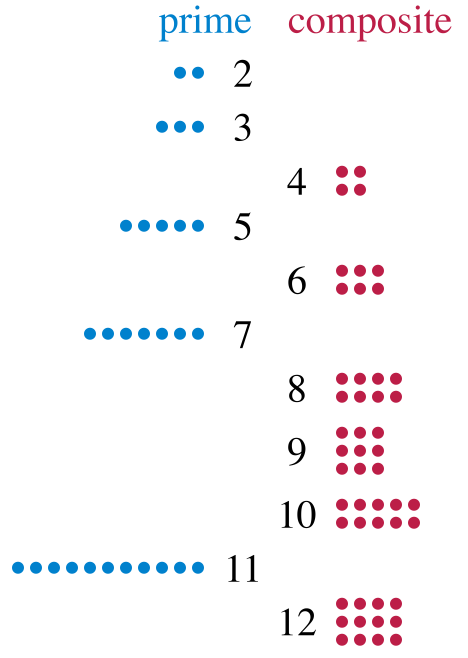
A composite number is a positive integer that can be formed by multiplying two smaller positive integers. Accordingly it is a positive integer that has at least one divisor other than 1 and itself. Every positive integer is composite, prime, or the unit 1, so the composite numbers are exactly the natural numbers that are not prime and not a unit. For example, the integer 14 is a composite number because it is the product of the two smaller integers 2 × 7 but the integers 2 and 3 are not because each can only be divided by one and itself.
The composite numbers up to 150 are: :4, 6, 8, 9, 10, 12, 14, 15, 16, 18, 20, 21, 22, 24, 25, 26, 27, 28, 30, 32, 33, 34, 35, 36, 38, 39, 40, 42, 44, 45, 46, 48, 49, 50, 51, 52, 54, 55, 56, 57, 58, 60, 62, 63, 64, 65, 66, 68, 69, 70, 72, 74, 75, 76, 77, 78, 80, 81, 82, 84, 85, 86, 87, 88, 90, 91, 92, 93, 94, 95, 96, 98, 99, 100, 102, 104, 105, 106, 108, 110, 111, 112, 114, 115, 116, 117, 118, 119, 120, 121, 122, 123, 124, 125, 126, 128, 129, 130, 132, 133, 134, 135, 136, 138, 140, 141, 142, 143, 144, 145, 146, 147, 148, 150.
Every composite number can be written as the product of two or more (not necessarily distinct) primes. For example, the composite number 299 can be written as 13 × 23, and the composite number 360 can be written as 23 × 32 × 5; furthermore, this representation is unique up to the order of the factors. This fact is called the fundamental theorem of arithmetic.
There are several known primality tests that can determine whether a number is prime or composite which do not necessarily reveal the factorization of a composite input.
Types
One way to classify composite numbers is by counting the number of prime factors. A composite number with two prime factors is a semiprime or 2-almost prime (the factors need not be distinct, hence squares of primes are included). A composite number with three distinct prime factors is a sphenic number. In some applications, it is necessary to differentiate between composite numbers with an odd number of distinct prime factors and those with an even number of distinct prime factors. For the latter :\mu(n) = (-1)^{2x} = 1
(where μ is the Möbius function and x is half the total of prime factors), while for the former
:\mu(n) = (-1)^{2x + 1} = -1.
However, for prime numbers, the function also returns −1 and \mu(1) = 1. For a number n with one or more repeated prime factors,
:\mu(n) = 0.
If all the prime factors of a number are repeated it is called a powerful number (All perfect powers are powerful numbers). If none of its prime factors are repeated, it is called squarefree. (All prime numbers and 1 are squarefree.)
For example, 72 = 23 × 32, all the prime factors are repeated, so 72 is a powerful number. 42 = 2 × 3 × 7, none of the prime factors are repeated, so 42 is squarefree.
Another way to classify composite numbers is by counting the number of divisors. All composite numbers have at least three divisors. In the case of squares of primes, those divisors are {1, p, p^2}. A number n that has more divisors than any x
Composite numbers have also been called "rectangular numbers", but that name can also refer to the pronic numbers, numbers that are the product of two consecutive integers.
Yet another way to classify composite numbers is to determine whether all prime factors are either all below or all above some fixed (prime) number. Such numbers are called smooth numbers and rough numbers, respectively.
Notes
References
This article was imported from Wikipedia and is available under the Creative Commons Attribution-ShareAlike 4.0 License. Content has been adapted to SurfDoc format. Original contributors can be found on the article history page.
Ask Mako anything about Composite number — get instant answers, deeper analysis, and related topics.
Research with MakoFree with your Surf account
Create a free account to save articles, ask Mako questions, and organize your research.
Sign up freeThis content may have been generated or modified by AI. CloudSurf Software LLC is not responsible for the accuracy, completeness, or reliability of AI-generated content. Always verify important information from primary sources.
Report