From Surf Wiki (app.surf) — the open knowledge base
Complex system
System composed of many interacting components

System composed of many interacting components
A complex system is a system composed of many components that interact with one another.{{cite journal | author1-link=James Ladyman | access-date = 28 July 2024 | access-date = 28 July 2024
The behavior of a complex system is intrinsically difficult to model due to the dependencies, competitions, relationships, and other types of interactions between their parts or between a given system and its environment.{{cite journal | access-date = 28 July 2024 | access-date = 28 July 2024
The term complex systems often refers to the study of complex systems, which is an approach to science that investigates how relationships between a system's parts give rise to its collective behaviors and how the system interacts and forms relationships with its environment. The study of complex systems regards collective, or system-wide, behaviors as the fundamental object of study; for this reason, complex systems can be understood as an alternative paradigm to reductionism, which attempts to explain systems in terms of their constituent parts and the individual interactions between them.
As an interdisciplinary domain, complex systems draw contributions from many different fields, such as the study of self-organization and critical phenomena from physics, of spontaneous order from the social sciences, chaos from mathematics, adaptation from biology, and many others. Complex systems is therefore often used as a broad term encompassing a research approach to problems in many diverse disciplines, including statistical physics, information theory, nonlinear dynamics, anthropology, computer science, meteorology, sociology, economics, psychology, and biology.
Types of systems
Complex systems can be:
- Complex adaptive systems which have the capacity to change,
- Polycentric systems "where many elements are capable of making mutual adjustments for ordering their relationships with one another within a general system of rules where each element acts with independence of other elements",
- Disorganised systems which involve localized interactions of multiple entities that do not form a coherent whole. Disorganised systems are linked to self-organisation processes.
- Hierarchic systems which are analyzable into successive sets of subsystems. They can also be called nested or embedded systems.
- Cybernetic systems which involve information feedback loops.
Key concepts
Adaptation
Complex adaptive systems are special cases of complex systems that are adaptive in that they have the capacity to change and learn from experience.{{cite book | author-link = John Henry Holland
Decomposability
A system is decomposable if the parts of the system (subsystems) are independent from each other, for example the model of a perfect gas consider the relations among molecules negligible.
In a nearly decomposable system, the interactions between subsystems are weak but not negligible, this is often the case in social systems. Conceptually, a system is nearly decomposable if the variables composing it can be separated into classes and subclasses, if these variables are independent for many functions but affect each other, and if the whole system is greater than the parts.
Features
Complex systems may have the following features:
;Complex systems may be open : Complex systems are usually open systems – that is, they exist in a thermodynamic gradient and dissipate energy. In other words, complex systems are frequently far from energetic equilibrium: but despite this flux, there may be pattern stability, see synergetics.
;Complex systems may exhibit critical transitions
:Critical transitions are abrupt shifts in the state of ecosystems, the climate, financial and economic systems or other complex systems that may occur when changing conditions pass a critical or bifurcation point. The 'direction of critical slowing down' in a system's state space may be indicative of a system's future state after such transitions when delayed negative feedbacks leading to oscillatory or other complex dynamics are weak.
;Complex systems may be nested :The components of a complex system may themselves be complex systems. For example, an economy is made up of organisations, which are made up of people, which are made up of cells – all of which are complex systems. The arrangement of interactions within complex bipartite networks may be nested as well. More specifically, bipartite ecological and organisational networks of mutually beneficial interactions were found to have a nested structure. This structure promotes indirect facilitation and a system's capacity to persist under increasingly harsh circumstances as well as the potential for large-scale systemic regime shifts.
;Dynamic network of multiplicity :As well as coupling rules, the dynamic network of a complex system is important. Small-world or scale-free networks which have many local interactions and a smaller number of inter-area connections are often employed. Natural complex systems often exhibit such topologies. In the human cortex for example, we see dense local connectivity and a few very long axon projections between regions inside the cortex and to other brain regions.
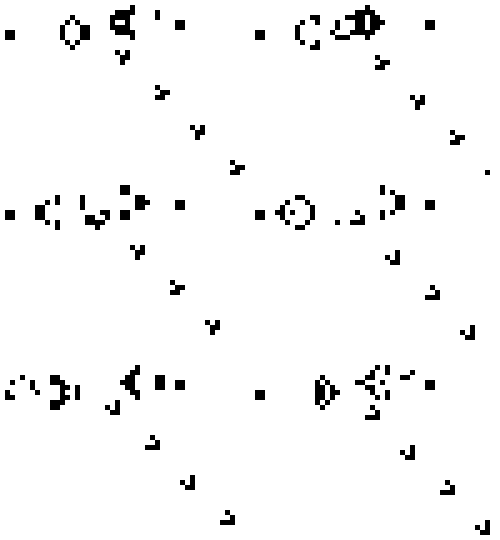
; May produce emergent phenomena :Complex systems may exhibit behaviors that are emergent, which is to say that while the results may be sufficiently determined by the activity of the systems' basic constituents, they may have properties that can only be studied at a higher level. For example, empirical food webs display regular, scale-invariant features across aquatic and terrestrial ecosystems when studied at the level of clustered 'trophic' species. Another example is offered by the termites in a mound which have physiology, biochemistry and biological development at one level of analysis, whereas their social behavior and mound building is a property that emerges from the collection of termites and needs to be analyzed at a different level.
; Relationships are non-linear : In practical terms, this means a small perturbation may cause a large effect (see butterfly effect), a proportional effect, or even no effect at all. In linear systems, the effect is always directly proportional to cause. See nonlinearity.
; Relationships contain feedback loops :Both negative (damping) and positive (amplifying) feedback are always found in complex systems. The effects of an element's behavior are fed back in such a way that the element itself is altered.
History
In 1948, Dr. Warren Weaver published an essay on "Science and Complexity", exploring the diversity of problem types by contrasting problems of simplicity, disorganized complexity, and organized complexity. Weaver described these as "problems which involve dealing simultaneously with a sizable number of factors which are interrelated into an organic whole."
While the explicit study of complex systems dates at least to the 1970s, the first research institute focused on complex systems, the Santa Fe Institute, was founded in 1984. Early Santa Fe Institute participants included physics Nobel laureates Murray Gell-Mann and Philip Anderson, economics Nobel laureate Kenneth Arrow, and Manhattan Project scientists George Cowan and Herb Anderson. Today, there are over 50 institutes and research centers focusing on complex systems.
Since the late 1990s, the interest of mathematical physicists in researching economic phenomena has been on the rise. The proliferation of cross-disciplinary research with the application of solutions originated from the physics epistemology has entailed a gradual paradigm shift in the theoretical articulations and methodological approaches in economics, primarily in financial economics. The development has resulted in the emergence of a new branch of discipline, namely "econophysics", which is broadly defined as a cross-discipline that applies statistical physics methodologies which are mostly based on the complex systems theory and the chaos theory for economics analysis.
The 2021 Nobel Prize in Physics was awarded to Syukuro Manabe, Klaus Hasselmann, and Giorgio Parisi for their work to understand complex systems. Their work was used to create more accurate computer models of the effect of global warming on the Earth's climate.
Applications
Complexity in practice
The traditional approach to dealing with complexity is to reduce or constrain it. Typically, this involves compartmentalization: dividing a large system into separate parts. Organizations, for instance, divide their work into departments that each deal with separate issues. Engineering systems are often designed using modular components. However, modular designs become susceptible to failure when issues arise that bridge the divisions.
Complexity of cities
Jane Jacobs described cities as being a problem in organized complexity in 1961, citing Dr. Weaver's 1948 essay. As an example, she explains how an abundance of factors interplay into how various urban spaces lead to a diversity of interactions, and how changing those factors can change how the space is used, and how well the space supports the functions of the city. She further illustrates how cities have been severely damaged when approached as a problem in simplicity by replacing organized complexity with simple and predictable spaces, such as Le Corbusier's "Radiant City" and Ebenezer Howard's "Garden City". Since then, others have written at length on the complexity of cities.
Complexity economics
Over the last decades, within the emerging field of complexity economics, new predictive tools have been developed to explain economic growth. Such is the case with the models built by the Santa Fe Institute in 1989 and the more recent economic complexity index (ECI), introduced by the MIT physicist Cesar A. Hidalgo and the Harvard economist Ricardo Hausmann.
Recurrence quantification analysis has been employed to detect the characteristic of business cycles and economic development. To this end, Orlando et al. developed the so-called recurrence quantification correlation index (RQCI) to test correlations of RQA on a sample signal and then investigated the application to business time series. The said index has been proven to detect hidden changes in time series. Further, Orlando et al., over an extensive dataset, shown that recurrence quantification analysis may help in anticipating transitions from laminar (i.e. regular) to turbulent (i.e. chaotic) phases such as USA GDP in 1949, 1953, etc. Last but not least, it has been demonstrated that recurrence quantification analysis can detect differences between macroeconomic variables and highlight hidden features of economic dynamics.
Complexity and education
Focusing on issues of student persistence with their studies, Forsman, Moll and Linder explore the "viability of using complexity science as a frame to extend methodological applications for physics education research", finding that "framing a social network analysis within a complexity science perspective offers a new and powerful applicability across a broad range of PER topics".
Complexity in healthcare research and practice
Healthcare systems are prime examples of complex systems, characterized by interactions among diverse stakeholders, such as patients, providers, policymakers, and researchers, across various sectors like health, government, community, and education. These systems demonstrate properties like non-linearity, emergence, adaptation, and feedback loops. Complexity science in healthcare frames knowledge translation as a dynamic and interconnected network of processes—problem identification, knowledge creation, synthesis, implementation, and evaluation—rather than a linear or cyclical sequence. Such approaches emphasize the importance of understanding and leveraging the interactions within and between these processes and stakeholders to optimize the creation and movement of knowledge. By acknowledging the complex, adaptive nature of healthcare systems, complexity science advocates for continuous stakeholder engagement, transdisciplinary collaboration, and flexible strategies to effectively translate research into practice.
Complexity and biology
Complexity science has been applied to living organisms, and in particular to biological systems. Within the emerging field of fractal physiology, bodily signals, such as heart rate or brain activity, are characterized using entropy or fractal indices. The goal is often to assess the state and the health of the underlying system, and diagnose potential disorders and illnesses.
Complexity and chaos theory
Complex systems theory is related to chaos theory, which in turn has its origins more than a century ago in the work of the French mathematician Henri Poincaré. Chaos is sometimes viewed as extremely complicated information, rather than as an absence of order. Chaotic systems remain deterministic, though their long-term behavior can be difficult to predict with any accuracy. With perfect knowledge of the initial conditions and the relevant equations describing the chaotic system's behavior, one can theoretically make perfectly accurate predictions of the system, though in practice this is impossible to do with arbitrary accuracy.
The emergence of complex systems theory shows a domain between deterministic order and randomness which is complex. This is referred to as the "edge of chaos".
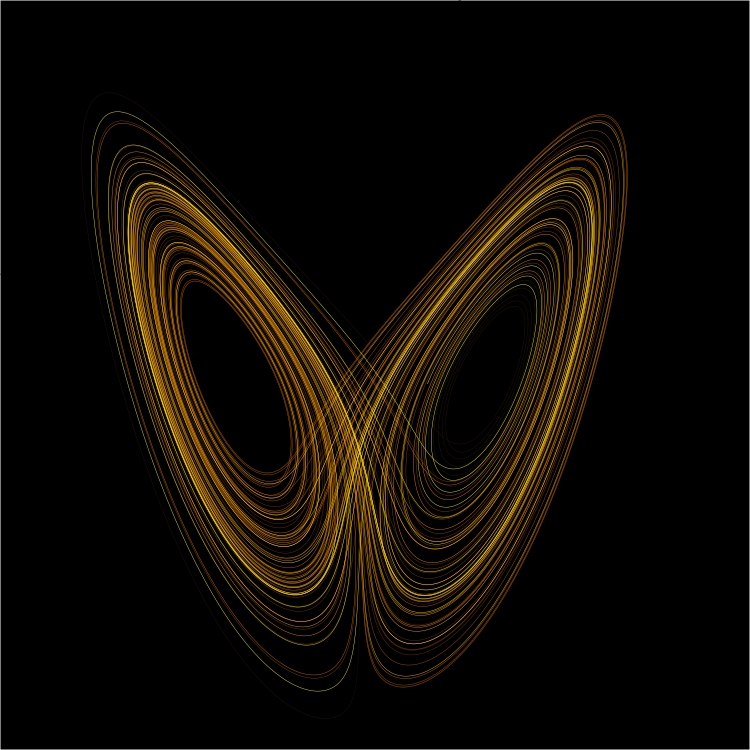
When one analyzes complex systems, sensitivity to initial conditions, for example, is not an issue as important as it is within chaos theory, in which it prevails. As stated by Colander, the study of complexity is the opposite of the study of chaos. Complexity is about how a huge number of extremely complicated and dynamic sets of relationships can generate some simple behavioral patterns, whereas chaotic behavior, in the sense of deterministic chaos, is the result of a relatively small number of non-linear interactions. For recent examples in economics and business see Stoop et al. who discussed Android's market position, Orlando who explained the corporate dynamics in terms of mutual synchronization and chaos regularization of bursts in a group of chaotically bursting cells and Orlando et al. who modelled financial data (Financial Stress Index, swap and equity, emerging and developed, corporate and government, short and long maturity) with a low-dimensional deterministic model.
Therefore, the main difference between chaotic systems and complex systems is their history. Chaotic systems do not rely on their history as complex ones do. Chaotic behavior pushes a system in equilibrium into chaotic order, which means, in other words, out of what we traditionally define as 'order'. On the other hand, complex systems evolve far from equilibrium at the edge of chaos. They evolve at a critical state built up by a history of irreversible and unexpected events, which physicist Murray Gell-Mann called "an accumulation of frozen accidents". In a sense chaotic systems can be regarded as a subset of complex systems distinguished precisely by this absence of historical dependence. Many real complex systems are, in practice and over long but finite periods, robust. However, they do possess the potential for radical qualitative change of kind whilst retaining systemic integrity. Metamorphosis serves as perhaps more than a metaphor for such transformations.
Complexity and network science
A complex system is usually composed of many components and their interactions. Such a system can be represented by a network where nodes represent the components and links represent their interactions. For example, the Internet can be represented as a network composed of nodes (computers) and links (direct connections between computers). Other examples of complex networks include social networks, financial institution interdependencies, airline networks, and biological networks.
Notable scholars
- Robert McCormick Adams
- Christopher Alexander
- Philip Anderson
- Kenneth Arrow
- Robert Axelrod
- W. Brian Arthur
- Per Bak
- Béla H. Bánáthy
- Niklas Luhmann
- Albert-Laszlo Barabasi
- Yaneer Bar-Yam
- Gregory Bateson
- Ludwig von Bertalanffy
- Alexander Bogdanov
- Samuel Bowles
- Guido Caldarelli
- Paul Cilliers
- Walter Clemens, Jr.
- James P. Crutchfield
- Chris Danforth
- Peter Sheridan Dodds
- Brian Enquist
- Joshua Epstein
- Doyne Farmer
- Jay Forrester
- Nigel R. Franks
- Murray Gell-Mann
- Carlos Gershenson
- Nigel Goldenfeld
- Vittorio Guidano
- Hermann Haken
- James Hartle
- F. A. Hayek
- Dirk Helbing
- John Holland
- Alfred Hubler
- Arthur Iberall
- Johannes Jaeger
- Stuart Kauffman
- J. A. Scott Kelso
- David Krakauer
- Simon A. Levin
- Ellen Levy
- Robert May
- Donella Meadows
- José Fernando Mendes
- Melanie Mitchell
- Cris Moore
- Yamir Moreno
- Edgar Morin
- Harold Morowitz
- Adilson E. Motter
- Scott Page
- Luciano Pietronero
- David Pines
- Vladimir Pokrovskii
- William T. Powers
- Ilya Prigogine
- Steen Rasmussen
- Sidney Redner
- Jerry Sabloff
- Cosma Shalizi
- Herbert Simon
- Dave Snowden
- Sergei Starostin
- Steven Strogatz
- Stefan Thurner
- Alessandro Vespignani
- Andreas Wagner
- Duncan Watts
- Geoffrey West
- Stephen Wolfram
- David Wolpert
- Douglas Hofstadter
- Tiago P. Peixoto
References
References
- Parker, B. R. (2013). ''Chaos in the Cosmos: the Stunning Complexity of the Universe''. Springer.
- Bekenstein, J. D. (2003). Information in the holographic universe, ''Scientific American'', ''289''(2), 58-65.
- Bar-Yam, Yaneer. (2002). "General Features of Complex Systems". Encyclopedia of Life Support Systems.
- McGinnis, Michael Dean. (1999). "Polycentricity and Local Public Economies: Readings from the Workshop in Political Theory and Policy Analysis". University of Michigan Press.
- Weaver, Warren. (1948). "Science and Complexity". American Scientist.
- Simon, Herbert A.. (1962). "The Architecture of Complexity". Proceedings of the American Philosophical Society.
- (2019). "On the 'complexity turn' in planning: An adaptive rationale to navigate spaces and times of uncertainty". Planning Theory.
- Ostrom, Elinor. (2007). "Sustainable Social-Ecological Systems: An Impossibility?". SSRN Electronic Journal.
- Alan Randall. (2011). "Risk and Precaution". Cambridge University Press.
- Pokrovskii, Vladimir. (2021). "Thermodynamics of Complex Systems: Principles and applications.". IOP Publishing, Bristol, UK..
- (2020). "Foreseeing the future of mutualistic communities beyond collapse". Ecology Letters.
- (October 2001). "Catastrophic shifts in ecosystems". Nature.
- Scheffer, Marten. (26 July 2009). "Critical transitions in nature and society". Princeton University Press.
- (September 2009). "Early-warning signals for critical transitions". Nature.
- (19 October 2012). "Anticipating Critical Transitions". Science.
- (24 July 2003). "The nested assembly of plant-animal mutualistic networks". Proceedings of the National Academy of Sciences.
- (January 2009). "A simple model of bipartite cooperation for ecological and organizational networks". Nature.
- (April 2009). "The architecture of mutualistic networks minimizes competition and increases biodiversity". Nature.
- (2014). "The sudden collapse of pollinator communities". Ecology Letters.
- A. L. Barab´asi, R. Albert. (2002). "Statistical mechanics of complex networks". Reviews of Modern Physics.
- M. Newman. (2010). "Networks: An Introduction". Oxford University Press.
- [[Daniel Dennett]] (1995), ''[[Darwin's Dangerous Idea]]'', Penguin Books, London, {{ISBN. 978-0-14-016734-4, {{ISBN. 0-14-016734-X
- (1990). "Community Food Webs: Data and Theory". Springer.
- (1984). "Community food webs have scale-invariant structure". Nature.
- (Oct 1948). "Science and Complexity". American Scientist.
- Vemuri, V.. (1978). "Modeling of Complex Systems: An Introduction". Academic Press.
- Ledford, H. (2015). "How to solve the world's biggest problems". Nature.
- "History". Santa Fe Institute.
- Waldrop, M. M. (1993). [https://archive.org/details/complexity00mmit Complexity: The emerging science at the edge of order and chaos.] Simon and Schuster.
- (2016). "The evolution of complex systems theory and the advancement of econophysics methods in the study of stock market crashes". Labuan Bulletin of International Business & Finance.
- (5 October 2021). "Nobel in physics: Climate science breakthroughs earn prize". BBC News.
- (1961). "The Death and Life of Great American Cities". Vintage Books.
- "Cities, scaling, & sustainability". Santa Fe Institute.
- (18 December 2017). "RQA correlations on real business cycles time series". Indian Academy of Sciences – Conference Series.
- (1 May 2018). "Recurrence quantification analysis of business cycles". Chaos, Solitons & Fractals.
- (2014). "Extending the theoretical framing for physics education research: An illustrative application of complexity science". Physical Review Special Topics - Physics Education Research.
- (2018-03-01). "Using Complexity and Network Concepts to Inform Healthcare Knowledge Translation". International Journal of Health Policy and Management.
- Hayles, N. K. (1991). ''[https://books.google.com/books?id=9g9QDwAAQBAJ&pg=PR7 Chaos Bound: Orderly Disorder in Contemporary Literature and Science]''. Cornell University Press, Ithaca, NY.
- [[Paul Cilliers. Cilliers, P.]] (1998). ''Complexity and Postmodernism: Understanding Complex Systems'', Routledge, London.
- [[Per Bak]] (1996). ''How Nature Works: The Science of Self-Organized Criticality'', Copernicus, New York, U.S.
- Colander, D. (2000). ''The Complexity Vision and the Teaching of Economics'', E. Elgar, Northampton, Massachusetts.
- (2022-11-18). "Exploiting deterministic features in apparently stochastic data". Scientific Reports.
- Orlando, Giuseppe. (2022-06-01). "Simulating heterogeneous corporate dynamics via the Rulkov map". Structural Change and Economic Dynamics.
- (2022-02-01). "Financial markets' deterministic aspects modeled by a low-dimensional equation". Scientific Reports.
- Buchanan, M. (2000). ''Ubiquity : Why catastrophes happen'', three river press, New-York.
- Gell-Mann, M. (1995). What is Complexity? Complexity 1/1, 16-19
- (2003). "Evolution of Networks".
- Newman, Mark. (July 2020). "Networks".
- (2016-09-06). "The price of complexity in financial networks". Proceedings of the National Academy of Sciences.
- (2004). "The architecture of complex weighted networks". Proceedings of the National Academy of Sciences.
This article was imported from Wikipedia and is available under the Creative Commons Attribution-ShareAlike 4.0 License. Content has been adapted to SurfDoc format. Original contributors can be found on the article history page.
Ask Mako anything about Complex system — get instant answers, deeper analysis, and related topics.
Research with MakoFree with your Surf account
Create a free account to save articles, ask Mako questions, and organize your research.
Sign up freeThis content may have been generated or modified by AI. CloudSurf Software LLC is not responsible for the accuracy, completeness, or reliability of AI-generated content. Always verify important information from primary sources.
Report