From Surf Wiki (app.surf) — the open knowledge base
Comparative anatomy
Study of similarities and differences in the anatomy of different species

Study of similarities and differences in the anatomy of different species
Comparative anatomy is a study of similarities and differences in the anatomy of different species. It is closely related to evolutionary biology and phylogeny (the evolution of species).
The science began in the classical era, continuing in the early modern period with work by Pierre Belon who noted the similarities of the skeletons of birds and humans.
Comparative anatomy has provided evidence of common descent, and has assisted in the classification of animals.
History
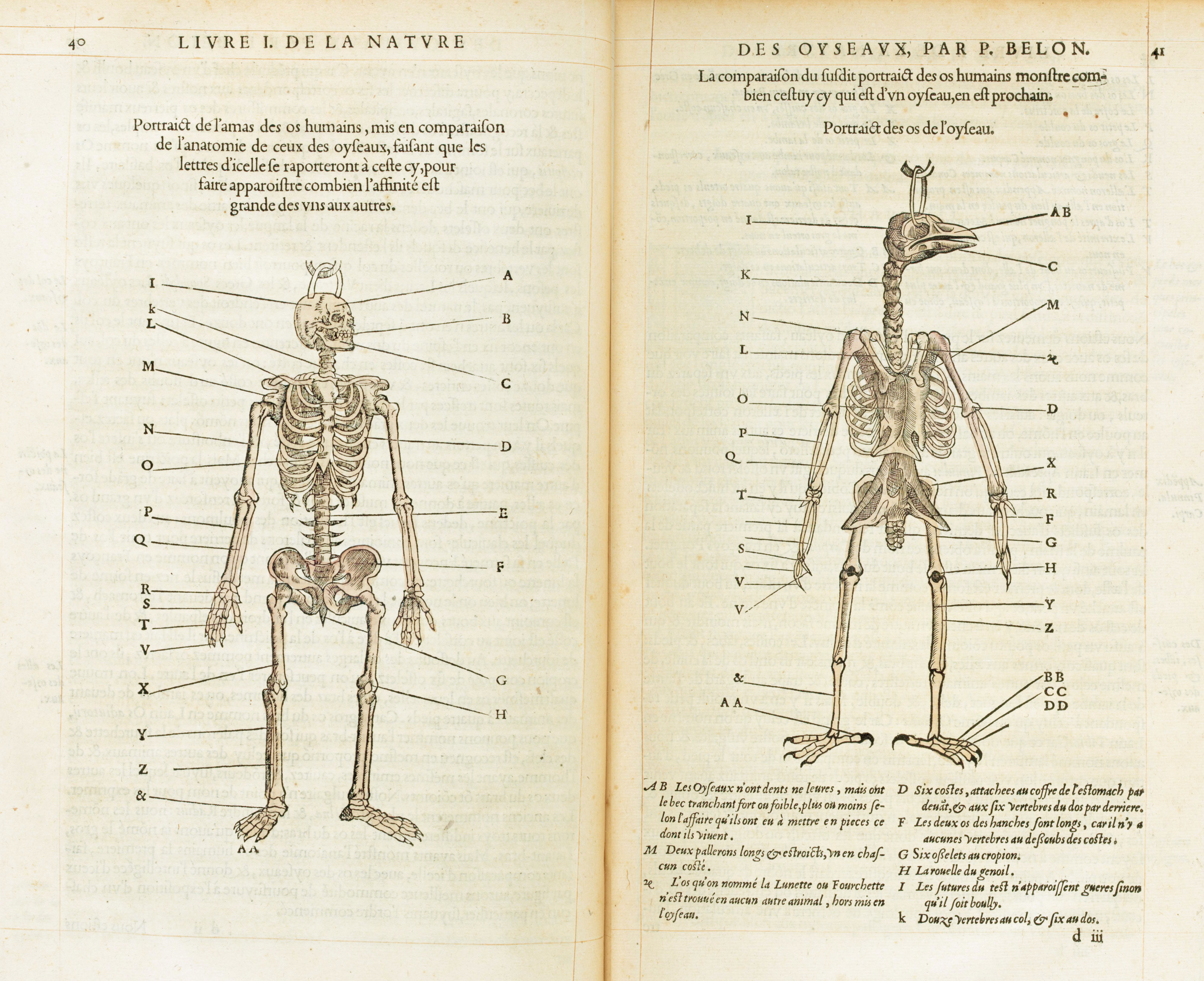
and birds compared by Pierre Belon, 1555]]
The first specifically anatomical investigation separate from a surgical or medical procedure is associated by Alcmaeon of Croton. Leonardo da Vinci made notes for a planned anatomical treatise in which he intended to compare the hands of various animals including bears. Pierre Belon, a French naturalist born in 1517, conducted research and held discussions on dolphin embryos as well as the comparisons between the skeletons of birds to the skeletons of humans. His research led to modern comparative anatomy.

Around the same time, Andreas Vesalius was also making some strides of his own. A young anatomist of Flemish descent made famous by a penchant for amazing charts, he was systematically investigating and correcting the anatomical knowledge of the Greek physician Galen. He noticed that many of Galen's observations were not even based on actual humans. Instead, they were based on other animals such as non-human apes, monkeys, and oxen. In fact, he entreated his students to do the following, in substitution for human skeletons, as cited by Edward Tyson : "If you can't happen to see any of these, dissect an Ape, carefully view each Bone, &c. ..." Then he advises what sort of Apes to make the choice of, as most resembling a Man : And conclude "One ought to know the Structure of all the Bones either in a Humane Body or in an Apes ; 'tis best in both ; and then to go to the Anatomy of the Muscles." Up until that point, Galen and his teachings had been the authority on human anatomy. The irony is that Galen himself had emphasized the fact that one should make one's own observations instead of using those of another, but this advice was lost during the numerous translations of his work. As Vesalius began to uncover these mistakes, other physicians of the time began to trust their own observations more than those of Galen. An interesting observation made by some of these physicians was the presence of homologous structures in a wide variety of animals, even including humans. These observations were later used by Darwin as he formed his theory of Natural Selection.
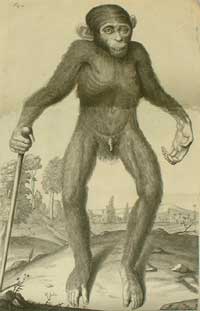
Edward Tyson is regarded as the founder of modern comparative anatomy. He is credited with determining that whales and dolphins are, in fact, mammals. Also, he concluded that chimpanzees are more similar to humans than to monkeys because of their arms. Marco Aurelio Severino also compared various animals, including birds, in his Zootomia democritaea, one of the first works of comparative anatomy. In the 18th and 19th century, great anatomists like George Cuvier, Richard Owen and Thomas Henry Huxley revolutionized our understanding of the basic build and systematics of vertebrates, laying the foundation for Charles Darwin's work on evolution. An example of a 20th-century comparative anatomist is Victor Negus, who worked on the structure and evolution of the larynx. Until the advent of genetic techniques like DNA sequencing, comparative anatomy together with embryology were the primary tools for understanding phylogeny, as exemplified by the work of Alfred Romer.
Concepts
Two major concepts of comparative anatomy are:
- Homologous structures - structures (body parts/anatomy) which are similar in different species because the species have common descent and have evolved, usually divergently, from a shared ancestor. They may or may not perform the same function. An example is the forelimb structure shared by cats and whales.
- Analogous structures - structures similar in different organisms because, in convergent evolution, they evolved in a similar environment, rather than were inherited from a recent common ancestor. They usually serve the same or similar purposes. An example is the streamlined torpedo body shape of porpoises and sharks. So even though they evolved from different ancestors, porpoises and sharks developed analogous structures as a result of their evolution in the same aquatic environment. This is known as a homoplasy.
Uses
Comparative anatomy has long served as evidence for evolution, now joined in that role by comparative genomics; it indicates that organisms share a common ancestor.
It also assists scientists in classifying organisms based on similar characteristics of their anatomical structures. A common example of comparative anatomy is the similar bone structures in forelimbs of cats, whales, bats, and humans. All of these appendages consist of the same basic parts; yet, they serve completely different functions. The skeletal parts which form a structure used for swimming, such as a fin, would not be ideal for forming a wing, which is better suited for flight. One explanation for the forelimbs' similar composition is descent with modification. Through random mutations and natural selection, each organism's anatomical structures gradually adapted to suit their respective habitats. The rules for development of special characteristics which differ significantly from general homology were listed by Karl Ernst von Baer as the laws now named after him.
References
References
- (January 2010). "Deep phylogeny--how a tree can help characterize early life on Earth". Cold Spring Harbor Perspectives in Biology.
- (22 April 1999). "Science and Creationism".
- (April 1999). "Aristotle: form, function, and comparative anatomy". The Anatomical Record.
- (1965). "Drawings from New York Collections I: The Italian Renaissance". Metropolitan Museum of Art.
- (1934). "The Five Great Naturalists of the Sixteenth Century: Belon, Rondelet, Salviani, Gesner and Aldrovandi: A Chapter in the History of Ichthyology". Isis.
- (March 2015). "Andreas Vesalius 500 years--A Renaissance that revolutionized cardiovascular knowledge". Revista Brasileira de Cirurgia Cardiovascular.
- Edward Tyson, Orang-Outang..., 1699, p. 59.
- Caldwell, Roy. (2006). "Comparative Anatomy: Andreas Vesalius". University of California Museum of Paleontology.
- (2015). "Vertebrates: Comparative Anatomy, Function, Evolution". McGraw-Hill Education.
- (November 2003). "Comparative genomics". PLOS Biology.
- (February 2002). "Biology". [[Benjamin Cummings]].
This article was imported from Wikipedia and is available under the Creative Commons Attribution-ShareAlike 4.0 License. Content has been adapted to SurfDoc format. Original contributors can be found on the article history page.
Ask Mako anything about Comparative anatomy — get instant answers, deeper analysis, and related topics.
Research with MakoFree with your Surf account
Create a free account to save articles, ask Mako questions, and organize your research.
Sign up freeThis content may have been generated or modified by AI. CloudSurf Software LLC is not responsible for the accuracy, completeness, or reliability of AI-generated content. Always verify important information from primary sources.
Report