From Surf Wiki (app.surf) — the open knowledge base
Common warthog
Wild member of the pig family

Wild member of the pig family
Tswalu Kalahari Reserve, South Africa Etosha National Park, Namibia
The common warthog (Phacochoerus africanus) is a wild member of the pig family (Suidae) found in grassland, savanna, and woodland in sub-Saharan Africa. In the past, it was commonly treated as a subspecies of P. aethiopicus, but today that scientific name is restricted to the desert warthog of northern Kenya, Somalia, and eastern Ethiopia.
Subspecies
| Image | Subspecies | Distribution | |
|---|---|---|---|
| [[File:Nolan warthog (Phacochoerus africanus africanus).jpg | 180px]] | Nolan or northern warthog (P. a. africanus) Gmelin, 1788 | Benin, Burkina Faso, Cameroon, Central African Republic, Chad, Democratic Republic of the Congo, Ethiopia, Gambia, Ghana, Guinea-Bissau, Ivory Coast, Mauritania, Nigeria, Senegal, South Sudan, Sudan, Togo |
| [[File:Warthog, Ethiopia (10115363456).jpg | 180px]] | Eritrean warthog (P. a. aeliani) Cretzschmar, 1828 | Eritrea, Ethiopia, Djibouti, Somalia |
| [[File:Warthog 06.JPG | 180px]] | Eastern or Central African warthog (P. a. massaicus) Lönnberg, 1908 | Burundi, Kenya, Rwanda, Tanzania, Uganda |
| [[File:Common warthog (Phacochoerus africanus sundevallii) female.jpg | 180px]] | Southern warthog (P. a. sundevallii) Lönnberg, 1908 | Angola, Botswana, Eswatini, Malawi, Mozambique, Namibia, South Africa, Zambia, Zimbabwe |
Description

The common warthog is a medium-sized species, with a head-and-body length ranging from 0.9 to, and shoulder height from 63.5 to. Females, at 45 to, are smaller and lighter than males, at 60 to. A warthog is identifiable by the two pairs of tusks protruding from the mouth and curving upwards. The lower pair, which is far shorter than the upper pair, becomes razor-sharp by rubbing against the upper pair every time the mouth is opened and closed. The upper canine teeth can grow to 25.5 cm long and have a wide elliptical cross section, being about 4.5 cm deep and 2.5 cm wide. A tusk will curve 90° or more from the root, and will not lie flat on a table, as it curves somewhat backwards as it grows. The tusks are not used for digging, but are used for combat with other hogs and in defense against predators – the lower set can inflict severe wounds.
Common warthog ivory is taken from the constantly growing canine teeth. The tusks, particularly the upper set, work in much the same way as elephant tusks with all designs scaled down. Tusks are carved predominantly for the tourist trade in eastern and southern Africa.
The head of the common warthog is large, with a mane down the spine to the middle of the back. Sparse hair covers the body. Its color is usually black or brown. Tails are long and end with a tuft of hair. Common warthogs do not have subcutaneous fat and the coat is sparse, making them susceptible to extreme environmental temperatures.
Ecology
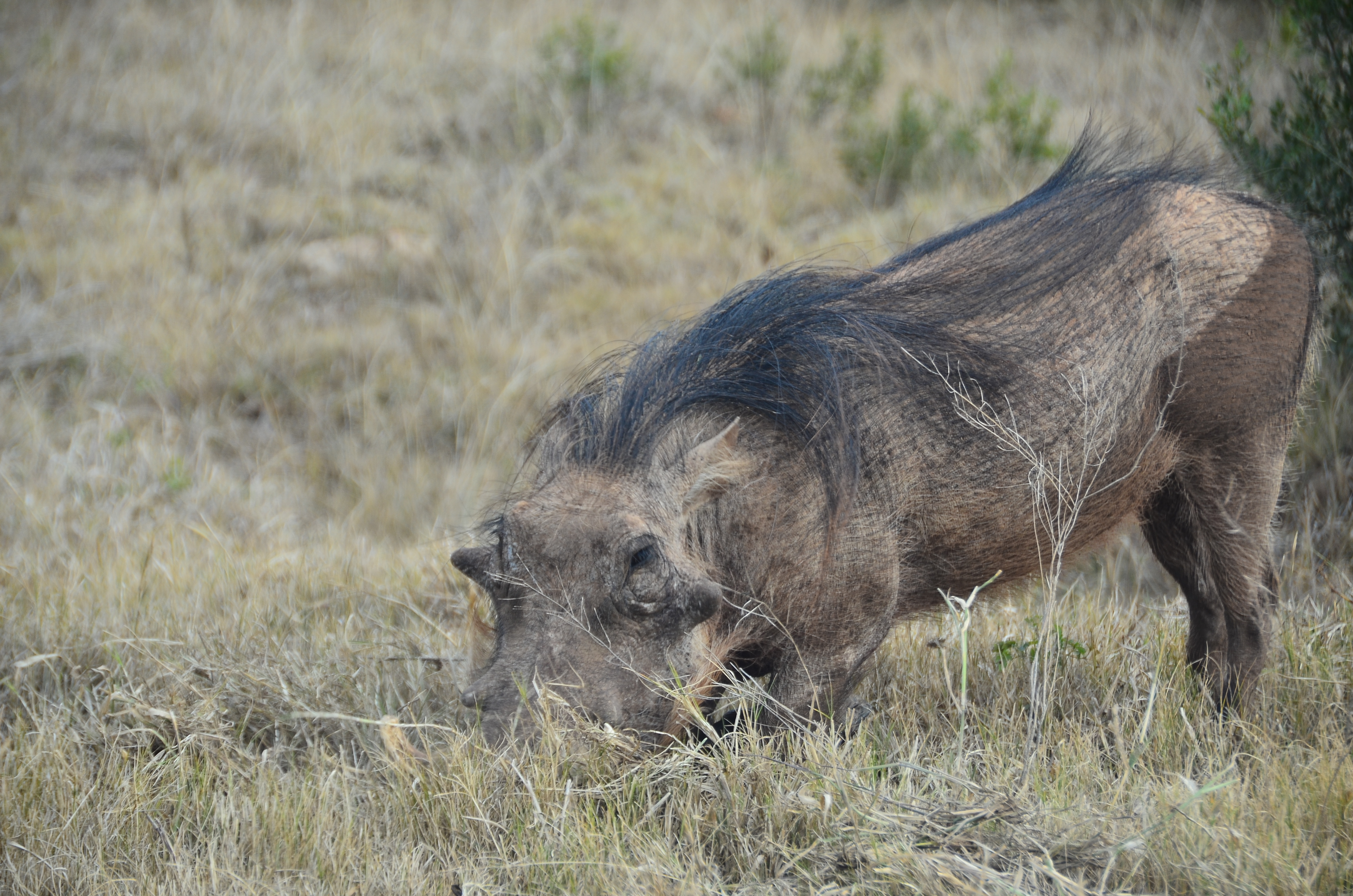

The common warthog is the only pig species that has adapted to grazing and savanna habitats. Its diet is omnivorous, composed of grasses, roots, berries and other fruits, bark, fungi, insects, eggs and carrion. The diet is seasonably variable, depending on availability of different food items. During the wet seasons, warthogs graze on short perennial grasses. During the dry seasons, they subsist on bulbs, rhizomes, and nutritious roots.
Warthogs are powerful diggers, using both their snouts and feet. When feeding, they often bend their front feet backwards and move around on the wrists. Calloused pads that protect the wrists during such movement form early in the development of the fetus. Although they can dig their own burrows, they often occupy abandoned burrows of aardvarks and other animals. The common warthog commonly reverses into burrows, with its head facing the opening and ready to burst out if necessary. Common warthogs will wallow in mud to cope with high temperatures and huddle together to cope with low temperatures.
Although capable of fighting (males fight each other during mating season), the common warthog's primary defense is to flee by means of fast sprinting. When threatened, warthogs can run at speeds of up to 48 km/h, they will run with their tails sticking up and will enter their dens rear first with tusks facing out. The common warthog's main predators are humans, lions, leopards, cheetahs, crocodiles, wild dogs and hyenas. Jackals, Verreaux's eagle owls and martial eagles sometimes prey on piglets. However, a female common warthog will defend her piglets aggressively. On occasion, common warthogs have been observed charging and even wounding large predators. Common warthogs have also been observed allowing banded mongooses and vervet monkeys to groom them to remove ticks.
Conservation status
As of 1999, the common warthog population in southern Africa was estimated to be about 250,000. Typical densities range between 1 and in protected areas, but local densities of 77 km2 were found on short grass in Nakuru National Park in Kenya. The species is susceptible to drought and hunting (especially with dogs), which may result in localized extinctions. The common warthog is present in numerous protected areas across its extensive range.
As an invasive species
In 2020, it was noted that a population of warthogs, descendants of escaped individuals from game ranches, were running free in southern Texas in the United States.
References
References
- (2016). "''Phacochoerus africanus''".
- {{MSW3|id=14200022}}
- {{MSW3
- "Common Warthog ''Phacochoerus africanus''".
- (2011). "Handbook of the Mammals of the World, Vol. 2". Lynx Edicions.
- Creel, Eileen. (2005-03-11). "Phacochoerus africanus common warthog". Animaldiversity.ummz.umich.edu.
- Estes, R. (1991). The Behavior Guide to African Mammals, Including Hoofed Mammals, Carnivores, Primates. Los Angeles, University of California Press. pp. 218–221 {{ISBN. 0520080858.
- Kleiman, D.G., Geist, V., McDade, M.C. (2004). ''Grzimek's Animal Life Encyclopedia''. The Gale Group Inc.
- Kingdon, J. (1979). East African Mammals: An Atlas of Evolution in Africa, Volume 3, Part B: Large Mammals. Chicago, University of Chicago Press. pp. 231–249.
- Unwin, Mike. (2003). "Southern African wildlife: a visitor's guide". Bradt Travel Guides.
- Vercammen, P., Mason, D.R. "[http://www.iucn.org/themes/ssc/sgs/pphsg/APchap4-2.htm Pigs, Peccaries and Hippos Status Survey and Action Plan] {{Webarchive. link. (9 May 2008 ".)
- (21 March 2017). "Facts About Warthogs".
- "Martial Eagle Kills Baby Warthog".
- ''Owls of the World'' by Konig, Weick & Becking. Yale University Press (2009), {{ISBN. 0300142277.
- [http://www.wildwatch.com/living_library/mammals-2/warthog Warthog – Africa's Jester] {{Webarchive. link. (5 April 2011 . Wildwatch.com. Retrieved 2012-08-22.)
- Maher, C. R.. (1995). "Definitions of territoriality used in the study of variation in vertebrate spacing systems". Animal Behaviour.
- (1982). "New Facial Gland in Domestic Pig". Journal of Mammalogy.
- (1992). "Roamers Stayers: A Model on Male Mating Tactics and Mating Systems". The American Naturalist.
- Jensen, S.P., Siefert, L., Okori, J.J.L., Clutlon-Brock, T.H. (1999). "Age Related Participation in Allosucking by Nursing Warthogs." ''Journal of Zoology'' London 248(4): 443–449
- Walther, F. R. (1984). ''Communication and Expression in Hoofed Mammals''. Bloomington, Indiana University Press {{ISBN. 0253313805
- Creel, Eileen. "Phacochoerus africanus (common warthog)".
- Cumming, D. H. M. (1999). ''Study on the development of Transboundary Natural Resource Management Areas in Southern Africa – Environmental Context''. Natural Resources, Land Use, and Conservation. Biodiversity Support Program. Washington, DC, USA.
- Radke, R.. (1991). "Monographie des warzenschweines (''Phacochoerus aethiopicus'')". Bongo.
- (9 May 2015). "Warthogs on the loose in Texas — African hogs likely escapees from ranches that import exotics - Texas Hunting & Fishing | Lone Star Outdoor News".
This article was imported from Wikipedia and is available under the Creative Commons Attribution-ShareAlike 4.0 License. Content has been adapted to SurfDoc format. Original contributors can be found on the article history page.
Ask Mako anything about Common warthog — get instant answers, deeper analysis, and related topics.
Research with MakoFree with your Surf account
Create a free account to save articles, ask Mako questions, and organize your research.
Sign up freeThis content may have been generated or modified by AI. CloudSurf Software LLC is not responsible for the accuracy, completeness, or reliability of AI-generated content. Always verify important information from primary sources.
Report
Social behavior and reproduction
Common warthogs are not territorial, but instead occupy a home range. Common warthogs live in groups called sounders. Females live in sounders with their young and with other females. Females tend to stay in their natal groups, while males leave, but stay within the home range. Subadult males associate in bachelor groups, but males live alone when they become adults. Adult males only join sounders with estrous females. Warthogs have two facial glands: the tusk gland and the sebaceous gland. Common warthogs of both sexes begin to mark around six to seven months old. Males tend to mark more than females. They mark sleeping and feeding areas and waterholes. Common warthogs use tusk marking for courtship, for antagonistic behaviors, and to establish status. Common warthogs (Phacochoerus africanus sundevallii) suckling.jpg|Suckling Etosha National park, Namibia female warthog with young.jpg|Female with young Etosha National park, Namibia Warthogs (Phacochoerus africanus) young males fighting.jpg|Young males fighting Tswalu Kalahari Reserve, South Africa Warthogs (Phacochoerus africanus) young males eyeballing.jpg|Young male kneels to protect throat Tswalu Kalahari Reserve, South Africa Nolan warthogs (Phacochoerus africanus africanus) juveniles drinking.jpg|P. a. africanus juveniles Senegal Warthog and Impala, Etosha, Namibia.jpg|Warthog and Impala at Etosha National Park
Reproduction Common warthogs are seasonal breeders. Rutting begins in the late rainy or early dry season and birthing begins near the start of the following rainy season. The mating system is described as "overlap promiscuity": the males have ranges overlapping several female ranges, and the daily behavior of the female is unpredictable. Boars employ two mating strategies during the rut. With the "staying tactic", a boar will stay and defend certain females or a resource valuable to them. In the "roaming tactic", boars seek out estrous sows and compete for them. Boars will wait for sows to emerge from their burrows. A dominant boar will displace any other boar that also tries to court his female. When a sow leaves her den, the boar will try to demonstrate his dominance and then follow her before copulation. For the "staying tactic", monogamy, female-defense polygyny, or resource-defense polygyny is promoted, while the "roaming tactic" promotes scramble-competition polygyny.
The typical gestation period is five to six months. When they are about to give birth, sows temporarily leave their families to farrow in a separate hole. The litter is two to eight piglets, with two to four typical. The sow will stay in the burrow for several weeks, nursing her piglets. Common warthog sows have been observed to nurse foster piglets if they lose their own litter. This behavior, known as allosucking, makes them cooperative breeders. Allosucking does not seem to be a case of mistaken identity or milk theft, and may be a sign of kin altruism. Piglets begin grazing at about two to three weeks and are weaned by six months. Piglets quickly attain mobility and stay close to their mothers for defense. Common warthogs live for an average of 7 to 11 years in the wild. Captive specimens on the other hand can live for an average of 21 years.