From Surf Wiki (app.surf) — the open knowledge base
Common ethanol fuel mixtures
Mixtures of common ethanol fuel types
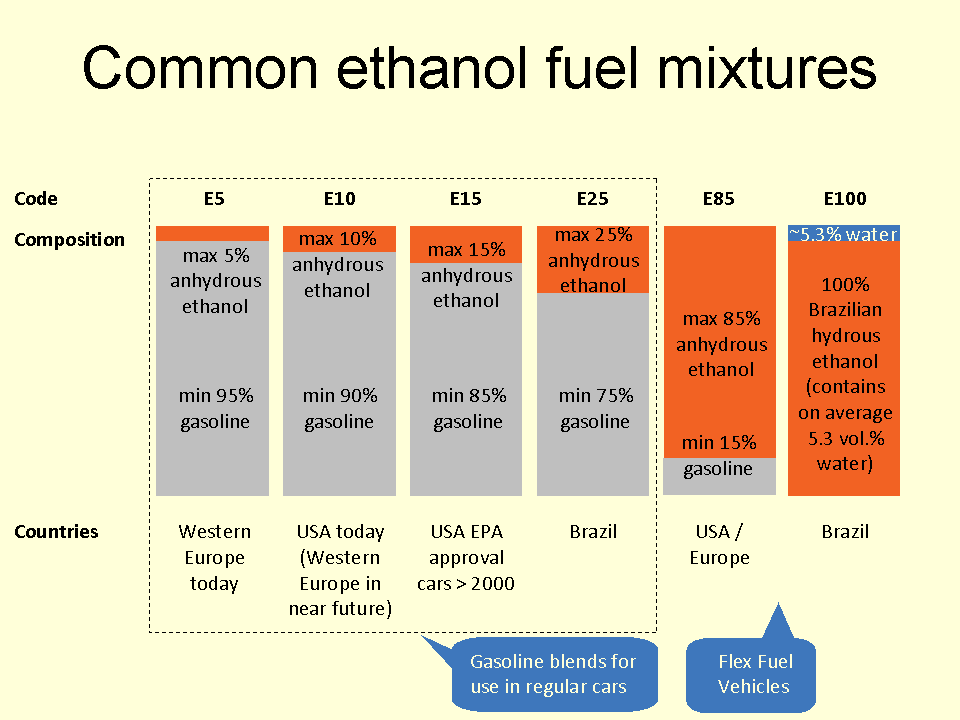
Mixtures of common ethanol fuel types
Several common ethanol fuel mixtures are in use around the world. The use of pure hydrous or anhydrous ethanol in internal combustion engines (ICEs) is only possible if the engines are designed or modified for that purpose, and used only in automobiles, light-duty trucks and motorcycles. Anhydrous ethanol can be blended with :gasoline (petrol) for use in gasoline engines, but with high ethanol content only after engine modifications to meter increased fuel volume since pure ethanol contains only 2/3 of the BTUs of an equivalent volume of pure gasoline. High percentage ethanol mixtures are used in some racing engine applications as the very high octane rating of ethanol is compatible with very high compression ratios.
Ethanol fuel mixtures have "E" numbers which describe the percentage of ethanol fuel in the mixture by volume, for example, E85 is 85% anhydrous ethanol and 15% gasoline. Low-ethanol blends are typically from E5 to E25, although internationally the most common use of the term refers to the E10 blend.
Blends of E10 or less are used in more than 20 countries around the world, led by the United States, where ethanol represented 10% of the U.S. gasoline fuel supply in 2011. Blends from E20 to E25 have been used in Brazil since the late 1970s. E85 is commonly used in the U.S. and Europe for flexible-fuel vehicles. Hydrous ethanol or E100 is used in Brazilian neat ethanol vehicles and flex-fuel light vehicles and hydrous E15 called hE15 for modern petrol cars in the Netherlands.
E10 or less==

E10, a fuel mixture of 10% anhydrous ethanol and 90% gasoline sometimes called gasohol, can be used in the internal combustion engines of most modern automobiles and light-duty vehicles without need for any modification on the engine or fuel system. E10 blends are typically rated as being 2 to 3 octane numbers higher than regular gasoline and are approved for use in all new U.S. automobiles, and mandated in some areas for emissions and other reasons.
Other common blends include E5 and E7. These concentrations are generally safe for recent engines that should run on pure gasoline. As of 2006, mandates for blending bioethanol into vehicle fuels had been enacted in at least 36 states/provinces and 17 countries at the national level, with most mandates requiring a blend of 10 to 15% ethanol with gasoline.
One measure of alternative fuels in the U.S. is the "gasoline-equivalent gallon" (GEG). In 2002, the U.S. used as motor fuel, ethanol equal to 137000 TJ, the energy equivalent of 1.13 e9USgal of gasoline. This was less than 1% of the total fuel used that year.
E10 and other blends of ethanol are considered to be useful in decreasing U.S. dependence on foreign oil, and can reduce carbon monoxide (CO) emissions by 20 to 30% under the right conditions. Although E10 does decrease emissions of CO and greenhouse gases such as CO2 by an estimated 2% over regular gasoline, it can cause increases in evaporative emissions and some pollutants depending on factors such as the age of the vehicle and weather conditions. According to the Philippine Department of Energy, the use of up to 10% ethanol-gasoline mixture is not harmful to cars' fuel systems. Generally, automobile gasoline containing alcohol (ethanol or methanol) is not recommended to be used in aircraft.
Availability
- E10 became the standard fuel at petrol stations in the United Kingdom as of September 2021.
- E10 was introduced nationwide in Thailand in 2007, and replaced 91 octane pure gasoline in that country in 2013.
- E10 is commonly available in the Midwestern United States. It was also mandated for use in all standard automobile fuel in the state of Florida by the end of 2010. Due to the phasing out of MTBE as a gasoline additive and mainly due to the mandates established in the Energy Policy Act of 2005 and the Energy Independence and Security Act of 2007, ethanol blends have increased throughout the United States, and by 2009, the ethanol market share in the U.S. gasoline supply reached almost 8% by volume.
- Mandatory blending of ethanol was approved in Mozambique, but the percentage in the blend has not been specified.
- South Africa approved a biofuel strategy in 2007, and mandated an 8% blend of ethanol by 2013.
- A 2007 Uruguayan law mandates a minimum of 5% of ethanol blended with gasoline starting in January 2015. The monopolic, state-owned fuel producer ANCAP started blending premium gasoline with 10% of bioethanol in December 2009, which will be available in all the country by early January 2010.
- The Dominican Republic has a mandate for blending 15% of ethanol by 2015.
- Chile is considering the introduction of E5, and Panama, Bolivia and Venezuela of E10.
- India achieved the target of 10 percent ethanol blending, 5 months ahead of schedule, in June 2022.
- From January 2018, all 92-octane fuel in Vietnam is mandated to contain 5 percent ethanol (E5). No ethanol blending is required for 95-octane fuel.
- From June 2021, Argentina approved an E12 minimum (Law 27640), and after October 2022 a waiver for a maximum of E15.
| Low ethanol blends used around the world (E5 to E25) | Country | Ethanol | ||||||||||||
|---|---|---|---|---|---|---|---|---|---|---|---|---|---|---|
| blend | Legal use | Country | Ethanol | |||||||||||
| blend | Legal use | Country | Ethanol | |||||||||||
| blend | Legal use | State | Ethanol | |||||||||||
| blend | State | Ethanol | ||||||||||||
| blend | ||||||||||||||
| Countries with mandatory blends or available for optional use | European Union | United States | ||||||||||||
| (states where mandatory only) | ||||||||||||||
| Argentina | Mandated | Mexico | Mandated{{#tag:ref | Started in late 2011 in Guadalajara. Scheduled for Monterrey and Mexico City in 2012. | group="n"}} | Austria | Optional | Florida | Minnesota | |||||
| Australia | Optional | New Zealand | Optional | Denmark | Optional | Hawaii | Missouri | |||||||
| Brazil | Mandated | Pakistan | Optional | Finland | Mandated | Iowa | Montana | |||||||
| Canada | Mandated | Paraguay | Mandated | France | Optional | Kansas | Oregon | |||||||
| China | Nine provinces | Peru | Mandated | Germany | Optional | Louisiana | Washington | |||||||
| Colombia | Mandated | Philippines | Mandated | Ireland | Mandated | California | ||||||||
| Costa Rica | Mandated | Thailand | Mandated | Netherlands | Optional | |||||||||
| India | Mandated | Vietnam | Optional | Romania | Mandated | |||||||||
| Jamaica | MandatedSince November 1, 2008 became available in some cities and will become mandatory in May 2009. | Zimbabwe | Mandated | Sweden | Mandated | |||||||||
| Malawi | Mandated | Uruguay | Mandated |
A 2011 study conducted by VTT Technical Research Centre of Finland found practically no difference in fuel consumption in normal driving conditions between commercial gasoline grades 95E10 and 98E5 sold in Finland, despite the public perception that fuel consumption is significantly higher with 95E10. VTT performed the comparison test under controlled laboratory conditions and their measurements showed that over a distance of 100 km, the cars tested used an average of 10.30 l of 95E10, as opposed to 10.23 l of 98E5. The difference was 0.07 in favor of 98E5 on average, meaning that using 95E10 gasoline, which has a higher ethanol content, increases consumption by 0.7%. When the measurements are normalized, the difference becomes 1.0%, a result that is highly consistent with an estimation of calorific values based on approximate fuel composition, which came out at 1.1% in favour of E5.
Sweden
| Year | Gasoline | Diesel | Jet kerosene |
|---|---|---|---|
| 2020 | 4.2 | 21 | - |
| 2021 | 6.0 | ||
| (1 Aug) | 26 | ||
| (1 Aug) | 0.8 | ||
| (1 July) | |||
| 2022 | 7.8 | 30.5 | 1.7 |
| 2023 | 10.1 | ||
| 7.8 ** | 35 | ||
| 30.5 ** | 2.6 | ||
| 2024 | 12.5 | ||
| 6* | 40 | ||
| 6* | 3.5 | ||
| 2025 | 15.5 | ||
| 6* | 45 | ||
| 6* | 4.5 | ||
| 2026 | 19 | ||
| 6* | 50 | ||
| 6* | 7.2 | ||
| 2027 | 22 * | 54 * | 10.8 |
| 2028 | 24 * | 58 * | 15.3 |
| 2029 | 26 * | 62 * | 20.7 |
| 2030 | 28 * | 66 * | 27 |
| *) The reduction was reduced to the EU minimum level (6 percent for petrol and diesel) according to a bill by the Kristersson Cabinet in 2023. | |||
| **)Further reduction was paused during 2023 based on a bill by the Andersson Cabinet. |
In Sweden, all 95-octane gasoline is E10 (6 to 10 percent of ethanol) since 1 August 2021, when the proportion of ethanol was increased from E5. In the early-mid-1990s, some fuel chains also sold E10. All newer and many older petrol cars bought in Sweden should handle this, since from January 2011, the Fuel Quality Directive (Directive 2009/30/EC) applied through its transposition into the law of Sweden as a member of the 27 member states of the EU.
E15

E15 contains 15% ethanol and 85% gasoline. This is generally the highest ratio of ethanol to gasoline that is possible to use in vehicles recommended by some auto manufacturers to run on E10 in the US. This is due to ethanol's hydrophilia and solvent power.
As a result of the Energy Independence and Security Act of 2007, which mandates an increase in renewable fuels for the transport sector, the U.S. Department of Energy began assessments for the feasibility of using intermediate ethanol blends in the existing vehicle fleet as a way to allow higher consumption of ethanol fuel. The National Renewable Energy Laboratory (NREL) conducted tests to evaluate the potential impacts of intermediate ethanol blends on legacy vehicles and other engines. In a preliminary report released in October 2008, the NREL presented the results of the first evaluations of the effects of E10, E15 and E20 gasoline blends on tailpipe and evaporative emissions, catalyst and engine durability, vehicle driveability, engine operability, and vehicle and engine materials. This preliminary report found none of the vehicles displayed a malfunction indicator light as a result of the ethanol blend used; no fuel filter plugging symptoms were observed; no cold start problems were observed at 24 C and 10 C laboratory conditions; and as expected, computer technology available in newer model vehicles adapts to the higher octane causing lower emissions with greater horsepower and in some cases greater fuel economy.
Other sources make the opposite claim about fuel economy. According to Consumer Reports, "ethanol isn’t as energy-dense as regular gasoline so you will see worse fuel economy with E15 gas.”
In March 2009, a lobbying group from the ethanol industry, Growth Energy, formally requested the U.S. Environmental Protection Agency (EPA) to allow the ethanol content in gasoline to be increased from 10% to 15%. Organizations doing such studies included the Energy Department, the State of Minnesota, the Renewable Fuels Association, the Rochester Institute of Technology, the Minnesota Center for Automotive Research, and Stockholm University in Sweden.

In October 2010, the EPA granted a waiver to allow up to 15% of ethanol blended with gasoline to be sold only for cars and light pickup trucks with a model year of 2007 or later, representing about 15% of vehicles on U.S. roads.{{cite news|url=http://content.usatoday.com/communities/driveon/post/2010/10/epa-to-allow-15-ethanol-in-gasoline-up-from-10-now-/1?POE=click-refer|title=EPA allows 15% ethanol in gasoline, but only for late-model cars
The EPA waiver authorizes sale of E15 only from Sep 15 to May 31 out of a black hose and a yellow hose to flex fuel vehicles only from June 1 to Sep 14. Retailers have shunned building infrastructure due to the costly regulatory requirements which have created a practical barrier to the commercialization of the higher blend. Most fuel stations do not have enough pumps to offer the new blend, few existing pumps are certified to dispense E15, and no dedicated tanks are readily available to store E15. Also, some state and federal regulations would have to change before E15 can be legally sold. The National Association of Convenience Stores, which represents most gasoline retailers, considers the potential for actual E15 demand is small, "because the auto industry is not embracing the fuel and is not adjusting their warranties or recommendations for the fuel type." One possible solution to the infrastructure barriers is the introduction of blender pumps that allow consumers to turn a dial to select the level of ethanol, which would also allow owners of flexible-fuel cars to buy E85 fuel.
In June 2011 EPA, in cooperation with the Federal Trade Commission, issued its final ruling regarding the E15 warning label required to be displayed in all E15 fuel dispensers in the U.S. to inform consumers about what vehicles can, and what vehicles and equipment cannot, use the E15 blend. Both the Alliance of Automobile Manufacturers and the National Petrochemical and Refiners Association complained that relying solely on this warning label is not enough to protect consumers from misfueling. In July 2012, a fueling station in Lawrence, Kansas became the first in the U.S. to sell the E15 blend. The fuel is sold through a blender pump that allows customers to choose between E10, E15, E30 or E85, with the latter blends sold only to flexible-fuel vehicles. , there are about 24 fueling stations selling E15 out of 180,000 stations across the U.S.

In December 2010, several groups, including the Alliance of Automobile Manufacturers, the American Petroleum Institute, the Association of International Automobile Manufacturers, the National Marine Manufacturers Association, the Outdoor Power Equipment Institute, and the Grocery Manufacturers Association, filed suit against the EPA in the United States Court of Appeals for the District of Columbia Circuit. The plaintiffs argued the EPA does not have the authority to issue a “partial waiver” that covers some cars and not others. Among other arguments, the groups argued that the higher ethanol blend is not only a problem for cars, but also for fuel pumps and underground tanks not designed for the E15 mixture. It was also argued that the rise in ethanol has contributed to the big jump in corn prices in recent years. In June 2013 the U.S. Supreme Court declined to hear an appeal from industry groups opposed to the EPA ruling about E15, and let the 2012 federal appeals court ruling stand.

, sales of E15 are not authorized in California, and according to the California Air Resources Board (CARB), the blend is still awaiting approval, and in a public statement the agency said that "it would take several years to complete the vehicle testing and rule development necessary to introduce a new transportation fuel into California's market."
According to a survey conducted by the American Automobile Association (AAA) in 2012, only about 12 million out of the more than 240 million light-duty vehicles on the U.S. roads in 2012 are approved by manufacturers are fully compliant with E15 gasoline. According with the association, BMW, Chrysler, Nissan, Toyota, and Volkswagen warned that their warranties will not cover E15-related damage. Also Porsches built since 2001 are approved by its manufacturer to use E15. Volkswagen announced that for the 2014 model year, its entire lineup will be E15 capable. Fiat Chrysler Automobiles announced in August 2015 that all 2016 model year Chrysler/Fiat, Jeep, Dodge and Ram vehicles will be E15 compatible.
In November 2013, the Environmental Protection Agency opened for public comment its proposal to reduce the amount of ethanol required in the U.S. gasoline supply as mandated by the Energy Independence and Security Act of 2007. The agency cited problems with increasing the blend of ethanol above 10%. This limit, known as the "blend wall," refers to the practical difficulty in incorporating increasing amounts of ethanol into the transportation fuel supply at volumes exceeding those achieved by the sale of nearly all gasoline as E10.{{cite news|url=https://www.nytimes.com/2013/11/16/us/for-first-time-epa-proposes-reducing-ethanol-requirement-for-gas-mix.html|title=For First Time, E.P.A. Proposes Reducing Ethanol Requirement for Gas Mix
hE15

A 15% hydrous ethanol and 85% gasoline blend, hE15, has been introduced at public gas stations in the Netherlands since 2008. Ethanol fuel specifications worldwide traditionally dictate use of anhydrous ethanol (less than 1% water) for gasoline blending. This results in additional costs, energy usage and environmental impacts associated with the extra processing step required to dehydrate the hydrous ethanol produced via distillation (3.5-4.9 vol.% water) to meet the current anhydrous ethanol specifications. A patented discovery reveals hydrous ethanol can be effectively used in most ethanol/gasoline blending applications.
According to the Brazilian Agência Nacional do Petróleo (ANP) specification, hydrous ethanol contains up to 4.9 vol.% water. In hE15, this would be up to 0.74 vol.% water in the overall mixture. Japanese and German scientific evidence revealed the water is an inhibitor for corrosion by ethanol.
The experiments show that water in fuel ethanol inhibits dry corrosion. At 10,000 ppm water in the E50 experiments by JARI and 3,500 ppm water in the E20 experiments by TU Darmstadt the alcoholate/alkoxide corrosion stopped. In the fuel ethanol this resembles 20,000 ppm or 2 volume% in the case of JARI and 5 x 3500 = 17,500 ppm of 1.75 volume% in the case of TU Darmstadt. The observations are in line with the fact that hydrous ethanol is known for being less corrosive than anhydrous ethanol. The reaction mechanism Al(OEt)3 +3/2H2 --will be the same at lower-mid blends. When enough water is present in the fuel, the aluminum will react preferably with water to produce aluminum oxide, repairing the protective aluminum oxide layer, which is why the corrosion stops. The aluminum alcoholate/alkoxide does not make a tight oxide layer, which is why the corrosion continues. In other words, water is essential to repair the holes in the oxide layer. Based on the Japanese/German results, a minimum of 2 vol.% or 2.52% m/m water is currently proposed in the revision of the hydrous ethanol specification for blending in petrol at E10+ levels. Water injection has additional positive effects on the engine performance (thermodynamic efficiency) and reduces overall CO2 emissions.

Overall, a transition from anhydrous to hydrous ethanol for gasoline blending is expected to make a significant contribution to ethanol's cost-competitiveness, fuel cycle net energy balance, air quality, and greenhouse gas emissions.
The level of blending above 10% (V/V) is chosen both from a technical (safety) perspective and to distinguish the product in Europe from regular unleaded petrol for reasons of taxes and customer clarity. Small-scale tests have shown many vehicles with modern engine types can run smoothly on this hydrous ethanol blend. Mixed tanking scenarios with anhydrous ethanol blends at 5% or 10% level do not induce phase separation. As avoiding mixing with E0, in particular at extremely low temperatures, in logistic systems and engines is not recommended, a separate specification for controlled usage is presented in a Netherlands Technical Agreement NTA 8115. The NTA 8115 is written for a worldwide application in trading and fuel blending.
{{anchor|E20|E25}} E20, E25
| Historical evolution | ||||
|---|---|---|---|---|
| of ethanol blends used in Brazil | ||||
| 1931–2015 (Selected years only) | Year | Ethanol | ||
| blend | Year | Ethanol | ||
| blend | ||||
| 1931 | E5 | |||
| 1966 | E25 | |||
| 1976 | E11 | |||
| 1978 | E18-20-23 | |||
| 1981 | E20-12-20 | |||
| 1987-88 | E22 | |||
| 1993-98 | E22 | |||
| 2000 | E20 | |||
| 2001 | E22 | |||
| 2003 | E20-25 | |||
| Source: 1937–2007, J.A. Puerto Rico (2007), Table 3.8, pp. 81–82 | ||||
| Note: The 2010 reduction from E25 to E20 was temporary and took | ||||
| place between February and April. The lower limit was reduced | ||||
| from 20% to 18% in April 2011. |
E20 contains 20% ethanol and 80% gasoline, while E25 contains 25% ethanol. These blends have been widely used in Brazil since the late 1970s. As a response to the 1973 oil crisis, the Brazilian government made mandatory the blend of ethanol fuel with gasoline, fluctuating between 10% and 22% from 1976 until 1992. Due to this mandatory minimum gasoline blend, pure gasoline (E0) is no longer sold in Brazil. A federal law was passed in October 1993 establishing a mandatory blend of 22% anhydrous ethanol (E22) in the entire country. This law also authorized the Executive to set different percentages of ethanol within pre-established boundaries, and since 2003, these limits were fixed at a maximum of 25% (E25) and a minimum of 20% (E20) by volume. Since then, the government has set the percentage on the ethanol blend according to the results of the sugarcane harvest and ethanol production from sugarcane, resulting in blend variations even within the same year.
Since July 1, 2007, the mandatory blend was set at 25% of anhydrous ethanol (E25) by executive decree, and this has been the standard gasoline blend sold throughout Brazil most of the time as of 2011. However, as a result of a supply shortage and the resulting high ethanol fuel prices, in 2010, the government mandated a temporary 90-day blend reduction from E25 to E20 beginning February 1, 2010. As prices rose abruptly again due to supply shortages that took place again between the 2010 and 2011 harvest seasons, some ethanol had to be imported from the United States, and in April 2011, the government reduced the minimum mandatory blend to 18%, leaving the mandatory blend range between E18 and E25.

All Brazilian automakers have adapted their gasoline engines to run smoothly with this range of mixtures, thus, all gasoline vehicles are built to run with blends from E20 to E25, defined by local law as "common gasoline type C". Some vehicles might work properly with lower concentrations of ethanol, but with a few exceptions, they are unable to run smoothly with pure gasoline, which causes engine knocking, as vehicles traveling to neighboring South American countries have demonstrated. Flex-fuel vehicles, which can run on any type of gasoline E20-E25 up to 100% hydrous ethanol (E100 or hydrated ethanol) ratios, were first available in mid-2003. In July 2008, 86% of all new light vehicles sold in Brazil were flexible-fuel, and only two carmakers build models with a flex-fuel engine optimized to operate with pure gasoline (E0): Renault with the models Clio, Symbol, Logan, Sandero and Mégane, and Fiat with the Siena Tetrafuel.
Thailand introduced E20 in 2008, but shortages in ethanol supplies by mid-2008 caused a delay in the expansion of the E20 fueling station network in the country. By mid-2010, 161 fueling stations were selling E20, and sales have risen 80% since April 2009. The rapid growth in E20 demand is because most vehicle models launched since 2009 were E20-compatible, and sales of E20 are expected to grow faster once more local automakers start producing small, E20-compatible, fuel-efficient cars. The Thai government is promoting ethanol usage through subsidies, as ethanol costs four baht (about 12 US cents) a litre more than gasoline.
A state law approved in Minnesota in 2005 mandated that ethanol comprise 20% of all gasoline sold in this American state beginning in 2013. Successful tests have been conducted to determine the performance under E20 by current vehicles and fuel dispensing equipment designed for E10. However, this mandate was later delayed to 2015, and has never taken effect because the federal EPA has yet to authorize the use of E20 as a replacement for gasoline.
A study commissioned by BP and published in September 2013, concluded that the use of advanced biofuels in the UK, and particularly E20 cellulosic ethanol, is a more cost-effective way of reducing emissions than using plug-in electric vehicles (PEVs) in the timeframe to 2030. The study also found that the use of higher blends of biofuels is complementary to hybrid electric vehicles (HEVs) and plug-in hybrids (PHEVs). Battery electric vehicles (BEVs) can deliver strong CO2 savings with a decarbonised electric grid, but are expected to have significantly higher costs than internal combustion engine vehicles and hybrid cars to 2030, as the latter are expected to be the most popular models by 2030. According to the study, in 2030 an E20 blend in an HEV can achieve a 10% emission savings compared to an HEV running on E5, for an annual fuel cost premium of compared to an annual cost of for an all-electric car.
E70, E75
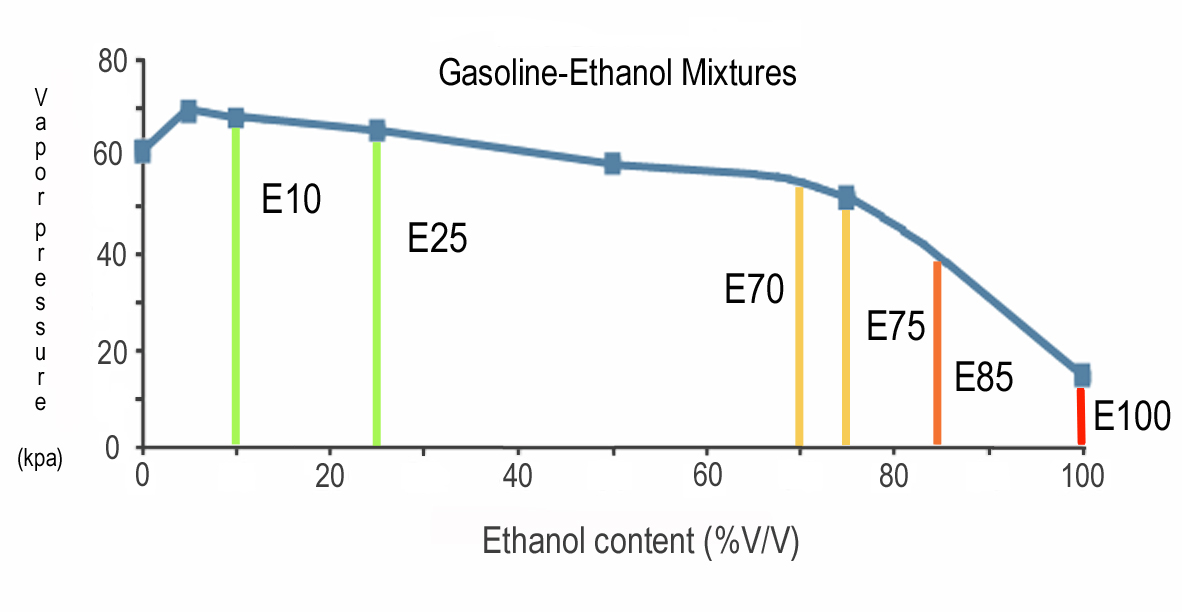
E70 contains 70% ethanol and 30% gasoline, while E75 contains 75% ethanol. These winter blends are used in the United States and Sweden for E85 flexible-fuel vehicles during the cold weather, but still sold at the pump labeled as E85. The seasonal reduction of the ethanol content to an E85 winter blend is mandated to avoid cold starting problems at low temperatures.
In the US, this seasonal reduction of the ethanol content to E70 applies only in cold regions, where temperatures fall below 32 F during the winter.{{cite book|publisher=Energy Conversion Engineering Conference and Exhibit, 2000. (IECEC) 35th Intersociety
For temperatures below -15 C, all E85 flex vehicles require an engine block heater to avoid cold starting problems.
E85

E85, a mixture of 85% ethanol and ~15% gasoline, is generally the highest ethanol fuel mixture found in the United States and several European countries, particularly in Sweden, as this blend is the standard fuel for flexible-fuel vehicles. This mixture has an octane rating of 108, however, the Ethanol molecule also carries with it an oxygen atom, where-as gasoline does not, effectively requiring the internal combustion engine to ingest less air per unit-volume by its own accord, which reduces pumping losses, and further increases the exo-thermic chemical reaction. Ethanol fuel is considered – although not widely known as – a form of "chemical supercharging", similar to that of Nitrous Oxide (N2O) & Nitromethane (CH3NO2).

The 85% limit in the ethanol content was set to reduce ethanol emissions at low temperatures and to avoid cold starting problems during cold weather, at temperatures lower than 11 C. A further reduction in the ethanol content is used during the winter in regions where temperatures fall below 0 C and this blend is called Winter E85, as the fuel is still sold under the E85 label. A winter blend of E70 is mandated in some regions in the US, while Sweden mandates E75. Some regions in the United States now allow E51 (51% ethanol, 49% gasoline) to be sold as E85 in the winter months.
As of October 2010, nearly 3,000 E85 fuel pumps were in Europe, led by Sweden with 1,699 filling stations. The United States had 3,354 public E85 fuel pumps located in 2,154 cities by August 2014, mostly concentrated in the Midwest.
Thailand introduced E85 fuel by the end of 2008, and by mid-2010, only four E85 filling stations were available, with plans to expand to 15 stations by 2012.
A major restriction hampering sales of E85 flex vehicles or fuelling with E85, is the limited infrastructure available to sell E85 to the public, as by 2014 only 2 percent of motor fuel stations offered E85, , there were only 3,218 gasoline fueling stations selling E85 to the public in the entire U.S., while about 156,000 retail motor fuel outlets do not offer the E85 blend. The number of E85 grew from 1,229 in 2007 to 2,442 in 2011, but only increased by 7% from 2011 to 2013, when the total reached 2,625. The main constraint for a more rapid expansion of E85 availability is that it requires dedicated storage tanks at filling stations, at an estimated cost of for each dedicated ethanol tank. A study conducted by the U.S. Department of Energy concluded that every service station in America could be converted to handle E85 at a cost of $3.4 billion to $10.1 billion.
ED95
ED95 designates a blend of 95% ethanol and 5% ignition improver; it is used in modified diesel engines where high compression is used to ignite the fuel, as opposed to the operation of gasoline engines, where spark plugs are used. This fuel was developed by Swedish ethanol producer SEKAB. Because of the high ignition temperatures of pure ethanol, the addition of ignition improver is necessary for successful diesel engine operation. A diesel engine running on ethanol also has a higher compression ratio and an adapted fuel system.

This fuel has been used with success in many Swedish Scania buses since 1985, which has produced around 700 ethanol buses, more than 600 of them to Swedish cities, and more recently has also delivered ethanol buses for commercial service in Great Britain, Spain, Italy, Belgium, and Norway.
As of 2010, the Swedish ED95 engine is in its third generation and already has complied with Euro 5 emission standards, without any kind of post-treatment of the exhaust gases. The ethanol-powered engine is also being certified as environmentally enhanced vehicle (EEV) in the Stockholm municipality. The EEV rule still has no date to enter into force in Europe and is stricter than the Euro 5 standard.
Nottingham became the first city in England to operate a regular bus service with ethanol-fuelled vehicles. Three ED95 single-deck buses entered regular service in the city in March 2008. Soon after, Reading also introduced ED95 double-deck buses.
Under the auspices of the BioEthanol for Sustainable Transport project, more than 138 bioethanol ED95 buses were part of demonstration trial at four cities, three in Europe, and one in Brazil, between 2006 and 2009. In Brazil, the first Scania ED95 bus with a modified diesel engine was introduced as a trial in São Paulo city in December 2007, and since November 2009, two ED95 buses were in regular service. The Brazilian trial project ran for three years and performance and emissions were monitored by the National Reference Center on Biomass (CENBIO- ) at the Universidade de São Paulo.
In November 2010, the municipal government of São Paulo city signed an agreement with UNICA, Cosan, Scania and Viação Metropolitana, a local bus operator, to introduced a fleet of 50 ethanol-powered ED95 buses by May 2011. Scania manufactures the bus engine and chassis in its plant located in São Bernardo do Campo, São Paulo, using the same technology and fuel as the ED95 buses already operating in Stockholm. The bus body is a Brazilian CAIO. The first ethanol-powered buses were delivered in May 2011, and the 50 buses will start regular service in June 2011 in the southern region of São Paulo. The 50 ED95 buses had a cost of R$ 20 million () and due to the higher cost of the ED95 fuel and the lower energy content of ethanol as compared to diesel, one of the firms participating in the cooperation agreement, Raísen (a joint venture between Royal Dutch Shell and Cosan), supplies the fuel to the municipality at 70% of the market price of regular diesel.
E100


E100 is pure ethanol fuel. Straight hydrous ethanol as an automotive fuel has been widely used in Brazil since the late 1970s for neat ethanol vehicles and more recently for flexible-fuel vehicles. The ethanol fuel used in Brazil is distilled close to the azeotrope mixture of 95.63% ethanol and 4.37% water (by weight) which is approximately 3.5% water by volume. | url-status = dead | archive-url = https://web.archive.org/web/20110608142735/http://ts.nist.gov/MeasurementServices/ReferenceMaterials/upload/1828.pdf | archive-date = 2011-06-08 The azeotrope is the highest concentration of ethanol that can be achieved by simple fractional distillation. The maximum water concentration according to the Agência Nacional do Petróleo (ANP) specification is 4.9 vol.% (approximately 6.1 weight%) The E nomenclature is not adopted in Brazil, but hydrated ethanol can be tagged as E100, meaning it does not have any gasoline, because the water content is not an additive, but rather a residue from the distillation process. However, straight hydrous ethanol is also called E95 by some authors.
The first commercial vehicle capable of running on pure ethanol was the Ford Model T, produced from 1908 through 1927. It was fitted with a carburetor with adjustable jetting, allowing use of gasoline or ethanol, or a combination of both. At that time, other car manufacturers also provided engines for ethanol fuel use. Thereafter, and as a response to the 1973 and 1979 energy crises, the first modern vehicle capable of running with pure hydrous ethanol (E100) was launched in the Brazilian market, the Fiat 147, after testing with several prototypes developed by the Brazilian subsidiaries of Fiat, Volkswagen, General Motors and Ford. , there were 1.1 million neat ethanol vehicles still in use in Brazil. Since 2003, Brazilian newer flex-fuel vehicles are capable of running on pure hydrous ethanol (E100) or blended with any combination of E20 to E27.5 gasoline (a mixture made with anhydrous ethanol), the national mandatory blend. , there were 17.1 million flexible-fuel vehicles running on Brazilian roads.
E100 imposes a limitation on normal vehicle operation, as ethanol's lower evaporative pressure (as compared to gasoline) causes problems when cold starting the engine at temperatures below 15 C. An improved flex-fuel engine generation was developed to eliminate the need for the secondary gas tank by warming the ethanol fuel during starting, and allowing them to start at temperatures as low as -5 C, the lowest temperature expected anywhere in the Brazilian territory. The Polo E-Flex, launched in March 2009, was the first flex-fuel model without an auxiliary tank for cold start. The warming system, called Flex Start, was developed by Robert Bosch GmbH.
Swedish carmakers have developed ethanol-only capable engines for the new Saab Aero X BioPower 100 Concept E100, with a V6 engine which is fuelled entirely by E100 bioethanol, and the limited edition of the Koenigsegg CCXR, a version of the CCX converted to use E85 or E100, as well as standard 98-octane gasoline, and currently the fastest and most powerful flex-fuel vehicle with its twin-supercharged V8 producing 1018 hp when running on biofuel, as compared to 806 hp on 91-octane unleaded gasoline.
The higher fuel efficiency of E100 (compared to methanol) in high performance race cars resulted in Indianapolis 500 races in 2007 and 2008 being run on 100% fuel-grade ethanol.
Use limitations
Modifications to engines
The use of ethanol blends in conventional gasoline vehicles is restricted to low mixtures, as ethanol-gasoline is corrosive and can degrade some of the materials in the engine and fuel system. Also, the engine has to be adjusted for a higher compression ratio as compared to a pure gasoline engine to take advantage of ethanol's higher oxygen content, thus allowing an improvement in fuel efficiency and a reduction of tailpipe emissions.
| Ethanol | ||||||||
|---|---|---|---|---|---|---|---|---|
| blend | Carburetor | Fuel Injection | Fuel pump | Fuel | ||||
| pressure | ||||||||
| device | Fuel filter | Ignition system | Evaporative | |||||
| system | Fuel | |||||||
| tank | Catalytic converter | Basic | ||||||
| engine | Motor oil | Intake | ||||||
| manifold | Exhaust system | Cold | ||||||
| start | ||||||||
| system | ||||||||
| ≤ 5% | ||||||||
| E5 to E10 | ||||||||
| E10 to E25 | ||||||||
| E25 to E85 | ||||||||
| E85 to E100 | ||||||||
Disadvantages to ethanol fuel blends when used in engines designed exclusively for gasoline include lowered fuel mileage, metal corrosion, deterioration of plastic and rubber fuel system components, clogged fuel systems, fuel injectors, and carburetors, delamination of composite fuel tanks, varnish buildup on engine parts, damaged or destroyed internal engine components, water absorption, fuel phase separation, and shortened fuel storage life. Many major auto, marine, motorcycle, lawn equipment, generator, and other internal combustion engine manufacturers have issued warnings and precautions about the use of ethanol-blended gasolines of any type in their engines, and the Federal Aviation Administration and major aviation engine manufacturers have prohibited the use of automotive gasolines blended with ethanol in light aircraft due to safety issues from fuel system and engine damage.
Other disadvantages
Combustion of ethanol gives some acetaldehyde, which is an irritant. Ethanol is not miscible with gasoline at low temperatures, e.g. in cold regions of the planet. It is also leads to deposits.
Notes
References
References
- Renewable Fuels Association. (2012-03-06). "Accelerating Industry Innovation - 2012 Ethanol Industry Outlook". [[Renewable Fuels Association]].
- [http://www.drivingethanol.org/ethanol_in_vehicles/e10.aspx E10: Every vehicle's ethanol blend], drivingethanol.org. {{webarchive. link. (May 12, 2008)
- (2009-10-16). "Towards Sustainable Production and Use of Resources: Assessing Biofuels". [[United Nations Environment Programme]] See Table 3.3.
- "U.S. Energy Information Administration (EIA)".
- [http://www.eere.energy.gov/afdc/pdfs/37135.pdf Low-Level Ethanol Fuel Blends], Clean Cities fact sheet, April 2005.
- [http://www.eere.energy.gov/afdc/vehicles/emissions_e10.html E10 Emissions], [[U.S. Department of Energy]].
- "AF/Bioethanol.htm Bioethanol". Doe.gov.ph.
- (October 27, 2006). "Special Airworthiness Information Bulletin CE-07-06".
- "Fuelling a greener future – E10 petrol available at pumps from today".
- (October 5, 2012). "New Year to see end of 91-octane petrol". The Nation.
- [http://www.eere.energy.gov/afdc/progs/ind_state_laws.php/FL/ETH Florida E85 Laws and Incentives] {{webarchive. link. (2008-08-07 , [[U.S. Department of Energy]].)
- (2010-04-10). "Bioenergy: Background - Ethanol". [[U.S. Department of Agriculture]].
- [http://www.seco.cpa.state.tx.us/re_ethanol_mtbe.htm MTBE & Ethanol] {{Webarchive. link. (2007-06-13 , State of Texas Energy Conservation Office.)
- link. (2011-07-27 - Parliament of Uruguay.)
- [http://www.elpais.com.uy/091218/pecono-460656/economia/ancap-planea-llevar-de-2-a-5-mezcla-con-biodiesel Ancap planea llevar de 2% a 5% mezcla con biodiesel] - Diario El País, December 12, 2009 {{in lang. es
- (2022-06-05). "India has achieved the target of 10 percent ethanol blending, 5 months ahead of schedule".
- [https://baochinhphu.vn/ngung-ban-xang-ron-92-tren-toan-quoc-tu-nam-2018-102226888.htm Ngừng bán xăng RON 92 trên toàn quốc từ năm 2018] - Báo Điện Tử Chính Phủ, September 12, 2017 {{in lang. vi
- "BOLETIN OFICIAL REPUBLICA ARGENTINA - MARCO REGULATORIO DE BIOCOMBUSTIBLES - Ley 27640".
- "Argentina.gob.ar".
- "State Legislation". Ethanol.org.
- Kate Galbraith. (2008-07-26). "In Gas-Powered World, Ethanol Stirs Complaints". The New York Times.
- (2010-11-26). "Situación del Mercado de Etanol en Argentina". Más Producción.com.
- (2011). "Technology Roadmaps: Biofuels for Transport". [[International Energy Agency]].
- El Universal (Mexico City). (2010-10-14). "Pemex adquirirá etanol para usarlo como combustible en Guadalajara". Informador.com.mx.
- AIT/FIA Information Centre (OTA). (2007). "Sale of biofuels around the world". Motormannen.
- (2006-04-12). "Shell Unleaded E10 Launched". Shell Australia.
- Datamonitor. (2008-08-12). "Gull New Zealand Launches New 91 Octane Biofuel". redOrbit.
- PSO. (2009-08-19). "PSO Launches 'E10 Gasoline' in Karachi". PSO.
- "New 95 E10 petrol introduced in Finland".
- (2010-09-01). "Government of Canada Releases Final Regulations for Renewable Fuel Content in Gasoline". Environmental Canada.
- Souto, Guillermo. (2008). "Paraguay explora su potencial en biocombustibles". COMUN IICA.
- (2011-01-17). "Le nouveau super carburant SP95-E10". Department of Ecology, Sustainable Development, Transportation and Housing.
- (2009-02-06). "SP95 E10 : le point sur le nouveau carburant distribué en France". Moto-Net.com.
- "Oregon Biofuel renewable fuel standard". Oregon.gov.
- (2007-06-27). "China Fuel Ethanol Production Projected to Increase 12% in 2007". Green Car Congress.
- Rothkopf, Garten. (2007). "A Blueprint for Green Energy in the Americas". [[Inter-American Development Bank]], Washington, D.C..
- Agencia Peruana de Noticias. (2011-07-15). "Producción peruana de etanol para gasohol crecería a más del doble en el último trimestre". [[América Economía]].
- (2010-12-30). "E10 coming to pumps in Germany 1 January". [[Green Car Congress]].
- Gloria Rey. (2007-10-12). "Energy-Colombia: Harvesting Sunshine for Biofuels".
- (September 2010). "A rodar con alcohol carburante". Diario Occidente.
- "Ethanol Around the World". Biofuels Association of Australia.
- "Ireland adopts mandatory ethanol blend". English.unica.com.br.
- (2012-03-16). "California Statistics and Data on Ethanol and E85 as Transportation Fuels". State of California.
- Mercedes Agüero. (2009-03-04). "Recope obligada a guardar etanol por atraso del Minaet". [[La Nación (Costa Rica).
- Mercedes Agüero. (2009-03-04). "Gasolineros estarían listos para vender mezcla en noviembre". [[La Nación (Costa Rica).
- Jairo Villegas. (2010-07-14). "Recope descarta plan de etanol a corto plazo". [[La Nación (Costa Rica).
- Jairo Villegas. (2011-04-07). "Recope pretende extender uso de etanol a todo el país". [[La Nación (Costa Rica).
- (2008-08-07). "E10, E20 market share up to 48 percent in Thailand, state oil CEO says production should increase". Biofuels Digest.
- (26 November 2019). "MINISTRY OF ROAD TRANSPORT AND HIGHWAYS NOTIFICATION".
- Kingsman. (2009-08-18). "Kingsman EU ETBE/Ethanol Report".
- (2008-11-05). "E10 Blend Projected to save Jamaica US 92 million on fuel imports". Jamaica Information Service.
- (2021-05-12). "Petrol Blend now at E20". [[Zimbabwe Energy Regulatory Authority]].
- "E10 - Transportstyrelsen".
- Mitchell, Donald. (2011). "Biofuels in Africa: Opportunities, Prospects, and Challenges". [[The World Bank]], Washington, D.C..
- "Gobierno evalúa aumentar mezcla de etanol en nafta y retomar uso de biodiesel en gasoil".
- "ANCAP - Súper 95".
- (2011-06-06). "VTT study finds no significant difference in car fuel consumption between E10 and E5". [[Green Car Congress]].
- "Swedish law "Reduktionsplikten" (2017:1201) on reduction of greenhouse gas emissions from certain fossil fuels {{!}} Lagen.nu".
- "Greenhouse gas reduction mandate".
- The [[Tidö Agreement]].
- "E10 - list of car model compatibility".
- (8 August 2013). "Vehicle compatibility with new (E10/B7) fuel standards".
- (2008-09-16). "Moving to E15 would help extend the fuel supply in the wake of the hurricanes". American Coalition for Ethanol.
- "How do I tell if my vehicle is an Flexible Fuel Vehicle (FFV)?". E85.
- (2008-10-07). "Preliminary Test Report Shows No Significant Change in Vehicle Emissions from Intermediate Ethanol Blends". Green Car Congress.
- (2008). "Effects of Intermediate Ethanol Blends on Legacy Vehicles and Small Non-Road Engines, Report 1". [[Oak Ridge National Laboratory]] and [[National Renewable Energy Laboratory]].
- "Can Using Gas With 15 Percent Ethanol Damage Your Car?". Consumer Reports, Inc..
- Jensen, Christopher. (2010-06-18). "E.P.A. Delays Ruling on Increasing Ethanol Content in Gasoline". The New York Times.
- Matthew L. Wald. (2010-10-13). "A Bit More Ethanol in the Gas Tank". [[The New York Times]].
- John O'Dell. (2010-11-19). "EPA Postpones Ruling on Expanded E15 Use, Says Testing Not Completed". [[Edmunds.com]].
- (2011-01-21). "US EPA extends E15 fuel waiver to MY 2001–2006 light-duty vehicles". [[Green Car Congress]].
- Matthew L. Wald. (2011-01-21). "E.P.A. Approves Use of More Ethanol in Gasoline". The New York Times.
- Jim Motavalli. (2011-06-28). "E.P.A.'s E15 Pump Labels Raise Ire of Automakers". The New York Times.
- Eric Loveday. (2011-06-29). "Attention! EPA releases finalized E15 warning label". [[AutoblogGreen]].
- Matthew L. Wald. (2012-07-11). "In Kansas, Stronger Mix of Ethanol". The New York Times.
- Matthew L. Wald. (2010-12-20). "Engine Makers Sue to Block E15 Fuel". The New York Times.
- David Shepardson. (2012-08-17). "U.S. court rejects auto industry challenge to E15". [[The Detroit News]].
- Sara Forden. (2012-08-17). "EPA Defeats Challenge To Higher Ethanol Levels In Fuel". Bloomberg News.
- David Sheparson. (2013-06-24). "Court declines to hear challenge to EPA's stance on E15 gasoline". The Detroit News.
- Jon LeSage. (2012-11-14). "CARB: It will take years for California to decide on E15". [[Autoblog Green]].
- Susanne Retka Schill. (2012-10-17). "GM, Ford announce E15 compatibility with new models". Ethanol Producer Magazine.
- Michael Green. (2012-11-30). "New E15 Gasoline May Damage Vehicles and Cause Consumer Confusion". [[American Automobile Association]].
- VW US Media Room. (2013-07-14). "Volkswagen of America bringing in downsized 1.8L EA888 engine to displace 2.5L; all vehicles E15 capable". [[Green Car Congress]].
- (2015-08-18). "FCA approving use of E15 in MY 2016 vehicles". [[Green Car Congress]].
- EPA. "EPA Proposes 2014 Renewable Fuel Standards, 2015 Biomass-Based Diesel Volume". U.S. Environmental Protection Agency (EPA).
- (2006-12-28). "Motorfuel based on gasoline and ethanol". [[World Intellectual Property Organization]].
- (2008-07-30). "Gasoline C made with Hydrous Ethanol in Brazil". Delphi South America Technical Center – Brazil.
- (2005). "SAE Technical Paper Series". SAE.
- "HE Blends website". HE Blends BV.
- "Netherlands Technical agreement NTA 8115 "Automotive fuels - Hydrous ethanol as a blending component for petrol – Requirement and test methods"". NEN.
- (2010-01-12). "Portaria No. 7 de 11 de Janeiro de 2010 do Ministério de Estado da Agricultura, Pecuária e Abastecimento e Resolução No. 1 do Conselho Interministeriarl do Açúcar e do Álcool". Diário Oficial da União.
- (2011-04-28). "Dilma assina medida que dá poder à ANP para regular etanol".
- Julieta Andrea Puerto Rico. (2008-05-08). "Programa de Biocombustíveis no Brasil e na Colômbia: uma análise da implantação, resultados e perspectivas". [[Universidade de São Paulo]].
- "Lei Nº 8.723, de 28 de Outubro de 1993. Dispõe sobre a redução de emissão de poluentes por veículos automotores e dá outras providências". Casa Civil da Presidência da República.
- "Portaria Nº 143, de 27 de Junho de 2007". Ministério da Agricultura, Pecuária e Abastecimento.
- Manoela Alcântara. "Mistura de álcool anidro à gasolina vai subir de 23% para 25%, anuncia Stephanes". Agência Brasil.
- (2010-01-11). "Governo reduz mistura de etanol na gasolina para 20%".
- Hugo Cilo. (2011-04-29). "A gasolina vai matar a indústria do etanol". [[ISTOÉ]] Dinheiro.
- "Glossário ANP:G (Glossary: Letter G)". Agência Nacional do Petróleo, Gás Natural e Biocombustíveis.
- Líria Alves. "Classificação e qualidade da Gasolina". Brasil Escola.
- Bob Sharp. "Receita caseira para rodar fora do país sem problemas ao abastecer". Revista Quatro Rodas.
- "Onda dos flex pode gerar desequilíbrio com a gasolina".
- A.C. Bispo. (2008-07-19). "Clio Hi-Flex impressiona pelo desempenho". Parana Online.
- Christine Lepisto. (2006-08-27). "Fiat Siena Tetra Power: Your Choice of Four Fuels". Treehugger.
- (2007-11-01). "Nouvelle Fiat Siena 2008: sans complexe". Caradisiac.
- Xavier Navarro. (2008-01-04). "Happy New Fuel: E20 on sale in Thailand". AutoblogGreen.
- Yuthana Praiwan. (2008-09-26). "Shell delays E20 on supply concerns". [[Bangkok Post]].
- Cindy Zimmerman. (2008-03-05). "E20 Passes Minnesota Testing". Domestic Fuel.
- Faye Sunderland. (2013-09-23). "Advanced biofuels could cut GHG emissions for less than electric cars". The Green Car Website (UK).
- Element Energy Limited. (2013-09-16). "The Role of Biofuels Beyond 2020". Element Energy.
- (January 2008). "Sustainable biofuels: prospects and challenges". The Royal Society.
- Gregory W. Davis. (2001-06-11). "Development of Technologies to Improve Cold Start Performance of Ethanol Vehicles: Final Report". State of Michigan.
- (2007-02-27). "When is E85 not 85 percent ethanol? When it's E70 with an E85 sticker on it". AutoblogGreen.
- (23 September 2008). "Ethanol fuel and cars". Interesting Energy Facts.
- Vägverket (Swedish Road Administration). (2007-05-30). "Swedish comments on Euro 5/6 comitology version 4, 30 May 2007: Cold Temperature Tests For Flex Fuel Vehicles". European Commission.
- "FAQs: Do ethanol cars really start when it is cold outside?". SEKAB.
- (2007). "Sustainable Ethanol: Biofuels, Biorefineries, Cellulosic Biomass, Flex-Fuel Vehicles, and Sustainable Farming for Energy Independence". Prairie Oak Publishing, Maryville, Missouri.
- "Ont om tankställen utanför Sverige? (Short of filling stations outside Sweden?)". ethanol.nu.
- "Search E85 stations". korridor.se.
- "3,354 Total E85 Stations in the United States". E85prices.com.
- (2010-06-18). "PTT widens E85 availability, prepares for boom in E20". [[Bangkok Post]].
- (2011-05-05). "Obama's fuel-efficiency push may lead fleets to use more gasoline". [[Automotive News]].
- "E85 Prices".
- (2014-03-07). "E85 fueling station availability is increasing". [[U.S. Energy Information Administration]].
- Glen Hess. (2007-09-17). "Renewable Fuels Face Bumpy Road".
- "ED95". [[SEKAB]].
- (2010-06-21). "Scania Delivering 85 New Ethanol Buses for Stockholm Fleet". [[Green Car Congress]].
- "Biofuel in Sweden". [[SEKAB]].
- (2010). "Ethanol Usage in Urban Public Transportation - Presentation of Results". Brazilian Reference Center on Biomass (CENBIO).
- Brian Warshaw. (2008-03-21). "England receives ethanol buses". Ethanol Producer Magazine.
- BEST. (2009). "Buses: 138 buses in five places". BEST Europe.
- BEST Cities and Regions. (2009). "BioEthanol for Sustainable Transport: Results and recommendations from the European BEST project". Environmental and Health Administration, City of Stockholm.
- (2008-01-31). "São Paulo joins EU's BEST project with pure ethanol bus trial; over 400 in operation so far". Biopact.
- "Começa a circular em São Paulo ônibus movido a etanol". Estado de São Paulo.
- (2007-12-23). "Sao Paulo Puts Ethanol Bus into Service in BEST Project". Green Car Congress.
- (2010-06-25). "O bom exemplo da Suécia:600 ônibus movidos com etanol para o transporte público de Estocolmo". [[UNICA, Brazil]].
- (2010-11-25). "São Paulo terá primeira frota de ônibus movida a etanol". [[Terra Networks]].
- (2010-11-29). "São Paulo putting 50 Scania ethanol buses into service". [[Green Car Congress]].
- Martha San Juan França. (2011-05-26). "São Paulo ganha frota de ônibus a etanol". Brasil Econômico.
- (2011-05-26). "Substituição de diesel por etanol: vantagem que novos ônibus trazem à cidade de São Paulo". [[UNICA, Brazil.
- (2006-01-24). "How to Beat the High Cost of Gasoline. Forever!".
- Agência Nacional do Petróleo, Gás Natural e Biocombustíveis (ANP). (2005-12-06). "Resolução ANP Nº 36, Delaware 6.12.2005 - DOU 7.12.2005". ANP.
- Márcia Azanha Ferraz Dias de Moraes. "Reflections on Brazil's Ethanol Industry". Ministério de Relações Exteriores (Brazil).
- "Fuels of the Future". ThinkQuest.
- Hunt, V, D, The Gasohol Handbook, Industrial Press Inc., 1981, pp 9, 420,421, 442
- English, Andrew. (2008-07-25). "Ford Model T reaches 100". [[The Daily Telegraph.
- "Ethanol: Introduction". Journey to Forever.
- William Lemos. (2007-02-05). "The Brazilian ethanol model". ICIS news.
- Revista Veja. (1979-06-13). "O petróleo da cana". [[Editora Abril]].
- UNICA, Brazil. (October 2012). "Frota brasileira de autoveículos leves (ciclo Otto)". UNICA Data.
- João Gabriel de Lima. (2006-02-01). "A riqueza é o saber".
- Ron Kotrba. (March 2008). "Cold Start 101". Ethanol Producer Magazine.
- (August 2008). "Here comes the 'Flex' vehicles third generation". Revista Brasileira de BioEnergia.
- Agência Estado. (2008-06-10). "[Bosch] investe na segunda geração do motor flex". Gazeta do Povo.
- Priscila Dal Poggetto. (2008-03-13). "Nova tecnologia dispensa gasolina na partida de carros bicombustíveis". Globo G1.
- Marli Olmos. (2007-11-26). "Partida a Frio Chega com a Linha 2009". Automotive Business.
- Quatro Rodas. (March 2009). "Volkswagen Polo E-Flex". [[Editora Abril]].
- (2009-03-12). "Volks lança sistema que elimina tanquinho de gasolina para partida a frio". UNICA.
- "Saab BioPower Aero X". [[Saab Automobile.
- Bill Siuru. "Saab BioPower 100 Concept E100 Ethanol Vehicle". GreenCar.com.
- Peter Grunet. (2007-03-05). "Green Flash". [[Top Gear Magazine]].
- (2008-02-27). "Geneva Preview: Koenigsegg CCX & CCXR Edition Models". Zimbio.
- Timothy Charles Holms. (2008-05-27). "Indianapolis 500 continues E100 use". Ethanol Producer Magazine.
- (January 2008). "The Vehicle Adaptation to Ethanol Fuel". The Royal Society.
- Joseph (2007) in [[The Royal Society]] (2008), "''Sustainable biofuels: prospects and challenges'', pp. 35-36".
- ''Is fuel with an increased level of ethanol a problem for small gas engines?'', Tools & Power Equipment, Consumer Reports, 24 June 2009
- Vatalaro, Michael,''[http://www.boatus.com/news/e10_0706.htm A Serious Problem - A Corny Solution]'', Boat US Magazine, (July 2006)
- Maloney, William,''[http://www.williammaloney.com/Misc/EthanolProsConsDrawbacks.htm Ethanol Pros & Cons in Automotive Gas]'', retrieved 8 August 2011
- "Manufacturer E10 (Ethanol) Fuel Recommendations". Fuel Testers.
- ''[http://www.eaa.org/autofuel/autogas/test_kit.asp FAA to STC Holders: No Ethanol in Auto Fuel] {{webarchive. link. (2011-09-26 '', EAA, retrieved 8 August 2011)
- (2013). "Wood Sulphate turpentine as a Gasoline Bio-component". Fuel.
This article was imported from Wikipedia and is available under the Creative Commons Attribution-ShareAlike 4.0 License. Content has been adapted to SurfDoc format. Original contributors can be found on the article history page.
Ask Mako anything about Common ethanol fuel mixtures — get instant answers, deeper analysis, and related topics.
Research with MakoFree with your Surf account
Create a free account to save articles, ask Mako questions, and organize your research.
Sign up freeThis content may have been generated or modified by AI. CloudSurf Software LLC is not responsible for the accuracy, completeness, or reliability of AI-generated content. Always verify important information from primary sources.
Report