From Surf Wiki (app.surf) — the open knowledge base
Comet dust
Cosmic dust that originates from a comet
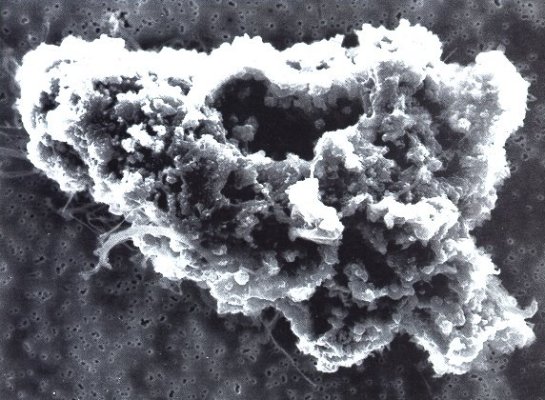
Cosmic dust that originates from a comet
Comet dust is cosmic dust that originates from a comet. Comet dust can provide clues to comets' origin. When the Earth passes through a comet dust trail, it can produce a meteor shower.
Physical characteristics
Size
The majority of dust from comet activity is sub-micrometer to roughly micrometer in size. However, this fraction is short-lived, as radiation pressure causes them to blow out of the Solar System or spiral inwards.
The next size class is large, "fluffy" or "cluster-type" aggregates of the above grains. These are typically 20-100 micrometers, a size not arbitrary but observed as the porous aggregates tend to fracture or compact.
Larger particles are micrometeoroids, not dust. In the absence of a definition from the IAU, groups devised their own definitions of dust: smaller than 100 micrometers, 50, 40, 30, and 20 microns, and
The IAU released a formal statement in 2017. Meteoroids are 30 micrometers to 1 meter, dust is smaller, and the term "micrometeoroid" is discouraged (though not micrometeorite). The IMO noted the new definition, but still displays a prior definition on their site. The Meteoritical Society site retains its prior definition, 0.001 cm. The AMS has posted no rigorous definition.
Composition
Dust is generally chondritic in composition. Its monomers contain mafic silicates, such as olivine and pyroxene. Silicates are rich in high-condensation temperature forsterite and enstatite. As these condense quickly, they tend to form very small particles, not merging droplets.
As with chondritic meteoroids, particles contain Fe(Ni) sulfide and GEMS (glass with embedded metal and sulfides)
Various amounts of organics (CHON) are present. Though organics are cosmically abundant, and were widely predicted to exist in comets, they are spectrally indistinct in most telescopes. Organics were only confirmed via mass spectrometry during the Halley flybys. Some organics are in the form of PAHs (Polycyclic Aromatic Hydrocarbons).
Very small inclusions of presolar grains (PSGs) may be found.
Dust and comet origin
The models for the origin of comets are:
- the interstellar model,
- the Solar System model,
- primordial rubble piles,
- aggregation of planetesimals in the dust disk around the Uranus–Neptune region,
- cold shells of material swept out by the protostellar wind. Bulk properties of the comet dust such as density as well as the chemical composition can distinguish between the models. For example, the isotopic ratios of comet and of interstellar dust are very similar, indicating a common origin.
The 1) interstellar model says that ices formed on dust grains in the dense cloud that preceded the Sun. The mix of ice and dust then aggregated into a comet without appreciable chemical modification. J. Mayo Greenberg first proposed this idea in the 1970s.
In the 2) Solar System model, the ices that formed in the interstellar cloud first vaporized as part of the accretion disk of gas and dust around the protosun. The vaporized ices later resolidified and assembled into comets. So the comets in this model would have a different composition than those comets that were made directly from interstellar ice.
The 3) primordial rubble pile model for comet formation says that comets agglomerate in the region where Jupiter was forming.
Stardust's discovery of crystalline silicates in the dust of comet Wild 2 implies that the dust formed above glass temperature ( 1000 K) in the inner disk region around a hot young star, and was radially mixed in the solar nebula from the inner regions a larger distance from the star or the dust particle condensed in the outflow of evolved red giants or supergiants. The composition of the dust of comet Wild 2 is similar to the composition of dust found in the outer regions of the accretion disks around newly-forming stars.
A comet and its dust allow investigation of the Solar System beyond the main planetary orbits. Comets are distinguished by their orbits; long period comets have long elliptical orbits, randomly inclined to the plane of the Solar System, and with periods greater than 200 years. Short period comets are usually inclined less than 30 degrees to the plane of the Solar System, revolve around the Sun in the same counterclockwise direction as the planets orbit, and have periods less than 200 years.
A comet will experience a range of diverse conditions as it traverses its orbit. For long period comets, most of the time it will be so far from the Sun that it will be too cold for evaporation of ices to occur. When it passes through the terrestrial planet region, evaporation will be rapid enough to blow away small grains, but the largest grains may resist entrainment and stay behind on the comet nucleus, beginning the formation of a dust layer. Near the Sun, the heating and evaporation rate will be so great, that no dust can be retained. Therefore, the thickness of dust layers covering the nuclei of a comet can indicate how closely and how often a comet's perihelion travels are to the Sun. If a comet has an accumulation of thick dust layers, it may have frequent perihelion passages that don't approach the Sun too closely.
A thick accumulation of dust layers might be a good description of all of the short period comets, as dust layers with thicknesses on the order of meters are thought to have accumulated on the surfaces of short-period comet nuclei. The accumulation of dust layers over time would change the physical character of the short-period comet. A dust layer both inhibits the heating of the cometary ices by the Sun (the dust is impenetrable by sunlight and a poor conductor of heat), and slows the loss of gases from the nucleus below. A comet nucleus in an orbit typical of short period comets would quickly decrease its evaporation rate to the point that neither a coma or a tail would be detectable and might appear to astronomers as a low-albedo near-Earth asteroid.
Further assemblages and bodies
Main article: Accretion (astrophysics)
Dust particles, aided by ices and organics, form "aggregates" (less often, "agglomerates") of 30 to hundreds of micrometers. These are fluffy, due to the imperfect packing of cluster-type (large) dust particles, and their subsequent, imperfect packing into aggregates.
The next size category is pebbles, of millimeters to centimeters scale. Pebbles were inferred at 103P/Hartley 2, and imaged directly at 67P/Churyumov-Gerasimenko. Astrophysical use of the word "pebble" differs from its geological meaning. In turn, the next-larger geological term, "cobble," has been skipped by Rosetta scientists.
Even larger bodies are "boulders" (decimeter-scale and above) or "chunks." These are rarely seen in the coma, as gas pressure is often insufficient to lift them to significant altitude or escape velocity.
The building blocks of comets are the putative cometesimals, analogous to planetesimal. Whether the actual cometesimals/planetesimals were pebble-scale, boulder-scale, or otherwise has been a key topic in Solar System and exoplanet research.
(Mis)Use of the term "dust"
At best, "dust" is a collective noun for the non-gas portion of the coma and tail(s). At worst, the term is an English usage, understood well by astronomers in the field, but not to the general public, teachers, and scientists from other fields. The larger solids are more properly called "debris" or, for all non-gases, the general "particles" or "grains."
Comet 2P/Encke
Main article: Comet Encke
Encke is officially a dust-poor, gas-rich comet. Encke actually emits most of its solid mass as meteoroids or "rocks," not dust. ISO measured no infrared evidence of a classical cometary dust tail due to small particles.
References
References
- (1987). "Symposium on the Diversity and Similarity of Comets, ESA SP-278". European Space Agency.
- (1987). "Symposium on the Diversity and Similarity of Comets, ESA SP-278". European Space Agency.
- (2005). "Comets: Nature, Dynamics, Origins, and their Cosmogonical Relevance". Springer.
- (11 Nov 1964). "Distribution of the Zodiacal Particles". Annals of the New York Academy of Sciences.
- (1982). "Comets". University of Arizona Press.
- Whipple, Fred. (1986). "The Mystery of Comets". Cambridge University Press.
- Dermott, S. (2001). "Interplanetary Dust". SpringerVerlag.
- (Mar 1991). "Mineralogy of 12 large 'chondritic' interplanetary dust particles".
- (1982). "Comets". University of Arizona Press.
- (1986). "ESA Proceedings of the 20th ESLAB Symposium on the Exploration of Halley's Comet. Volume 2: Dust and Nucleus". European Space Agency.
- (1983). "How to maintain the spatial distribution of interplanetary dust". Astronomy & Astrophysics.
- (June 1983). "Packing efficient of fluffy particles". Planetary and Space Science.
- (2003). "Workshop on Cometary Dust in Astrophysics". Lunar and Planetary Institute.
- (2009). "Deep Impact as a World Observatory Event: Synergies in Space, Time, and Wavelength". Springer-Verlag.
- (1995). "On the definition of the term 'meteoroid'". Q. J. R. Astron. Soc..
- (Mar 2010). "Meteorite and meteoroid: New comprehensive definitions". Meteoritics & Planetary Science.
- Millman, P. (1961). "A Report on Meteor Terminology". J. R. Astron. Soc. Canada.
- "Resolutions Adopted A. By The General Assembly".
- (1997). "Morphological structural and chemical composition of cometary nuclei and dust". Space Science Reviews.
- (1994). "Mineralogical and chemical relationships of interplanetary dust particles, micrometeorites, and meteorites in".
- (2007). "physical properties of comet and interplanetary dust". Planetary and Space Science.
- (2019). "The Dawn of Dust Astronomy". Space Science Reviews.
- (1988). "Meteorites and the Early Solar System". University of Arizona Press.
- (Jan 1991). "Heating and thermal transformation of micrometeoroids entering the Earth's atmosphere". Icarus.
- (21 Aug 2003). "Frictional and radiation heating of micron-sized meteoroids in the Earth's upper atmosphere". Mon. Not. R. Astron. Soc..
- Rehder, D. (2010). "Chemistry in Space". Wiley-VCH.
- (2015). "EMU Notes in Mineralogy".
- Rietmeijer, F. (Oct 2002). "Mesospheric Metal abundances and Meteoric Dust: Analysis of surviving Meteoroids".
- (Jun 2007). "Physical properties of comet and interplanetary dust". Planetary and Space Science.
- "Definitions of terms in meteor astronomy".
- Perlerin, V.. (26 September 2017). "Definitions of terms in meteor astronomy (IAU)".
- "Glossary".
- Benoit, P.. "Dust".
- "METEOR FAQS".
- "Glossary".
- (1983). "Pyroxene whiskers and platelets in interplanetary dust: evidence of vapor phase growth". Nature.
- (2006). "81P/Wild 2 Under a Microscope". Science.
- (15 Dec 2006). "Mineralogy and Petrology of Comet 81P/Wild 2 Nucleus Samples". Science.
- (Nov 1995). "Iron and iron-nickel sulfides in chondritic interplanetary dust particles". Geochimica et Cosmochimica Acta.
- (1986). "Composition of comet Halley dust particles from Giotto observations". Nature.
- (1987). "The organic component in dust from comet Halley as measured by the PUMA mass spectrometer on board Vega 1". Nature.
- (1992). "CHON as a component of dust from comet Halley". Nature.
- (2018). "Cometary Dust". Space Science Reviews.
- (1993). "Identification of complex aromatic molecules in individual interplanetary dust particles". Science.
- (2006). "Spitzer spectral observations of the deep impact ejecta". Science.
- (2006). "Organics captured from comet 81P/Wild 2 by the Stardust spacecraft". Science.
- (15 Dec 2006). "IR Spectroscopy of Comet 81P/Wild 2 Samples Returned by Stardust". Science.
- Science News 149, June 1, 1996, pp. 346–347.
- (1977). "Comets, asteroids, meteorites: Interrelations, evolution and origins, Proceedings of the Thirty-Ninth International Colloquium". University of Toledo.
- Greenberg, J. (1982). "Comets". University of Arizona Press.
- (2006). "The Circumstellar Environments of Young Stars at AU Scales". Protostars and Planets V.
- (2016). "Comet Formation in Collapsing Pebble Clouds: Wh". Astronomy & Astrophysics.
- (10 November 2016). "Fractal comet dust- a window into the early Solar System". Mon. Not. R. Astron. Soc..
- (2004). "Comets II". University of Arizona Press.
- (May 2017). "Cometary Dust: the Diversity of primitive refractory grains". Philos. Trans. R. Soc. A.
- (Jul 2017). "Evidence for the formation of comet 67P/Churyumov-Gerasimenko through gravitational collapse of a bound clump of pebbles". Mon. Not. R. Astron. Soc..
- (Dec 2015). "Evidence for Pbs in Cms". Icarus.
- (Nov 2016). "Unexpected and significant findings in comet 67P/Churyumov-Gerasimenko:an interdisciplinary view". Mon. Not. R. Astron. Soc..
- (2013). "The detection, localization, and dynamics of large icy particles surrounding Comet 103P/Hartley 2". Icarus.
- (2015). "Origin and Evolution of the Cometary Reservoirs". Space Science Reviews.
- (2016). "The Agilkia boulders/pebbles size–frequency distributions: OSIRIS and ROLIS joint observations of 67P surface". Mon. Not. R. Astron. Soc..
- (2016). "Origin of the local structures at the Philae landing site and implications on the". Mon. Not. R. Astron. Soc..
- (2017). "The Pebbles/boulders size distribution on Sais: Rosetta's final landing site on Comet 67P/Churyumov-Gerasimenko". Mon. Not. R. Astron. Soc..
- (2019). "Synthesis of the morphological description of cometary dust at comet 67P/Churyumov-Gerasimenko". Astronomy & Astrophysics.
- A'Hearn, M. (2006). "Whence Comets?". Science.
- (2018). "Local growth of dust- and ice-mixed aggregates as building blocks in the solar nebula". Astronomy & Astrophysics.
- (Nov 2015). "Accretion of Cometary Nuclei in the Solar Nebula: Boulders, Not Pebbles". AAS/Division for Planetary Sciences Meeting Abstracts #47.
- (2017). "Fractal dust constrains the collisional history of comets". Mon. Not. R. Astron. Soc..
- (2018). "Forming the cores of giant planets from the radial pebble flux in protoplanetary disks". Astronomy & Astrophysics.
- (2020). "Linking studies of tiny meteoroids, zodiacal dust, cometary dust and circumstellar disks". Planetary and Space Science.
- Borovička, J. (2016). "About the definition of meteoroid, asteroid, and related terms". WGN, the Journal of the IMO.
- Hadjuk, A. (1991). "Comets in the Post-Halley Era, Vol. 1". Kluwer.
- (Nov 2016). "Acceleration of individual, decimeter-sized aggregates in the lower coma of Comet 67P/Churyumov-Gerasimenko". Mon. Not. R. Astron. Soc..
- (1994). "Numerical simulations of particle orbits around 2060 Chiron". Astronomical Journal.
- (2013). "DFMI measurements during Stardust-NExT Flyby of Comet 9P/Tempel 1". Icarus.
- (23 Jan 2015). "Cometary science. Dust measurements in the coma of comet 67P/Churyumov-Gerasimenko inbound to the Sun". Science.
- (Dec 1985). "Spectrophotometry of seventeen comets. II - The continuum". Astronomical Journal.
- Sekanina, Z. (1988). "Outgassing Asymmetry of Periodic Comet Encke I- Apparitions 1924-1984". Astronomical Journal.
- (2000). "The Formation of Encke Meteoroids and Dust Trail". Icarus.
This article was imported from Wikipedia and is available under the Creative Commons Attribution-ShareAlike 4.0 License. Content has been adapted to SurfDoc format. Original contributors can be found on the article history page.
Ask Mako anything about Comet dust — get instant answers, deeper analysis, and related topics.
Research with MakoFree with your Surf account
Create a free account to save articles, ask Mako questions, and organize your research.
Sign up freeThis content may have been generated or modified by AI. CloudSurf Software LLC is not responsible for the accuracy, completeness, or reliability of AI-generated content. Always verify important information from primary sources.
Report