From Surf Wiki (app.surf) — the open knowledge base
Comedo
| Field | Value |
|---|---|
| image | Blausen 0811 SkinPores.png |
| caption | Illustration comparing a normal skin pore with a whitehead and a blackhead |
| field | Dermatology |
| synonyms | Plural: comedones |
A comedo (plural comedones) is a clogged hair follicle (pore) in the skin. Keratin (skin debris) combines with oil to block the follicle.
The chronic inflammatory condition that usually includes comedones, inflamed papules, and pustules (pimples) is called acne. Infection causes inflammation and the development of pus. Whether a skin condition classifies as acne depends on the number of comedones and infection. Comedones should not be confused with sebaceous filaments.
Comedo-type ductal carcinoma in situ (DCIS) is not related to the skin conditions discussed here. DCIS is a noninvasive form of breast cancer, but comedo-type DCIS may be more aggressive, so may be more likely to become invasive.
Causes
Oil production in the sebaceous glands increases during puberty, causing comedones and acne to be common in adolescents. Acne is also found premenstrually and in women with polycystic ovarian syndrome. Smoking may worsen acne.
Oxidation rather than poor hygiene or dirt causes blackheads to be black. Washing or scrubbing the skin too much could make it worse, by irritating the skin. Touching and picking at comedones might cause irritation and spread infection. What effect shaving has on the development of comedones or acne is unclear.
Some skin products might increase comedones by blocking pores, Make-up and skin products that are oil-free and water-based may be less likely to cause acne. Whether dietary factors or sun exposure make comedones better, worse, or neither is unknown.
A hair that does not emerge normally, an ingrown hair, can also block the pore and cause a bulge or lead to infection (causing inflammation and pus).
Genes may play a role in the chances of developing acne. People of Latino and recent African descent may experience more inflammation in comedones, more comedonal acne, and earlier onset of inflammation.
Pathophysiology
Comedones are associated with the pilosebaceous unit, which includes a hair follicle and sebaceous gland. These units are mostly on the face, neck, upper chest, shoulders, and back. This small plug is called a microcomedo. Androgens increase sebum (oil) production. If sebum continues to build up behind the plug, it can enlarge and form a visible comedo.
A comedo may be open to the air ("blackhead") or closed by skin ("whitehead"). Cutibacterium acnes is the suspected infectious agent in acne. It can proliferate in sebum and cause inflamed pustules (pimples) characteristic of acne. Nodules are inflamed, painful, deep bumps under the skin.
Comedones that are 1 mm or larger are called macrocomedones. They are closed comedones and are more frequent on the face than neck.
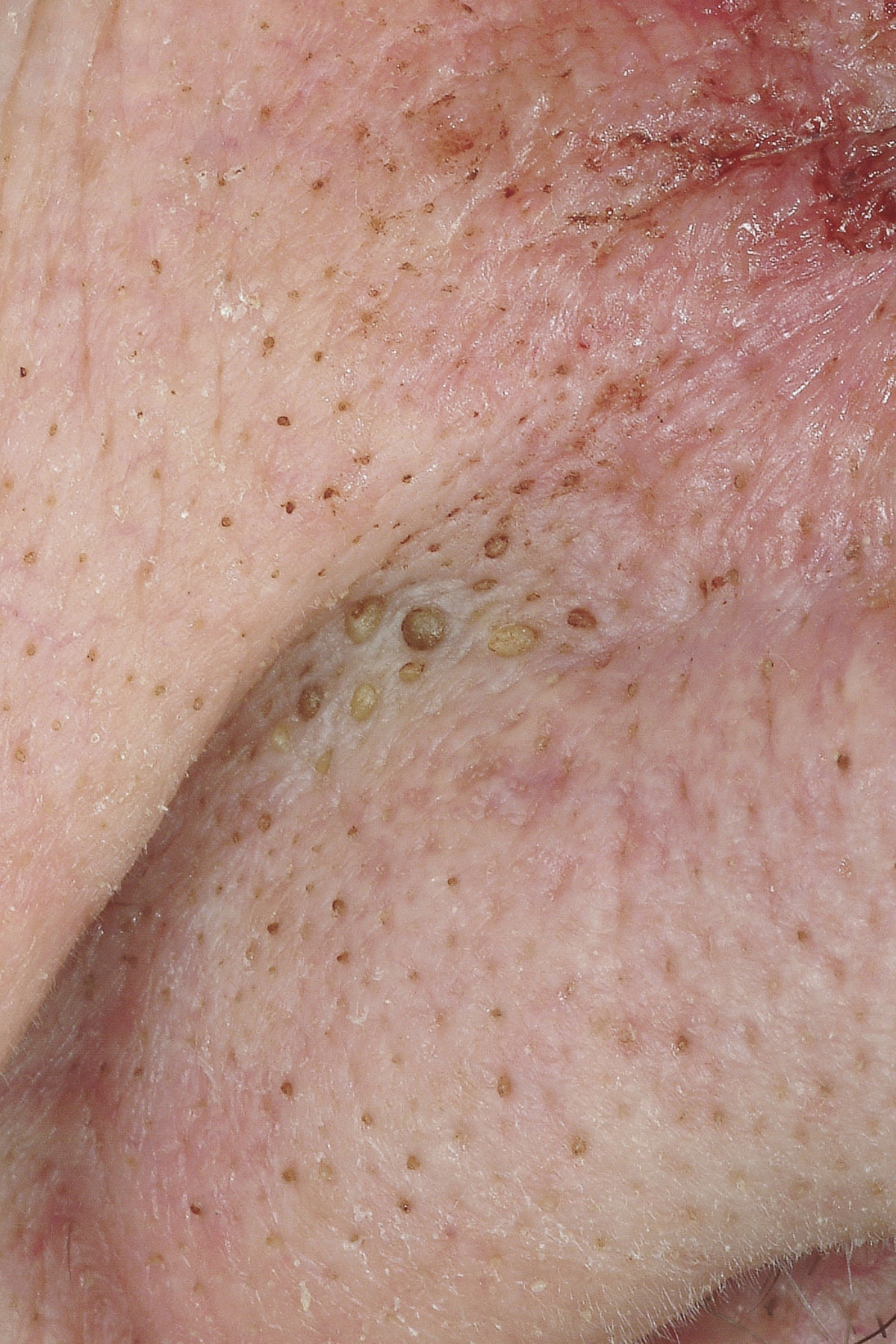
Solar comedones (sometimes called senile comedones) are related to many years of exposure to the sun, usually on the cheeks, not to acne-related pathophysiology.
Management
Using nonoily cleansers and mild soap may not cause as much irritation to the skin as regular soap. Blackheads can be removed across an area with commercially available pore-cleansing strips (which can still damage the skin by leaving the pores wide open and ripping excess skin) or the more aggressive cyanoacrylate method used by dermatologists.
Squeezing blackheads and whiteheads can remove them, but can also damage the skin. Doing so increases the risk of causing or transmitting infection and scarring, as well as potentially pushing any infection deeper into the skin. Comedo extractors are used with careful hygiene in beauty salons and by dermatologists, usually after steaming the face or washing in warm water.
Complementary medicine options for acne in general have not been shown to be effective in trials. These include aloe vera, pyridoxine (vitamin B6), fruit-derived acids, kampo (Japanese herbal medicine), ayurvedic herbal treatments, and acupuncture.
Some acne treatments target infection specifically, but some treatments are aimed at the formation of comedones, as well. Others remove the dead layers of the skin and may help clear blocked pores.
Dermatologists can often extract open comedones with minimal skin trauma, but closed comedones are more difficult. but dermabrasion and laser therapy have also been known to cause scarring.
Macrocomedones (1 mm or larger) can be removed by a dermatologist using surgical instruments or cauterized with a device that uses light. The acne drug isotretinoin can cause severe flare-ups of macrocomedones, so dermatologists recommend removal before starting the drug and during treatment.
Some research suggests that the common acne medications retinoids and azelaic acid are beneficial and do not cause increased pigmentation of the skin. Retinoids should only be applied at night, since a) light degrades them, and b) the skin repair cycle peaks at night. Sunscreen should also be used during the day, as the skin becomes more sensitive to UV.
Rare conditions
Favre–Racouchot syndrome occurs in sun-damaged skin and includes open and closed comedones.
Nevus comedonicus, or comedo nevus, is a benign hamartoma (birthmark) of the pilosebaceous unit around the oil-producing gland in the skin. It has widened open hair follicles with dark keratin plugs that resemble comedones, but they are not actually comedones.
Dowling–Degos disease is a genetic pigment disorder that includes comedo-like lesions and scars.
Familial dyskeratotic comedones are a rare autosomal-dominant genetic condition, with keratotic (tough) papules and comedo-like lesions.
References
References
- Informed Health Online. "Acne". Institute for Quality and Efficiency in Health Care (IQWiG)..
- "Comedo". Oxford University Press.
- National Cancer Institute. (2002). "Breast cancer treatment". National Cancer Institute.
- (2011). "Acne vulgaris". BMJ Clinical Evidence.
- British Association of Dermatologists. "Acne". British Association of Dermatologists.
- Williams, HC. (Jan 28, 2012). "Acne vulgaris.". Lancet.
- Wise, EM. (November 2011). "Clinical pearl: comedone extraction for persistent macrocomedones while on isotretinoin therapy.". The Journal of Clinical and Aesthetic Dermatology.
- Primary Care Dermatology Society. "Acne: macrocomedones". Primary Care Dermatology Society.
- DermNetNZ. "Solar comedones". New Zealand Dermatological Society.
- Poli, F. (Apr 15, 2002). "[Cosmetic treatments and acne].". La Revue du Praticien.
- Korting, HC. (Mar–Apr 1995). "The influence of the regular use of a soap or an acidic syndet bar on pre-acne.". Infection.
- Pagnoni, A. (1999). "Extraction of follicular horny impactions the face by polymers. Efficacy and safety of a cosmetic pore-cleansing strip (Bioré)". Journal of Dermatological Treatment.
- Gollnick, HP. (2003). "Topical treatment in acne: current status and future aspects.". Dermatology.
- Woolery-Lloyd, HC. (Apr 1, 2013). "Retinoids and azelaic Acid to treat acne and hyperpigmentation in skin of color.". [[Journal of Drugs in Dermatology]].
- "Do you need to turn off the lights after applying retinol?".
- (2007). "Dermatology: 2-Volume Set". Mosby.
- Zarkik, S. (Jul 15, 2012). "''Keratoacanthoma arising in nevus comedonicus''.". Dermatology Online Journal.
- DermNetNZ. "Comedo Naevus". New Zealand Dermatological Society.
- Bhagwat, PV. (Jul–Aug 2009). "Three cases of Dowling Degos disease in two families.". Indian Journal of Dermatology, Venereology and Leprology.
- Khaddar, RK. (January 2012). "[Extensive Dowling-Degos disease following long term PUVA therapy].". Annales de Dermatologie et de Vénéréologie.
- Hallermann, C. (Jul–Aug 2004). "Two sisters with familial dyskeratotic comedones.". European Journal of Dermatology.
- OMIM. "Comedones, familial dyskeratotic". OMIM.
This article was imported from Wikipedia and is available under the Creative Commons Attribution-ShareAlike 4.0 License. Content has been adapted to SurfDoc format. Original contributors can be found on the article history page.
Ask Mako anything about Comedo — get instant answers, deeper analysis, and related topics.
Research with MakoFree with your Surf account
Create a free account to save articles, ask Mako questions, and organize your research.
Sign up freeThis content may have been generated or modified by AI. CloudSurf Software LLC is not responsible for the accuracy, completeness, or reliability of AI-generated content. Always verify important information from primary sources.
Report