From Surf Wiki (app.surf) — the open knowledge base
Combat medic
Military personnel who provide first aid and frontline trauma care

Military personnel who provide first aid and frontline trauma care
.jpg)
Medical personnel from most Western nations carry weapons for protection of themselves and their patients but remain designated non-combatants, wearing the red cross, crescent or crystal.
United States
In the United States Armed Forces, MEDEVAC vehicles display a large Red Cross on a white background. However, ground forces do not display this due to increased targeting of medical personnel by insurgents.
Traditionally, most United States medical personnel also wore a distinguishing red cross, to denote their protection as non-combatants under the Geneva Convention. This practice continued into World War II. However, the enemies faced by professional armies in more recent conflicts are often insurgents who either do not recognize the Geneva Convention or choose not to adhere to it, and thus readily engage all personnel, irrespective of non-combatant status. As their non-combatant status is not respected, many US medics no longer wear non-combatant markings. This can enable medics to be used as medically trained soldiers, fighting aggressively rather than just in self-defence. Combat Medics in the United States Army and United States Navy Hospital Corpsmen are virtually indistinguishable from regular combat troops, except for the extra medical equipment they carry.
The modern-day interpretation of the U.S. Army doctrine requires medics to carry one primary weapon and, if possible, a secondary weapon. It is also common to find American combat medics who are no longer wearing the red or white cross because it is considered unethical to do so when the combat medic is carrying a weapon and could engage in actual combat.
As a result of the 2005 BRAC, the U.S. Department of Defense has moved most medical training for all branches of the armed forces to Fort Sam Houston of Joint Base San Antonio.
China
Before the 1979 Chinese invasion of Vietnam, the People's Liberation Army did not employ armoured ambulances, leading to difficulties in evacuation of casualties from the front lines. To fill this gap, the PLA first developed the WZ750 armored ambulance based on the Type-81 tracked armored command vehicle, and later on the WZ751 and WZ 753 vehicles. In addition to combat roles, PLA medics have been deployed to deal with the COVID-19 pandemic.
Germany
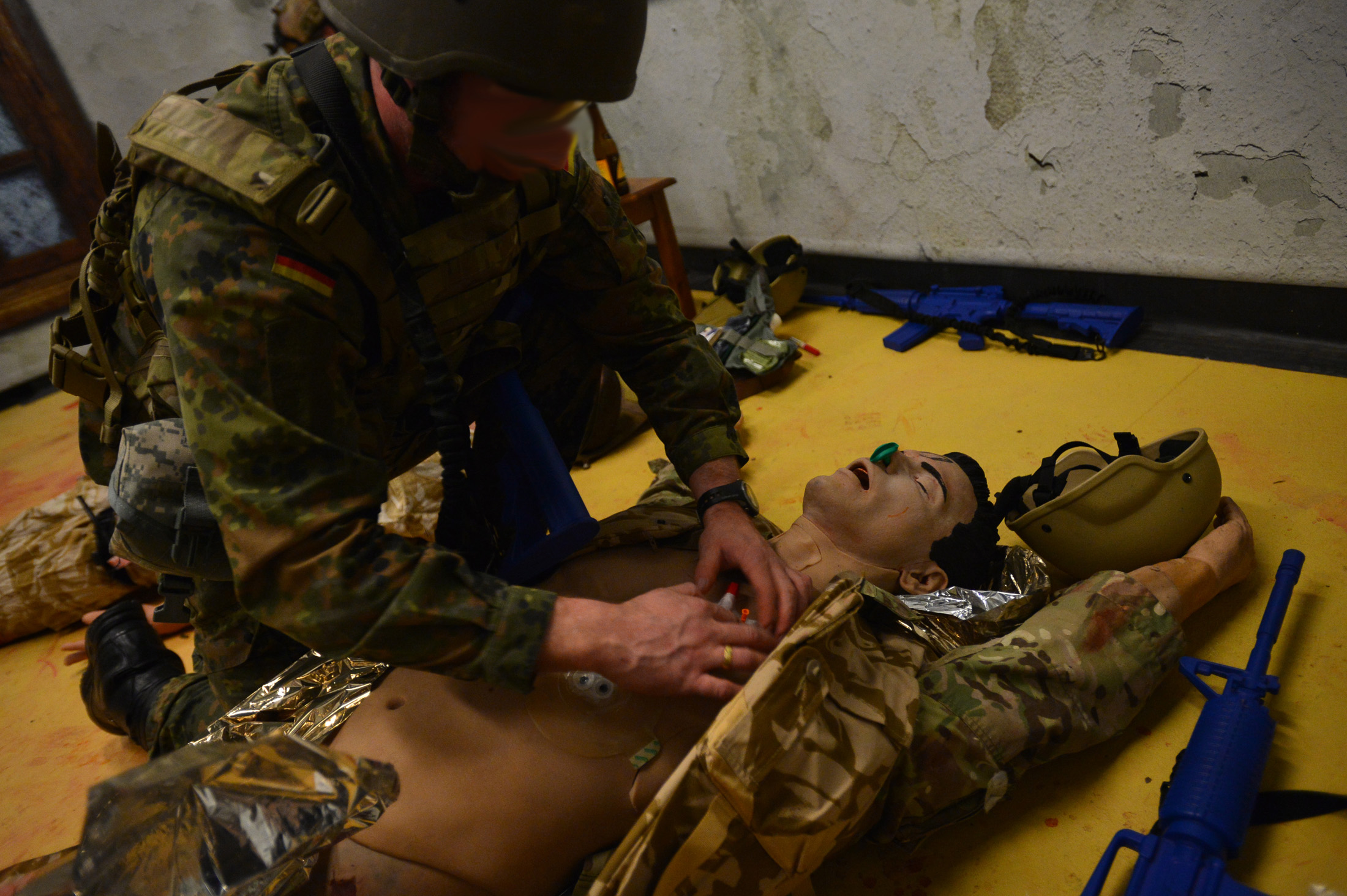
Following German rearmament in the 1950s, the medical service was reestablished based on the traditional structure, with a medical service for each military branch. This changed in 2002, when the medical services were largely merged to form the Joint Medical Service. Since 2002, most of the former responsibilities of the Army Medical Service have been transferred to the Joint Medical Service, although the entity still exists as a much smaller organisation within the German military.
References
Citations
Sources
- STP 8-91W15-SM-TG SOLDIER'S MANUAL AND TRAINER'S GUIDE, MOS 91W, HEALTH CARE SPECIALIST, SKILL LEVELS 1/2/3/4/5
References
- "Medical Technician | Canadian Armed Forces".
- "Medical Technician | Canadian Armed Forces".
- (8 March 2013). "Who, What, Why: Does shooting goats save soldiers' lives?". BBC News.
- (12 August 1949). "International Humanitarian Law - First 1949 Geneva Convention". Icrc.org.
- (12 August 1949). "International Humanitarian Law - First 1949 Geneva Convention". Icrc.org.
- Rottman, Gordon. (2016). "World War II US Army Combat Equipments". Osprey Publishing.
- (12 August 1949). "International Humanitarian Law - First 1949 Geneva Convention". Icrc.org.
- (2007). "The Roman Army: A Social and Institutional History". Oxford University Press.
- Schroeder-Lein, G. R. (2008). The Encyclopedia of Civil War Medicine. United States: M. E. Sharpe Incorporated. p. 225-226
- Schroeder-Lein, G. R. (2008), p. 14-15
- "The World War II Combat Medic".
- (12 August 1949). "International Humanitarian Law—First 1949 Geneva Convention". [[International Committee of the Red Cross]].
- "Customary IHL - Practice Relating to Rule 25. Medical Personnel". ihl-databases.icrc.org.
- Middleton, Thomas A. (2010). ''Saber's Edge: A Combat Medic in Ramadi, Iraq'', p. 7. UPNE.
- Middleton, Thomas. (2009). "Saber's Edge: A Combat Medic in Ramadi, Iraq". University Press of New England.
- Middleton, p. 8.
- Steve Elliott. "All military medical training roads now start at METC". Aetc.af.mil.
- “Wang Xiaomeng [王笑梦] Zhang Shaohua [张韶华], “战场救护神 - 解放军卫勤保障装备撷英 (Amazing Battlefield Rescue – Selections of PLA Medical Service Equipment),” Xinmin Evening News [新民晚报], 10 February 2020. http://www.xinhuanet.com/ politics/2019-04/24/c_1124411852.htm
- "Rx PLA: The PLA Medical System’s Role in China’s Efforts to Fight COVID-19".
- Rolf Clement, Paul Elmar Jöris, "Der Sanitätsdienst," in ''50 Jahre Bundeswehr 1955–2005'', pp. 198ff., Mittler, 2005
- "Geschichte des Sanitätsdienstes". [[Bundeswehr]].
This article was imported from Wikipedia and is available under the Creative Commons Attribution-ShareAlike 4.0 License. Content has been adapted to SurfDoc format. Original contributors can be found on the article history page.
Ask Mako anything about Combat medic — get instant answers, deeper analysis, and related topics.
Research with MakoFree with your Surf account
Create a free account to save articles, ask Mako questions, and organize your research.
Sign up freeThis content may have been generated or modified by AI. CloudSurf Software LLC is not responsible for the accuracy, completeness, or reliability of AI-generated content. Always verify important information from primary sources.
Report