From Surf Wiki (app.surf) — the open knowledge base
Columbus Day
National holiday in the Americas
.jpg)
National holiday in the Americas
| Field | Value | |
|---|---|---|
| holiday_name | Columbus Day | |
| image | Desembarco de Colón de Dióscoro Puebla.jpg | |
| caption | First Landing of Columbus on the Shores of the New World; painting by Dióscoro Puebla (1862) | |
| duration | 1 day | |
| frequency | Annual | |
| observedby | Various countries in the Americas, Italy, Spain, various Little Italys around the world | |
| date | October 12 (actual/traditional); second Monday in October (United States) | |
| type | Historical | |
| significance | {{plain list | |
| week_ordinal | second | |
| weekday | Monday | |
| month | October | |
| date | October (United States) | |
| date | October (United States) | |
| date | October (United States) | |
| date | October (United States) |
- Celebrations honoring Christopher Columbus' arrival in the Americas in 1492
- Recognize contributions of Americans of Italian descent
Columbus Day is a national holiday in many countries of the Americas and elsewhere, and a federal holiday in the United States, which officially celebrates the anniversary of Christopher Columbus's arrival in the Americas. He went ashore at Guanahaní, an island in the Bahamas, on October 12, 1492 [OS]. He built La Navidad on the northwestern coast of the island of Hispaniola (now present-day Haiti) in late December of 1492, the first European fort in the Americas. After the destruction of the fort by the indigenous Taíno people, Columbus established La Isabela on the central-northern coast of the island (now present-day Dominican Republic) in late December of 1493, the first stable settlement in the Americas.
Christopher Columbus ( ) was an Italian explorer from Genoa who led a Spanish maritime expedition to cross the Atlantic Ocean in search of an alternative route to the Far East. Columbus believed he sailed his crew to the East Indies, but Europeans realized years later that his voyages landed them in the New World. His first voyage to the New World was made on the Spanish ships Niña, Pinta, and Santa María and took about three months. The crew's arrival in the New World initiated the colonization of the Americas by Spain, followed in the ensuing centuries by other European powers, as well as the transfer of plants, animals, culture, human populations, and technology between the New and Old Worlds, an event referred to by some late 20th‐century historians as the Columbian exchange.
The landing is celebrated as Columbus Day in the United States, but the name varies internationally. In some Latin American countries, October 12 is known as Día de la Raza or "Day of the Race". This was the case for Mexico, until it renamed it to "Day of the Pluricultural Nation". Some countries such as Spain refer to the holiday as the Day of Hispanicity or Día de la Hispanidad and is also Spain's National Day or Fiesta Nacional de España, where it coincides with the religious festivity of La Virgen del Pilar. Since 2009, Peru has celebrated Día de los pueblos originarios y el diálogo intercultural ("Indigenous Peoples and Intercultural Dialogue Day"). Uruguay celebrate it as Pan American Day and Día de las Américas ("Day of the Americas"). The day is also commemorated in Italy, as Giornata Nazionale di Cristoforo Colombo or Festa Nazionale di Cristoforo Colombo, and in the Little Italys around the world. In Belize, the day is recognized as Indigenous People's Resistance Day.
Observance in the United States
History
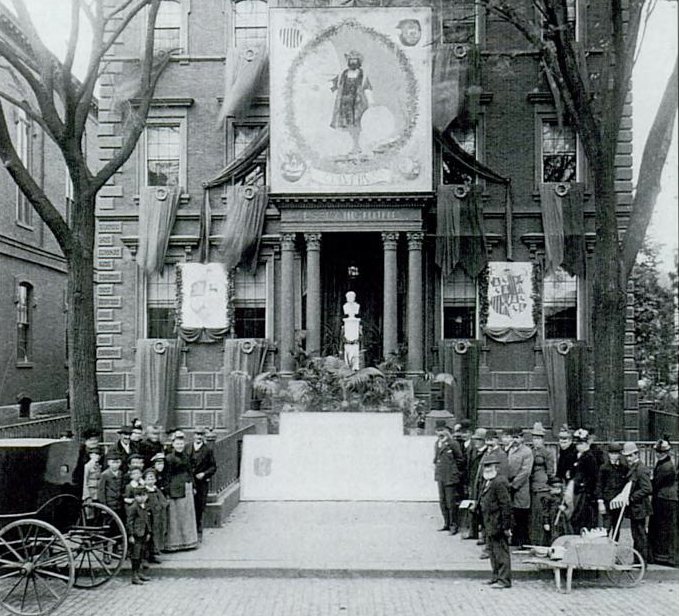
The first Columbus Day celebration took place on October 12, 1792, when the Columbian Order of New York, better known as the Tammany Society (the precursor to Tammany Hall), held an event to commemorate the 300th anniversary of the historic landing.{{cite encyclopedia|title=Columbus Day|url=https://www.britannica.com/topic/Columbus-Day|encyclopedia=Britannica Encyclopedia |access-date=October 11, 2021}} The Columbus Obelisk in Baltimore was erected in 1792.
Many Italian Americans observe Columbus Day as a celebration of their heritage and not of Columbus himself (Columbus never set foot in any part of what is now the United States). The day was celebrated in New York City on October 12, 1866. The day was first enshrined as a legal holiday in the United States through the lobbying of Angelo Noce, an Italian-American immigrant, in Denver. The first statewide holiday was proclaimed by Colorado governor Jesse F. McDonald in 1905, and it was made a statutory holiday in 1907. (Colorado replaced Columbus Day with Frances Xavier Cabrini Day in 2020, though that holiday is observed a week earlier.)
For the 400th anniversary of Christopher Columbus's voyage in 1892, following the lynchings of 11 Italian immigrants by a mob in New Orleans, President Benjamin Harrison declared Columbus Day as a one-time national celebration. The proclamation was part of a wider effort after the lynching incident to placate Italian Americans and ease diplomatic tensions with Italy. During the anniversary in 1892, teachers, preachers, poets, and politicians used rituals to teach ideals of patriotism. These rituals took themes such as citizenship boundaries, the importance of loyalty to the nation, and the celebration of social progress; included among them was the Pledge of Allegiance by Francis Bellamy.

In 1934, as a result of lobbying by the Knights of Columbus and New York City Italian leader Generoso Pope, Congress passed a statute stating: "The President is requested to issue each year a proclamation (1) designating October 12 as Columbus Day; (2) calling on United States government officials to display the flag of the United States on all government buildings on Columbus Day; and (3) inviting the people of the United States to observe Columbus Day, in schools and churches, or other suitable places, with appropriate ceremonies that express the public sentiment befitting the anniversary of the discovery of America." President Franklin Delano Roosevelt responded by making such a proclamation. This proclamation did not lead to the modern federal holiday; it was similar to language regarding Thomas Jefferson's birthday and Gold Star Mothers Day. In 1941, some 1,881 Italian Americans were interned and lost rights as "enemy aliens" because of a widely held belief that they would remain loyal to Italy, an Axis power, during World War II. Almost all of those interned were citizens of Italy, including Italian students and businessmen residing in the U.S.; the internment did not include the 690,000 Italians who had immigrated to the United States and millions of other Americans of Italian descent. On Columbus Day 1942, Franklin Roosevelt announced the removal of the designation of Italian Americans as "enemy aliens" along with a plan to offer citizenship to 200,000 elderly Italians living in the United States who had been unable to acquire citizenship due to a literacy requirement. However, the implementation of the announcement was not completed until those interned in camps were released following Italy's surrender to the Allies on September 8, 1943.
In 1966, Mariano A. Lucca, from Buffalo, New York, founded the National Columbus Day Committee, which lobbied to make Columbus Day a federal holiday. These efforts were successful and legislation to create Columbus Day as a federal holiday was signed by President Lyndon Johnson on June 28, 1968, to be effective beginning in 1971.
Since 1971, when Columbus Day became an officially recognized federal holiday in the United States, it has been observed on the second Monday in October, as commemorated by annual Presidential proclamation noting Columbus' achievements. It is generally observed by banks, the bond market, the U.S. Postal Service, other federal agencies, most state government offices, many businesses, and most school districts. Some businesses and some stock exchanges remain open, and some states and municipalities abstain from observing the holiday. The traditional date of the holiday also adjoins the anniversary of the United States Navy (founded October 13, 1775), and thus both occasions are customarily observed by the Navy and the Marine Corps with either a 72- or 96-hour liberty period.
The observance on the second Monday in October means it coincides with the Canadian holiday of Thanksgiving.
Localization
.jpg)
Actual observance varies in different parts of the United States, ranging from large-scale parades and events to complete nonobservance. Most states do not celebrate Columbus Day as an official state holiday. Some mark it as a "Day of Observance" or "Recognition”. Most states that celebrate Columbus Day will close state services, while others operate as normal.
San Francisco claims the nation's oldest continuously existing celebration with the Italian-American community's annual Columbus Day Parade, which was established by Nicola Larco in 1868, while New York City boasts the largest, with over 35,000 marchers and one million viewers around 2010.
As in the mainland United States, Columbus Day is a legal holiday in the U.S. territory of Puerto Rico. In the United States Virgin Islands, the day is celebrated as both Columbus Day and "Puerto Rico Friendship Day".
Virginia also celebrates two legal holidays on the day, Columbus Day and Yorktown Victory Day, which honors the final victory at the Siege of Yorktown in the Revolutionary War.
Nonobservance
Despite Columbus Day being a national holiday and a celebration of Italian heritage, the celebration of Columbus Day in the United States began to decline at the end of the 20th century, although Americans continue to celebrate it.{{cite news
Iowa and Nevada do not observe Columbus Day as an official holiday, but the states' respective governors are "authorized and requested" by statute to proclaim the day each year.See:
- Iowa proclamation:
- Nevada proclamation: Nevada Revised Statues Chapter 236 , section 236.025 "Columbus Day" In Nevada’s case, it’s not because of the controversy, but because it falls too close to Nevada Day (which is a full holiday for which schools and some state government facilities are closed). Several other states have removed the day as a paid holiday for state government workers, while maintaining it either as a day of recognition, or as a legal holiday for other purposes, including California and Texas.
The practice of U.S. cities eschewing Columbus Day to celebrate Indigenous Peoples' Day began in 1992 with Berkeley, California. The list of cities that have followed suit as of 2018 includes Austin, Boise, Cincinnati, Denver, Los Angeles, Mankato, Philadelphia, Portland, San Francisco, Santa Fe, Seattle, Saint Paul, Phoenix, Tacoma, and "dozens of others".
Columbus, Ohio, has chosen to honor veterans instead of Christopher Columbus, and removed Columbus Day as a city holiday in 2018. Various tribal governments in Oklahoma designate the day as Native American Day, or name it after their own tribe.
In 2017, the city council of Akron, Ohio, became split along racial lines with the decision to replace Columbus Day with Indigenous Peoples' Day, creating pushback from the city's Italian-American community. In 2018, a compromise was reached, with the city council voting to name the first Monday of October as North American First People's Day while keeping Columbus Day, and in 2020, Columbus Day was renamed Italian-American Heritage and Culture Day.
Latin American observance

The date Columbus arrived in the Americas is celebrated in some countries of Latin America. The most common name for the celebration in Spanish (including some Latin American communities in the United States) is the Día de la Raza ("day of the race" or the "day of the [Hispanic] people"), commemorating the first encounters of Europeans and the Native Americans. The day was first celebrated in Argentina in 1917, in Venezuela and Colombia in 1921, in Chile in 1922, and in Mexico, it was first celebrated in 1928. The day was also celebrated under this title in Spain until 1957, when it was changed to the Día de la Hispanidad ("Hispanicity Day"), and in Venezuela, it was celebrated under this title until 2002, when it was changed to the Día de la Resistencia Indígena (Day of Indigenous Resistance). Originally conceived of as a celebration of Hispanic influence in the Americas, as evidenced by the complementary celebrations in Spain and Latin America, Día de la Raza has come to be seen by nationalist activists throughout Latin America as a counter to Columbus Day – a celebration of the native races and cultures and their resistance to the arrival of Europeans in the Americas.
In the United States, Día de la Raza has served as a time of mobilization for panethnic Latino activists, particularly since the 1960s. Since then, La Raza has served as a periodic rallying cry for Hispanic activists. The first Hispanic March on Washington occurred on Columbus Day in 1996. The name was used by the largest Hispanic social justice organization in the nation, UnidosUS, which was known as the National Council of La Raza from 1968 to 2017.
On October 10, 1992, Pope John Paul II visited the Dominican Republic to celebrate the 500th anniversary of the discovery of the Americas and the arrival of Christianity in the "New World". His visit ended with a mass in the nation's cathedral, the first cathedral in the Western Hemisphere.
Argentina


The Day of the Race was established in Argentina in 1916 by a decree of President Hipólito Yrigoyen. The name was changed to "Day of Respect of Cultural Diversity" by a presidential decree in 2010 issued by President Cristina Kirchner. The statue of Columbus was removed from its original position near the Casa Rosada and replaced by one of Juana Azurduy, a patriot and leader in the struggle for independence who had indigenous ancestors.
Colombia
Colombia, whose name originated from Columbus himself, celebrates El día de la Raza y de la Hispanidad (meaning "Day of the Race and Hispanicity"), and is taken as an opportunity to celebrate the encounter of "the two worlds" and to reflect on the richness that the racial diversity has brought to the culture. In 2021 the Ministry of Culture changed the name of the holiday to ‘Día de la Diversidad Étnica y Cultural de la Nación Colombiana (meaning "Day of Ethnic and Cultural Diversity of the Colombian nation").
Peru
In Peru, it was known as Día del descubrimiento de América ("Day of the discovery of America"). Since 2009, it has been celebrated as Día de los pueblos originarios y el diálogo intercultural (Indigenous Peoples and Intercultural Dialogue Day).
Venezuela
Between 1921 and 2002, Venezuela celebrated Día de la Raza along with many other Latin American nations. The original holiday was officially established in 1921 under President Juan Vicente Gómez. In 2002, under President Hugo Chávez, the holiday was changed to Día de la Resistencia Indígena (Day of Indigenous Resistance) to commemorate the Indigenous peoples' resistance to European settlement.
On October 12, 2004, a crowd of progovernment activists toppled a statue of Christopher Columbus by Rafael de la Cova in Caracas. The activists also sprayed allusive graffiti over its pedestal. The walk where the statue had stood was renamed in 2008 "Indigenous Resistance Walk". Later, a statue of an indigenous leader, Guaicaipuro, was erected on the plinth.
Costa Rica
On September 21, 1994, Costa Rica changed the official holiday from Día de la Raza to Día del Encuentro de las Culturas (Day of the Encounter of Cultures) to recognize the mix of European, Native American (autochthonous populations), African and Asian cultures that constitute modern Costa Rican (and Latin American) culture and ethnicity. In accordance to the Costa Rican labor law, the holiday is observed on October 12. Should this date coincide with a Tuesday, Wednesday, Thursday, or Friday, the employer shall agree that said holiday be postponed to the following Monday. In 2020, Costa Ricans eliminated this holiday, which was under debate in years prior. Hence, in exchange Costa Rica now celebrates the 'Military Abolition Day' on December 1.
El Salvador
In June 1915, the official holiday of '*Fiesta de la Raza''' was established, with October 12 being the date of the national holiday. Presently, since October 12, 2021, the Legislative Assembly of El Salvador abolished the previous national *Fiesta de la Raza'' holiday, " [to] vindicate the origin and identity of indigenous peoples who were forgotten by previous governments, who for decades celebrated Race Day as a positive event and who never adopted mechanisms to enhance human rights". The holiday is no longer celebrated officially.
Mexico
In Mexico, the date was known as Columbus Day or Day of the Race. On December 18, 2020, by decree of President Andrés Manuel López Obrador, the name of October 12 was changed to "Day of the Pluricultural Nation". The statue of Columbus along Mexico City's Paseo de la Reforma was removed and replaced with a replica of The Young Woman of Amajac, a sculpture depicting an Indigenous woman.
Caribbean observance
Only a handful of Caribbean countries observe holidays related to Columbus Day. In Belize, October 12 is observed as Indigenous Peoples' Resistance Day. Formerly known as Pan American Day, the name was changed in 2021 to move away from its colonial legacy. In the Bahamas, it was formerly known as Discovery Day, until 2001 when it was replaced by National Heroes Day. In 1937, Cuban President Federico Laredo Brú (1936–1940) spoke to the nation and countries of America in Cuba on October 12 commemorating Christopher Columbus's voyage to the New World. Federico Laredo Brú spoke about Columbus's impact on the land and the future of its settlement. He ended his speech with venerating Christopher Columbus's efforts to colonize and establish settlements along the new front and the pride of one's nation. He added "Por mi raza hablo mi espiritu," which translates to "For my race my spirit called," to support the political infrastructure at the time.
Columbus's legacy

In December 1937, Cuban president Federico Laredo Brú and Dominican Republic president Rafael Trujillo ordered a crew of aviators to travel through Latin America collecting funds from large capital cities for a monumental light house in the Dominican Republic. The exploration Escuadrilla Binacional Pro Faro de Colón was inspired by Columbus's journey across the North Atlantic Ocean to America. The expedition consisted of three Stinson Reliant SR-9s borrowed from the Cuban Air Force – named Santa María, Niña and Pinta after the vessels commanded by Columbus – and a Curtiss Wright CW-19R from the Dominican military aviation named Colon after Columbus. On December 15, after visiting a majority of South America, their flight to the Peruvian capital Lima was hampered by an unexpected sandstorm. Two planes (Colon and La Pinta) were forced to land in Pisco and Niña disappeared in the storm. The Santa Maria was the only plane to reach Lima as planned, landing at Las Palmas on the day of the storm. After extensive searches, Niña radioed their whereabouts after their radio was damaged in the storm. The aircraft restrategized in Las Palmas, and on December 29 their expedition took off from El Techo airport in Bogotá en route to El Guabito airport in Cali. Later that day, the crew flew into an unexpected storm over the Valley of Cauca. With minimal visibility and poor navigation, Niña, La Pinta, and Santa Maria crashed into high mountains, while Colon, unaware of the other aircraft, flew over the storm and safely made it to Panama City. The plane is preserved today as remembrance of the bravery of the crew and Christopher Columbus's journey.
In 1992, in remembrance of the 500th anniversary of the discovery of America, the Columbus Lighthouse, in Santo Domingo Este was inaugurated. The monument is both a mausoleum and a museum showcasing objects including a boat from Cuba and Colombian jewelry. Constructed of concrete, the monument is 680 ft long.{{Citation | access-date = 2010-04-25}} Its architecture is cross-shaped and represents the Christianization of the Americas. According to Dominican authorities, Columbus' remains are sheltered at the lighthouse. Spanish authorities proved through DNA tests that remains in the Cathedral of Seville were his and Dominican authorities have not allowed the same, so whether the sets are related remains unknown.
European observance
Italy

Since the 18th century, many Italian communities in the Americas have observed the Discovery of the New World as a celebration of their heritage, since Columbus was born in Republic of Genoa, nowadays Italy. In Italy, Columbus Day has been officially celebrated since 2004. It is officially named Giornata nazionale di Cristoforo Colombo ("National Christopher Columbus Day").
The Christopher Columbus House in Genoa, Italy, is an 18th-century reconstruction of the house in which Christopher Columbus grew up. The house is located outside Genoa's 14th-century walls. During the Renaissance, the area became subject to intense building, mainly consisting of public housing. Columbus was born in 1451, and historical documents indicated that Columbus lived here between approximately 1455 and 1470. At this time, the house had two or maybe three stories, with a shop on the ground floor, and the front door to the left of the shop.
The "Lega Navale Italiana" has created a Regata di Colombo ("Columbus Regatta") as a celebration of the Columbus achievement. Italians have celebrated Christopher Columbus ( ) naming after him many civilian and military ships, like the training ship SS Cristoforo Colombo and the ocean liner SS Cristoforo Colombo.
Spain
.jpg)
The first celebration of the Discovery of the Américas by Columbus in Spain was as early as 1642 when the city of Zaragoza designated the Virgen del Pilar (Our Lady of the Pillar) as symbol of the Hispanidad (Hispanicity) on the date of the Spanish expedition's arrival to the New World. This holiday was declared a religious feast day throughout the Spanish Empire in 1730. In 1892, the 12 of October was declared a one-time national day in commemoration of the 4th centenary of the Discovery of America and the perpetuation of the festivity was then first considered. The Spanish government suggested other nations (Hispanic American countries, Italy and the United States of America) to join the celebration, which was followed with enthusiasm by them, with a few exceptions. The Discovery of America and the Hispanicity has been celebrated as a national day since 1918 under different names like "Día de la Hispanidad" or "Dia de la Raza", due to changes of political regimes in the 20th century. The national day emphasises Spain's ties with the Hispanidad, the international Hispanic community and Spanish legacy to the world. In 1981 a royal decree established the Fiesta Nacional y Día de la Hispanidad as a national holiday. The holiday is widely celebrated in Spain with official and cultural events throughout the country. Shops and businesses are closed as with other bank holidays. The observation is enhanced with the feast day of Our Lady of the Pillar (Fiestas del Pilar), the so-called Mother of Hispanidad, and of Our Lady of Guadalupe in Extremadura (Santa María de Guadalupe) (appointed Queen of Hispanicity in 1928 by the Vatican) from Guadalupe, Caceres, whose Monastery was the venue in June 1492 for the decisive meeting between the Catholic Monarchs and Columbus to start organizing the travel and where the latter came back in 1493, right after returning from his first voyage, to thank Her for his success.
Opposition

For years after the first Columbus Day celebration in 1892, opposition to Columbus Day recognized the suffering inflicted on American Indians with westward expansion.
It also originated from anti-immigrant nativist Know Nothing political movement, who sought to eliminate its celebration because of its association with immigrants from the Catholic countries of Ireland and Italy, and the American Catholic fraternal organization, the Knights of Columbus. Some anti-Catholics, notably including the Ku Klux Klan and the Women of the Ku Klux Klan, opposed celebrations of Columbus or monuments about him because they thought that it increased Catholic influence in the United States, which was largely a Protestant country.
In the summer of 1990, 350 representatives from American Indian groups from all over the hemisphere met in Quito, Ecuador, at the first Intercontinental Gathering of Indigenous People in the Americas, to mobilize against the 500th anniversary (quin-centennial) celebration of Columbus Day planned for 1992. The following summer, in Davis, California, more than a hundred Native Americans gathered for a follow-up meeting to the Quito conference. They declared October 12, 1992, to be "International Day of Solidarity with Indigenous People".
More recently, mainly since the 1990s, more people oppose Columbus's and other Europeans' actions against the indigenous populations of the Americas. This opposition was initially led by Native Americans and was expanded upon by left-wing political parties. In some locations, holidays commemorating Columbus have now been abolished, with various Latin American countries altering the holidays to now recognise indigenous populations.

A statue of Christopher Columbus, which formerly occupied the plinth, was knocked down by activists in 2004.]]
There are many interrelated strands of criticism. One refers primarily to the treatment of the indigenous populations during the European colonization of the Americas, which followed Columbus's discovery. Some groups, such as the American Indian Movement, have argued that the ongoing actions and injustices against Native Americans are masked by Columbus myths and celebrations. American anthropologist Jack Weatherford says that on Columbus Day, Americans celebrate the greatest waves of genocide of the American Indians known in history.
A second strain of criticism of Columbus Day focuses on the character of Columbus himself. In time for the 2004 observation of the day, the final volume of a compendium of Columbus-era documents was published by the University of California, Los Angeles' Medieval and Renaissance Center. It stated that Columbus, while a brilliant mariner, exploited and enslaved the indigenous population.
Spelman College historian Howard Zinn described some of the details in his book, A People's History of the United States, of how Columbus personally ordered the enslavement and mutilation of the native Arawak people in a bid to repay his investors.
Journalist and media critic Norman Solomon reflects, in Columbus Day: A Clash of Myth and History, that many people choose to hold on to the myths instead of reality in the events surrounding Columbus. He disputes the idea that the Spaniards' arrival was beneficial towards the Indians by quoting History of the Indies by the Catholic priest Bartolomé de las Casas, who observed the region where Columbus was governor. Las Casas writes that the Spaniards were driven by "insatiable greed" as they killed and tortured native populations with "the strangest and most varied new methods of cruelty" and laments that "my eyes have seen these acts so foreign to human nature, and now I tremble as I write".
Notes
References
References
- (16 May 2021). "Christopher Columbus".
- Gambino, Megan. (October 4, 2011). "Alfred W. Crosby on the Columbian Exchange". [[Smithsonian Magazine]].
- (13 October 2017). "Cusco marks Indigenous Peoples and Intercultural Dialogue Day".
- "Pagina iniziale".
- (November 23, 2012). "Governo Italiano – Dipartimento per il Cerimoniale dello Stato". Governo.it.
- Strauss, Valerie. (2015-10-12). "Christopher Columbus: 3 things you think he did that he didn't". The Washington Post.
- Corday, Karen. (2020-10-22). "The Reason Christopher Columbus Didn't Actually Discover America".
- "Día de la Raza – Viva Cuernavaca".
- Noce, Angelo. (1910). "Columbus Day in Colorado: Angelo Noce ...". Angelo Noce, printer.
- Sale, Kirkpatrick, "The Conquest of Paradise", p. 359, {{ISBN. 0-333-57479-6
- "Yuma Pioneer September 15, 1905 – Colorado Historic Newspapers Collection".
- (October 3, 2020). "The first Monday Of October is Frances Xavier Cabrini Day. Here's why Colorado chose to replace Columbus Day".
- "Proclamation on the 40th Anniversary of the Discovery of America by Columbus".
- Staples, Brent. (2019-10-12). "Opinion: How Italians Became 'White'". The New York Times.
- Kubal, Timothy. 2008. Cultural Movements and Collective Memory: Christopher Columbus and the Rewriting of the National Origin Myth. New York: Palgrave Macmillan.
- Connell, William J.. (2010). "What Columbus Day Really Means". The American Scholar.
- Appelbaum, Yoni. (October 8, 2012). "How Columbus Day Fell Victim to Its Own Success".
- United States House of Representatives. (April 30, 1934). "36 USC 107, ch. 184, 48 Stat. 657". [[Office of the Law Revision Counsel]].
- American Memory. (October 6, 2010). "Today in History: October 12". [[Library of Congress]] (National Digital Library).
- (October 12, 2020). "Why Columbus Day of 1942 is so Meaningful Today".
- (2004). "Una Storia Segreta: The Secret History of Italian American Evacuation and Internment during World War II". Berkeley: Heyday Books.
- (1994-03-02). "Mariano A. Lucca, 92, Columbus Day Backer". The New York Times.
- Stephen, Stathis. (1999). "Federal holidays: evolution and application".
- Straus, Jacob R.. (2014). "Federal Holidays: Evolution and Current Practices".
- (June 29, 1968). "LBJ Signs Bill to Set Up Five 3-Day Holidays". Sarasota Herald-Tribune.
- House, The White. (2022-10-07). "A Proclamation on Columbus Day, 2022".
- (October 10, 2009). "Is Columbus Day Sailing Off the Calendar?". The Wall Street Journal.
- (2007-12-01). "Who Was Who". Oxford University Press.
- "Working on Columbus Day? It depends on where you live".
- Gore, Leada. (October 12, 2015). "Columbus Day 2015: What's Closed, What's Open on Monday, Oct. 12?". Alabama Media Group.
- "sfcolumbusday.org". sfcolumbusday.org.
- "Columbus Citizens Foundation". Columbuscitizensfd.org.
- "Manhattan Style 'The Annual Columbus Day Parade'". Manhattanstyle.com.
- "PR Newswire 'Performers, Bands, and Red, White and Green on Fifth Avenue in NYC Columbus Day Parade'". Prnewswire.com.
- NextPage – LivePublish. "Title 1 Virgin Islands Code Section 171". Michie.com.
- "LIS > Code of Virginia > 2.2-3300". Leg1.state.va.us.
- Delkic, Melina. (2022-10-09). "Indigenous Peoples' Day, Explained". The New York Times.
- "Modified District Government Services for Indigenous Peoples' Day".
- "Hawaii celebrates the discoverer's day that commemorates the Polynesian discovery".
- "Hawaii Revised Statutes, Section 8-1.5". Hawaii.gov.
- "Alaska Statutes: AS 44.12.010. Legal Holidays". Touchngo.com.
- Mary Adamski. (October 13, 1998). "Idea of Discoverers' Day Insults Native Americans". Honolulu Star-Bulletin.
- Evans, Brad. (October 7, 2016). "Vermont ditches Columbus Day for Indigenous Peoples' Day". mynbc5.com.
- "In South Dakota it's Native American Day".
- (April 3, 2019). "New Mexico scraps Columbus Day for Indigenous Peoples' Day".
- (April 27, 2019). "Maine becomes the latest state to replace Columbus Day with Indigenous Peoples' Day". Turner Broadcasting System, Inc..
- (October 9, 2023). "Celebrations of Indigenous Peoples Day across Minnesota".
- Christian Leonard. (12 October 2019). "What's Open (and Not) on Columbus Day?". NBC Los Angeles.
- "State of Oregon: Department of Administrative Services – Calendar".
- "State Holidays – Washington State Department of Health".
- "RCW 1.16.050 "Legal holidays" and "legislatively recognized days"—Unpaid holidays for employees with appointments or contracts of less than 12 consecutive months.".
- https://www.usatoday.com/story/news/2024/10/12/nevadas-12-official-holidays-and-why-columbus-day-isnt-one-of-them/75635620007/
- "California Government Code, Section 6700".
- Ortiz, Joe. (February 4, 2010). "Schwarzenegger's Dropping Two State Holidays is Legal, California judge rules". Mcclatchydc.com.
- "Texas Government Code § 662.044. Columbus Day".
- "Columbus Day in the United States".
- O'Neil, Luke. (October 8, 2018). "Goodbye, Columbus: holiday in decline as brutal legacy re-evaluated". [[The Guardian]].
- Paddock, Richard C.. (January 13, 2008). "UC Berkeley's bones of contention". Los Angeles Times.
- "Austin City Council renames Columbus Day to Indigenous Peoples Day".
- (September 3, 2017). "What Christopher Columbus achieved was momentous. He deserves a holiday.". Los Angeles Times.
- (October 10, 2009). "Is Columbus Day Sailing Off the Calendar?". The Wall Street Journal.
- "Cambridge City Council Meeting – June 6, 2016 Agenda".
- (October 9, 2007). "News: UW Group Offers Alternative to Columbus". The Badger Herald.
- Sattin, Brad. "Mpls. City Council Passes Indigenous Peoples Day Resolution". KSTP/ABC-5 Eyewitness News.
- (October 6, 2014). "Columbus Day in Seattle no Longer: Now Indigenous Peoples' Day".
- (October 10, 2016). "Columbus Day changed to Indigenous People's Day in Vermont and city of Phoenix". cbsnews.com.
- (October 4, 2017). "Columbus Day designated as Indigenous Peoples Day in Salt Lake City".
- Adcock, Clifton. (October 13, 2008). "Holiday Not Celebrated by Tribes: American Indians See Columbus Day As a Reminder of Harsh Treatment Ages Ago". Tulsa World.
- "Akron leaders revisit the renaming of Columbus Day with community input and newfound empathy".
- (2020-09-28). "After years of debate, Akron will not celebrate Columbus Day this fall".
- "3rd Annual Dia de la Raza Celebration".
- French, Howard. (1992-10-10). "Pope Arrives in Dominican Republic". The New York Times.
- Gonzáles, Gabriel Esteban. (12 October 2022). "Día del Respeto a la Diversidad Cultural: una reivindicación que demoró cinco siglos".
- "Christopher Columbus monument removal, Buenos Aires, Argentina - World History Commons".
- "El Metro de Medellín y el Ministerio de Cultura se unen para la conmemoración del Día de la Diversidad Étnica y Cultural de la Nación Colombiana".
- "12 de Octubre: Día de los pueblos originarios y el diálogo intercultural". Lima COP20.
- García Marco, Daniel. (October 12, 2016). "¿Dónde está la estatua de Cristóbal Colón que fue juzgada, condenada y colgada el 12 de octubre de 2004 en Caracas?". BBC Mundo.
- "Ley del Día de las Culturas". Mep.go.cr.
- (November 28, 2018). "Costa Rican president backs holiday for army abolition".
- Legislative Assembly, Press. (October 13, 2021). "Asamblea Legislativa suprime 'Fiesta de la Raza', por considerar que lesiona la dignidad de los pueblos originarios".
- (2020-11-20). "October 12 will now be the "Day of the Pluricultural Nation" in Mexico".
- (December 18, 2020). "Decreto por el que se declara el día 12 de octubre de cada año, como el "Día de la Nación Pluricultural".".
- (2021-10-12). "Mexico promotes indigenous people as it erases memory of Columbus".
- Pietroni, David Guido. (2021-10-13). "Pre-Hispanic Indigenous Sculpture Will Replace Columbus Statue in Mexico City".
- "Belize to Commemorate Indigenous People's Resistance Day, Honoring Indigenous Contributions".
- Laredo Bru, Federico. (1937). "Dia de la Raza". Sociedad Colombiana Panamericana.
- (June 6, 2018). "Escuadrilla Pro Faro de Colón in Peru (English)".
- Sood, Suemedha. (November 9, 2012). "The mystery of Christopher Columbus's legacy".
- Killgrove, Kristina. "DNA Testing Of Skeleton May Prove Christopher Columbus Was Really Portuguese". Forbes.
- Charles Speroni, "The Development of the Columbus Day Pageant of San Francisco," ''Western Folklore'', Vol. 7, No. 4 (Oct. 1948), pp. 325–335. U.S. State Department, Bureau of International Information Programs.
- (2020). "Ritratto di Genova nel '400. Veduta d'invenzione. Ediz. italiana e inglese". SAGEP.
- Beneš, C.E.. (2018). "A Companion to Medieval Genoa". Brill.
- "Regata della "Giornata Nazionale di Cristoforo Colombo"". Lega Navale Italiana.
- Cenarro, Ángela. (1997). "La Reina de la Hispanidad: Fascismo y Nacionalcatolicismo en Zaragoza. 1939–1945". Institución Fernando el Católico.
- Marcilhacy, David. (2013). "América como vector de regeneración y cohesión para una España plural: 'La Raza' y el 12 de octubre, cimientos de una identidad compuesta". Hispania.
- Marcilhacy, David. (2011). "Las fiestas del 12 de octubre y las conmemoraciones americanistas bajo la Restauración borbónica: España ante su pasado colonial". Revista de Historia Jerónimo Zurita.
- Prakke, L.. (2004). "Constitutional Law of 15 EU Member States". Kluwer.
- (2004). "National Days/National Ways: Historical, Political, and Religious Celebrations around the World". Greenwood Publishing.
- (September 14, 2022). "Questioning Columbus".
- (2008). "Cultural movements and collective memory: Christopher Columbus and the rewriting of the national origin myth". Macmillan.
- ''A Faithful Response to the 500th Anniversary of the Arrival of Christopher Columbus in A Resolution of the National Council of the Churches of Christ in the USA'', para. 1.
- (2013-10-12). "Why Do We Still Celebrate Columbus Day?". Liberal America.
- "Indigenous People's Opposition to Celebration and Glorification of Colonial Pirate Christopher Columbus".
- (January 4, 2010). "History.com: Columbus Day Alternatives".
- (October 13, 2004). "Derriban la Estatua de Cristóbal Colón en Caracas". Iblnews.com.
- ''Blackfoot Physics: A Journey into the Native American Universe'', by F. David Peat, Weiser, 2005, {{ISBN. 1-57863-371-0, p. 310
- "Examining the Reputation of Christopher Columbus". Baltimore Evening Sun, reprinted by Clergy and Laity Concerned.
- Meg Sullivan. (October 6, 2004). "'Repertorium Columbianum' Makes Landfall".
- Zinn, Howard. (1980). "A People's History of the United States".
- Solomon, Norman. (October 1995). "Columbus Day: A Clash of Myth and History". Media Beat.
This article was imported from Wikipedia and is available under the Creative Commons Attribution-ShareAlike 4.0 License. Content has been adapted to SurfDoc format. Original contributors can be found on the article history page.
Ask Mako anything about Columbus Day — get instant answers, deeper analysis, and related topics.
Research with MakoFree with your Surf account
Create a free account to save articles, ask Mako questions, and organize your research.
Sign up freeThis content may have been generated or modified by AI. CloudSurf Software LLC is not responsible for the accuracy, completeness, or reliability of AI-generated content. Always verify important information from primary sources.
Report