From Surf Wiki (app.surf) — the open knowledge base
Colossi of Memnon
Two Ancient Egyptian statues near Luxor

Two Ancient Egyptian statues near Luxor
| Field | Value |
|---|---|
| name | Colossi of Memnon |
| native_name | |
| image | Colossi of Memnon May 2015 2.JPG |
| caption | The Colossi of Memnon in 2015 |
| location | West of Luxor |
| type | statue |
| material | quartzite stone |
| height | 18 m |
| complete | 1350 BC |
| dedicated_to | Amenhotep III |
| coordinates |
The Colossi of Memnon ( or es-Salamat) are two large stone statues of the Pharaoh Amenhotep III, which stand at the front of the ruined Mortuary Temple of Amenhotep III, the largest temple in the Theban Necropolis. They have stood since 1350 BC, and were well known to ancient Greeks and Romans, as well as early modern travelers and Egyptologists. The statues contain 107 Roman-era inscriptions in Greek and Latin, dated to between AD 20 and 250; many of these inscriptions on the northernmost statue make reference to the Greek mythological king Memnon, whom the statue was then erroneously thought to represent.
Scholars have debated how the identification of the northern colossus as "Memnon" is connected to the Greek name for the entire Theban Necropolis as the Memnonium.
Etymology
Description
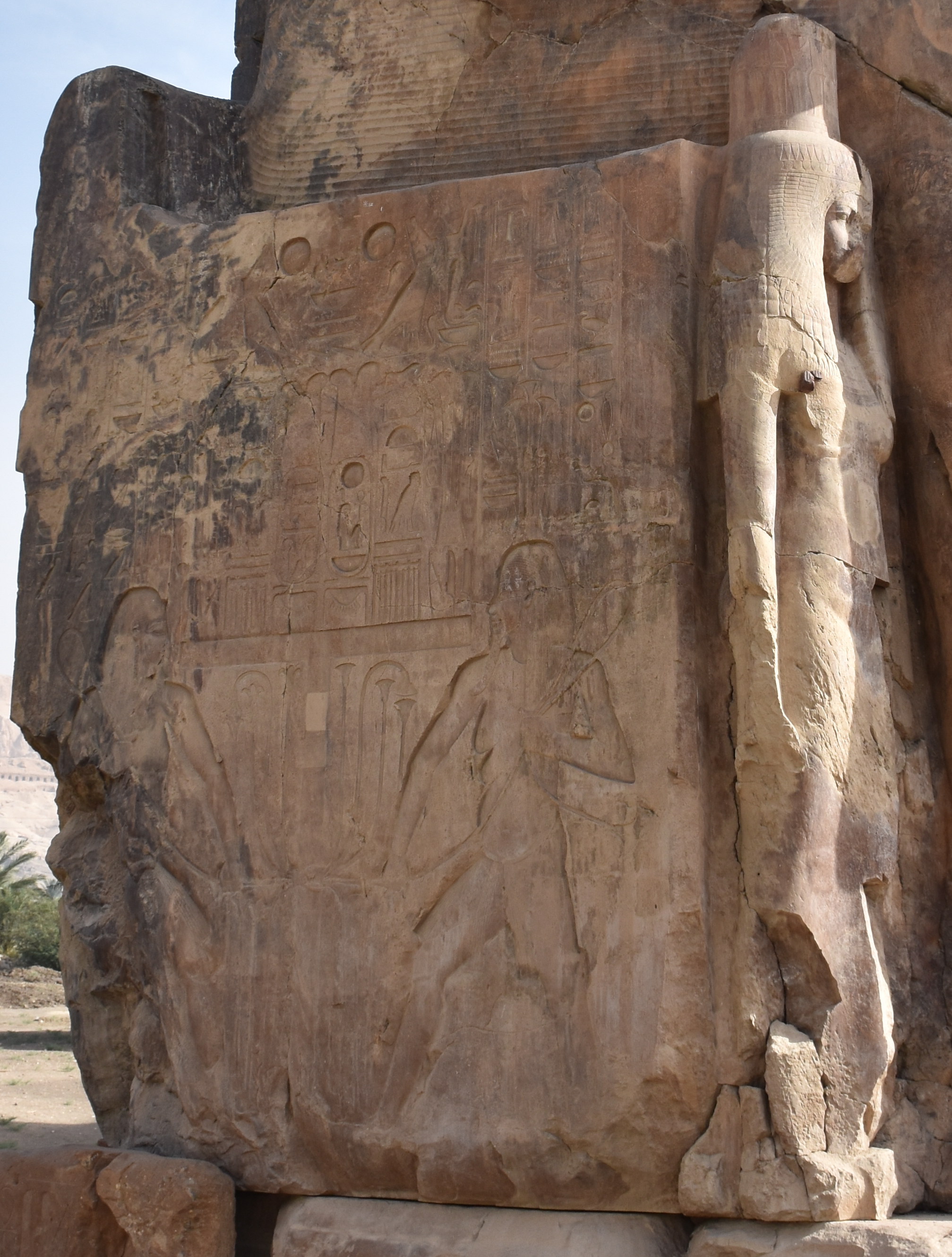
The twin statues depict Amenhotep III (fl. 14th century BC) in a seated position, his hands resting on his knees and his gaze facing eastwards (actually ESE in modern bearings) towards the river. Three shorter figures are carved into the front throne alongside his legs: these are his wife Tiye and mother Mutemwiya. The middle between Amenhotep III's ankles would have been an unidentified daughter, although it has been destroyed. The side panels depict the Nile god Hapi.
The statues are made from blocks of quartzite sandstone which was quarried at el-Gabal el-Ahmar (near modern-day Cairo) and transported 675 km overland to Thebes (Luxor). The stones are believed to be too heavy to have been transported upstream on the Nile. The blocks used by later Roman engineers to reconstruct the northern colossus may have come from Edfu (north of Aswan). Including the stone platforms on which they stand – themselves about 4 m – the colossi reach 18 m in height and weigh an estimated 720 tons each. The two figures are about 15 m apart. The size of the statues makes them visible up to over 10 miles away. Regarding their size; they stood as the guardians of Amenhotep III's mortuary temple. Amenhotep III's process of immortalizing himself in statuary was prevalent, His approach to statuary representation and inscriptions had supported his ideology as being much more than the king of kings. His titles repeatedly called him the "good god". Suzanne Bickel describes the height of both colossi were accessible to the surrounding public as a method of allowing all to worship Amenhotep III himself and the gods at his temple.
Both statues are quite damaged, with the features above the waist virtually unrecognizable. The southern statue comprises a single piece of stone, but the northern figure has a large extensive crack in the lower half and above the waist consists of 5 tiers of stone. These upper levels consist of a different type of sandstone, and are the result of a later reconstruction attempt, which William de Wiveleslie Abney attributed to Septimius Severus. It is believed that originally the two statues were identical to each other, although inscriptions and minor art may have varied.
The original function of the Colossi was to stand guard at the entrance to Amenhotep's memorial temple (or mortuary temple): a massive construct built during the pharaoh's lifetime, where he was worshipped as a god-on-earth both before and after his departure from this world. In its day, this temple complex was the largest and most opulent in Ancient Egypt. Covering a total of 35 ha, even later rivals such as Ramesses II's Ramesseum or Ramesses III's Medinet Habu were unable to match it in area; even the Temple of Karnak, as it stood in Amenhotep's time, was smaller.
_-_TIMEA.jpg)
Floods
Amenhotep III had positioned the mortuary temple in front of the floodplain of the Nile in an effort to fill a lake in front of the Colossi. Furthermore, this lake acted as a water retention reservoir and prevented the temple from flooding completely during high inundations. Hourig Sourouzian felt that Amenhotep III did not plan for the site to flood altogether as the surrounding wall for the mortuary temple behind the Colossi was constructed primarily of mud brick.
With the exception of the Colossi, however, very little remains today of Amenhotep's temple. It stood on the edge of the Nile floodplain, and successive annual inundations gnawed away at its foundations – a 1840s lithograph by David Roberts shows the Colossi surrounded by water – and it was not unknown for later rulers to dismantle, purloin, and reuse portions of their predecessors' monuments.
Roman era inscriptions
The statues contain 107 Roman-era inscriptions in Greek and Latin, dated between 20-250CE; these inscriptions allowed modern travellers to connect the statues to the classical Greek and Latin literature. Many of the inscriptions include the name "Memnon". Several of the inscriptions refer to sounds emitted by the statues, the most famous being poetry by Julia Balbilla recording multiple visits during November 130 CE in a party that included the Emperor Hadrian and his wife Vibia Sabina. Of the 107 Roman-era inscriptions: 61 of them are written in Greek, 45 are written in Latin, and one bilingual text is written.
They were first studied in detail by Jean-Antoine Letronne in his 1831 La statue vocale de Memnon considérée dans ses rapports avec l'Égypte et la Grèce and then catalogued in the second volume (1848) of his Recueil des inscriptions grecques et latines de l'Égypte. File:Colossi of Memnon 2022 19.jpg File:Colossi of Memnon 2022 23.jpg File:Colossi of Memnon 2022 26.jpg File:Colossi of Memnon 2022 30.jpg File:Memnon 11.jpg|Base inscriptions File:Ancient Greek Graffiti ... (36688175375).jpg|Leg inscriptions File:Memnonis crus dexterum - Pococke Richard - 1743.jpg|1743 transcription File:Memnonis crus alterum - Pococke Richard - 1743.jpg|1743 transcription
Earthquakes
Soon after its construction the temple was destroyed by an earthquake, recently dated by the Armenian Institute of Seismology to around 1200 BC, which left only the two huge colossi at the entrance still standing. These were further destroyed by an earthquake in 27 BC, after which they were partly reconstructed by the Roman authorities.
The 1200 BC earthquake also opened numerous chasms in the ground which meant that many statues were buried, some in pristine condition. These have been the subject of extensive restoration and excavation conducted by the Armenian/German archaeologist Hourig Sourouzian, who has revealed that the complex consisted of three pylons, each fronted by colossal statues, while at the far end a rectangular Temple complex consisted of a peristyle court surrounded by columns. So far four of the statues have been re-erected, with eight waiting to be re-erected, while some 200 statues or pieces of statues are in the Luxor Museum, some on display, others in store awaiting conservation.
Name
The modern Arabic name is Kom el-Hatan, but it is generally known by the Roman name as the Temple of Memnon. Memnon was a hero of the Trojan War and King of Ethiopia, who led his armies from Africa into Asia Minor to help defend the beleaguered city of Troy but was ultimately slain by Achilles. Memnon (whose name means the Steadfast or Resolute) was said to be the son of Eos, the goddess of dawn. He was associated with colossi built several centuries earlier, because of the reported cry at dawn of the northern statue (see below), which became known as the Colossus of Memnon. Eventually, the entire Theban Necropolis became generally referred to as the Memnonium making him "Ruler of the west" as in the case of the god Osiris who was called chief of the west.
In the 19th century, William de Wiveleslie Abney noted that "[t]he Arabs called these statues 'Shama' and 'Tama', and when speaking of them together gave them the appelation of Sanamât, or the idols."
Sounds
In 27 BCE, a large earthquake reportedly shattered the northern colossus, collapsing it from the waist up and cracking the lower half. Following its rupture, the remaining lower half of this statue was then reputed to "sing" on various occasions – always within an hour or two of sunrise, usually right at dawn. The sound was most often reported in February or March, but this is probably more a reflection of the tourist season rather than any actual pattern.
The earliest report in literature is that of the Greek historian and geographer Strabo, who said that he heard the sound during a visit in 20 BCE, by which time it apparently was already well-known.{{refn|I too, when I was present at the places with Aelius Gallus and his crowd of associates, both friends and soldiers, heard the noise at about the first hour, but whether it came from the base or from the colossus, or whether the noise was made on purpose by one of the men who were standing all round and near to the base, I am unable positively to assert; for on account of the uncertainty of the cause I am induced to believe anything rather than that the sound issued from stones thus fixed. Strabo, Rerum Geographicarum. XVII 1.46}} The description varied; Strabo said it sounded "like a blow", Pausanias compared it to "the string of a lyre" breaking, but it also was described as the striking of brass or whistling. Other ancient sources include Pliny (not from personal experience, but he collected other reports), Tacitus, Philostratus and Juvenal. In addition, the base of the statue is inscribed with about 90 surviving inscriptions of contemporary tourists reporting whether they had heard the sound or not.
The legend of the "Vocal Memnon", the luck that hearing it was reputed to bring, and the reputation of the statue's oracular powers became known outside of Egypt, and a constant stream of visitors, including several Roman emperors, came to marvel at the statues. The last recorded reliable mention of the sound dates from 196. Sometime later in the Roman era, the upper tiers of sandstone were added (the original remains of the top half have never been found); the date of this reconstruction is unknown, but local tradition places it circa 199, and attributes it to the Roman Emperor Septimius Severus in an attempt to curry favour with the oracle (it is known that he visited the statue, but did not hear the sound). Colossi of Memnon https://www.atlasobscura.com/places/colossi-of-memnon
Various explanations have been offered for the phenomenon; these are of two types: natural or man-made. Strabo himself apparently was too far away to be able to determine its nature: he reported that he could not determine if it came from the pedestal, the shattered upper area, or "the people standing around at the base". If natural, the sound was probably caused by rising temperatures and the evaporation of dew inside the porous rock.
Similar sounds, although much rarer, have been heard from some of the other Egyptian monuments (Karnak is the usual location for more modern reports). Perhaps the most convincing argument against it being the result of human agents is that it did cease, probably due to the added weight of the reconstructed upper tiers.
Since the northernmost statue is commonly associated with the renowned acoustic phenomenon, much of the literature and cultural discourse tends to overlook the southern counterpart. Despite its significance as a key structure commissioned by Amenhotep III, this oversight persisted. As a result, many Greco-Roman travelers, drawn by the mystique of the site, would etch their names upon the colossi during their visits, leaving behind inscriptions that reflect their fascination and desire for posterity.
Gallery
Modern images
File:Colossi of Memnon.jpg|The colossi of Memnon File:AmenhotepIII South Colossus.jpg|West (or south) colossus File:Egypt.ColossiMemnon.01.jpg|East (or north) colossus File:MEMNON (Ship) (c112-02-03).jpg|Sailing card for the clipper ship Memnon File:Memnon-Edit-3.jpg|Panoramic view
Notable historical images
File:The Statue of Memnon, at Thebes - Pococke Richard - 1743.jpg|1743 by Richard Pococke File:Thèbes. Memnonium (Ramesseum). Détails du colosse du sud. (Restoration) (NYPL b14212718-1267951).jpg|c.1800 from Description de l'Égypte File:Thèbes. Memnonium (Ramesseum). Détails de la statue colossalle de Memnon. (Restoration) (NYPL b14212718-1267952).jpg|c.1800 from Description de l'Égypte, showing the inscriptions File:Illustration by David Roberts, digitally enhanced by rawpixel-com 9.jpg|1830s from The Holy Land, Syria, Idumea, Arabia, Egypt, and Nubia File:Illustration by David Roberts, digitally enhanced by rawpixel-com 10.jpg |1830s from The Holy Land, Syria, Idumea, Arabia, Egypt, and Nubia File:Illustration by David Roberts, digitally enhanced by rawpixel-com 76.jpg |1830s from The Holy Land, Syria, Idumea, Arabia, Egypt, and Nubia File:Lepsius-Projekt tw 1-2-091.jpg|1850s in Lepsius' Denkmäler aus Ägypten und Äthiopien File:John Beasly Greene (American, born France - (The Colossus of Memnon at Thebes) - Google Art Project.jpg|1851, first ever photographs, by John Beasley Greene File:John Beasly Greene (American, born France - (The Colossus of Memnon) - Google Art Project (NgFgaIvzgkFPBw).jpg|1851, first ever photographs, by John Beasley Greene File:John Beasly Greene (American, born France - (The Colossus of Memnon) - Google Art Project.jpg|1851, first ever photographs, by John Beasley Greene File:Colossi of Memnon 10M.jpg|An Egyptian postage stamp
References
Citations
Bibliography
- Lord Curzon: "The Voice of Memnon" in Tales of Travel (1923)
- Rupert T. Gould: "Three Strange Sounds: The Cry of Memnon" in Enigmas: Another Book of Unexplained Facts (1929)
- Armin Wirsching: "Excursion on transport and erection of the Colossi" in: Armin Wirsching: Obelisken transportieren und aufrichten in Aegypten und in Rom (3rd ed. 2013)
- Denon, V. Voyage Dans La Basse Et La Haute Egypte. Paris: s.n., 1802.
- Kozloff, Arielle P. Amenhotep III: Egypt’s Radiant Pharaoh. Cambridge: Cambridge University Press, 2012.
- O’Connor, David B., and Eric H. Cline. Amenhotep III: Perspectives on his reign. Ann Arbor, MI: The University of Michigan Press, 1998.
- Rosenmeyer, Patricia A. The language of Ruins: Greek and Latin Inscriptions on the Memnon Colossus. New York, NY: Oxford University Press, 2018.
- Weeks, Kent R., and Araldo De Luca. Valley of the Kings. New York, NY: Friedman/Fairfax, 2001.
References
- "Luxor, Egypt". BBC News.
- Wilfong, T.. "Places: 786066 (Memnon Colossi)". Pleiades.
- Adam Łukaszewicz, [https://bazhum.muzhp.pl/media/files/The_Journal_of_Juristic_Papyrology/The_Journal_of_Juristic_Papyrology-r1995-t25/The_Journal_of_Juristic_Papyrology-r1995-t25-s131-146/The_Journal_of_Juristic_Papyrology-r1995-t25-s131-146.pdf MEMNON, KING OF EGYPT], The Journal of Juristic Papyrology, Vol. XXV, 1995, pp. 131-146: "Are two different etymologies of Memnonia and Memnon possible in the same area? We are approaching again the very essence of the problem. Is the name of Memnonia a derivative of the appellation of the vocal colossus or is that name independent from the name of Memnon applied to the statue of Amenhotep III? Consequently, the question is whether there was an Egyptian Memnon different from Amenhotep III or was the name of Nebmaatre the unique source of the Memnonian place-names in western Thebes?"
- (1998). "Amenhotep III: perspectives on his reign". the University of Michigan press.
- R. F. Heizer. (1973-12-21). "The Colossi of Memnon Revisited". [[Science (journal).
- "The Seventy Wonders of the Ancient World", edited by Chris Scarre (1999) Thames & Hudson, London
- Time Life Lost Civilizations series: Ramses II: Magnificence on the Nile (1993)
- Denon, Vivant. (1802). "Voyage Dans La Basse Et La Haute Egypte".
- Kozloff, Arielle P.. (2012). "Amenhotep III: Egypt's radiant pharaoh". Cambridge University Press.
- (2012-02-20). "The Birthplace of Amenhotep III". Cambridge University Press.
- [https://digi.ub.uni-heidelberg.de/diglit/abney1876/0020/image ''Thebes and its five greater temples ''], by [[William de Wiveleslie Abney]]; published 1876 by Sampson, Low, Marston, Searle, & Rivington; archived at the [[University of Heidelberg]]
- Kozloff, Arielle P.. (2012). "Amenhotep III: Egypt's radiant pharaoh". Cambridge University Press.
- Rosenmeyer, P.A.. (2018). "The Language of Ruins: Greek and Latin Inscriptions on the Memnon Colossus". Oxford University Press.
- Rosenmeyer, Patricia A.. (2017). "The language of ruins: Greek and Latin inscriptions on the Memnon colossus". Oxford University Press.
- Letronne, A.J.. (1833). "La statue vocale de Memnon considérée dans ses rapports avec l'Égypte et la Grèce: étude historique faisant suite aux recherches pour servir à l'histoire de l'Égypte pendant la domination des grecs et des romains". Imprimerie royale.
- [https://numelyo.bm-lyon.fr/f_view/BML:BML_00GOO0100137001102566580/IMG00000031# Recueil des inscriptions grecques et latines de l'Égypte], volume 2, planches
- Archaeoseismological studies at the temple of Amenhotep III, Luxor, Egypt, Arkadi Karakhanyan et al, The Geological Society of America Special Paper 471, 2010
- Sourouzian, H. and Lawler, A.; Unearthing Egypt's Greatest Temple, Smithsonian Magazine 38, 46–53.
- Liddell-Scott-Jones Greek-English Lexicon
- Godwin, William. (1876). "Lives of the Necromancers". London, F. J. Mason.
- Strabo, Rerum Geographicarum. XVII 42-46
- Strabo, Rerum Geographicarum. XVII, 561
- Pausania, Attica. I, XLII, 3.
- Tacito, Annales. II, 61
- Plinio, Naturalis Historiae. XXXVI, VII, 10-12.
- Septimius Severus https://www.worldhistory.org/Septimius_Severus/
- Colossi of Memnon: View of the northern colossi https://curate.nd.edu/show/b8515m63c0t/
- Colossi of Memnon § The Singing Statue https://www.worldhistory.org/Colossi_of_Memnon/
- Rosenmeyer, Patricia A.. (2018). "The language of ruins: Greek and Latin inscriptions on the Memnon colossus". Oxford University Press.
This article was imported from Wikipedia and is available under the Creative Commons Attribution-ShareAlike 4.0 License. Content has been adapted to SurfDoc format. Original contributors can be found on the article history page.
Ask Mako anything about Colossi of Memnon — get instant answers, deeper analysis, and related topics.
Research with MakoFree with your Surf account
Create a free account to save articles, ask Mako questions, and organize your research.
Sign up freeThis content may have been generated or modified by AI. CloudSurf Software LLC is not responsible for the accuracy, completeness, or reliability of AI-generated content. Always verify important information from primary sources.
Report