From Surf Wiki (app.surf) — the open knowledge base
Coke bottle styling
Automotive body design with a narrow center surrounded by flaring fenders

Automotive body design with a narrow center surrounded by flaring fenders
Coke bottle styling is an automotive body design with a narrow center surrounded by flaring fenders. This design element bears a general resemblance to a Coca-Cola classic glass contour bottle design, and was inspired by the tapering middle fuselage of contemporary fighter jets. Industrial designer Raymond Loewy, who in 1955 had re-designed the actual Coke bottle as well,{{Cite web | access-date = October 20, 2019 | archive-date = August 19, 2019 | archive-url = https://web.archive.org/web/20190819164556/https://www.coca-colacompany.com/stories/the-story-of-the-coca-cola-bottle | url-status = dead
Origin
Main article: Area rule
The design was pioneered in fighter jets to significantly reduce the sharp drag rise at transonic speed and supersonic speeds. Using this design often results in a pinch-waisted fuselage shape that National Advisory Committee for Aeronautics (NACA) labeled the design principle the "area rule" and variously identified as a coke bottle, wasp waist, or Marilyn Monroe shape (i.e. an hourglass figure). The area rule design technique is most effective between Mach 0.75 and 1.2, or at speeds over 575 mph. The design technique on automobiles provides a visual attraction, but negligible performance improvement.
Development

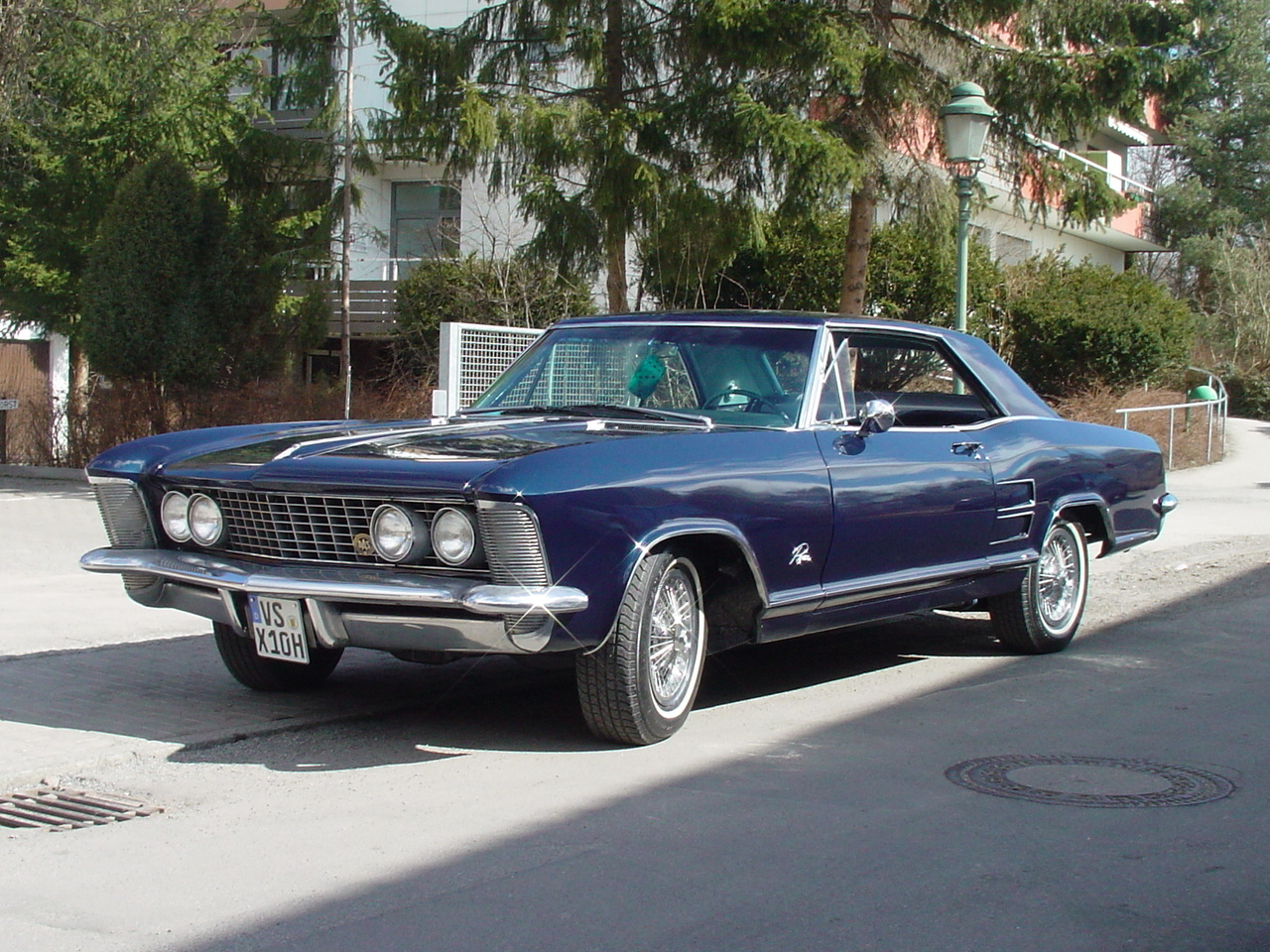
The exotic shapes of early supersonic fighter jets dramatically influenced automobile stylists. First, the tailfin fad, appeared in the mid-1950s and was on the decline by the early 1960s, then the "Coke bottle" look of severely wasp-waisted high-performance jet fighters, such as the Northrop F-5. The initial result was luxury performance automobiles, such as the 1962 Studebaker Avanti and 1963 Buick Riviera, earned this term "by having more rounded body panels with arcs over the wheelwells, making them resemble bottles of Coca-Cola laid on their sides."
United States
Studebaker introduced the Raymond Loewy-designed Avanti gran turismo with pronounced Coke bottle look in 1962. The 1962 Pontiac full-size models also "had a subtle horizontal crease about halfway down [the bodyside] and a slight wasp-waist constriction at the doors which swelled out again in the rear quarters" One of the cleanest examples of the "Coke bottle" styling was the 1963 Buick Riviera, a pioneering personal luxury car. Chevrolet first applied the Coke bottle look on Bill Mitchell's 1963 Corvette Sting Ray. The styling of the 1962 through 1968 versions has been described "like a bottle of Coke on wheels" because of the long hood and "powerful wheel arches".
By 1966, the General Motors A-body sedans received a mid-riff pinch and "hop up" fenders. Intermediates such as the 1968-1970 Dodge Charger and Ford Torino followed suit, as well as compacts such as the Ford Maverick and Plymouth Duster. General Motors also styled their "B" body full-size cars from 1965 to 1968 with this style, which is most prominent on the "fastback" 2-door hardtop models. Chrysler's "interpretation of the Coke-bottle styling treatment to its struggling B-body cars ... [resulted in] ... smooth lines, subtly rounded curves, and near perfect proportions." Notable automobiles with this style include many of the muscle cars during this era, such as the Pontiac GTO, Chevrolet Camaro, and Dodge Charger.
Design "themes" such as the "hop up" fenders became so pervasive across the industry that American Motors' all-new 1967 Rebel was criticized because "viewed from any angle, anyone other than an out-and-out car buff would have trouble distinguishing the Rebel from its GM, Ford, and Chrysler Corp. competition." However, AMC discovered that compared to slab styling with deeply sculpted ridges, "the rounded "Coke-bottle" panels would be easier to make and the dies would last longer — an important cost consideration."
Author Clinton Walker described the archetypal product of Australian suburbia, the muscle car, with its "Coke bottle hip bump but the midriff of a go-go dancer?" According to automotive historian Darwin Holmstrom, Chevrolet "took it to its illogical extreme with the 1968 Corvette, though that car more closely resembled a prosthetic phallus than a Coke bottle".
By the late-1970s and early-1980s, cars like the Ford Fairmont and Chrysler K-cars moved towards straight lines. The Audi 100 (C3) and Ford Taurus led towards functional aerodynamic styling.
International markets
This styling "was to be seen right across the marketplace and, before long, around the world". Japanese, European, and Australian automobiles also adopted this style during the latter 1960s and into 1970s.
In Japan, Toyota released the curvaceous limited production Toyota 2000GT in 1967, characterized by its "flowing design" and "Coke Bottle Shape". Other period Toyota Coke bottle designs include the 1972-1976 Toyota Corona Mark II and the Toyota Celica. Japanese automaker Nissan offered this appearance on the 1970s-era Nissan Cedrics, Nissan Glorias, Nissan Laurels, Nissan Bluebirds, and Nissan Violets. Mitsubishi also adopted this appearance on the 1973 through 1980 Galant and the 1973-1979 Lancer. The smallest car with this style is usually considered to be the 1967 Suzuki Fronte 360, which was less than 3 m long, while the Subaru 360 also used similar styling elements, notably the curvaceous "belt line".
Examples
- AMC Ambassador (1967-1969) {{cite book |url= https://books.google.com/books?id=r9j7MWLE_jMC&dq=Cars+with+Coke+bottle+styling&pg=PA74
- AMC Javelin (1968-1974)
- Buick Riviera (1963-1965)
- Chevrolet Camaro (1967-1969)
- Chevrolet Corvair (1965–1969)
- Chevrolet Impala (1965–1970)
- Corvette Sting Ray (1963-1967)
- Dodge Charger (1968-1970)
- Studebaker Avanti (1963-1964)
Gallery
1965 Pontiac Bonneville (13924689508).jpg|1965 Pontiac Bonneville Lamborghini Miura (Kirchzarten) jm20695.jpg|1966 Lamborghini Miura P400 1967 Chevrolet Camaro convertible, base six.jpg|1967 Chevrolet Camaro Toyota 2000GT rear.jpg|1967-1969 Toyota 2000GT Opel Commodore A 2500-6 2.JPG|1967-1971 Opel Commodore A Vauxhall Victor FD license plate 1968 in Hertfordshire with lots of grass.jpg|1967-1972 Vauxhall Victor FD 1968 Dodge Charger R-T - Flickr - Highway Patrol Images.jpg|1968 Charger R/T 1969 Corvette.jpg|1969 Chevrolet Corvette 1970 Toyota Celica 01.jpg|1970 Toyota Celica 1971 AMC Javelin SST red Kenosha street.JPG|1971 AMC Javelin Chrysler VH Valiant Charger R-T HEMI Six-Pack.jpg|1971 Chrysler Australia's Valiant Charger PlymouthBarracuda.jpg|1972 Plymouth Barracuda File:Ford Cortina MkIII GXL ca 2000cc registered June 1972.JPG|1972 Ford Cortina Mark III 10 Tango Code K Sed 68S 21H==.JPG|1973-1976 Ford Falcon XB 1976_Datsun_180B_(P610)GL_sedan(2011-01-05).jpg|1977 Datsun 180B GL sedan
References
References
- (20 November 2016). "Plymouth Belvedere and Plymouth Satellite".
- (13 March 2021). "Ranking The Greatest "Coke Bottle" Car Designs Of All Time". HotCars.
- (2004). "Ultimate Hot Rod Dictionary: A-Bombs to Zoomies". MBI Publishing.
- (1993). "Fifty Years Among the New Words: A Dictionary of Neologisms, 1941-1991". Cambridge University Press.
- Heversi, Dennis. (25 October 2009). "Richard T. Whitcomb Is Dead at 88; Revolutionized the Design of Jet Aircraft". The New York Times.
- Warwick, Graham. (17 April 2006). "Flying Sideways".
- Holmstrom, Darwin. (2016). "American Muscle Cars: A Full-Throttle History". Motorbooks.
- Jedlicka, Dan. "1963-64 Studebaker Avanti".
- Wilson, Paul Carroll. (1976). "Chrome dreams: automobile styling since 1893". Chilton.
- (2011). "Car: The Definitive Visual History of the Automobile". DK Publishing.
- Mueller, Mike. (2002). "Chevelle". MotorBooks.
- "Design: Drink a Coke, drive a Coke".
- (2006). "Muscle: America's Legendary Performance Cars". MBI Publishing.
- Kilpatrick, Bill. (October 1966). "1967: The Showdown Year".
- (1 January 2020). "How American Motors abandoned its uniqueness in the second half of the 1960s".
- Mitchell, Larry. (2000). "AMC Muscle Cars". Motorbooks.
- Walker, Clinton. (2009). "Golden Miles: Sex, Speed and the Australian Muscle Car". Wakefield Press.
- [https://books.google.com/books?id=zlteCwAAQBAJ&dq=took+it+to+its+illogical+extreme+with+the+1968+Corvette,+though+that+car+more+closely+resembled+a+prosthetic+phallus+than+a+Coke+bottle&pg=PA130 Holmstrom, p. 130.]
- Ozeki, Kazuo. (2007). "Suzuki Story: Small Cars, Big Ambitions". Miki Press.
- Quella, Chad. (16 November 2020). "The Spirit Is Still Alive: American Motors Corporation 1954-1987: 1967".
- Strohl, Daniel. (July 2005). "Attack of the Welterweight".
- Robinson, Aaron. (17 November 2023). "First-Gen Camaro (1967–69): The one that picked a fight". Hagerty.
- Cheetham, Craig. (2006). "Ultimate American Cars". MotorBooks/MBI.
- "1967 Chevrolet Impala".
- Magnante, Steve. (10 August 2012). "1968 Dodge Charger R/T 426 Hemi First Drive". Motor Trend.
- (17 December 2007). "1963-1964 Studebaker Avanti".
This article was imported from Wikipedia and is available under the Creative Commons Attribution-ShareAlike 4.0 License. Content has been adapted to SurfDoc format. Original contributors can be found on the article history page.
Ask Mako anything about Coke bottle styling — get instant answers, deeper analysis, and related topics.
Research with MakoFree with your Surf account
Create a free account to save articles, ask Mako questions, and organize your research.
Sign up freeThis content may have been generated or modified by AI. CloudSurf Software LLC is not responsible for the accuracy, completeness, or reliability of AI-generated content. Always verify important information from primary sources.
Report