From Surf Wiki (app.surf) — the open knowledge base
COinS
Bibliographic metadata embedding method
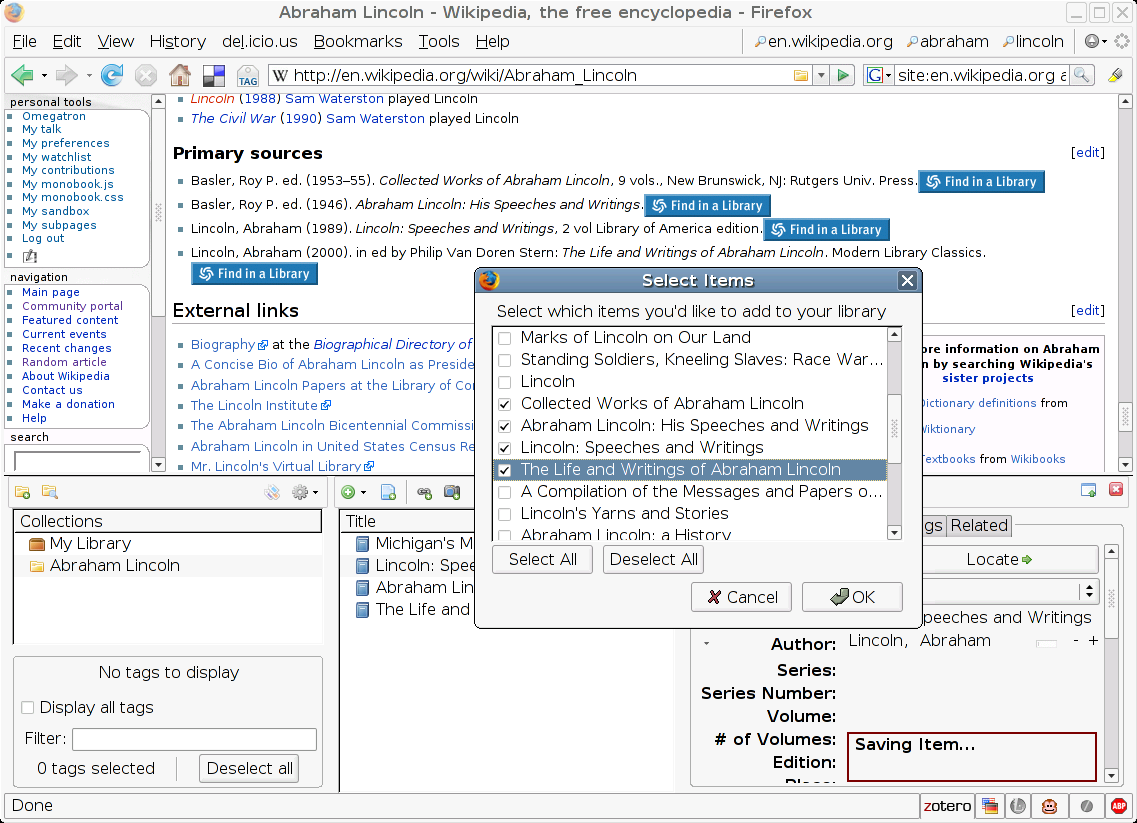
Bibliographic metadata embedding method
ContextObjects in Spans (COinS) is a method to embed bibliographic metadata in the HTML code of web pages. This allows bibliographic software to publish machine-readable bibliographic items and client reference management software to retrieve bibliographic metadata. The metadata can also be sent to an OpenURL resolver. This allows, for instance, searching for a copy of a book at a specific library.
History
In the late 1990s, OpenURL was created at Ghent University as a framework to provide context-sensitive links. The OpenURL link server implementation called SFX was sold to Ex Libris Group which marketed it to libraries, shaping the idea of a "link resolver". The OpenURL framework was later standardized as ANSI/NISO Z39.88 in 2004 (revised 2010). A core part of OpenURL was the concept of "ContextObjects" as metadata to describe referenced resources.
In late 2004, Richard Cameron, the creator of CiteULike, drew attention to the need for a standard way of embedding metadata in HTML pages. In January 2005, Daniel Chudnov suggested the use of OpenURL. Embedding OpenURL ContextObjects in HTML had been proposed before by Herbert Van de Sompel and Oren Beit-Arie and a working paper by Chudnov and Jeremy Frumkin. Discussion of the latter on the GPS-PCS mailing list resulted in a draft specification for embedding OpenURLs in HTML, which later became COinS. A ContextObject is embedded in an HTML span element.
The adoption of COinS was pushed by various publications and implementations. The specification was OCOinS.info, which includes specific guides to implement COinS for journal articles and books. Despite the specification webpage no longer being live, the standard is still usable, though fairly rare.
Data model
From OpenURL 1.0, COinS borrows one of its serialization formats ("KEV") and some ContextObject metadata formats included in OpenURL implementation guidelines. The ContextObject implementation guidelines of COinS include four publication types (article with several subtypes, book, patent, and generic) and a couple of simple fields. However, the guidelines are not a required part of COinS, so the standard does not provide a strict metadata model like Dublin Core or the Bibliographic Ontology.
Use
The use of COinS is still fairly rare.
The following websites make use of COinS:
- HubMed
- Wikipedia
Server-side applications
Some server-side applications embed COinS, including refbase.
Client tools
Client tools which can make use of COinS include:
- BibDesk
- Bookends (Mac)
- Citavi
- LibX
- Mendeley
- ResearchGate
- Sente (Mac)
- Zotero
References
References
- Chudnov, Daniel. (14 July 2006). "COinS for the Link Trail". Library Journal.
- (2004). "ANSI/NISO Z39.88-2004(R2010) – The OpenURL Framework for Context-Sensitive Services". National Information Standards Organization.
- (20 December 2004). "Autodiscovery and embedding metadata".
- (6 January 2005). "sample inline openurl".
- Van de Sompel, Herbert. (July–August 2001). "Generalizing the OpenURL Framework beyond References to Scholarly Works – The Bison-Futé Model". D-Lib Magazine.
- (10 December 2004). "Service Autodiscovery for Rapid Information Movement".
- "gcs-pcs-list".
- "Latent OpenURLs in HTML for Resource Autodiscovery, Localization and Personalization". OCOinS.info.
- "OpenURL COinS: A Convention to Embed Bibliographic Metadata in HTML".
- Tan, Hao. (11 November 2025). "Making Research Easier to Save: A Guide to Zotero Integration for Academic Websites".
- Apps, Ann. (16 April 2003). "Z39.88-2004 KEV Implementation Guidelines". MIMAS, The University of Manchester, UK.
- Bleier, Roman. (15 October 2021). "How to cite this digital edition?". Digital Humanities Quarterly.
- (17 December 2019). "Wikipedia:COinS".
- "Standard link resolver support: OpenURL & COinS".
- "BibDesk Help: 5.10.5 Web Group".
- "Importing with the Hunter".
- Reichelt, Jan. (5 August 2009). "Mendeley Web now supports COinS".
- "dev:exposing metadata:coins".
This article was imported from Wikipedia and is available under the Creative Commons Attribution-ShareAlike 4.0 License. Content has been adapted to SurfDoc format. Original contributors can be found on the article history page.
Ask Mako anything about COinS — get instant answers, deeper analysis, and related topics.
Research with MakoFree with your Surf account
Create a free account to save articles, ask Mako questions, and organize your research.
Sign up freeThis content may have been generated or modified by AI. CloudSurf Software LLC is not responsible for the accuracy, completeness, or reliability of AI-generated content. Always verify important information from primary sources.
Report