From Surf Wiki (app.surf) — the open knowledge base
Codd's cellular automaton
2D cellular automaton devised by Edgar F. Codd in 1968
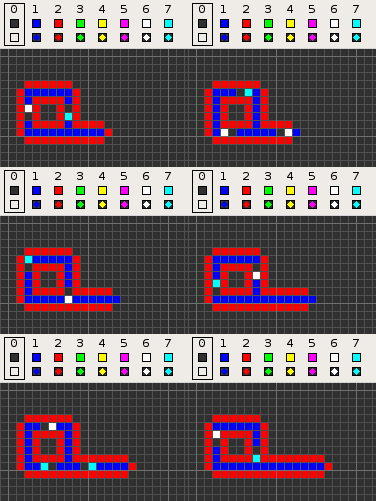
2D cellular automaton devised by Edgar F. Codd in 1968
Codd's cellular automaton is a cellular automaton (CA) devised by the British computer scientist Edgar F. Codd in 1968. It was designed to recreate the computation- and construction-universality of von Neumann's CA but with fewer states: 8 instead of 29. Codd showed that it was possible to make a self-reproducing machine in his CA, in a similar way to von Neumann's universal constructor, but never gave a complete implementation.
History
In the 1940s and '50s, John von Neumann posed the following problem:
- What kind of logical organization is sufficient for an automaton to be able to reproduce itself? He was able to construct a cellular automaton with 29 states, and with it a universal constructor. Codd, building on von Neumann's work, found a simpler machine with eight states. This modified von Neumann's question:
- What kind of logical organization is necessary for an automaton to be able to reproduce itself?
Three years after Codd's work, Edwin Roger Banks showed a 4-state CA in his PhD thesis that was also capable of universal computation and construction, but again did not implement a self-reproducing machine. John Devore, in his 1973 masters thesis, tweaked Codd's rules to greatly reduce the size of Codd's design. A simulation of Devore's design was demonstrated at the third Artificial Life conference in 1992, showing the final steps of construction and activation of the offspring pattern, but full self-replication was not simulated until the 2000s using Golly. Christopher Langton made another tweak to Codd's cellular automaton in 1984 to create Langton's loops, exhibiting self-replication with far fewer cells than that needed for self-reproduction in previous rules, at the cost of removing the ability for universal computation and construction.
Comparison of CA rulesets
| CA | number of states | symmetries | computation- and construction-universal | size of self-reproducing machine | ||||||||||||||
|---|---|---|---|---|---|---|---|---|---|---|---|---|---|---|---|---|---|---|
| von Neumann | 29 | none | yes | 130,622 cells | ||||||||||||||
| Codd | 8 | rotations | yes | doi=10.1162/artl.2010.16.2.16200 | journal=Artificial Life | volume=16 | issue=2 | pages=99–117 | author=Hutton, Tim J. | year=2010 | url=http://www.sq3.org.uk/papers/Hutton_CoddsSelfReplicatingComputer_2010.pdf | title=Codd's self-replicating computer | pmid=20067401 | s2cid=10049331 | access-date=2010-08-01 | archive-date=2012-02-05 | archive-url=https://web.archive.org/web/20120205001352/http://www.sq3.org.uk/papers/Hutton_CoddsSelfReplicatingComputer_2010.pdf | url-status=dead}} |
| Devore | 8 | rotations | yes | 94,794 cells | ||||||||||||||
| Banks IV (Banks IV Cellular Automaton) | 2 - 4 | rotations and reflections | yes | Somewhere around 100,000,000,000 cells | ||||||||||||||
| Langton's loops | 8 | rotations | no | 86 cells |
Specification
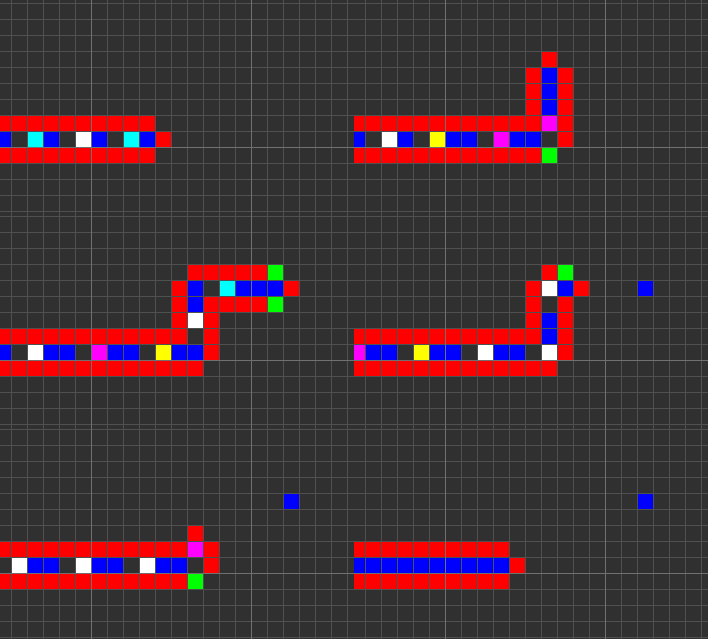
Codd's CA has eight states determined by a von Neumann neighborhood with rotational symmetry.
The table below shows the signal-trains needed to accomplish different tasks. Some of the signal trains need to be separated by two blanks (state 1) on the wire to avoid interference, so the 'extend' signal-train used in the image at the top appears here as '70116011'.
| purpose | signal train |
|---|---|
| extend | 70116011 |
| extend_left | 4011401150116011 |
| extend_right | 5011501140116011 |
| retract | 4011501160116011 |
| retract_left | 5011601160116011 |
| retract_right | 4011601160116011 |
| mark | 701160114011501170116011 |
| erase | 601170114011501160116011 |
| sense | 70117011 |
| cap | 40116011 |
| inject_sheath | 701150116011 |
| inject_trigger | 60117011701160116011 |
Universal computer-constructor
Codd designed a self-replicating computer in the cellular automaton, based on Wang's W-machine. However, the design was so colossal that it evaded implementation until 2009, when Tim Hutton constructed an explicit configuration. There were some minor errors in Codd's design, so Hutton's implementation differs slightly, in both the configuration and the ruleset.
References
References
- (1966). "''Theory of Self-Reproducing Automata.''". www.walenz.org.
- Codd, Edgar F.. (1968). "Cellular Automata". Academic Press, New York.
- Banks, Edwin. (1971). "Information Processing and Transmission in Cellular Automata". PhD thesis, MIT, Department of Mechanical Engineering.
- Langton, C. G.. (1984). "Self-Reproduction in Cellular Automata". Physica D: Nonlinear Phenomena.
- Hutton, Tim J.. (2010). "Codd's self-replicating computer". Artificial Life.
- "Roger Banks Proof of Universal Computation in Cellular Automata".
This article was imported from Wikipedia and is available under the Creative Commons Attribution-ShareAlike 4.0 License. Content has been adapted to SurfDoc format. Original contributors can be found on the article history page.
Ask Mako anything about Codd's cellular automaton — get instant answers, deeper analysis, and related topics.
Research with MakoFree with your Surf account
Create a free account to save articles, ask Mako questions, and organize your research.
Sign up freeThis content may have been generated or modified by AI. CloudSurf Software LLC is not responsible for the accuracy, completeness, or reliability of AI-generated content. Always verify important information from primary sources.
Report