From Surf Wiki (app.surf) — the open knowledge base
Cocoa butter
Pale-yellow, edible fat extracted from the cocoa bean

Pale-yellow, edible fat extracted from the cocoa bean
| Field | Value |
|---|---|
| name | Cocoa butter |
| image | Cocoa butter p1410148.JPG |
| caption | Raw cocoa butter |
| fatcomposition | y |
| sat | 57–64%: |
| stearic acid (24–37%), palmitic acid (24–30%), myristic acid, (0–4%), arachidic acid (1%), lauric acid (0–1%) | |
| unsat | 36–43% |
| monoun | 29–43%: |
| oleic acid (29–38%), palmitoleic acid (0–2%) | |
| polyun | 0–5%: |
| linoleic acid (0–4%), | |
| α-Linolenic acid (0–1%) | |
| properties | y |
| energy_per_100g | 3699 kJ |
| melt | 34.1 °C, 35 - |
| roomtemp | solid |
| refract | 1.44556–1.44573 |
| iodine | 32.11–35.12, 35.575 |
| acid | 1.68 |
| sapon | 191.214, 192.88–196.29 |
stearic acid (24–37%), palmitic acid (24–30%), myristic acid, (0–4%), arachidic acid (1%), lauric acid (0–1%) oleic acid (29–38%), palmitoleic acid (0–2%) linoleic acid (0–4%), α-Linolenic acid (0–1%)
Cocoa butter, also called theobroma oil, is a pale-yellow, edible fat extracted from the cocoa bean (Theobroma cacao). It is used to make chocolate, as well as some ointments, toiletries, and pharmaceuticals. Cocoa butter has a cocoa flavor and aroma. Its melting point is slightly below human body temperature. It is an essential ingredient of chocolate and related confectionary products. Cocoa butter does not contain butter or other animal products; it is vegan.
Extraction and composition
For use in chocolate manufacture, the cocoa beans are first fermented and then dried. The beans are then roasted and separated from their hulls to produce cocoa nibs. About 54–58% of the cocoa nibs is cocoa butter. The cocoa nibs are ground to form cocoa mass, also known as cocoa liquor or chocolate liquor. Chocolate liquor is pressed to separate the cocoa butter from the non-fat cocoa solids. Cocoa butter is sometimes deodorized to remove strong or undesirable tastes.
Cocoa butter contains a high proportion of saturated fats also with the monounsaturated oleic acid in each triglyceride. The predominant triglycerides are POS, SOS, and POP, where P = palmitic, O = oleic, and S = stearic acid residues. Cocoa butter, unlike non-fat cocoa solids, contains only traces of caffeine and theobromine.
| Fatty acid | Percentage |
|---|---|
| Arachidic acid (C20:0) | 1.0% |
| Linoleic acid (C18:2) | 3.2% |
| Oleic acid (C18:1) | 34.5% |
| Palmitic acid (C16:0) | 26.0% |
| Palmitoleic acid (C16:1) | 0.3% |
| Stearic acid (C18:0) | 34.5% |
| Other Fatty Acids | 0.5% |
Adulterants and substitutes
Some food manufacturers substitute less expensive materials in place of cocoa butter. Several analytical methods exist for testing for diluted cocoa butter. Adulterated cocoa butter is indicated by its lighter color and its diminished fluorescence upon ultraviolet illumination. Unlike cocoa butter, adulterated fat tends to smear and have a higher non-saponifiable content.
Owing to the high cost of cocoa butter, substitutes have been designed to use as alternatives. In the United States, 100% cocoa butter must be used as the product's fat source for the product to be called chocolate. The EU requires that alternative fats not exceed 5% of the total fat content.
Substitutes include: coconut, palm, and a mixture of mango kernel fat and palm oil, and PGPR.
Uses

Cocoa butter is a major ingredient in practically all types of chocolates, especially white, milk, and couverture chocolate. This application continues to dominate the consumption of cocoa butter.
Pharmaceutical companies use cocoa butter extensively. As a nontoxic solid at room temperature that melts at body temperature, it is considered an ideal base for medicinal suppositories.
Personal care
For a fat melting around body temperature, cocoa has good stability. This quality, coupled with natural antioxidants, prevents rancidity – giving it a storage life of two to five years. The velvety texture, pleasant fragrance and emollient properties of cocoa butter have made it a popular ingredient in products for the skin, such as soaps and lotions.
History
Cocoa butter was first made by boiling cocoa mass with water and skimming off the fat floating over it. In the 18th century, the first hydraulic presses were used to press cocoa butter and the (more effective) Van Houten press began to be employed in the second half of the 19th century. A by-product of chocolate factories, cocoa butter was mainly used for cosmetic and pharmaceutical preparations until the late 19th century. It eventually became a common chocolate ingredient with the rise of chocolate in confectionery.
Physical properties
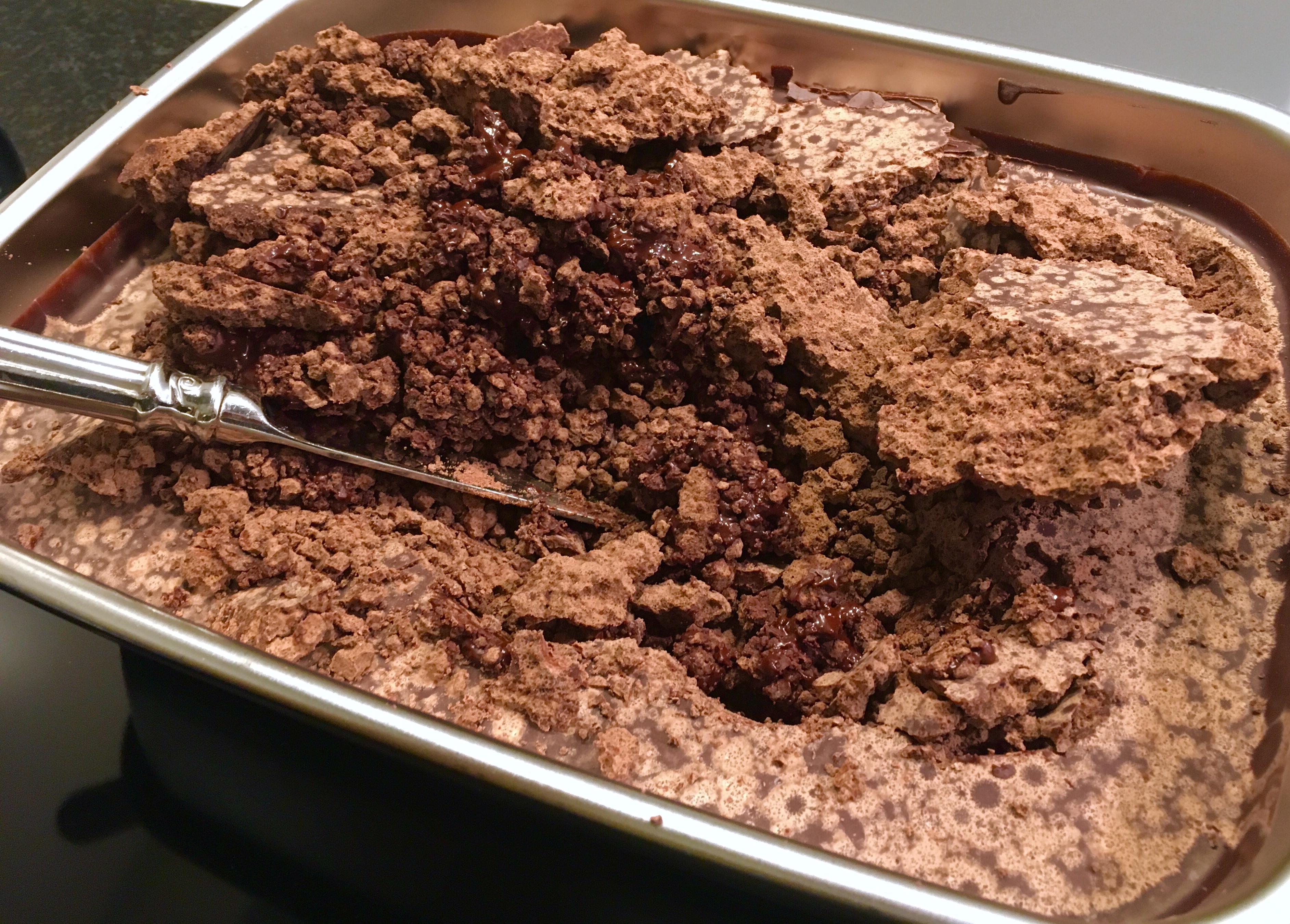
Cocoa butter typically has a melting point of around 34–38 C, so chocolate is solid at room temperature but readily melts once inside the mouth. Cocoa butter displays polymorphism, having different crystalline forms with different melting points. Conventionally the assignment of cocoa butter crystalline forms uses the nomenclature of Wille and Lutton with forms I, II, III, IV, V, and VI having melting points 17.3 ,, respectively. The production of chocolate aims to crystallize the chocolate so that the cocoa butter is predominantly in form V, which is the most stable form that can be obtained from melted cocoa butter. (Form VI either develops in solid cocoa butter after long storage or is obtained by crystallization from solvents). A uniform form V crystal structure will result in smooth texture, sheen, and snap. This structure is obtained by chocolate tempering. Melting the cocoa butter in chocolate and then allowing it to solidify without tempering leads to the formation of unstable polymorphic forms of cocoa butter. This can easily happen when chocolate bars are allowed to melt in a hot room and lead to the formation of white patches on the surface of the chocolate called fat bloom or chocolate bloom.
Cocoa butter from different places has different properties. Malaysian and Indonesian cocoa butter generally crystallize faster, and into a harder chocolate than Brazilian cocoa butter. Brazilian cocoa butter, after slowly crystallizing, forms a softer chocolate. West African cocoa butter has properties between the two.
References
Sources
References
- (15 August 2011). "Cocoa butter amounts converter". Convert-to.com.
- (July 1998). "Cocoa butter".
- Adams, Ashley. (August 12, 2019). "Is Cocoa Butter Vegan and Dairy-Free?". [[Dotdash Meredith]].
- "Cocoa butter pressing".
- The Nibble. "The World's Best White Chocolate Page 3: Percent Cacao & Cocoa Butter".
- (2004). "Fat bloom in chocolate and compound coatings". European Journal of Lipid Science and Technology.
- "Composition of the Cocoa Bean". Hershey Center for Health & Nutrition.
- (November 1997). "Characterization of cocoa butter extracted from Criollo cultivars of ''Theobroma cacao'' L.". Food Research International.
- (June 1981). "Composition of cocoa shell fat as related to cocoa butter". Zeitschrift für Ernährungswissenschaft.
- (5 October 2016). "USDA nutrient database".
- Frank, Jill. (24 October 2014). "Cocoa Butter Alternatives in Chocolate". Prospector.
- {{cite encyclopedia. Thomas. Alfred. Wiley-VCH. (2002)
- "Cocoa butter prices, bean futures soar".
- Moriarty, Andrew. "Cocoa Price: The full story behind the cocoa bean price increase".
- (1981). "Fatty acid composition and characteristics of the kernel fat of different mango (''Mangifera indica'') varieties". Journal of the Science of Food and Agriculture.
- (2012). "Blending of mango kernel fat and palm oil mid-fraction to obtain cocoa butter equivalent". Journal of Food Science and Technology.
- Beckett, Steve T.. (2017). "Beckett's Industrial Chocolate Manufacture and Use". [[John Wiley & Sons]].
- Chew, Norma. (24 November 2011). "What Are The Benefits of Cocoa Butter?". LiveStrong.
- Skrzypiec, Marcin. (2016-01-12). "Can Cocoa Powder Go Bad?".
- Dand, Robin. (1997). "The International Cocoa Trade". John Wiley & Sons.
- Clarence-Smith, William Gervase. (2003). "Cocoa and Chocolate, 1765-1914". [[Taylor & Francis]].
- Deite, Carl. (1888). "A Practical Treatise on the Manufacture of Soap and Candles". H. C. Baird & Company.
- (1966). "Polymorphism of cocoa butter". Journal of the American Oil Chemists' Society.
- Industrial Chocolate Manufacture and Use, 4th Edition, ed S.T. Beckett, Chapter 12, G. Talbot
This article was imported from Wikipedia and is available under the Creative Commons Attribution-ShareAlike 4.0 License. Content has been adapted to SurfDoc format. Original contributors can be found on the article history page.
Ask Mako anything about Cocoa butter — get instant answers, deeper analysis, and related topics.
Research with MakoFree with your Surf account
Create a free account to save articles, ask Mako questions, and organize your research.
Sign up freeThis content may have been generated or modified by AI. CloudSurf Software LLC is not responsible for the accuracy, completeness, or reliability of AI-generated content. Always verify important information from primary sources.
Report