From Surf Wiki (app.surf) — the open knowledge base
Cochlearia officinalis
Species of flowering plant

Species of flowering plant
Cochlearia officinalis, common scurvygrass, scurvy-grass, or spoonwort, is a species of flowering plant in the family Brassicaceae. The plant acquired its common name from the observation that it cured scurvy.
Description
Cochlearia officinalis is a biennial/perennial, growing to 10 -. the flowers are small, white or lilac, with four daisy-like petals. The spherical seeds ripen from July to September. The small, round seeds are reddish-brown. The flowers are hermaphrodite and the plant is self-fertile.
Taxonomy
It is commonly known as 'common scurvy-grass', 'scurvy-grass' and 'spoonwort'.
It was formally described by the Swedish botanist Carl Linnaeus in his Species Plantarum in 1753.
The specific epithet officinalis refers to the Linnaean term for plants with an established medicinal, culinary, or other use.
It has one known subspecies, Cochlearia officinalis subsp. integrifolia (Hartm.) Nordal & Stabbetorp.
Distribution and habitat
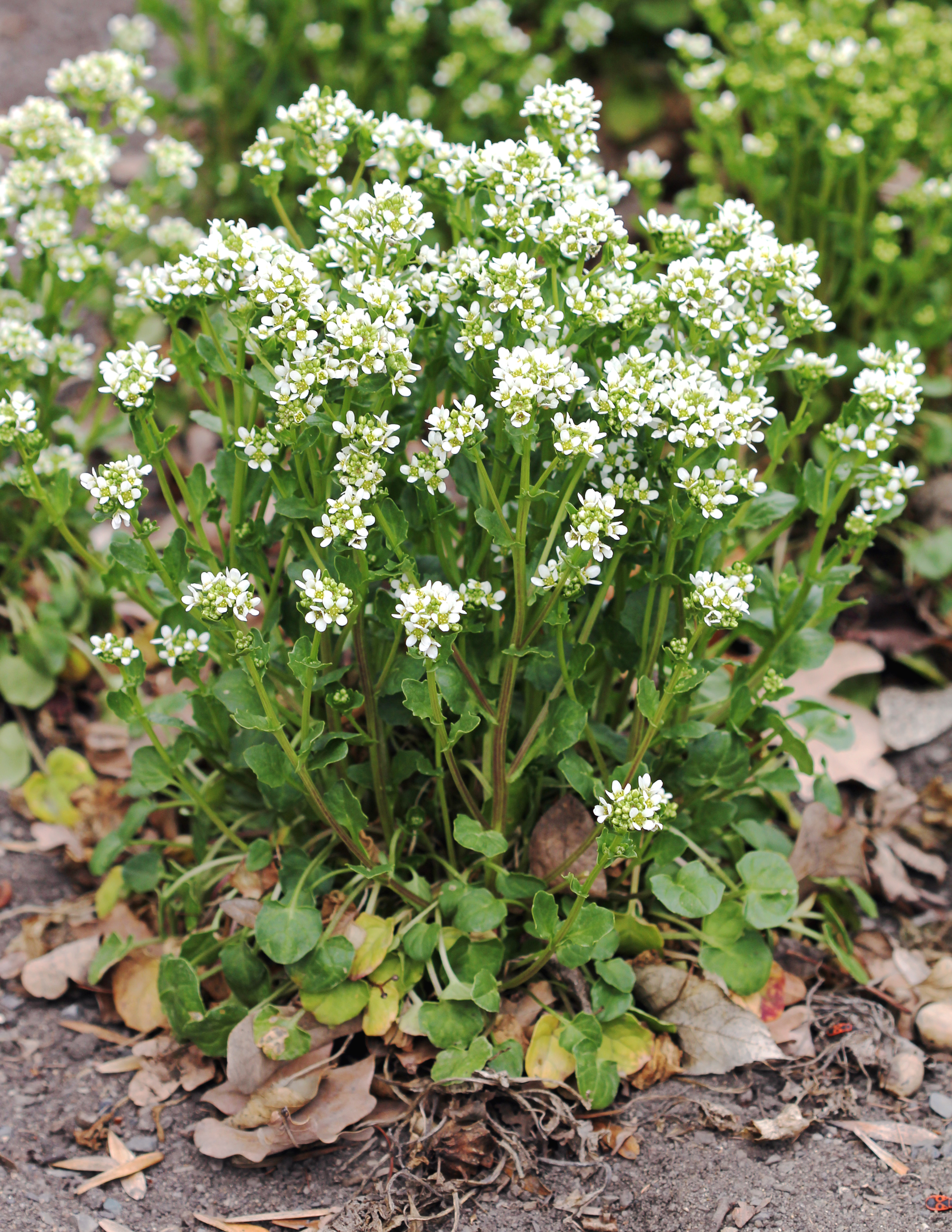
Cochlearia officinalis is native to temperate Europe.
Range
It is found within Eastern Europe, in the Russian Federation, (within the Administrative centre of Arkhangelsk, Komi, Murmansk and Nenets). In Central Europe, within Belgium, Germany, Netherlands and Switzerland. In Northern Europe, within Iceland, Denmark, the Faroe Islands, Finland, Ireland, Norway, Sweden and the United Kingdom, and in Southwestern Europe within France.
It has also naturalised in other parts of Europe such as Italy and Spain.
Habitat
It grows in the coastal and mountainous regions of Europe, including the Alps. In Ireland, it prefers saltmarshes, coastal cliffs and walls, and rocky, muddy seashores. In Northern Scandinavia, it grows in gravel beaches, crevices in beach cliffs and salt marshes.
Ecology
The flowers are pollinated by bees, flies, and beetles. The plant attracts wildlife and tolerates frost.
Uses
It was once used by herbalists as a cure for scurvy, as the plant contains Vitamin C. Nicholas Culpeper wrote of scurvygrass in his book Complete Herbal that its chief good effect is when used "by those that have the scurvy" and that it "is of singular good effect to cleanse the blood, liver and spleen, taking the juice in the Spring every morning fasting in a cup of drink". The plant was taken onboard ships in dried bundles or distilled extracts. Its very bitter taste was usually disguised with herbs and spices. Scurvygrass drinks and sandwiches were a popular in the UK until the mid-19th century, when citrus fruits became more readily available.
The leaves were made into a beer called scurvygrass ale, which has been occasionally remade as a craft ale.
References
References
- "Cochlearia officinalis - L.". Plants For A Future.
- (1981). "Reader's Digest Field Guide to the Wild Flowers of Britain". [[Reader's Digest]].
- "''Cochlearia officinalis''". rhs.org.uk.
- (2008). "Exploring the Cornish Coast". Alison Hodge.
- "Brassicaceae ''Cochlearia officinalis'' L.". ipni.org.
- (23 March 2012). "''Cochlearia officinalis'' L. is an accepted name". theplantlist.org.
- Stearn, William T.. (2004). "Botanical Latin". Timber Press (OR).
- (4 April 2012). "Taxon: ''Cochlearia officinalis'' L.". npgsweb.ars-grin.gov.
- "Information on Common Scurvygrass". wildflowersofireland.net.
- (2017). "RADseq provides evidence for parallel ecotypic divergence in the autotetraploid Cochlearia officinalis in Northern Norway". Scientific Reports.
- (24 April 2014). "52 WEEKS OF HISTORICAL HOW-TO'S, WEEK 26: BREWING SCURVY GRASS ALE!".
This article was imported from Wikipedia and is available under the Creative Commons Attribution-ShareAlike 4.0 License. Content has been adapted to SurfDoc format. Original contributors can be found on the article history page.
Ask Mako anything about Cochlearia officinalis — get instant answers, deeper analysis, and related topics.
Research with MakoFree with your Surf account
Create a free account to save articles, ask Mako questions, and organize your research.
Sign up freeThis content may have been generated or modified by AI. CloudSurf Software LLC is not responsible for the accuracy, completeness, or reliability of AI-generated content. Always verify important information from primary sources.
Report