From Surf Wiki (app.surf) — the open knowledge base
Cob (material)
Building material made of soil and fiber

Building material made of soil and fiber
Cob, cobb, or clom (in Wales) is a natural building material made from subsoil, water, fibrous organic material (typically straw), and sometimes lime. The contents of subsoil vary, and if it does not contain the right mixture, it can be modified with sand or clay. Cob is fireproof, termite proof, resistant to seismic activity, and uses low-cost materials, although it is very labour intensive. It can be used to create artistic and sculptural forms, and its use has been revived in recent years by the natural building and sustainability movements.
In technical building and engineering documents, such as the Uniform Building Code of the western USA, cob may be referred to as "unburned clay masonry," when used in a structural context. It may also be referred to as "aggregate" in non-structural contexts, such as "clay and sand aggregate," or more simply "organic aggregate," such as where cob is a filler between post and beam construction.
History and usage
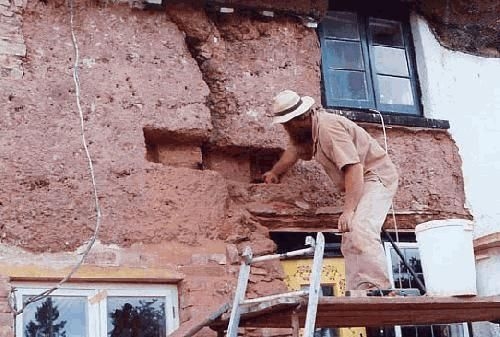

Cob is an English term attested to around the year 1600 for an ancient building material that has been used for building since prehistoric times. The use of this material in Iran is more than 4000 years old. The etymology of cob and cobbing is unclear, but in several senses means to beat or strike, which is how cob material is applied to a wall.
Many similar materials and methods of earthen building are used around the world, such as adobe, lump clay, torchis (French), bauge (French),
Cob structures can be found in a variety of climates across the globe. European examples include:
- in England, notably in the counties of Devon and Cornwall in the West Country, and in East Anglia (where it is referred to as clay lump)
- in Wales, notably in rural Anglesey
- in Donegal Bay in Ulster and in Munster, South-West Ireland
- in Finisterre and Ille-et-Vilaine in Brittany, where many homes have survived over 500 years and are still inhabited
Some of the oldest human-made structures in Afghanistan are composed of rammed earth and cob. Cobwork (tabya) was used in the Maghreb and al-Andalus in the 11th and 12th centuries, and was described in detail by Ibn Khaldun in the 14th century.
Many old cob buildings can be found in Africa, the Middle East, and the southwestern United States like the Taos Pueblo. A number of cob cottages survive from mid-19th-century New Zealand.
Traditionally, English cob was made by mixing the clay-based subsoil with sand, straw and water using oxen to trample it. English soils contain varying amounts of chalk, and cob made with significant amounts of chalk are called chalk cob or wychert. The earthen mixture was then ladled onto a stone foundation in courses and trodden onto the wall by workers in a process known as cobbing. The construction would progress according to the time required for the prior course to dry. After drying, the walls would be trimmed and the next course built, with lintels for later openings such as doors and windows being placed as the wall takes shape.
The walls of a cob house are generally about 24 in thick, and windows were correspondingly deep-set, giving the homes a characteristic internal appearance. The thick walls provided excellent thermal mass which was easy to keep warm in winter and cool in summer. Walls with a high thermal mass value act as a thermal buffer inside the home. The material has a long life-span even in rainy or humid climates, provided a tall foundation and large roof overhang are present
Cob is fireproof, while "fire cob" (cob without straw or fiber) is a refractory material (the same material, essentially, as unfired common red brick), and historically, has been used to make chimneys, fireplaces, forges and crucibles. Without fiber, however, cob loses most of its tensile strength.
Modern cob buildings
![The Sota Construction Services Corporate Headquarters in [[Pittsburgh]], [[Pennsylvania]], [[United States]], constructed of cob walls](https://upload.wikimedia.org/wikipedia/commons/8/80/Sota_Construction_Office_Building.jpg)


In 2000-01, a modern, four bedroom cob house in Worcestershire, England, UK, designed by Associated Architects, was sold for £999,000. Cobtun House was erected in 2001 and won the Royal Institute of British Architects' Sustainable Building of the Year award in 2005. The total construction cost was £300,000, but the metre (yard) thick outer cob wall cost only £20,000.
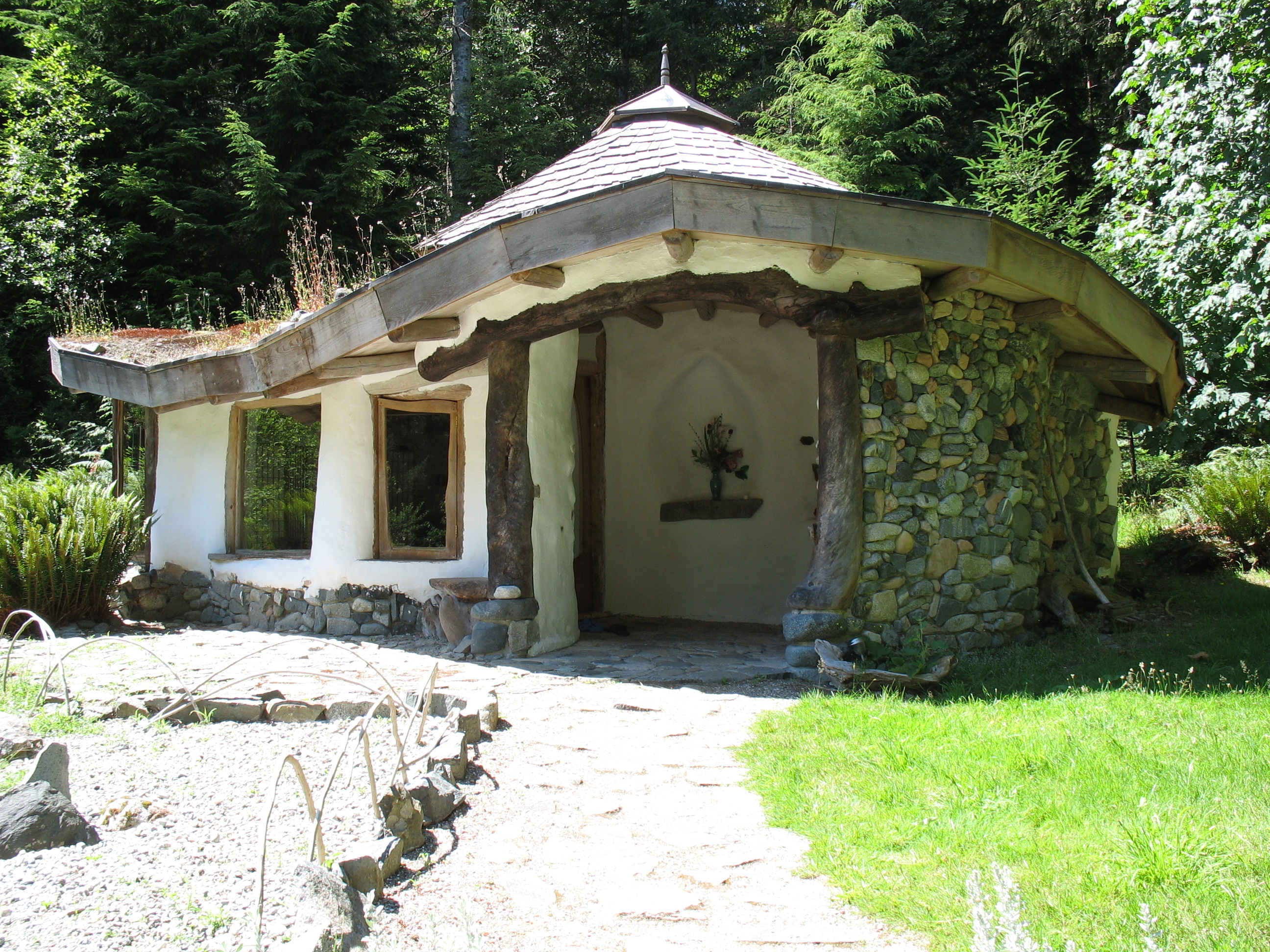
In the Pacific Northwest of the United States there has been a resurgence of cob construction, both as an alternative building practice and one desired for its form, function, and cost effectiveness. Pat Hennebery, Tracy Calvert, Elke Cole, and the Cobworks workshops erected more than ten cob houses in the Southern Gulf Islands of British Columbia, Canada.
In 2010, Sota Construction Services in Pittsburgh, Pennsylvania, United States, completed construction on its new 7,500 square foot corporate headquarters, which featured exterior cob walls along with other energy saving features like radiant heat flooring, a rooftop solar panel array, and daylighting. The cob walls, in conjunction with the other sustainable features, enabled the edifice to earn a LEED Platinum rating in 2012, and it also received one of the highest scores by percentage of total points earned in any LEED category.
In 2007, Ann and Gord Baird began constructing a two-storey cob house in Victoria, British Columbia, Canada, for an estimated $210,000 CDN. The home of 2,150 square feet includes heated floors, solar panels, and a southern exposure to enable passive solar heating.
Welsh architect Ianto Evans and researcher Linda Smiley refined the construction technique known as "Oregon Cob" in the 1980s and 1990s. Oregon Cob integrates the variation of wall layup technique which uses loaves of mud mixed with sand and straw with a rounded architectural stylism. They are experimenting with a mixture of cob and straw bale denominated "balecob".
Cob building code
In 2019 an appendix for the International Residential Code (IRC) was approved by a vote in the public comment hearings. Appendix U of the IRC governs use of cob in load-bearing walls of single story residential structures. Based on currently available test data, the appendix limits the conditions under which cob may be used without engineering approval, such as seismic activity.
References
References
- Wright, Joseph. "COB(B, sb3. 1.", ''The English Dialect Dictionary, Being the Complete Vocabulary of All Dialect Words Still in Use, or Known to Have Been in Use during the Last Two Hundred Years''. London: H. Frowde;, 1898. 676-677. Print.
- Goodnow, Cecelia. (October 5, 2007). "Thinking of building a cob home?". Seattle Post-Intelligencer.
- "cob, n2. 1." ''Oxford English Dictionary'' 2nd. ed. 2009. CD-rom.
- "cob". HarperCollins.
- Rapp, George Robert. "Unbaked clay or mud", ''Archaeomineralogy''. 2nd ed. Berlin: Springer, 2009. Print.
- (23 February 2012). "African architecture".
- Edwards, Jay Dearborn, and Nicolas Verton. "mud with straw", ''A Creole Lexicon Architecture, Landscape, People''. Baton Rouge: Louisiana State UP, 2004. Print.
- ''bousille'' (French mud with moss), beaten clay-''pahsa'' (Central Asia), and ''cat and clay''.[http://www.merriam-Webster.com/dictionary/cat%20and%20clay "cat and clay" Websters Online Dictionary accessed March 23, 2015.]
- "Earth Buildings and Their Repair". Cathedral Publications Ltd..
- Hilling, John B.. (2018). "The Architecture of Wales From the First to the Twenty-First Century". University of Wales Press.
- McArdle, Patricia. (June 19, 2011). "Afghanistan's Last Locavores". [[The New York Times]].
- Routledge Hill, Donald. (1996). "Encyclopedia of the history of Arabic science". Routledge.
- "Ferrymead Cob Cottage". New Zealand Historic Places Trust Pouhere Taonga.
- (2009). "Building Green: A Complete How-to Guide to Alternative Building Methods : Earth Plaster, Straw Bale, Cordwood, Cob, Living Roofs". Sterling Publishing Company, Inc..
- (2005). "Sustainable earth walls to meet the building regulations". Elsevier.
- Cioruța, Bogdan. (2016). "Trends In The Techniques Of Design And Building Traditional Earth Houses". [[North University of Baia Mare]].
- Saxton, R. H.. (1995). "The performance of cob as a building material". [[The Institution of Structural Engineers]].
- [http://transitionculture.org/about/ Practical Sustainability: About]
- Welcome to The Hollies. (2010-08-03). "The Hollies". thehollies.ie.
- "Sota Construction Services, Inc. - Sota Construction Corporate Offices".
- "Sota Construction Office Expansion | U.S. Green Building Council".
- Barton, Adriana. (3 August 2007). "A Dream Home Made of Mud". [[The Globe and Mail]].
- [http://www.networkearth.org/naturalbuilding/history.html The History of Cob]
- [http://www.alternativesmagazine.com/17/kemery.html Building with Oregon Cob]
- [https://www.iccsafe.org/building-safety-journal/bsj-technical/cob-code-appendix-approved-for-the-2021-irc/ Cob code appendix approved for the 2021 IRC]
This article was imported from Wikipedia and is available under the Creative Commons Attribution-ShareAlike 4.0 License. Content has been adapted to SurfDoc format. Original contributors can be found on the article history page.
Ask Mako anything about Cob (material) — get instant answers, deeper analysis, and related topics.
Research with MakoFree with your Surf account
Create a free account to save articles, ask Mako questions, and organize your research.
Sign up freeThis content may have been generated or modified by AI. CloudSurf Software LLC is not responsible for the accuracy, completeness, or reliability of AI-generated content. Always verify important information from primary sources.
Report