From Surf Wiki (app.surf) — the open knowledge base
Coat of arms of Canada
none

none
| Field | Value |
|---|---|
| name | Arms of His Majesty The King in Right of Canada |
| Armoiries de Sa Majesté le Roi du Canada | |
| image | Coat of arms of Canada.svg |
| armiger | Charles III, King of Canada |
| year_adopted | Approved by order in council on 21 April 1921, and by royal proclamation on 21 November 1921. last revised 12 July 1994. |
| crest | Upon a royal helmet, a lion passant guardant or imperially crowned proper and holding in the dexter paw a maple leaf gules. |
| torse | Argent and gules, the mantling gules doubled argent. |
| shield | Tierced in fess, the first and second divisions containing the quarterly coat following, namely, 1st gules three lions passant guardant in pale or, 2nd, or a lion rampant within a double tressure flory-counter-flory gules, 3rd, azure a harp or stringed argent, 4th, azure three fleurs-de-lis or, and the third division being argent three maple leaves conjoined on one stem proper. |
| supporters | Dexter: a lion or holding a lance argent, point or, flying therefrom to the dexter the Royal Union Flag, sinister: a unicorn argent armed, crined and unguled or, gorged with a coronet composed of crosses-patée and fleurs-de-lis a chain affixed thereto and reflexed or, holding a like lance flying therefrom to the sinister a banner azure charged with three fleurs-de-lis or. |
| compartment | A wreath of roses, thistles, shamrocks, and lilies proper. |
| motto | |
| orders | The ribbon of the Order of Canada () |
| other_elements | The whole ensigned by the royal crown proper. |
| earlier_versions | Arms of Canada, revised 1957 |
Armoiries de Sa Majesté le Roi du Canada
The coat of arms of Canada, also known as the Royal Coat of Arms of Canada or, formally, as the Arms of His Majesty The King in Right of Canada, is the arms of dominion of the Canadian monarch and, thus, also the official coat of arms of Canada. In use since 1921, it is closely modelled after the royal coat of arms of the United Kingdom, with French and distinctive Canadian elements replacing or added to those derived from the British version.
The maple leaves in the shield, blazoned "proper" (i.e., in natural colour), were originally drawn vert (green), but were redrawn gules (red) in 1957 and a circlet of the Order of Canada was added to the arms for limited use in 1987. The arms are registered with the Canadian Heraldic Authority and protected under Crown copyright; they are used to signify national sovereignty and the federal government uses the arms to represent the state under the Federal Identity Program. Elements of the coat of arms are also used in other designs, with the shield being used in the various royal standards belonging to members of the royal family and the crest of the arms serving as the focal point of the governor general's flag.
History
Prior to Confederation in 1867, the royal coat of arms of the United Kingdom served in Canada as the symbol of royal authority. Arms had not been granted to any of the colonies in British North America, apart from 17th century grants to Nova Scotia and Newfoundland. Arms were then granted by royal warrant, on 26 May 1868, to Ontario, Quebec, Nova Scotia, and New Brunswick. (That Nova Scotia had previously been granted arms was forgotten and it took until 1929 for the historic arms granted in the 17th century to be reinstated. which were used on the first Red Ensign carried by Canadian troops at Vimy Ridge in 1917.
As more provinces and territories joined Canada, the original four arms were marshalled with the arms of the new members of Confederation, eventually resulting in a shield with nine quarterings. This occurred by way of popular and even Canadian governmental usage; flag-makers took to using the complex shield on Canadian Red Ensigns. None of those shields, besides the original four-segment version of 1868, were ever official in any sense, nor were any of these shields a national "coat of arms", as they had never been approved by the monarch.
Heraldists considered nine quarterings on a shield as too convoluted for a national symbol and, A committee, which included Dominion Archivist Arthur Doughty, was formed in 1919 to pursue the issue, eventually agreeing that the elements of the new arms would reference the royal arms of England, Ireland, Scotland, and France, with maple leaves representing Canada, though there was at the time no consensus on how the leaves were to be used. A 1917 proposal by Edward Marion Chadwick (who had designed the crest, supporters, and motto of the coat of arms of Ontario) sparked a discussion about featuring First Nations figures as supporters. Though Chadwick had depicted the clothing and regalia accurately, Joseph Pope rejected the idea, stating, "I myself do not see any necessity for commemorating the Indians at all."
The arms' design was settled by the following year and the committee conferred with the College of Arms in London, only to face resistance to the use of the UK's royal arms from the Garter King of Arms, as well as concern over whether the inclusion of the fleurs-de-lis would imply Canada claimed sovereignty over France. The Canadian Commissioner-General in Paris discreetly confirmed with French officials that the coat of arms would not spark a diplomatic spat. A counter-proposal from the college added the flags to the supporters and a crown to the lion, as in the British arms, and placed the three fleurs-de-lis between two green maple leaves in the fifth charge on the shield, below the four charges of the arms of the UK.
After some manoeuvring, including the personal intervention of Winston Churchill, the new arms of Canada were eventually formally requested by an order-in-council on 21 April 1921 and adopted on 21 November of the same year, by proclamation of King George V, as the Arms or Ensigns Armorial of the Dominion of Canada;. the committee records were preserved with Library and Archives Canada. with the addition of maple leaves in the base and the reference to the French royal arms in the fourth quarter. Eugène Fiset, the Deputy Minister of Defence, claimed in 1918 that the design of the arms would determine the national colours of Canada and an unnamed member of the committee stated, "the colours of the shield will become the national colours of the Dominion [...] the red maple leaf has been used in service flags to denote men who have sacrificed their lives for the country [...] The case for white is that it contains an allusion to snow, which is characteristic of our climate and our landscape in certain seasons." In the 1940s, military historian Archer Fortescue Duguid suggested King George V had chosen red and white as Canada's official colours because those were the colours in the wreath and mantling on the arms. However, Forrest Pass, a curator at Library and Archives Canada, determined there is no record of either the King or the committee giving much importance to the mantling and the royal proclamation of the coat of arms makes no mention of national colours, specifically.
With the passage of the Statute of Westminster in 1931, Canada and other Dominions became fully sovereign from the United Kingdom. This had the effect of elevating the Canadian coat of arms, which had been granted as deputed arms for particular uses in a colony, to the status of the royal arms of the King in right of the country, for general purposes throughout the country. They thus replaced the British coat of arms, which had previously been arms of general purpose throughout the British Empire, in courtrooms and on government buildings to represent the reigning monarch. This change can be seen in the Great Seal of Canada of King George VI, where the royal arms of Canada replaced the British arms, and is even more evident in the Great Seal of Canada for Queen Elizabeth II, on which the title Queen of Canada is used.
By 1957, the arms were redrawn by Alan Beddoe so as to have red leaves and to change the royal crown from a Tudor design to one more resembling St Edward's Crown, as preferred by Queen Elizabeth II. While unsuccessful in this first attempt, Hicks continued his campaign and was joined by a number of other amateur and professional heraldists. As a journalist in the parliamentary press gallery in Ottawa in the late 1980s and early '90s, Hicks strategically recast the change as something worth doing to commemorate the 25th anniversary of the Order of Canada's founding, in 1992; an idea that was endorsed by the Advisory Committee on the Order of Canada.
It took until 1994 for the Queen to approve the new design for general use; though, the Canadian Heraldic Authority, established by the Queen in 1988, began to allow for its limited use beginning in 1987, where the arms were used to represent the Queen personally on letters patent granting new arms for distinguished Canadians.
Member of Parliament Pat Martin introduced, in June 2008, a motion into the House of Commons calling on the government to amend the coat of arms to incorporate symbols representing Canada's First Nations, Inuit, and Métis peoples, as Chadwick had suggested in 1917. After the coronation of King Charles III and Queen Camilla on 6 May 2023, the Canadian Heraldic Authority revealed a new Canadian Royal Crown featuring maple leaves, a snowflake, and symbols with meaning to Canada's Indigenous peoples. The authority stated changes will take place in due course.
Armorial evolution===
Arms of Canada 1868.svg|1868-1870, quartering the arms of the four founding provinces Arms of Canada 1870.svg|1870–1873, addition of Manitoba Arms of Canada 1873.svg|1873–1907, addition of British Columbia and Prince Edward Island Arms of Canada 1907.svg|1907–1921, addition of Saskatchewan and Alberta File:Coat of arms of Canada (1921).jpg|1921–1923 Coat of arms of Canada (1923).jpg|1923–1957 Coat of Arms of Canada (1957).png|1957–1994
Use
.jpg)
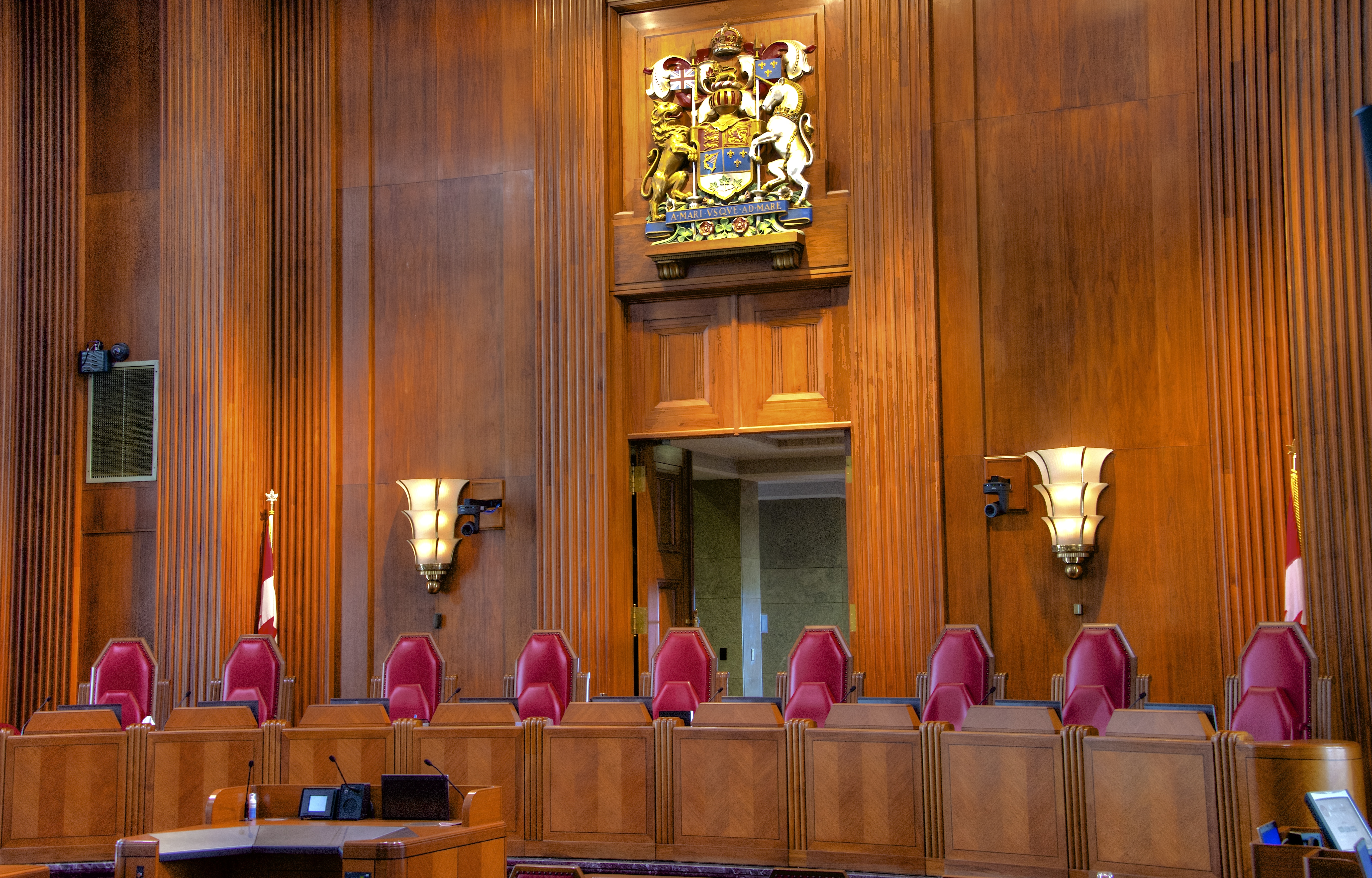
The coat of arms, being those of the sovereign and the state, is used to signify national sovereignty and ownership. The federal government uses the arms to represent the state under the Federal Identity Program and the prime minister within it, and the Supreme Court, as well as the Canadian Armed Forces and Royal Canadian Mounted Police (RCMP). In the latter two, the most senior non-commissioned ranks wear the 1957 version of the arms as a badge of rank, representing the fact that they have received the King's warrant (as opposed to the King's Commission for officers).
The arms of Canada is also present on all pre-polymer denominations of Canadian banknotes—printed on each bill in a way that functions as a security feature,—as well as the 50¢ coin and on the cover of Canadian passports. Permanent resident cards issued from 2009 to 2015 feature a holographic representation of the 1957 version of the coat of arms.
The full achievement of the coat of arms has been used by the Canadian government on occasion on a plain red flag, such as in 1967 for the country's centennial celebrations. It is also used on a flag in its full achievement in military ceremonies, such as Canadian Armed Forces Tattoo performances.
As the royal arms are personal to the sovereign, they cannot be used without the King's consent. The coat of arms "as designed in 1921 and revised in 1957 [...] [and] in 1994" are "protected under the Trade-marks Act and the Copyright Act and cannot be used or reproduced without authorization." Further, "marks and designs similar to the official symbols are pursued as a copyright or trade-mark infringement." In addition, under Crown copyright, "permission is always required when the work is being revised, adapted, or translated, regardless if the purpose of the reproduction is for personal or public non-commercial distribution."
Designs derived from the arms
The banner of the arms was in 2023 also made the sovereign's flag, for use by the monarch in Canada and when representing Canada abroad. Between 1962 and 2022, the banner of arms defaced with a variant of the Queen's cypher formed the Queen's Personal Canadian Flag, for use by Queen Elizabeth II. Six additional standards for use by other members of the Canadian royal family were created in the 2010s, all using a similar design with the banner of the arms as their base. The personal flag of the governor general has, since 1981, featured the crest of the royal arms of Canada on a blue background.
With the support of former Speakers of the House of Commons John Fraser and Gilbert Parent, Bruce Hicks campaigned for the Canadian Parliament to have a distinct heraldic symbol, along the lines of the portcullis (variations of which are used by the Commons and Lords in the British Parliament). In response, Member of Parliament Derek Lee tabled a motion calling for a committee to be struck, which passed and Hicks and Robert Watt, the first Chief Herald of Canada, were called as the only two expert witnesses; though, Senator Serge Joyal joined the committee ex-officio, on behalf of the Senate. The Commons' Speaker, Peter Milliken, then asked the Canadian Heraldic Authority to design such a symbol and, on 15 February 2008, the Governor General authorized the House of Commons to begin using a badge, consisting of the shield of the royal arms superimposed on the ceremonial mace (assigned to the House of Commons as a symbol of the royal authority under which it operates). Following the Commons example, the Senate then requested and obtained, exactly two months later, a similar badge for itself, with the shield of the royal arms surmounted on the mace assigned to the Senate.
Blazon
The heraldic blazon of Canada's coat of arms, as declared in the 1921 proclamation, is:
Tierced in fesse the first and second divisions containing the quarterly coat following, namely, 1st, gules three lions passant guardant in pale Or, 2nd, Or a lion rampant within a double tressure flory-counter-flory gules, 3rd, azure a harp Or stringed argent, 4th, azure, three fleurs-de-lis Or, and the third division argent three maple leaves conjoined on one stem proper. And upon a royal helmet mantled argent doubled gules the crest, that is to say, on a wreath of the colours argent and gules a lion passant guardant Or imperially crowned proper and holding in the dexter paw a maple leaf gules. And for supporters on the dexter a lion rampant Or holding a lance argent, point Or, flying therefrom to the dexter the Union Flag, and on the sinister, a unicorn argent armed crined and unguled Or, gorged with a coronet composed of crosses-patée and fleurs-de-lis a chain affixed thereto reflexed of the last, and holding a like lance flying therefrom to the sinister a banner azure charged with three fleurs-de-lis Or; the whole ensigned with the Imperial Crown proper and below the shield upon a wreath composed of roses, thistles, shamrocks and lillies a scroll azure inscribed with the motto A mari usque ad mare.
The circlet of the Order of Canada was added around the shield for limited use in 1987 and for general use in 1994.
Symbolism
| Element | Description | Image | Crown | Crest | Helm | Escutcheon | Ribbon | Motto | Supporters | Compartment | ||
|---|---|---|---|---|---|---|---|---|---|---|---|---|
| The coat of arms are surmounted by a rendition of St. Edward's Crown, which has been used in the coronations of Canada's monarchs. This element represents Canada's status as a constitutional monarchy headed by a sovereign king or queen. This style of crown was that preferred by Queen Elizabeth II, and was modernized in 1957 from the 1921 design, which used the Tudor crown. | [[File:Canadian Crown.svg | center | 130x130px]] | |||||||||
| The crest is based on the Royal Crest of the United Kingdom but differenced by the addition of a maple leaf, It appears on the flag of the Governor-General, symbolizing that the Governor-General is a representative of the Sovereign. The crest consists of a crowned gold lion standing on a twisted wreath of red and white silk and holding a maple leaf in its right paw. | [[File:Canadian Crest.svg | center | 130x130px]] | |||||||||
| The arms show a royal helmet, which is a barred helm of gold embossed with a maple leaf design looking outward, with mantling of white and red, stylized in the official version to look like maple leaves. | [[File:Canadian Helm.svg | center | 130x130px]] | |||||||||
| The escutcheon is divided into five sections. | [[File:Canadian Coat of Arms Shield.svg | center | 130x130px]] | |||||||||
| The ribbon (also called a circlet) is marked desiderantes meliorem patriam, meaning "desiring a better country", which is the motto of the Order of Canada, taken from Hebrews 11:16. This component was added by the Queen in 1987 on the advice of Prime Minister Brian Mulroney. the constitution of the Order of Canada was amended to include entitlement by all recipients to encircle their own arms with the ribbon if arms are granted to them. Since 1994 the arms used by government ministers and institutions have slowly changed to reflect the new version with the ribbon. | [[File:Order of Canada circlet (heraldry).svg | center | 130x130px]] | |||||||||
| The motto of Canada is in Latin a mari usque ad mare (From sea to sea), a part of Psalm 72:8. This phrase was suggested by Joseph Pope, then-Under Secretary of State, when the Arms were redesigned in 1921. The motto was originally used in 1906 on the head of the mace of the Legislative Assembly of Saskatchewan. | [[File:Canadian Motto.svg | center | 130x130px]] | |||||||||
| Supporting the shield on either side are the English lion and Scottish unicorn, which are also the supporters of the UK coat of arms. The English lion stands on the viewer's left and holds a gold-pointed silver lance flying the Royal Union Flag. The Scottish unicorn has a gold horn, a gold mane, gold hooves, and around its neck a gold, chained coronet of crosses and fleurs-de-lis; it holds a lance flying a banner of royalist France, the three gold fleurs-de-lis on a blue background. Unlike the British version, the lion is not crowned, nor is it facing the viewer. The broken chain on the unicorn symbolizes the unicorn's resistance to oppression. | [[File:Supporters from the coat of arms of Canada.svg | center | 130x130px]] | |||||||||
| The entire coat of arms rests on the compartment, which is made up of the floral emblems of the founding nations. | [[File:Canadian Compartment.svg | center | 130x130px]] |
Notes
References
References
- (Mar 15, 2005). "Canada".
- Cook, Sheila-Marie. (March 2007). "The Canadian Heraldic Authority – Approvals". Canada Gazette.
- Department of Canadian Heritage. (2016). "Canada: Symbols of Canada". Queen's Printer for Canada.
- (5 December 1995). "Statements by Members {{ndash}} Royal Arms of Canada".
- Military Police Complaints Commission. "The Commission > Publications > Outlook With Vision: Annual Report 2001". Queen's Printer for Canada.
- Bank of Canada. "Currency Museum > Learning Centre". Queen's Printer for Canada.
- Reynolds, Ken. "Pro Valore: Canada's Victoria Cross". Queen's Printer for Canada.
- Department of National Defence. "Features > 2008 > Modern Canadian Victoria Cross unveiled at Rideau Hall". Queen's Printer for Canada.
- Bousfield, Arthur. (2002). "Fifty Years the Queen". Dundurn Press.
- Citizenship and Immigration Canada. (2009). "Discover Canada". Queen's Printer for Canada.
- "The Public Register of Arms, Flags and Badges of Canada, Vol. IV, p. 457". The Canadian Heraldic Authority.
- Treasury Board of Canada Secretariat. (31 January 2003). "Federal Identity Program". Queen's Printer for Canada.
- "The Coat of Arms of Canada – A Short History". Royal Heraldry Society of Canada.
- Tidridge, Nathan. (2011). "Canada's Constitutional Monarchy: An Introduction to Our Form of Government". Dundurn Press.
- Department of Canadian Heritage, Government of Canada. (2 October 2014). "Canadian Flags of the Royal Family". Queen's Printer for Canada.
- "Royal Heraldry Society of Canada: The Coat of Arms". RHSC.
- (21 May 2008). "Canadian Symbols Promotion – Nova Scotia". Canadian Heritage.
- (2006). "RSNL1990 CHAPTER C-20 – COAT OF ARMS ACT". Earl G. Tucker, Queen's Printer.
- "Heraldry and Flags: Newfoundland and Labrador Heritage". Memorial University of Newfoundland.
- (24 September 2007). "Ceremonial and Canadian Symbols Promotion – Ontario". Canadian Heritage.
- (21 May 2008). "Ceremonial and Canadian Symbols Promotion – Quebec". Canadian Heritage.
- "Nova Scotia/Nouvelle-Ecosse – Coat-of-Arms/Le blason". Government of Nova Scotia.
- (24 September 2007). "Canadian Symbols Promotion – New Brunswick". Canadian Heritage.
- Bruce M. Hicks. (2010). "Use of Non-Traditional Evidence: A case study using heraldry to examine competing theories for Canada's Confederation". British Journal of Canadian Studies.
- Fraser, Alistair B. (30 January 1998). "The Flags of Canada".
- Pass, Forrest. (21 November 2021). "Five Myths about the Arms of Canada". Library and Archives Canada.
- (23 June 2008). "Ceremonial and Canadian Symbols Promotion – The arms of Canada". Canadian Heritage.
- {{London Gazette. (22 November 1921)
- (23 June 2008). "Ceremonial and Canadian Symbols Promotion – The arms of Canada (page 2)". Canadian Heritage.
- (2008). "Symbols of Canada". Canadian Heritage.
- Tidridge, Nathan. (2011). "Canada's Constitutional Monarchy". Dundurn Press.
- Swann, Conrad. "Canada Symbols of Sovereignty: An investigation of the arms and seals borne from the earliest times to the present in connection with public authority in and over Canada. along with consideration of some connected flags". University of Toronto Press.
- McCreery, Christopher. (January 2005). "The Order of Canada: Its Origins, History and Development". University of Toronto Press.
- Canadian Heritage. "The Arms of Canada (Ottawa: Government of Canada)".
- (20 June 2008). "Coat of arms ignores aboriginal people, MP say". CBC.
- (6 May 2023). "New Royal emblems". The Governor General of Canada.
- (2010). "Ceremonial and Procedural Handbook of Canada". Her Majesty the Queen in Right of Canada.
- Newman, Warren J.. (2017). "Some Observations on the Queen, the Crown, the Constitution, and the Courts". Centre for Constitutional Studies.
- "Prime Minister of Canada: The Ministry". Office of the Prime Minister.
- "Prime Minister of Canada / Premier ministre du Canada". Office of the Prime Minister.
- (4 September 2008). "Supreme Court of Canada – Welcome Page". [[Supreme Court of Canada]].
- Canadian Forces Department of History and Heritage. (2010). "Canadian Forces Dress Instructions". Canadian Armed Forces.
- (30 October 2008). "National Defence and the Canadian Forces". Forces.gc.ca.
- Royal Canadian Mounted Police. (7 April 2014). "RCMP Badges and Insignia". Her Majesty the Queen of Canada as represented by the Minister of Public Safety.
- (June 2016). "Check to Protect". Bank of Canada / Banque du Canada.
- "Royal Canadian Mint – Monnaie Royale Canadienne". Mint.ca.
- "Passport Canada: Features of the Passport". Passport Canada.
- (23 January 2013). "Permanent Resident Card". Immigration, Refugees and Citizenship Canada.
- Flags of the World. (February 2004). "Canadian Coat of Arms flag".
- The News and Eastern Townships Advocate. (25 May 1967). "The Minute Book".
- Government of Canada. (1 June 2012). "Royal arms and insignia". Her Majesty the Queen in Right of Canada.
- Treasury Board of Canada Secretariat. (10 May 2012). "Legal Protection (Canada)". Her Majesty the Queen in Right of Canada.
- Her Majesty the Queen in Right of Canada. (5 March 2013). "About Crown Copyright". Government of Canada Publications.
- "Royal Emblems". Office of the Governor General of Canada.
- Fraser, Alistair B. (30 January 1998). "The Flags of Canada".
- "Ceremonial and Canadian Symbols Promotion – Personal Flags and Standards". Minister of Public Works and Government Services.
- "Symbols of the Governor General". Rideau Hall.
- Hicks, Bruce. "A 'Call to Arms' for the Canadian Parliament". Canadian Parliamentary Review.
- "The Speaker – House of Commons Canada – Welcome". Parliament of Canada.
- "Public Register of Arms- House of Commons". [[Governor General of Canada]].
- "Library of Parliament – Canadian symbols at Parliament".
- "Public Register of Arms- Senate". [[Governor General of Canada]].
- "Royal Arms of Britain". Heraldica.org.
- (28 April 2004). "The History of Heraldry in Canada". Royal Heraldry Society of Canada.
- "Maple Leaf".
- (2008). "Symbols of Canada". Canadian Heritage.
- (6 December 2005). "The Constitution of the Order of Canada". [[Governor General of Canada]].
- Lamb, W. Kaye. "A Mari usque ad Mare". Historica Foundation of Canada.
- Andrew Chung. (28 October 2007). "Time to herald our northern coast?". The Star.
- Deveau, Scott. (3 September 2006). "From sea to sea to sea". Theglobeandmail.com.
- CBC News. (10 March 2006). "'To sea' or not 'to sea': that is the question". Cbc.ca.
This article was imported from Wikipedia and is available under the Creative Commons Attribution-ShareAlike 4.0 License. Content has been adapted to SurfDoc format. Original contributors can be found on the article history page.
Ask Mako anything about Coat of arms of Canada — get instant answers, deeper analysis, and related topics.
Research with MakoFree with your Surf account
Create a free account to save articles, ask Mako questions, and organize your research.
Sign up freeThis content may have been generated or modified by AI. CloudSurf Software LLC is not responsible for the accuracy, completeness, or reliability of AI-generated content. Always verify important information from primary sources.
Report