From Surf Wiki (app.surf) — the open knowledge base
Coach (bus)
Bus used for longer-distance service

Bus used for longer-distance service
a bus used for longer-distance service

A coach (also known as a motorcoach or coach bus) is a type of bus built for longer distance service, in contrast to transit buses that are typically used for shorter journeys within a single metropolitan region. Often used for touring, intercity, and international bus service, coaches are also used for private charter for various purposes.
Deriving the name from horse-drawn carriages and stagecoaches that carried passengers, luggage, and mail, modern motor coaches are almost always high-floor buses, with separate luggage hold mounted below the passenger compartment. In contrast to transit buses, motor coaches typically feature forward-facing seating, with no provision for standing. Other accommodations may include onboard restrooms, televisions, and overhead luggage space.
The name used for this type of bus varies between countries. In United States they are officially designated as motorcoach ("a bus designed with an elevated passenger deck located over a baggage compartment") as well as being referred to as coach bus. In United Kingdom, Europe, Australia and many other countries they are called coach. In Japan they are called highway buses, while those operating airport services are called airport limousines or limousine buses.
History
Background
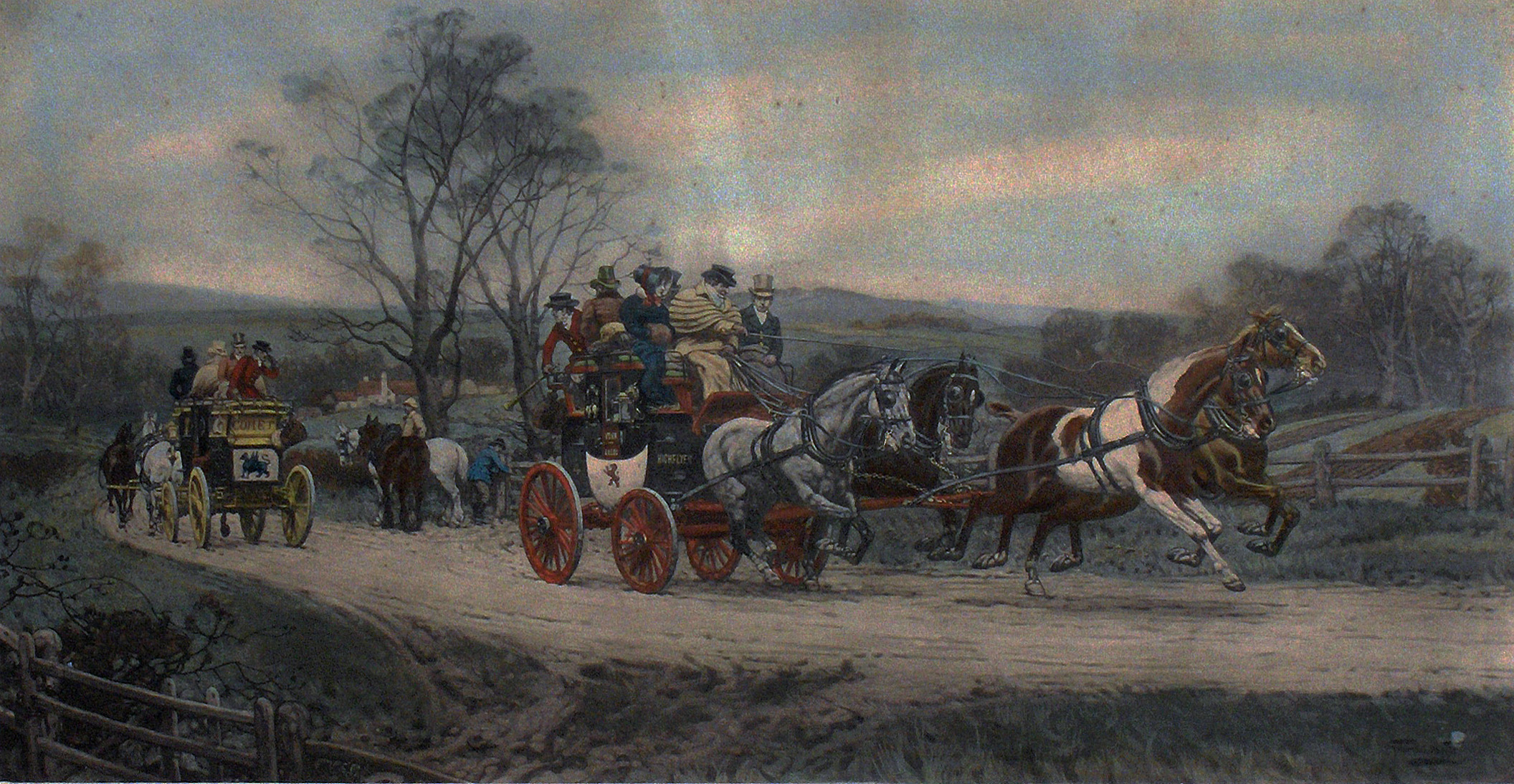
Horse-drawn chariots and carriages ("coaches") were used by the wealthy and powerful where the roads were of a high enough standard from possibly 3000 BC. In Hungary, during the reign of King Matthias Corvinus in the 15th century, the wheelwrights of Kocs began to build a horse-drawn vehicle with steel-spring suspension. This "cart of Kocs" as the Hungarians called it () soon became popular all over Europe. The imperial post service employed the first horse-drawn mail coaches in Europe since Roman times in 1650, and as they started in the town of Kocs, the use of these mail coaches gave rise to the term "coach". Stagecoaches (drawn by horses) were used for transport between cities from about 1500 in Great Britain until displaced by the arrival of the railways.
One of the earliest motorized vehicles was the charabanc, which was used for short journeys and excursions until the early years of the 20th century. The first "motor coaches" were purchased by operators of those horse-drawn vehicles in the early 20th century by operators such as Royal Blue Coach Services, who purchased their first charabanc in 1913 and were running 72 coaches by 1926.
Features

Coaches are designed for comfort, as passengers are onboard for significant periods of time on long journeys, or the hirer desires a high standard of comfort on shorter trips.
They can vary considerably in quality: some higher-specification coaches feature luxury seats and refreshments, while others may only have the bare essentials such as non-reclining highback seats and an underfloor baggage compartment. Coaches typically have only a single, narrow door, but some may have two doors - it can be a tradeoff between faster passenger boarding/alighting times and having 2-4 extra seats.
Some coaches are designed for commuter services, which are typically farther than local transit routes. As such, these coaches may have amenities rarely seen on transit buses, such as onboard restrooms, but sparser than coaches meant for long-distance travel.
Seats are normally in a configuration of 2 seats either side of a central aisle - or in premium coaches there can be 2 seats on one side of the aisle and 1 seat on the other side (for example, "excellent" and "premium" class Intercity/Express buses in South Korea), or even 1 seat either side of the aisle in luxury coaches. Other seating layouts can be found on coaches built for a specific purpose (e.g. some overnight buses in Japan have 3 single seats with 2 narrow aisles).
Some characteristics include:
- Air conditioning is installed on virtually every modern coach.
- Comfortable highback seats - covered in cloth/fabric or leatherette (or even leather in some luxury coaches) - that recline and can include a fold-out tray table and/or beverage holder, and armrests.
- Luggage racks above the seats for storing carry-on bags.
- Luggage compartment, accessed from outside the vehicle, under the main floor (or sometimes at the rear)
- Personal reading light and adjustable air conditioning outlet above the seat
- On-board restrooms fitted with chemical toilets, hand basins and soap or hand sanitizer
- On some coaches, on-board entertainment including movies may be shown to passengers
- On-board refreshment service provided by an attendant or a vending machine
- Wheelchair accessible. This is generally provided using a wheelchair lift, although some coaches are in a partial (or full) double-deck layout able to accommodate wheelchair(s) and optionally a small number of regular seats on the lower level, with access by a portable or foldout ramp, with the remainder of the lower level normally used for luggage storage and a toilet.
- Curtains or blinds, useful on overnight services or to block harsh sunlight
- Onboard AC power, USB charging ports and Wi-Fi access
- Seat belt for safety
Manufacture
Coaches, like buses, may be fully built by integrated manufacturers, or a separate chassis consisting of only an engine, wheels and basic frame may be delivered to a coachwork factory for a body to be added. A few coaches are built with monocoque bodies without a chassis frame. Integrated manufacturers (most of whom also supply chassis) include Autosan, Scania, Fuso, and Alexander Dennis. Major coachwork providers (some of whom can build their own chassis) include Van Hool, Neoplan, Marcopolo, Irizar, MCI, Prevost, Volvo, Denning Manufacturing in Australia and Designline in New Zealand.
Regulations
In some European countries following the 1958 type certification treaty, coach (that is vehicle of type M2 or M3) type certification is regulated by regulation number 107 from the UNECE. In the U.S., commercial drivers of motorcoaches are regulated by the Federal Motor Carrier Safety Administration (FMCSA).
Drivers of buses & coaches require a Commercial driver's license (a higher class of license than is required to drive a car). Many states/countries also require bus/coach drivers to obtain an additional certification to carry paying passengers - for example United Kingdom & European Union require a Driver Certificate of Professional Competence (Driver CPC)
Seat belts for drivers and all passengers are now legally required in many countries - for example United Kingdom. Refer to: Overview of Seat Belt Legislation by Country.
Image gallery
Modern coaches
A representative selection of vehicles currently (or recently) in use in different parts of the world. File:NX Coach Scania Levente.jpg|Caetano Levante 3 bodied Scania K410EB6 operated by National Express File:Cropped 1500 series.jpg|A 56-passenger Prevost coach in Canada File:Mercedes-Benz Tourismo, Berlin (20180910 131322).jpg|A Mercedes-Benz Tourismo in Berlin, Germany File:KIA Granbird Silkroad 2015.jpg|A Kia Granbird Silkroad from 2015 at the Seoul Motor Show File:Stagecoach Neoplans on Oxford Tube.JPG|Oxford Tube bodied double-decker Neoplan Skyliners File:MAZ-251 MinskOblautotrans No. 152.jpg|MAZ-251 in Minsk, Belarus File:Jrbuskanto-chitaseagull-20070907.jpg|Hino S'elega in Tokyo, Japan File:Savonlinja Volvo B7R 9700S.jpg|ExpressBus Savonlinja Volvo B7R / 9700S (no. 792, AAI-840, 2006) at Jyväskylä bus station File:MAN coach, Wilms-bus-touristik in Saarburg, bild 4.JPG|MAN Lion's coach L File:Alinsabus(6507-HLF) - Flickr - antoniovera1.jpg|An Irizar i6 built on a MAN chassis File:Greyhound-Bus.jpg|Greyhound Lines MCI 102DL3 Coach bus File:Irisbus Magelys Busworld 2007.JPG|An Iveco Bus (Irisbus) Magelys at Busworld 2007 File:Setra S 417 HDH in Mannheim 100 9272.jpg|Setra S 417 HDH in Mannheim File:Flixbus (Belle Vue Manchester) YG25FEP (2).jpg|Yutong GT12 operated by FlixBus File:Shuttle Bus RMUTT 40-0785.jpg|Hino Coach Bus in RMUTT (Pathumthani, Thailand) File:Airport Limousine Bus (Airport Transport Service Co Ltd). 439 Mitsubishi Fuso Aero Ace, At Akihabara Station.png|Airport Limousine Bus. Mitsubishi Fuso Aero Ace in Tokyo, Japan File:Itaka Solaris Vacanza 13, San Sebastian, Spain. (20373503160).jpg|Solaris Vacanza 13, A 3-axle Solaris coach manufactured between 2001 and 2010 in San Sebastian, Spain
Vintage coaches
A selection of vehicles in use in different parts of the world in the past. File:Southdown 649.JPG|A Leyland Tiger used by Southdown Motor Services in England File:1961_Restored_Bedford.jpg|Bedford SB 1961 coach owned by MacBraynes Bus File:Bedford VAL Duple Viceroy.jpg|Bedford VAL File:King_Alfred_1931_Short_bodied_Dennis_30cwt.jpg|Short bodied Dennis 1931 King Alfred File:MCI MC 6 MH.jpg|Greyhound Lines MCI MC 6 coach built by Motor Coach Industries File:ZiS 127 in Tallinn.JPG|ZIS-127 in Tallinn File:Royal Air Force in the Middle East, 1944-1945. CM5691.jpg|A Pullman bus of the Nairn Transport Company for the Damascus- Baghdad service across the desert
References
- Anderson, R. C. A. and Frankis, G. (1970). History of Royal Blue Express Services. David & Charles.
References
- "Safety Resources for Bus, Motorcoach, & Minibus Operators {{!}} FMCSA".
- "What's the Difference Between a Bus and a Coach? {{!}} National Charter Bus".
- developerChris. "Coach Hire {{!}} Get Your Instant Quotes Today".
- "Europe's Long-Distance Buses".
- (2023-11-18). "Highway Buses".
- "How to Use {{!}} Airport Limousine Bus".
- Mackay, James. (1988). "The Guinness Book of Stamps". Guinness Publishing LTD, Enfield, UK.
- [[Harold James Dyos. Dyos, H. J.]] & Aldcroft, D. H. (1969) ''British Transport, an economic survey'' Penguin Books, p. 225.
- [http://www.petergould.co.uk/local_transport_history/fleetlists/standerwick1.htm W C Standerwick Ltd by Peter Gould]
- Anderson & Frankis, p. 28–29.
- Anderson & Frankis, p. 41.
- "What's the Difference Between a Bus & a Coach Bus? | Dreamliner Coach Company".
- Eraslan, Ergun. (2006). "Usability Ranking of Intercity Bus Passenger Seats Using Fuzzy Axiomatic Design Theory". Springer.
- "Types of Bus Classes > Intercity and Express Buses > Transport > ibs".
- "バスタイプのご紹介|高速バス3列独立シート特集".
- Staff Writer. (2022-06-06). "BLK delivers new double decker coach {{!}} News".
- "Driver CPC training for qualified drivers".
- "SN00542.pdf".
This article was imported from Wikipedia and is available under the Creative Commons Attribution-ShareAlike 4.0 License. Content has been adapted to SurfDoc format. Original contributors can be found on the article history page.
Ask Mako anything about Coach (bus) — get instant answers, deeper analysis, and related topics.
Research with MakoFree with your Surf account
Create a free account to save articles, ask Mako questions, and organize your research.
Sign up freeThis content may have been generated or modified by AI. CloudSurf Software LLC is not responsible for the accuracy, completeness, or reliability of AI-generated content. Always verify important information from primary sources.
Report