From Surf Wiki (app.surf) — the open knowledge base
Clytemnestra
Figure from Greek mythology

Figure from Greek mythology
| Field | Value |
|---|---|
| type | Greek |
| image | Clytemnestra by John Collier, 1882.jpg |
| caption | Clytemnestra, John Collier, 1882 |
| god_of | Queen of Mycenae |
| spouse | Tantalus, Agamemnon, Aegisthus |
| father | Tyndareus |
| mother | Leda |
| siblings | Helen of Troy, Castor and Pollux, Phoebe, Timandra, Philonoe |
| children | Orestes, Electra, Iphigenia, Chrysothemis, Iphianassa, Aletes, Erigone, Helen |
Not to be confused with Clytie or Clytia, names used for several other figures in Greek mythology.
In Greek mythology, Clytemnestra (, ; , ), was the wife of Agamemnon, king of Mycenae, and the half-sister of Helen of Troy. With Agamemnon, she was the mother of Orestes and Electra.
Clytemnestra appears as a character in multiple ancient Greek works, including the Homeric epics and plays by Aeschylus, Sophocles, and Euripides. She is infamous for murdering Agamemnon and the Trojan princess Cassandra, whom Agamemnon had taken as a war prize, when they returned from Trojan War. However, in Homer's Odyssey and Iliad, her role in Agamemnon's death is unclear and her character is significantly more subdued.
Etymology
Name
Her Greek name Klytaimnḗstra is also sometimes Latinized as Clytaemnestra. It is commonly glossed as "famed for her suitors." However, this form is a later misreading motivated by an erroneous etymological connection to the verb mnáomai (μνάoμαι, "woo, court"). The original form is believed to have been Klytaimḗstra (Κλυταιμήστρα) without the -n-. The present form of the name does not appear before the middle Byzantine period. Homeric poetry shows an awareness of both etymologies. Aeschylus, in certain wordplays on her name, appears to assume an etymological link with the verb mḗdomai (μήδoμαι, "scheme, contrive"). Thus given the derivation from κλῠτός (klutós "celebrated") and μήδομαι (mḗdomai "to plan, be cunning"), this would result in the quite descriptive "famous plotter".
Background
Clytemnestra was the daughter of Tyndareus and Leda, King and Queen of Sparta, making her a Spartan Princess. According to myth, Zeus appeared to Leda in the form of a swan, raping and impregnating her. She then laid with her husband the same night, and later gave birth to a set of two eggs: one fathered by Zeus that Helen and Pollux emerged from, and one fathered by Tyndareus that Castor and Clytemnestra emerged from. Her other sisters were Philonoe, Phoebe and Timandra.
In myth, Clytemnestra is most commonly described as having two husbands: Agamemnon and Aegisthus. Some sources name a third, Tantalus, whom Agamemnon slew before taking Clytemnestra as his wife. The child Clytemenstra had with her first husband was killed too. Another myth says both Agamemnon and his brother Menelaus, king of Sparta, competed as suitors for Clytemnestra and Helen's hands, with Agamemnon marrying Clytemnestra and Menelaus marrying Helen. Clytemnestra became queen of Mycenae through the marriage and bore Agamemnon four children: Orestes, Electra, Iphigenia, and Chrysothemis. Some time after Agamemnon left for Troy, Clytemnestra began an affair with Aegisthus, son of Thyestes and her husband's cousin. After murdering Agamemnon, they ruled Mycenae as king and queen consort. Together they had a son, Aletes, and two daughters: Erigone and Helen.
Mythology
After Helen was taken by Paris to Troy, her husband, Menelaus, asked all Helen's suitors, including Agamemnon, to help retrieve her. Greek forces gathered at the port city of Aulis, but consistently weak winds prevented the fleet from sailing to Troy. The priest Calchas prophesized that the winds would be favorable if Agamemnon sacrificed his daughter Iphigenia to the goddess Artemis to atone for killing her sacred deer. Agamemnon persuaded Clytemnestra to send Iphigenia to him, telling her he was going to marry her to the hero Achilles. When Iphigenia arrived at Aulis, she was sacrificed, the winds turned, and the troops set sail for Troy.[[Image:Murder of agamemnon.jpg|thumb|Murder of Agamemnon, painting by [[Pierre-Narcisse Guérin]] (1817)|left|287x287px]]
The Trojan War lasted ten years. During this period of Agamemnon's long absence, Clytemnestra began a love affair with Aegisthus, her husband's cousin and the son of Thyestes. Whether Clytemnestra was seduced into the affair or entered into it independently differs between authors and versions of the myth. Together, the pair began plotting Agamemnon's demise. Depending on the version of the myth, different reasons have been given for Clytemnestra's decision to murder her husband. These include being angered by the sacrifice of Iphigenia, being seduced into the idea by Aegisthus so that he could take the throne and avenge his father, and being insulted by Agamemnon taking Cassandra as a concubine and giving her preferential treatment.
Murder of Agamemnon
After defeating the Trojans, Agamemnon returned to Mycenae. He brought with him a war prize: Cassandra, a seer cursed by Apollo so that her prophecies would never be believed. Upon his return, Agamemnon was murdered either by Aegisthus, Clytemnestra, or they acted together. The character who strikes the killing blow and Clytemnestra's characterization differs between authors and versions of the myth.
In Aeschylus' Agamemnon, one of the better-known versions of the story, Clytemnestra is portrayed as a conniving, bloodthirsty woman whose desires were encouraged by Aegisthus, wanting to avenge his father. In the play, Clytemnestra welcomes her husband home and helps him down from his chariot before escorting him inside the palace. Cassandra remains outside in the chariot, where she receives a premonition and prophesizes that Clytemnestra will murder Agamemnon; a crowd watches and listens, but is unable to comprehend what she says. In this version of the story, Clytemnestra waits until Agamemnon has gotten into the bath before she entangles him in a net and stabs him three times with a blade. Cassandra, accepting her fate, walks into the palace and is killed as well. When Clytemnestra's act is discovered by the crowd, she revels in the deed and defends her actions: announcing that she has finally avenged Iphigenia's murder.[[Image:Orestes Pursued by the Furies by William-Adolphe Bouguereau (1862) - Google Art Project.jpg|thumb|[[Orestes Pursued by the Furies]] by [[William-Adolphe Bouguereau]]. Clytemnestra was killed by Orestes and the [[Furies]] tormented him for committing [[matricide]].|234x234px]]In Euripides' Electra, Electra claims that, while her mother was involved in the plot, Aegisthus was the one who struck the killing blow. Alternately, Homer has the pair acting together. In the Odyssey, Agamemnon's shade claims that Aegisthus and Clytemnestra hosted a feast, during which the pair launched a surprise attack and murdered him alongside a number of his soldiers. In this version, Clytemnestra killed Cassandra alone.
Death
After the murders, Aegisthus took the throne and ruled Mycenae with Clytemnestra as his queen. During this time, they had three children: a son, Aletes, and two daughters, Erigone and Helen. After seven years, Orestes returned home to Mycenae, intent on taking revenge for the death of his father. With Electra's help, he murdered Clytemnestra, Aegisthus, and their children. However, Clytemnestra cursed Orestes with her dying breath, and he was haunted by the Erinyes, the goddesses of vengeance.
After being freed from the Erinyes' torment, Orestes took the throne of Mycenae. In some versions of the myth, he took his half-sister, Erigone as a wife. Together they had two children: Tisamenus and Penthilus.
Appearance in later works
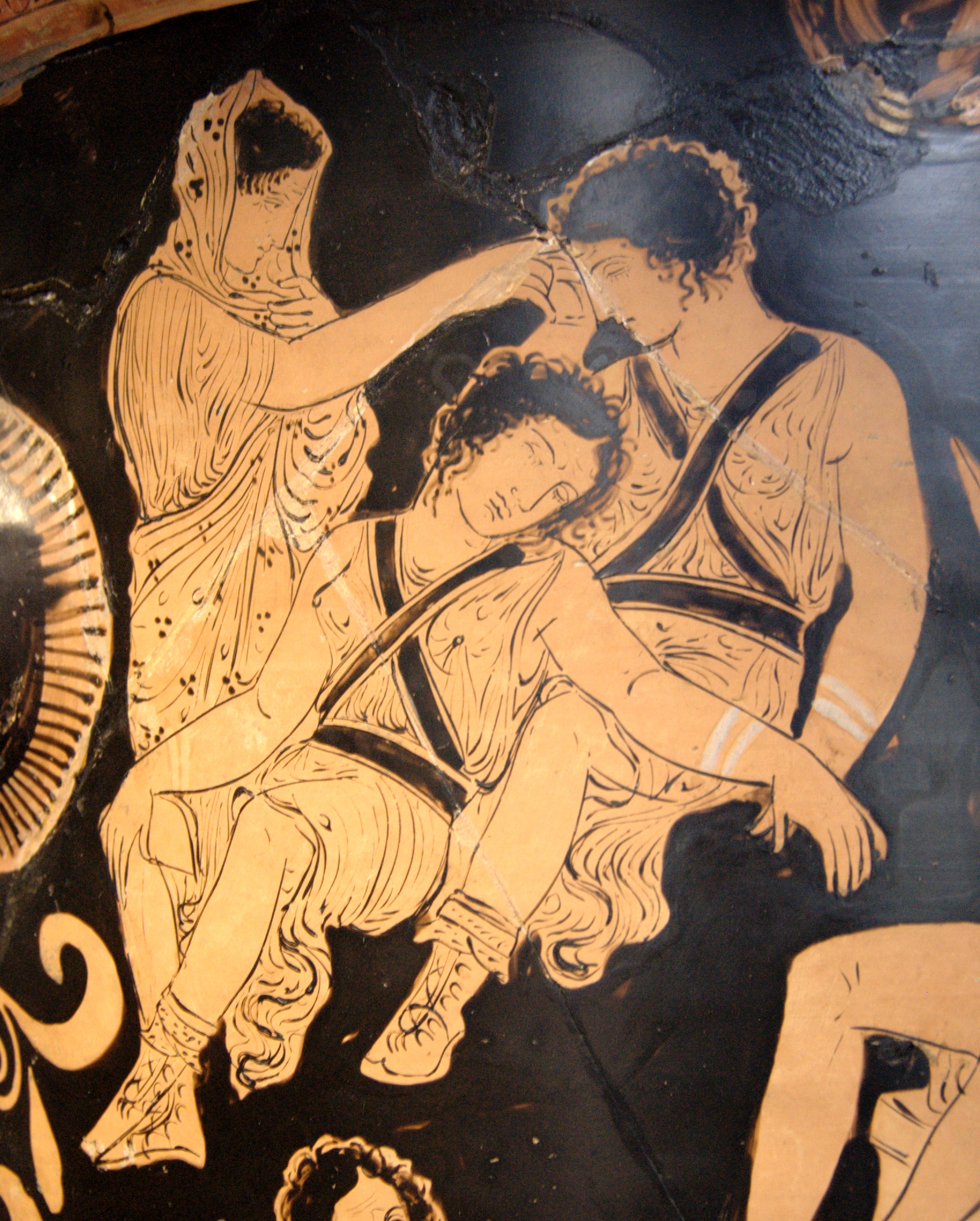
- Clytemnestra is one of the main characters in Aeschylus's Oresteia, and is central to the plot of all three parts. She murders Agamemnon in the first play, and is murdered herself in the second. Her death then leads to the trial of Orestes by a jury composed of Athena and 12 Athenians in the final play. Her role is the largest in any surviving Greek tragedy.
- In Mourning Becomes Electra, Eugene O'Neill's retelling of the Oresteia by Aeschylus, Clytemnestra is renamed Christine Mannon.
- In Ferdinando Baldi's The Forgotten Pistolero, a Spaghetti Western adaptation of the Oresteia, Clytemnestra is named Anna Carrasco and is portrayed by Luciana Paluzzi.
- The American modern dancer and choreographer Martha Graham created a two-hour ballet, Clytemnestra (1958), about the queen.
- The Aeschylus work was also adapted by South African composer Cromwell Everson into the first Afrikaans opera, Klutaimnestra, in 1967. In four acts, the opera premiered on November 7, 1967, in Biesenbach Hall, Worcester, Western Cape, South Africa.
- John Eaton composed an opera in one act entitled The Cry of Clytemnestra recounting the events leading up to and including Clytemnestra's murder of Agamemnon.
- In the 1977 film adaptation Iphigenia, Clytemnestra is portrayed by the Greek actress Irene Papas.
- In the 2003 miniseries Helen of Troy, Clytemnestra is played by Katie Blake.
- Clytemnestra appears as an extremely abusive mother in the play Molora, Yaël Farber's 2007 rewriting of the Oresteia set in post-apartheid South Africa and its Truth and Reconciliation Commission hearings.
- The 2017 novel House of Names by Colm Tóibín is a retelling of the Oresteia, with divine elements largely removed. There are three narrators: Clytemnestra, Orestes, and Electra.
- Clytemnestra is one of several narrators of A Thousand Ships (2019) by Natalie Haynes, which retells the Trojan War from the perspective of the women involved.
- Clytemnestra is the protagonist of the eponymous novel Clytemnestra (2023) by Costanza Casati.
- An asteroid 179 Klytaemnestra is named after Clytemnestra.
- Lupita Nyong'o is expected to portray Clytemnestra in a 2026 film adaptation of the Odyssey.
- In The Voyage Home by Pat Barker, 2024
References
Citations
Sources
- Servius. In Aeneida, xi.267.
References
- "Definition of CLYTEMNESTRA".
- {{Cite LPD. 3
- (1878). "[[s:Encyclopædia Britannica, Ninth Edition". Charles Scribner's Sons.
- ''Oresteia'', Loeb edition by [[Alan Sommerstein]], introduction, p. x, 2008.
- MARQUARDT, PATRICIA A.. (1992). "Clytemnestra: A Felicitous Spelling in the "Odyssey"". Arethusa.
- Compare [[wikt:Κλυταιμνήστρα. entry "Κλυταιμνήστρα"]], in ''Wiktionary''.
- [[Aeschylus]], ''Agamemnon'', [https://www.perseus.tufts.edu/hopper/text?doc=Perseus%3Atext%3A1999.01.0004%3Acard%3D83 83].
- [[Ovid]], ''[[Amores (Ovid)
- [[Bibliotheca (Pseudo-Apollodorus). Apollodorus]], ''[[Bibliotheca (Apollodorus)
- [[Euripides]], ''[[Helen (play)
- "A Dictionary of Greek and Roman biography and mythology, Leda".
- [[Athenaeus]], ''[[Deipnosophistae
- [[Euripides]], ''[[Iphigenia in Aulis]]'', [https://www.perseus.tufts.edu/hopper/text?doc=Perseus%3Atext%3A1999.01.0108%3Acard%3D1 49]
- Tzetzes, John. "Chiliades 1.18 line 463-465". Theoi Classical Texts Library.
- Apollodorus, ''Bibliotheke'', Epitome 2.15-2.16
- Apollodorus, ''Bibliotheke'', Epitome 2.15-2.16
- [[Euripides]], ''[[Orestes]]'', [https://www.perseus.tufts.edu/hopper/text?doc=Perseus:text:1999.01.0116:card=1&highlight=clytemnestra 1].
- [[Homer]], ''[[Odyssey]]'', [https://www.perseus.tufts.edu/hopper/text?doc=Perseus:text:1999.01.0218:book=3:card=6&highlight=clytemnestra 3.8]
- [[Euripides]], ''[[Electra (Euripides play)
- [[Gaius Julius Hyginus. Hyginus]], ''[[Fabulae]]'', [https://topostext.org/work/206#122 122].
- Photius, Bibliotheca excerpts''',''' 190.30
- [[Pseudo-Apollodorus
- [[Euripides]], ''[[Iphigenia in Aulis]]'', [https://www.perseus.tufts.edu/hopper/text?doc=Perseus%3Atext%3A1999.01.0108%3Acard%3D1 1].
- [[Gaius Julius Hyginus. Hyginus]], ''[[Fabulae]]'', [https://topostext.org/work/206#98 98].
- [[Euripides]], ''[[Iphigenia in Tauris]]'', [https://www.perseus.tufts.edu/hopper/text?doc=Perseus:text:1999.01.0112:card=1&highlight=clytemnestra 1].
- [[Euripides]], ''[[Electra (Euripides play)
- [[Pseudo-Apollodorus
- Homer portrays Clytemnestra as being seduced by flattery. [[Homer]], ''[[Odyssey]]'', [https://www.perseus.tufts.edu/hopper/text?doc=Perseus:text:1999.01.0218:book=3:card=6&highlight=clytemnestra 3.6].
- [[Sophocles]] has Clytemnestra willingly enter into the relationship. Sophocles, ''[[Electra (Sophocles play)
- [[Sophocles]], ''[[Electra (Sophocles play)
- [[Homer]], ''[[Odyssey]]'', [https://www.perseus.tufts.edu/hopper/text?doc=Perseus:text:1999.01.0136:book=1:card=1 1.25-40].
- [[Gaius Julius Hyginus. Hyginus]], ''[[Fabulae]]'', [https://topostext.org/work/206#117 117].
- [[Homer]], ''[[Iliad]]'', [https://www.perseus.tufts.edu/hopper/text?doc=Perseus:text:1999.01.0134:book=1:card=92 1.105-120].
- [[Aristotle]], ''[[Economics (Aristotle)
- "Cassandra." ''Women of Classical Mythology: A Biographical Dictionary''. New York: Oxford University Press, 1991, pp. 109-111. Copyright © 1991 by Robert E. Bell.
- [[Aeschylus]], ''Agamemnon'', [https://www.perseus.tufts.edu/hopper/text?doc=Perseus%3Atext%3A1999.01.0004%3Acard%3D1577 1577].
- [[Aeschylus]], ''Agamemnon'', [https://www.perseus.tufts.edu/hopper/text?doc=Perseus%3Atext%3A1999.01.0004%3Acard%3D1107 1107].
- [[Aeschylus]], ''Agamemnon'', [https://www.perseus.tufts.edu/hopper/text?doc=Perseus%3Atext%3A1999.01.0004%3Acard%3D1372 1372].
- [[Aeschylus]], ''Agamemnon'', [https://www.perseus.tufts.edu/hopper/text?doc=Perseus%3Atext%3A1999.01.0004%3Acard%3D1431 1431].
- [[Homer]], ''[[Odyssey]]'', [https://www.perseus.tufts.edu/hopper/text?doc=Perseus%3Atext%3A1999.01.0136%3Abook%3D11%3Acard%3D404 11.405-440].
- Photius, Bibliotheca excerpts''',''' 190.30
- Apollodorus, ''Epitome'', [https://www.perseus.tufts.edu/hopper/text?doc=Perseus%3Atext%3A1999.01.0022%3Atext%3DEpitome%3Abook%3DE%3Achapter%3D6%3Asection%3D25 6.25].
- Apollodorus, ''Epitome'', [https://www.perseus.tufts.edu/hopper/text?doc=Perseus%3Atext%3A1999.01.0022%3Atext%3DEpitome%3Abook%3DE%3Achapter%3D6%3Asection%3D28 6.28].
- Apollodorus, ''[[Bibliotheca (Apollodorus)
- [[Pausanias (geographer)
- Mendelsohn, Daniel. (July 24, 2017). "Novelizing Greek Myth".
- Haynes, Natalie. (March 28, 2022). "Is Clytemnestra an Archetypically Bad Wife or a Heroically Avenging Mother?".
- Miller, Madeline. (November 7, 2011). "Myth of the Week: Clytemnestra".
- Monohan, Marie Adornetto. ''Women and Justice in Aeschylus' “Oresteia.”'' 1987. ProQuest Dissertations Publishing, pp. 22-23.
- (2001). "Classical Myth & Culture in the Cinema". Oxford University Press.
- Farber, Yaël. (2007–2011). "Molora".
This article was imported from Wikipedia and is available under the Creative Commons Attribution-ShareAlike 4.0 License. Content has been adapted to SurfDoc format. Original contributors can be found on the article history page.
Ask Mako anything about Clytemnestra — get instant answers, deeper analysis, and related topics.
Research with MakoFree with your Surf account
Create a free account to save articles, ask Mako questions, and organize your research.
Sign up freeThis content may have been generated or modified by AI. CloudSurf Software LLC is not responsible for the accuracy, completeness, or reliability of AI-generated content. Always verify important information from primary sources.
Report