From Surf Wiki (app.surf) — the open knowledge base
Cloud iridescence
Optical phenomenon
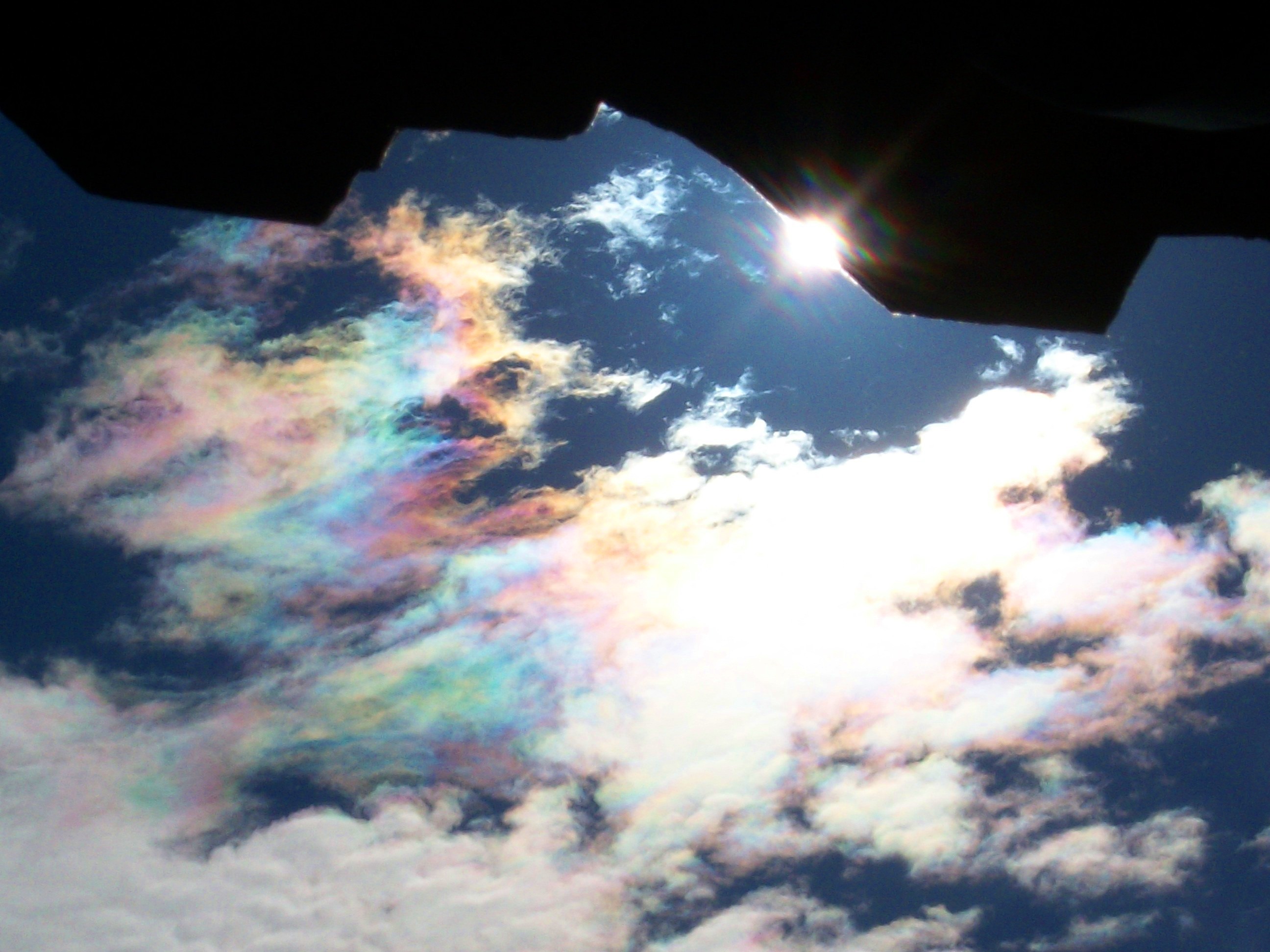
Optical phenomenon
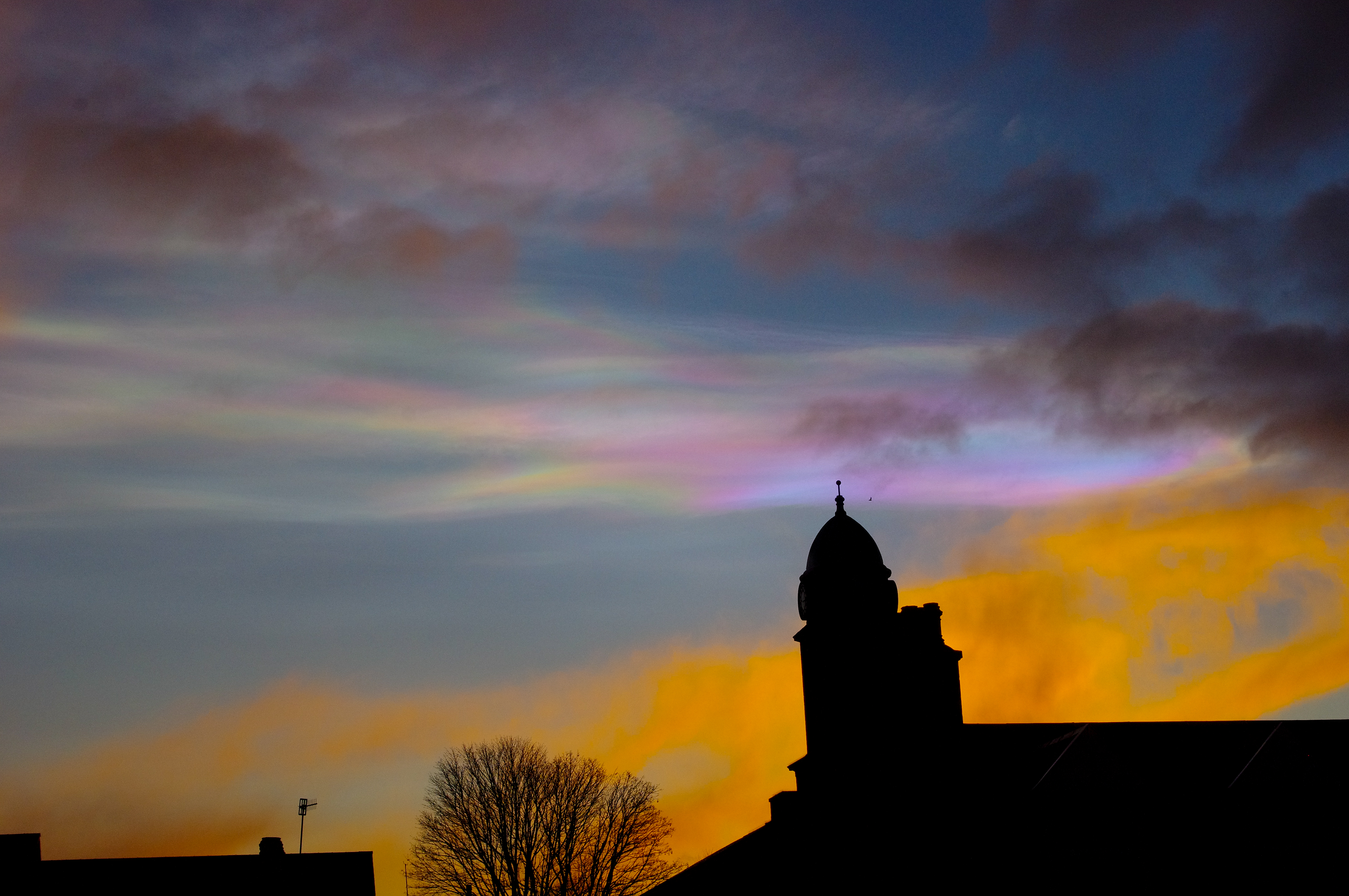
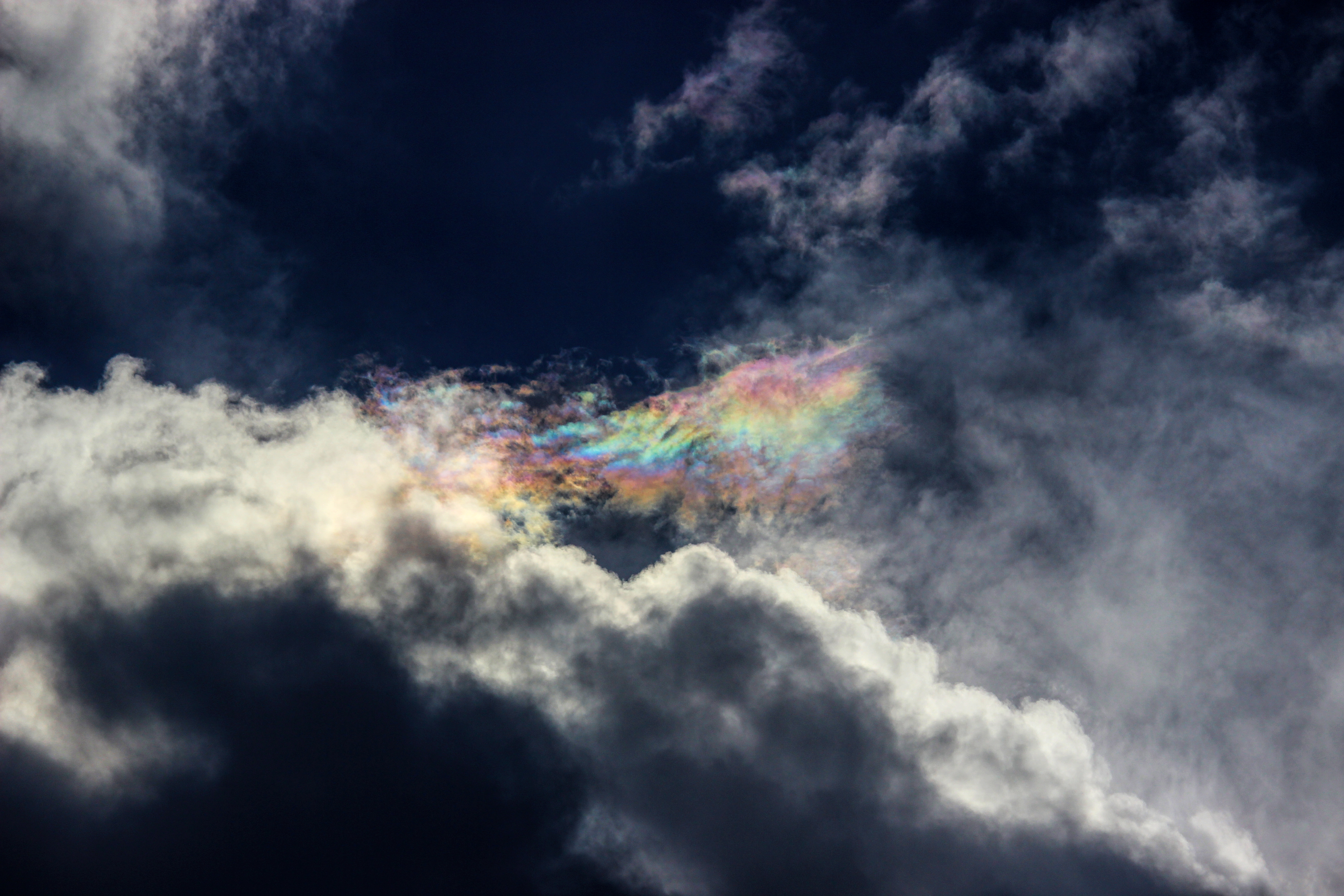
Cloud iridescence or irisation is a colorful optical phenomenon that occurs in a cloud and appears in the general proximity of the Sun or Moon. The colors resemble those seen in soap bubbles and oil on a water surface. It is a type of photometeor. This fairly common phenomenon is most often observed in altocumulus, cirrocumulus, lenticular, and cirrus clouds. They sometimes appear as bands parallel to the edge of the clouds. Iridescence is also seen in the much rarer polar stratospheric clouds, also called nacreous clouds.
The colors are usually pastel, but can be very vivid or mingled together, sometimes similar to mother-of-pearl. When appearing near the Sun, the effect can be difficult to spot as it is drowned in the Sun's glare. This may be overcome by shielding the sunlight with one's hand or hiding it behind a tree or building. Other aids are dark glasses, or observing the sky reflected in a convex mirror or in a pool of water.
Etymology
Irisations are named after the Greek goddess Iris, goddess of rainbows and messenger of Zeus and Hera to the mortals below.
Mechanism
Iridescent clouds are a diffraction phenomenon caused by small water droplets or small ice crystals individually scattering light. Larger ice crystals do not produce iridescence, but can cause halos, a different phenomenon.
Irisation is caused by very uniform water droplets diffracting light (within 10 degrees from the Sun) and by first order interference effects (beyond about 10 degrees from the Sun). It can extend up to 40 degrees from the Sun.
If parts of clouds contain small water droplets or ice crystals of similar size, their cumulative effect is seen as colors. The cloud must be optically thin, so that most rays encounter only a single droplet. Iridescence is therefore mostly seen at cloud edges or in semi-transparent clouds, while newly forming clouds produce the brightest and most colorful iridescence. When the particles in a thin cloud are very similar in size over a large extent, the iridescence takes on the structured form of a corona, a bright circular disk around the Sun or Moon surrounded by one or more colored rings.
Gallery
File:CircumHorizontalArc GQ 07312012 1938.jpg File:Viet Nam.jpg|Ho Chi Minh City, Viet Nam. May 12th, 2024 File:IridescentCloudArran.jpg File:Iridescent Cloud.JPG File:Cloud iridescence 3.jpg File:CloudOberGatlinburg.jpg File:Cloud iridescence at Kokkola, Finland.jpg File:IrisationCloudsPICT4884crop640x480.jpg|Irisation in clouds over Wellington NZ File:Cloud Iridescence and Crepuscular Rays.jpg|Vibrant cloud iridescence captured before sunset File:Iridescent cloud edge.jpg| File:Iridescent Altostratus, but cropped.jpg|Iridescent Altostratus clouds seen in Cheongju City. File:At Teide Observatory 2019 027.jpg|Iridescent clouds seen in Tenerife File:Cloud-iridescence-Parker-Canyon-AZ-Aug-6-2022.jpg|Parker Canyon, AZ. Aug 6th, 2022
References
References
- Gedzelman, Stanley David. (1 June 1988). "In Praise of Altocumulus". Weatherwise.
- [http://www.answers.com/topic/irisation-meteorology Answers.com – Sci-Tech Dictionary: irisation]
- (25 November 2007). "An Iridescent Cloud Over Colorado".
- "Iridescent Clouds". Atmospheric Optics.
- Sassen, Kenneth. (1 January 2003). "Cirrus cloud iridescence: a rare case study". Applied Optics.
- "Nacreous Clouds". Atmospheric Optics.
- [http://tierra.rediris.es/megacryometeors/photometeors.pdf ''PHOTOMETEORS'', by Jesús Martínez-Frías] {{webarchive. link. (2009-12-13)
- [https://books.google.com/books?id=MAiKY4xU6y8C&pg=PA233&dq=Cloud+iridescence+Irisation&lr= The ''Cloudspotter's Guide'' By Gavin Pretor-Pinney, p. 233]
- "Cloud Iridescence {{!}} SKYbrary Aviation Safety".
- [https://books.google.com/books?id=4Abp5FdhskAC&pg=PA133&dq=Cloud+iridescence+Irisation&lr= ''Color and Light in Nature'' By David K. Lynch, William Charles Livingston, p. 133]
- [http://tierra.rediris.es/megacryometeors/photometeors.pdf ''PHOTOMETEORS'', by Jesús Martínez-Frías] {{webarchive. link. (2009-12-13)
- "Corona". Atmospheric Optics.
- (12 August 2011). "Icy wave-cloud lunar corona and cirrus iridescence". Applied Optics.
This article was imported from Wikipedia and is available under the Creative Commons Attribution-ShareAlike 4.0 License. Content has been adapted to SurfDoc format. Original contributors can be found on the article history page.
Ask Mako anything about Cloud iridescence — get instant answers, deeper analysis, and related topics.
Research with MakoFree with your Surf account
Create a free account to save articles, ask Mako questions, and organize your research.
Sign up freeThis content may have been generated or modified by AI. CloudSurf Software LLC is not responsible for the accuracy, completeness, or reliability of AI-generated content. Always verify important information from primary sources.
Report