From Surf Wiki (app.surf) — the open knowledge base
Cloud cover
Fraction of the sky obscured by clouds when observed from a particular location

Fraction of the sky obscured by clouds when observed from a particular location
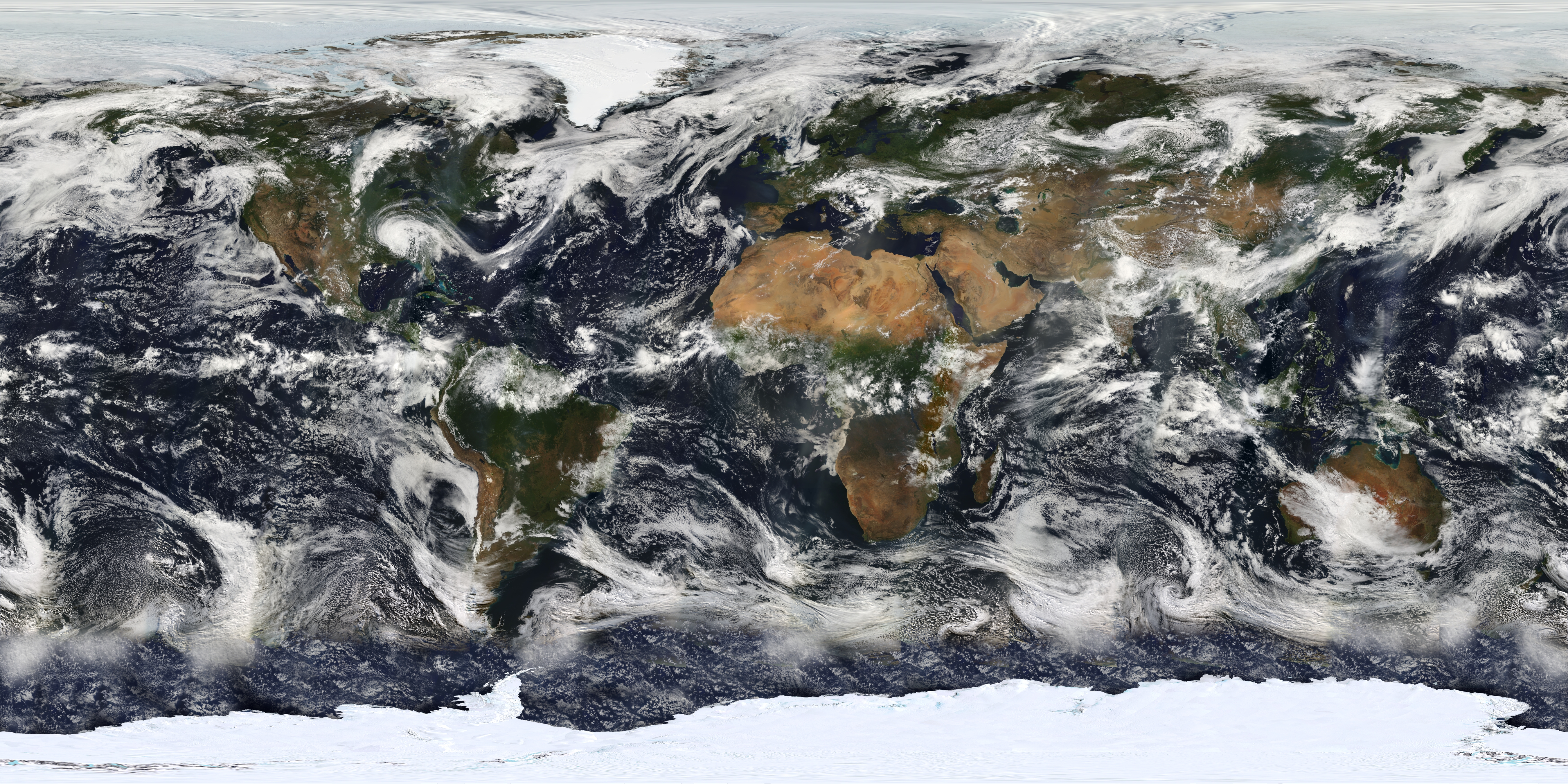

Cloud cover (also known as cloudiness, cloudage, or cloud amount) refers to the fraction of the sky obscured by clouds on average when observed from a particular location. Okta is the usual unit for measurement of the cloud cover. The cloud cover is correlated to the sunshine duration as the least cloudy locales are the sunniest ones while the cloudiest areas are the least sunny places, as clouds can block sunlight, especially at sunrise and sunset where sunlight is already limited.


The global cloud cover averages around 67-68%, though it ranges from 56% to 73% depending on the minimum optical depth considered (lower when optical depth is large, and higher when it is low, such that subvisible cirrus clouds are counted).{{cite journal
Role in the climate system
Clouds play multiple critical roles in the climate system and diurnal cycle. In particular, being bright objects in the visible part of the solar spectrum, they efficiently reflect light to space and thus contribute to the cooling of the planet, as well as trapping remaining heat at night. Cloud cover thus plays an important role in the energetic balance of the atmosphere and a variation of it is a factor and consequence of and to the climate change expected by recent studies.
Measuring Cloud Cover
As per Bernardineli et al., a nuance of "cloud cover" as a measurement is its own definition - which can either mean (in the extreme) - a narrow field of view measurement from a satellite, or a wide field of view measurement from a local observer. Although idealized procedures exists for estimating a local observation by taking spatial-temporal windows of remote measurements, empirical estimates are usually lacking.
Variability
Cloud cover values only vary by 3% from year-to-year averages, whereas the local, day-to-day variability in cloud amounts typically rises to 30% over the globe. Land is generally covered by 10-15% less cloud than the oceans, because the seas are covered with water, allowing for more evaporation.
Lastly, there is a latitudinal variation in the cloud cover. Areas around 10-15% below the global mean can be found around 20°N and 20°S, due to an absence of equatorial effects and strong winds reducing cloud formation. On the other hand, in the storm regions of the Southern Hemisphere midlatitudes were found to have with 15–25% more cloudiness than the global mean at 60°S. On average, about 67% of the entire Earth is cloud-covered at any moment.
On a continental scale, it can be noticed based upon a long-term satellite recording of cloudiness data that on a year-mean basis, Europe, North America, South America and Asia are dominated by cloudy skies due to the westerlies, monsoon or other effects. On the other hand, Africa, the Middle East and Australia are dominated by clear skies due to their continentality and aridity.
On a regional scale, some exceptionally humid areas of Earth experience cloudy conditions virtually all time such as South America's Amazon rainforest while some highly arid areas experience clear-sky conditions virtually all the time such as Africa's Sahara Desert.
Altitude of typical cloud cover
Although clouds can exist within a wide range of altitudes, typical cloud cover has a base at approximately 4,000m and extends up to an altitude of about 5,000m. Clouds height can vary depending on latitude; with cloud cover in polar latitudes being slightly lower and in tropical regions the cloud cover may extend up to 8,000m. The type of cloud is also a factor, with low cumulus clouds sitting at 300–1,500m while high cirrus clouds at 5,500-6,500m.
References
- McIntosh, D. H. (1972) Meteorological Glossary, Her Majesty's Stationery Office, Met. O. 842, A.P. 897, 319 p.
References
- Brun, P., Zimmermann, N.E., Hari, C., Pellissier, L., Karger, D.N. (preprint): Global climate-related predictors at kilometre resolution for the past and future. Earth Syst. Sci. Data Discuss. https://doi.org/10.5194/essd-2022-212
- Lessa Bernardineli, Danilo. (2023). "Comparing ground-based and satellite retrievals of cloud fraction over the Amazon". SSRN Electronic Journal.
- Huschke, Ralph E.. (1970). "Glossary of Meteorology". [[American Meteorological Society]].
- (2013). "Spatial and Temporal Distribution of Clouds Observed by MODIS Onboard the Terra and Aqua Satellites". Institute of Electrical and Electronics Engineers (IEEE).
- WMO. "Luminance".
- "IPCC Third Assessment Report Chapter 7. Physical Climate Processes and Feedbacks (Atmospheric Processes and Feedbacks 7.2)". International Panel on Climate Change.
- (2018-10-31). "Cloud Fraction".
- "NOAA Cloud Cover Glossary".
- (2020-07-07). "Cloudy Earth".
- (2012). "Met Office introduction to clouds".
This article was imported from Wikipedia and is available under the Creative Commons Attribution-ShareAlike 4.0 License. Content has been adapted to SurfDoc format. Original contributors can be found on the article history page.
Ask Mako anything about Cloud cover — get instant answers, deeper analysis, and related topics.
Research with MakoFree with your Surf account
Create a free account to save articles, ask Mako questions, and organize your research.
Sign up freeThis content may have been generated or modified by AI. CloudSurf Software LLC is not responsible for the accuracy, completeness, or reliability of AI-generated content. Always verify important information from primary sources.
Report