From Surf Wiki (app.surf) — the open knowledge base
Clotted cream
Thick cream made by indirectly heating full-cream cow's milk

Thick cream made by indirectly heating full-cream cow's milk
| Field | Value |
|---|---|
| name | Clotted cream |
| image | Clotted cream (cropped).JPG |
| image_size | 300px |
| caption | A tub of clotted cream, showing top crust |
| alternate_name | Clouted cream, Devonshire cream, Cornish cream |
| country | England |
| region | Devon, Cornwall |
Clotted cream (, sometimes called scalded, clouted, Devonshire or Cornish cream) is a thick cream made by heating full-cream cow's milk using steam or a water bath and then leaving it in shallow pans to cool slowly. During this time, the cream content rises to the surface and forms "clots" or "clouts", hence the name. Clotted cream is an essential ingredient for cream tea.
Although its origin is uncertain, the cream is associated with dairy farms in South West England and in particular the counties of Devon and Cornwall. The largest commercial producer in the United Kingdom is Rodda's at Scorrier, near Redruth, Cornwall, which can produce up to 25 tons of clotted cream a day.
In 1998 "Cornish clotted cream" was registered as a Protected Designation of Origin (PDO) under European Union law. The designation can be used if the production follows certain requirements, from milk produced in Cornwall and the cream has a minimum fat content of 55 per cent. Following Brexit, the PDO was also registered under UK law. It is recognised as a geographical indication in Georgia, Iceland, Moldova, Montenegro, Norway, Serbia, Switzerland and Ukraine.
Description
Or baby-buttercups newly-born; Its balmy perfume, delicate pulp, One longs to swallow it all at a gulp, Sure man had ne'er such gifts or theme As your melt-in-mouthy Devonshire cream."
—William Barry Peacock, Manchester, 1853 Clotted cream has been described as having a "nutty, cooked milk" flavour, and a "rich sweet flavour" with a texture that is grainy, sometimes with oily globules on the crusted surface.
According to the UK Food Standards Agency, clotted cream provides 586 kcal per 100 g.
History
Originally made by farmers to reduce the amount of waste from their milk, clotted cream has become so deep-rooted in the culture of southwest Britain that it is embedded as part of the region's tourist attractions. While there is no doubt of its strong and long association with Cornwall and Devon, it is not clear how ancient its origins are.
The Oxford Companion to Food follows traditional folklore by suggesting it may have been introduced to Cornwall by Phoenician traders in search of tin. It is similar to kaymak (or kajmak), a Near Eastern delicacy that is made throughout the Middle East, southeast Europe, Iran, Afghanistan, India, and Turkey. A similar clotted cream known as mn (өрөм) is also made in Mongolia.
Contemporary ancient food experts, noting Strabo's commentaries on Britain, have proposed that the early Britons would have probably clotted their cream to preserve its freshness.
More recently, regional archaeologists have associated the stone fogou (dial. 'fuggy-hole'), or souterrains, found across Atlantic Britain, France and Ireland as a possible form of "cold store" for dairy production of milk, cream, and cheese in particular. Similar functions are ascribed to the linhay (or 'linney') stone-built form, often used as a dairy in later medieval longhouses in the same regions.

It has long been disputed whether clotted cream originated in Devon or Cornwall, There is evidence that the monks of Tavistock Abbey were making clotted cream in the early 14th century. After their abbey had been ransacked by Vikings in AD 997, the monks rebuilt it with the help of Ordulf, Earl of Devon. In a BBC report, local historians claimed local workers were drafted in to help with the repairs, and the monks rewarded them with bread, clotted cream, and strawberry preserves. The 1658 cookery book The Compleat Cook had a recipe for "clouted cream".

In the 19th century it was regarded as better nourishment than "raw" cream because that cream was liable to go sour and be difficult to digest, causing illness. An article from 1853 calculates that creating clotted cream will produce 25 per cent more cream than regular methods. In Devon it was so common that in the mid-19th century it was used in the formative processes of butter, instead of churning cream or milk. The butter made in this way had a longer lifespan and was free from any negative flavours added by the churning.
It has long been the practice for local residents in southwest England, or those on holiday, to send small tins or tubs of clotted cream by post to friends and relations in other parts of the British Isles.
Protected Designation of Origin
In 1993 an application was made for the name Cornish clotted cream to have a Protected Designation of Origin (PDO) in the European Union for cream produced by the traditional recipe in Cornwall. This was accepted in 1998. Cornish clotted cream must be made from milk produced in Cornwall and have a minimum butterfat content of 55 per cent. The unique, slightly yellow Cornish clotted cream colour is due to the high carotene levels in the grass.
Preparation
Traditionally, clotted cream was created by straining fresh cow's milk, letting it stand in a shallow pan in a cool place for several hours to allow the cream to rise to the surface, then heating it either over hot cinders or in a water bath, before a slow cooling. The clots that formed on the top were then skimmed off with a long-handled cream-skimmer, known in Devon as a reamer or raimer. By the mid-1930s the traditional way of using milk brought straight from the dairy was becoming a rarity in Devon because using a cream separator actively separated the cream from the milk using centrifugal force, which produced far more clotted cream than the traditional method from the same amount of milk.
Today, there are two distinct methods for making clotted cream. The "float cream method" includes scalding a floating layer of double cream in milk (skimmed or whole) in shallow trays. To scald, the trays are heated using steam or very hot water. After the mixture has been heated for up to an hour it is slowly cooled for 12 hours or more, before the cream is separated and packaged. The "scald cream method" is similar, but the milk layer is removed and a layer of cream, which has been mechanically separated to a minimum fat level is used. This cream is then heated in a similar manner, but at a lower temperature and after a set amount of time it is then chilled and packaged. In the United Kingdom the resultant cream is deemed to be equivalent to pasteurised for legal purposes. Unlike pasteurisation, however, there is no requirement for the temperatures to be recorded on thermograph charts. As the temperatures are lower than used in standard pasteurisation, much care is needed in ensuring high standards of hygiene.
The largest manufacturer in the United Kingdom is Rodda's, a family-owned business based in Scorrier, Cornwall.{{cite web
One Devon manufacturer, Definitely Devon was purchased by Robert Wiseman Dairies in March 2006, closing one of the two Devon dairies and moving all production to Okehampton. However, in 2011 Robert Wiseman sold the Definitely Devon Brand to Rodda's, who moved the production of Definitely Devon to Cornwall, which caused some controversy as the name was not changed, prompting an investigation by Trading Standards.
Throughout southwest England, clotted cream manufacture is a cottage industry, with many farms and dairies producing cream for sale in local outlets. Clotted cream is also produced in Somerset, Dorset, Herefordshire, Pembrokeshire, and the Isle of Wight.
When authentic clotted cream is not available, there are ways to create a substitute product, such as by mixing mascarpone with whipping cream, a little sugar, and vanilla extract.
Uses
Cream tea
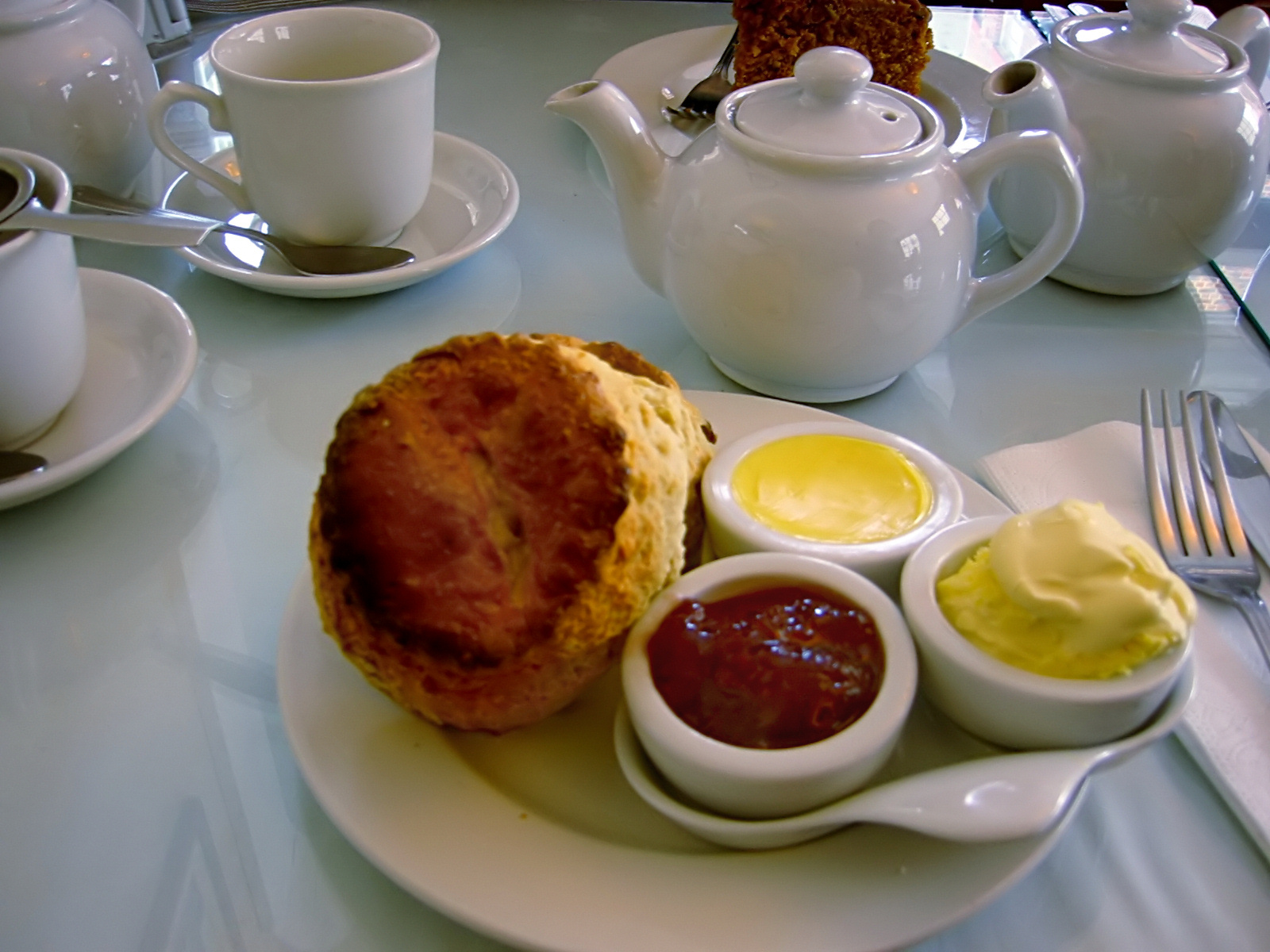
Main article: Cream tea
Clotted cream is an essential part of a cream tea, a favourite with tourists particularly in Cornwall and Devon. It is served on scones—or the more traditional "splits"—with strawberry jam, along with a pot of tea. Traditionally, there are differences in the way it is eaten in each county: in Devon the cream is traditionally spread first on the scone, with the jam dolloped on top. In Cornwall the jam is spread first with a dollop of cream. Cream teas, known as Devonshire teas, spread to southern Australia as early immigrants from Cornwall and Devon took their traditional recipes with them. In 2010 Langage Farm in Devon started a campaign for "Devon cream tea" to have protected designation of origin similar to "Cornish clotted cream". One variation on a cream tea is called "Thunder and Lightning" which consists of a round of bread topped with clotted cream and golden syrup, honey or treacle.
Confectionery
Clotted cream can be used as an accompaniment to hot or cold desserts. Clotted cream, especially clotted cream from Devon, where it is less yellow due to lower carotene levels in the grass, is regularly used in baking. It is used throughout southwest England in the production of ice cream and fudge.
Savoury dishes
Clotted cream is used in some savoury dishes, and can be incorporated into mashed potato, risotto or scrambled eggs.
Historical
Cabbage cream (which does not contain cabbage despite the name) was a delicacy in the mid-17th century: layers of clotted cream were interspersed with sugar and rosewater, creating a cabbage-like effect when served. It was a common accompaniment to junket, a milk-based dessert that went out of fashion in the mid-20th century.
Literature and folklore
Clotted cream was mentioned in The Shepheardes Calendar, a poem by Edmund Spenser in 1579:
Ne would she scorn the simple shepherd swain, For she would call him often heam, And give him curds and clouted cream.
As with many Cornish and Devonian icons, clotted cream has become entrenched in local folklore. For example, one myth tells of Jenny who enticed the giant Blunderbore (sometimes called Moran) by feeding him clotted cream. He eventually fell in love with her and made her his fourth wife. Another myth, from Dartmoor, tells of a princess who wanted to marry an elven prince, but according to tradition had to bathe in pure cream first. A witch who wanted the prince for her daughter kept souring the cream. Eventually, the prince offered the princess clotted cream that the witch was unable to sour.
Clotted cream is also mentioned as one of the staple foods of the hobbits in J.R.R. Tolkien's The Lord of the Rings books.
Notes
References
References
- "BBC - Devon Great Outdoors - Tony Beard's Dartmoor Diary".
- (3 September 2021). "GIs worldwide compilation". Origin GI.
- Hawker, Rev. J. M.. (1881). "Clouted Cream". Report and Transactions of the Devonshire Association.
- Figioni, Paula. (2010). "How Baking Works: Exploring the Fundamentals of Baking Science". John Wiley and Sons.
- Barnett, Anne. (1998). "Understanding Ingredients". Heinemann.
- (2008). "Food Standards Agency: Manual of Nutrition". HMSO London.
- Terry Marsden. (2006). "Between the local and the global: confronting complexity in the contemporary agri-food sector". Emerald Group Publishing.
- Alan Davidson. (2006). "The Oxford companion to food". Oxford University Press.
- Wood, Jacqui. (2001). "Prehistoric Cooking". Tempus.
- Medieval Decon & Cornwall: Shaping an Ancient Countryside, Ed. Sam Turner, 2006
- (12 December 2020). "The Pre-Norman Landscape". Flyingpast.org.
- Spencer, Nikki. (30 May 1998). ["A tour through Cornwall, in the autumn of 1808"](https://archive.org/details/atourthroughcor00warngoog }} and {{cite news). Wilkie and Robinson.
- Lane, John. (1998). "In Praise of Devon: A Guide to Its People, Places and Character". Dundurn Press.
- (17 January 2004). "Did cream teas originate in Tavistock in 997AD". [[BBC News]].
- "To make Clouted Cream". Vintage Recipes.
- Sinclair, John. (1807). "The code of health and longevity: or, A concise view, of the principles calculated for the preservation of health, and the attainment of long life". A. Constable & co.
- (21 January 1853). "Rural economy: The dairy". [[The New York Times]].
- (1839). "The transactions of the Provincial medical and surgical association". Provincial Medical and Surgical Association.
- Spencer, Nikki. (30 May 1998). "The tartars of cream". [[The Independent]].
- {{cite EU regulation. (30 September 1998)
- "EU Protected Food Names Scheme — UK registered names — National application No: 03514: Cornish clotted cream". [[Department for Environment, Food and Rural Affairs]].
- Fielden, Marjory Eckett. (1934). "Old-time survivals in Devon". The Devonshire Press.
- Early, Ralph. (1998). "The technology of dairy products". Springer.
- A. H. Varnam. (2001). "Milk and milk products: technology, chemistry and microbiology". Springer.
- Anderson, Lisa. (23 January 1985). "'Clotted cream' caviar of dairy". [[Ottawa Citizen]].
- "Interview with Nicholas Rodda".
- (23 October 2006). "Forty-five jobs go in dairy close". [[BBC News]].
- (21 April 2011). "Fury as 'Definitely Devon' clotted cream is made in Cornwall and label says add jam first". This Is Devon.
- (26 May 2011). "Trading probe into 'Definitely Devon' claims". This Is Cornwall.
- "Restaurants in UK - Book UK Restaurants - Bookatable".
- "Dorset Afternoon Teas at Heights Hotel on Portland". Heights Hotel.
- [http://www.potsandpieces.com/Teashop.html The Teashop, Ross-on-Wye] {{webarchive. link. (June 21, 2013)
- [http://www.welshicons.org.uk/main/food-drink/producers/welsh-dairy-products/ Welsh Icons: Welsh Dairy Products] {{webarchive. link. (2011-10-02)
- "Calbourne Classics Isle of Wight clotted cream".
- "Devonshire (Clotted) or Devon Cream Recipe". Joy of Baking.
- (22 August 2010). "Nigel Slater's Devonshire cream tea recipes". [[The Guardian]].
- "The History of Devonshire Tea".
- (9 June 2010). "How do you do take your cream tea?". [[BBC News Online]].
- (2001). "Wakefield Companion to South Australian History". [[Wakefield Press (Australia).
- Savill, Richard. (20 May 2010). "Cream teas battle rages between Devon and Cornwall". [[The Daily Telegraph]].
- (8 June 2010). "Devon cream tea campaign put to government". [[BBC News]].
- (5 September 1982). "Britain's Best at Teatime". [[The New York Times]].
- "BBC - Food - Clotted cream recipes".
- (22 June 2011). "Clotted cream: the perfect summer treat". [[The Guardian]].
- (1998). "A gift to young housewives". Indiana University Press.
- Viccars, Sue. (2011). "Frommer's Devon and Cornwall With Your Family". Frommer.
- Sandles, Tim. "Dartmoor Clotted Cream". Legendary Dartmoor.
- (2012-10-30). "The Wisdom of the Shire: A Short Guide to a Long and Happy Life". Macmillan.
This article was imported from Wikipedia and is available under the Creative Commons Attribution-ShareAlike 4.0 License. Content has been adapted to SurfDoc format. Original contributors can be found on the article history page.
Ask Mako anything about Clotted cream — get instant answers, deeper analysis, and related topics.
Research with MakoFree with your Surf account
Create a free account to save articles, ask Mako questions, and organize your research.
Sign up freeThis content may have been generated or modified by AI. CloudSurf Software LLC is not responsible for the accuracy, completeness, or reliability of AI-generated content. Always verify important information from primary sources.
Report