From Surf Wiki (app.surf) — the open knowledge base
Clinton, Oneida County, New York

| Field | Value |
|---|---|
| official_name | Clinton, New York |
| settlement_type | Village |
| image_skyline | Center_of_downtown_Clinton_NY.jpg |
| image_caption | Center of Clinton, and starting point for street numbers, at College Street and West Park Row |
| image_map | Oneida County New York incorporated and unincorporated areas Clinton highlighted.svg |
| mapsize | 260px |
| map_caption | Location in Oneida County and the state of New York |
| subdivision_type | Country |
| subdivision_name | United States |
| subdivision_type1 | State |
| subdivision_name1 | New York |
| subdivision_type2 | County |
| subdivision_name2 | Oneida |
| unit_pref | Imperial |
| area_footnotes | |
| area_total_km2 | 1.62 |
| area_land_km2 | 1.62 |
| area_water_km2 | 0.00 |
| area_total_sq_mi | 0.63 |
| area_land_sq_mi | 0.63 |
| area_water_sq_mi | 0.00 |
| population_as_of | 2020 |
| population_total | 1683 |
| population_density_km2 | 1038.27 |
| population_density_sq_mi | 2688.50 |
| timezone | Eastern (EST) |
| utc_offset | -5 |
| timezone_DST | EDT |
| utc_offset_DST | -4 |
| elevation_m | 184 |
| elevation_ft | 604 |
| coordinates | |
| postal_code_type | ZIP code |
| postal_code | 13323 |
| area_code | 315 |
| blank_name | FIPS code |
| blank_info | 36-16419 |
| blank1_name | GNIS feature ID |
| blank1_info | 0946885 |
| website |
Clinton (or Ka-dah-wis-dag, "white field" in Seneca language) is a village in Oneida County, New York, United States. The population was 1,942 at the 2010 census, declining to 1,683 in the 2020 census, 13% decline). It was named for George Clinton, the first Governor of New York.
Hamilton College and the former Kirkland College are in proximity to the village.
In describing the attractions of Hamilton College in 1833, it was stated to be "situated in one of the most healthful, delightful, and fertile parts of our country; surrounded by a numerous, increasing, virtuous, and enterprising population."{{cite book
History
Part of Coxe's Patent, 6th division, Clinton began in March 1787 when Revolutionary War veterans from Plymouth, Connecticut, settled in Clinton. Pioneer Moses Foote brought seven other families with him to the area. The new inhabitants found good soil, plentiful forests, and friendly in southern Kirkland along with Oneida people, who passed through on trail. Named after New York's first governor, George Clinton, fourth Vice President of the United States and an uncle of Erie Canal builder and New York governor DeWitt Clinton, the village had a gristmill on the Oriskany Creek on College Street the first year and slowly developed as a farming and mercantile center.
In 1793, Presbyterian minister Rev. Samuel Kirkland founded Hamilton-Oneida Academy as a seminary to serve as part of his missionary work with the Oneida tribe. The seminary admitted both white and Oneida boys, although no Oneida boys lasted more than one year. Kirkland named it in honor of Treasury Secretary Alexander Hamilton, who was a member of the first Board of Trustees of the Hamilton-Oneida Academy. The Academy became Hamilton College in 1812, making it the third oldest college in New York, after Columbia and Union, after it expanded to a four-year college curriculum.
Originally in the Town of Whitestown and then the Town of Paris, Clinton became part of the newly formed Town of Kirkland in 1827, and became an incorporated village in April 1843 with its own board of trustees, officials, employees, and status as a taxing jurisdiction.
According to Gordon's 1836 Gazetteer, Clinton had 50 dwellings, six stores, four taverns, two clothing works, a worsted factory, a grist mill, three churches (Universalist, Baptist, and Congregational), two academies, and two seminaries.{{cite book
Elihu Root, Secretary of State under President McKinley and Secretary of War under presidents McKinley and Roosevelt, was born in a building on the Hamilton College campus, and is probably Clinton's most famous son.
Although never a factory town, Clinton did have the Clinton Knitting Company on the site of the Clinton House Apartments on Kirkland Avenue in the first half of the 20th century, as well as the Clinton Canning Company to process local vegetables in the late summer and fall.
The pharmaceutical company Bristol-Myers Squibb began as the Clinton Pharmaceutical Company in 1887 on the second floor of 3-5 West Park Row and moved to Syracuse after three years. Both founders, William Bristol and John Myers, graduated from Hamilton College.
Attractions


The village centers around the Village Green, a park where many community events take place. Annual events on and around the Village Green include a summer farmers market, the Shopper's Stroll during the weekend after Thanksgiving, and the Clinton Art and Music festival in August. The Kirkland Art Center also hosts many activities throughout the year, including the KAC Road Race. The historic Clinton Cider Mill, a local favorite on Elm Street, has been producing cider since the early 1900s and is open seasonally from Labor Day through Thanksgiving.
The Clinton Historic District is listed on the National Register of Historic Places. There is also an active Clinton Historical Society.
Education
The Clinton Central School District covers Clinton and most of the surrounding Town of Kirkland. Its campus is near the center of Clinton.
Hamilton College is near the village, in the Town of Kirkland.
History of education
In the 19th century, Clinton was known as a "village of schools"{{cite news
Prior to the passage of the New York State Compulsory School Law of 1894, about half of the town's school-age children attended a school.
As put in 1878:
There was a public elementary or grammar school on East Park Row, which in 1802 was replaced by a brick building and in 1839 by a larger wood structure.{{cite book

From 1793 to 1812 the Hamilton–Oneida Academy, forerunner of Hamilton College (1812), operated in what would later become Clinton. Its three-story building, torn down in 1830{{cite book |editor-first=Mary Ann |editor-last=Stiefvater
Between the closing of the Hamilton-Oneida Academy in 1812 and the opening of the Clinton Grammar School a "classical" (college preparatory) school operated at what is today (2023) the oldest house in Clinton, at 29 West Park Row.{{cite news
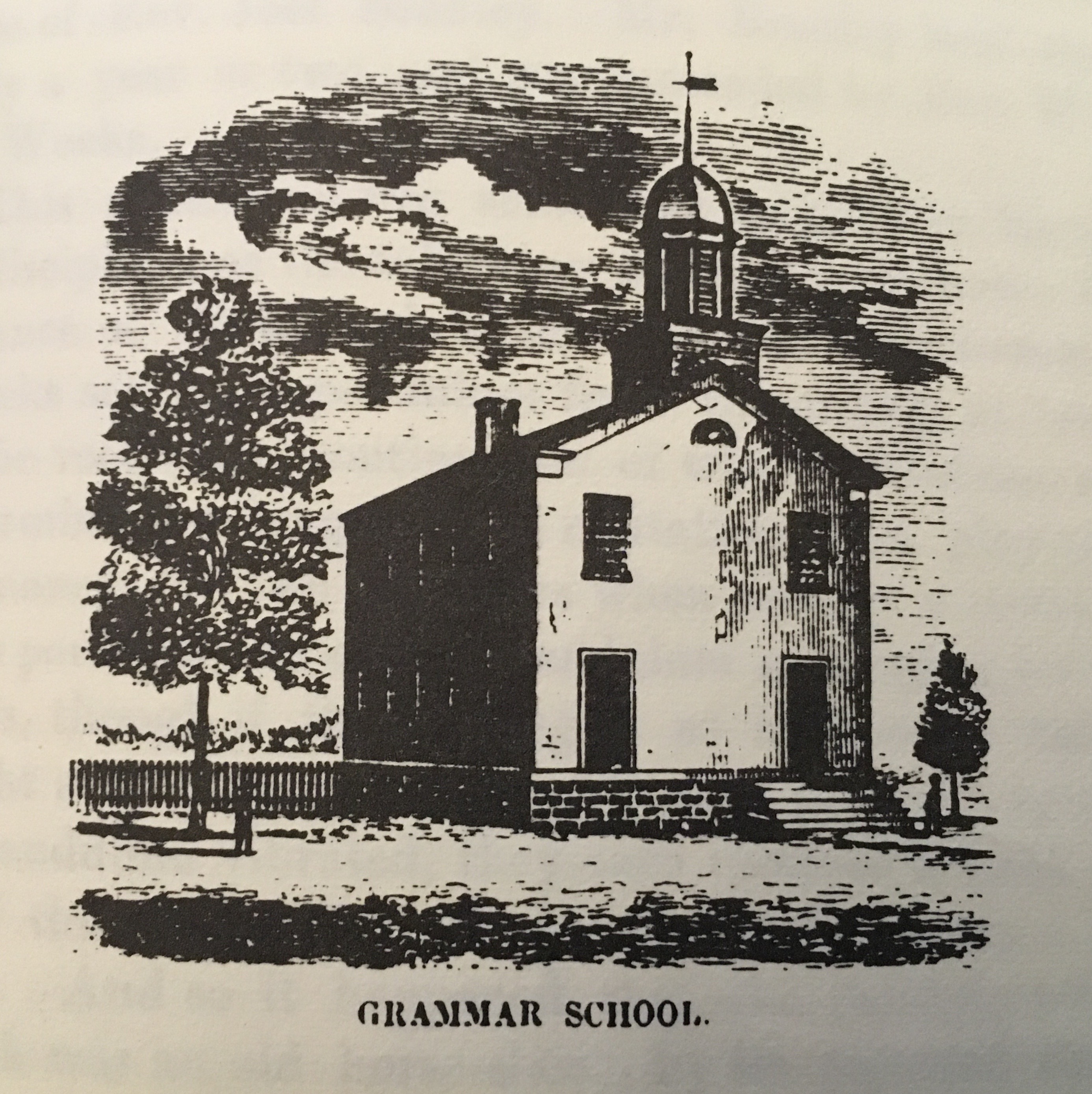
In 1813 the Clinton Grammar School was founded; it was chartered in 1815. Under four different names, including Rural High School and Clinton Military Academy,{{cite book
From 1814 to 1856 the Royce Academy was a boarding and day school for young ladies. Its last location was the former Royce mansion, at the intersection of Kirkland and Chenango Avenues. It closed upon the death of Miss Nancy Royce, an invalid who was the main instructor. "Two or three Indian girls, of the Stockbridge tribe, were at one time members of this school."
The Clinton Liberal Institute was a coeducational preparatory school founded by the Universalist Church, operating at the corner of Utica and Mulberry Streets from 1831 to 1878, and then in Fort Plain until destroyed by fire in 1900.{{cite journal
In 1833, Rev. Hiram H. Kellogg, a Presbyterian minister, abolitionist,{{cite book |editor-first1=James S. |editor-last1=Pula |editor-first2=Cheryl A. |editor-last2=Pula}} Hamilton College graduate, and good friend of Gerrit Smith, opened in Clinton a Young Ladies' Domestic Seminary, also called the Clinton Female Seminary and the Clinton Seminary,{{cite news |editor-first1=L. Maria |editor-last1=Child |editor-link1=L. Maria Child |editor-first2=Jean Fagan |editor-last2=Yellin |author-link=Harriet A. Jacobs |editor-link2=Jean Fagan Yellin |orig-date=September 15, 1847
In 1841, the Free Will Baptists purchased the building previously occupied by Kellogg's Seminary, and established the Clinton Seminary.{{cite book
In 1844, the Clinton Grammar School, Clinton Liberal Institute, Clinton Seminary, and Hamilton Academy, all being under the supervision of the New York State Board of Regents which made them eligible, received state appropriations of $48.84, $274.01, $387.95, and $225.18 respectively. No other village in the area had as many recipient institutions, Together with the Oneida Institute, which received $86.82, other Oneida institutions made it the leading county.{{cite news
In 1849, an advertisement reveals that Miss Catherine Hopkins, for some years Principal of the Female Department of the Hamilton Academy, was running a Young Ladies' Seminary, where Latin, Greek, French, German, and Italian could be studied.{{cite news

Houghton Seminary In 1854, a Home Cottage Seminary was founded, at 23 Chestnut St., "at the west end of Chestnut Street,"{{citation
In 1858, a one-man Law School that was operated in Clinton by Theodore Dwight, son of Benjamin Dwight (see below), at Hamilton College was moved to New York City, "where it will be maintained in connection with Columbia College."{{cite news
In 1860, a "picturesque" Rural High School, occupying 18 acres at Elm St. and Norton Avenue (at the time Factory Street), operated in Clinton.{{cite news |orig-date=1915
From 1861 to 1896 a Cottage School for girls, later renamed the Cottage Seminary, operated on the west side of current Chenango Avenue, at College Street. It was a combination boarding and day school.{{cite book
Additional schools operating at this time included Miss Mary Brown's School on College Street, and Miss Louisa Pond's Select School (1830s–1840s). Miss Katherine Lee conducted in her home a school for young children from 1905 to 1912; another source says it closed in 1906. Mrs. Elizabeth Marr's Select School, established in 1861, located finally at 8 Meadow St., continued late into the 1870s; in 1873 the enrollment was 26. Mrs. Chloe R. Garlinghouse's school on Marvin Street operated from 1876 to 1891. Miss Martha Mears's school on College Street was operated in the 1880s. Miss Anna Sykes conducted her Music School on Dwight Avenue for a number of years from 1872. Rev. Benjamin Dwight opened his home for a girls' school from 1865 to 1889.
In 1882 a school for boys, named Kirkland Hall, opened in the former White Seminary, vacant since the Clinton Liberal Institute moved to Fort Plain. It operated until 1889. It had an affiliated fraternity chapter, Theta Phi. Another source says that in 1886, the Flint Brothers "reopened the Anderson school in the old Institute."
In 1884 a boarding and day school for girls was established, in a new building at the north-east corner of Marvin and Chestnut Streets. It was first named the Florence Seminary, then renamed Huntington Hall. It closed in 1888, the students moving to the Houghton Seminary.
In 1873, there were in Clinton "two Schools for young gentlemen, and three for young ladies,.{{cite book
In 1891, Clinton's public school started to offer classes in grades 1 through 12. 191 pupils enrolled on opening day. In 1893, the opening of the Clinton Union School and Academy, on Marvin Street,{{citation |editor-first=George |editor-last=Searles
Sports
The Clinton Arena was home to the Clinton Comets of the Eastern Hockey League, which ended play at the arena in 1973. Portions of the movie Slap Shot were filmed at the famed Clinton Arena. The Clinton High School hockey program is widely regarded as one of the best in New York State, despite the small size of the school. The team won back-to-back state championships twice, in 1994–1995 and 1995–1996 and again in 2004–2005 and 2005–2006.
In 2005 and 2006, Clinton's Cross Country team won back-to-back scholar athlete state championships.
In 1984, Clinton's football team went to the Carrier Dome beating V.V.S. in the semi-final, 3-0 and became Section 3 Class B Co-Champion along with Bishop Grimes since the game ended in a tie, 0-0.
Clinton's boys' soccer program won their first Section III title in 2006, and a second in 2011, for the first time advancing to the state semi-finals, as well as an undefeated regular season. It is also noted that they are among the top contenders for the Center-State Conference Championship every year. Clinton track and field is also well known in the area.
Geography
Clinton is located at (43.048852, -75.380250).
According to the United States Census Bureau, the village has a total area of 0.6 sqmi, all land.
The village is east of the Oriskany Creek.
The village is the location of one of the several "knob and kettle structure" kames located along the Oriskany valley, named The Knob. In 1836 its then owner, William T. Richmond, donated it to the Clinton Liberal Institute. Richmond's intent was that, with the accompaniment of worth of equipment donated by a R. W. Haskins of Buffalo, the Institute could build an observatory on the hill, but this plan never came to fruition.
Demographics
As of the census of 2000, there were 1,952 people, 922 households, and 488 families residing in the village. The population density was 3,349.4 PD/sqmi. There were 965 housing units at an average density of 1,655.8 /sqmi. The racial makeup of the village was 98.05% White, 0.61% African American, 0.72% Asian, 0.26% from other races, and 0.36% from two or more races. Hispanic or Latino people of any race were 1.33% of the population.
There were 922 households, out of which 25.7% had children under the age of 18 living with them, 43.8% were married couples living together, 6.8% had a female householder with no husband present, and 47.0% were non-families. 41.6% of all households were made up of individuals, and 20.5% had someone living alone who was 65 years of age or older. The average household size was 2.11 and the average family size was 2.94.
In the village, the population was spread out, with 22.7% under the age of 18, 7.4% from 18 to 24, 23.0% from 25 to 44, 27.4% from 45 to 64, and 19.5% who were 65 years of age or older. The median age was 43 years. For every 100 females, there were 88.8 males. For every 100 females age 18 and over, there were 82.8 males.
The median income for a household in the village was $41,958, and the median income for a family was $66,685. Males had a median income of $45,750 versus $31,369 for females. The per capita income for the village was $26,165. About 3.1% of families and 9.7% of the population were below the poverty line, including 4.7% of those under age 18 and 12.2% of those age 65 or over.
Economy
- Indium Corporation (1934), materials refiner, smelter, manufacturer, and supplier
Notable people
- Natalie Babbitt, award-winning children's author, wife of Kirkland College President Samuel Fisher Babbitt
- Clara Barton, founder of American Red Cross, studied at the Clinton Liberal Institute
- Frederick Bee, builder of telegraph over Sierra Nevada mountains and Consul of the Chinese Consulate in San Francisco
- Susan Bennett, voice-over artist best known for being the female American voice of Apple's "Siri"
- William McLaren Bristol, co-founder of Bristol-Meyers Squibb
- Jack Britton, former World Welterweight Champion in boxing known as the "Boxing Marvel"
- Terry Brooks, fantasy author, graduated from Hamilton College
- Grover Cleveland, US President, childhood resident in 1851–52 at 26 Utica Street when his father was a Presbyterian minister working in Clinton for a missionary society. Cleveland's biographers say he attended the Clinton Liberal Institute,{{cite journal
- Rose Cleveland, sister of the President, studied at Houghton Academy and taught history and literature there; she also taught more briefly at Hamilton College. She was the nation's first lady for two years; her brother was a bachelor.
- George W. Clinton, son of Governor DeWitt Clinton, graduated from Hamilton College.
- Flick Colby, choreographer
- Rev. Benjamin Woodbridge Dwight, Hamilton College graduate and tutor, founded school in Clinton
- Edward P. Felt, passenger on United Flight 93, died September 11, 2001
- Ulysses S. Grant III, United States Army officer, grandson of President Ulysses S. Grant
- Asa Gray, botanist, studied at the Clinton Grammar School{{cite journal
- Alex Haley, writer
- George Hastings, US Congressman, 1853-1857
- Mark Hopkins, President of Williams College, studied, as a "private pupil", at the Clinton Grammar School{{cite news
- Louisa Matilda Jacobs, an African American, studied at the Young Ladies' Domestic Seminary
- Rev. Hiram Huntington Kellogg Sr., graduate of Hamilton College, founder of the Young Ladies' Domestic Seminary and first president of Knox College
- Samuel Kirkland, a missionary among the Oneida, obtained a charter for Hamilton College in 1812
- Sarah J. Maas, author of Throne of Glass series of fantasy novels, graduated from Hamilton College
- Louis M. Martin, member New York State Assembly, New York Supreme Court
- Elizabeth Smith Miller, daughter of Gerrit Smith, studied at Young Ladies' Domestic Seminary{{cite book
- Myrtilla Miner, educator of Blacks, studied at the Young Ladies' Domestic Seminary
- John Ripley Myers, co-founder of Bristol-Meyers Squibb
- Joe Nolan, ice hockey defenceman for the Clinton Comets in the 1950s
- Nick Palmieri, professional ice hockey player, was born in Clinton
- Christian Heinrich Friedrich Peters, Danish-born astronomer, worked at Litchfield Observatory, Hamilton College
- Ezra Pound, poet and intellectual; attended Hamilton College
- Electa Quinney, native American, studied at the Young Ladies' Domestic Seminaary
- Elihu Root, U.S. Senator, Secretary of War, Nobel peace prize, born in Clinton and attended Hamilton College
- Bernie Sanders, taught political science at Hamilton College in 1991; later U.S. Senator from Vermont
- B. F. Skinner, psychologist and social philosopher, graduated from Hamilton College
- Gerrit Smith, valedictorian of the first graduating class at Hamilton College, U.S. congressman 1853-1854, three-time presidential candidate
- Charles Henry Smyth Jr., attended Clinton Grammar School, geology professor at Hamilton College
- Leland Stanford, Governor and Senator of California, founder of Stanford University, studied briefly at the Clinton Liberal Institute{{cite news
- De Wayne Stebbins, Wisconsin State Senator from 1895 to 1903, was born in Clinton
- Antoinette Sterling, studied music at the White Seminary under Annie Sykes, who had studied at Kellogg's school for young ladies
- Hildegarde Swift, award-winning children's author, was born in Clinton
Archival material
In the William L. Clements Library, University of Michigan, Ann Arbor, Michigan, are the Gridley family papers, [1798]-1885. They contain (212 items) the letters of a highly educated Clinton family, who were drawn to evangelical religion and progressive causes in the 1820-1830s.{{cite web
References
Sources
References
- "ArcGIS REST Services Directory". United States Census Bureau.
- Jones, Pomroy. (1851). "Annals and recollections of Oneida County". Published by the author.
- "2020 CENSUS - CENSUS BLOCK MAP: Hamilton College CDP, NY". [[U.S. Census Bureau]].
- From the Foote family, comprising the Genealogy and History of Nathaniel Foote of Wethersfield, Conn. and his descendants. of 2 primary source edition Volume 1. By Abram William Foote
- "Hamilton had championed a humane, enlightened policy toward the Indians...Through his interest in educating native Americans, Hamilton's name came to adorn a college." ([[Ron Chernow]], ''Alexander Hamilton'', 2004, p. 337).
- Clinton Historical Society. "Some history about Clinton, NY".
- "Shopping, Lodging, Dining Map and Directory".
- "Farmers Market".
- "Shoppers' Stroll & Holiday Parade".
- "Art & Music Festival".
- "About Us".
- (June 2, 2020). "Visit the Clinton Cider Mill".
- "2020 CENSUS - SCHOOL DISTRICT REFERENCE MAP: Oneida County, NY". [[U.S. Census Bureau]].
- Geography Division. (April 14, 2021). "2020 Census - Census Block Map: Kirkland town, NY". [[U.S. Census Bureau]].
- {{rp. 7 [[Elihu Root]], [[Mark Hopkins (educator). 51[https://web.archive.org/web/20230810133020/https://clintonhistory.pastperfectonline.com/photo/41C759E7-9B78-449F-9EB0-608727519495 Link to picture of Clinton Grammar School]
- {{rp. 222[https://web.archive.org/web/20230810121821/https://clintonhistory.pastperfectonline.com/Photo/DF348600-BFFE-4A4C-ADBC-259032122008#gallery Link to picture of Royce Academy]
- ''Journal of Regents Minutes,'' December 14, 1905 (excerpt held by [[Clinton Historical Society (Clinton, New York). Clinton Historical Society]]).
- [https://web.archive.org/web/20230810132524/https://s3.amazonaws.com/pastperfectonline/images/museum_1130/018/20001311.jpg Link to picture of Dwight's Rural High School. Note students in the windows.]
- (February 12, 2011). "US Gazetteer files: 2010, 2000, and 1990". [[United States Census Bureau]].
- "Census of Population and Housing". Census.gov.
- "U.S. Census website". [[United States Census Bureau]].
This article was imported from Wikipedia and is available under the Creative Commons Attribution-ShareAlike 4.0 License. Content has been adapted to SurfDoc format. Original contributors can be found on the article history page.
Ask Mako anything about Clinton, Oneida County, New York — get instant answers, deeper analysis, and related topics.
Research with MakoFree with your Surf account
Create a free account to save articles, ask Mako questions, and organize your research.
Sign up freeThis content may have been generated or modified by AI. CloudSurf Software LLC is not responsible for the accuracy, completeness, or reliability of AI-generated content. Always verify important information from primary sources.
Report