From Surf Wiki (app.surf) — the open knowledge base
Climate change in the Arctic
Impacts of climate change on the Arctic
Impacts of climate change on the Arctic
- https://phys.org/news/2021-05-arctic-faster-planet.html (refs: 2, 34)
- https://www.science.org/content/article/arctic-warming-four-times-faster-rest-world (refs: 3, 36, 158)
- https://doi.org/10.1038%2Fs43247-022-00498-3 (refs: 4, 23, 35, 157)
- https://doi.org/10.1029%2F2022GL099371 (refs: 5, 41)
- https://www.ipcc.ch/report/ar6/wg1/downloads/report/IPCC_AR6_WGI_TS.pdf (refs: 30, 214)
- https://www.ncbi.nlm.nih.gov/pmc/articles/PMC9200822 (refs: 37, 159)
- https://www.theguardian.com/environment/2022/jun/15/new-data-reveals-extraordinary-global-heating-in-the-arctic (refs: 38, 160)
- https://www.science.org/doi/10.1126/science.abn7950 (refs: 39, 114, 137, 146)
- https://climatetippingpoints.info/2022/09/09/climate-tipping-points-reassessment-explainer/ (refs: 40, 122, 138)
- https://www.nature.com/articles/s43247-022-00498-3 (refs: 45, 215)
- https://www.ipcc.ch/report/ar6/wg1/downloads/report/IPCC_AR6_WGI_Chapter09.pdf (refs: 55, 78, 119)
- https://ui.adsabs.harvard.edu/abs/2014Natur.510..525R (refs: 70, 74)
- https://doi.org/10.1029%2F2008gb003327 (refs: 116, 202)
- https://www.ncbi.nlm.nih.gov/pmc/articles/PMC6099852 (refs: 121, 134)
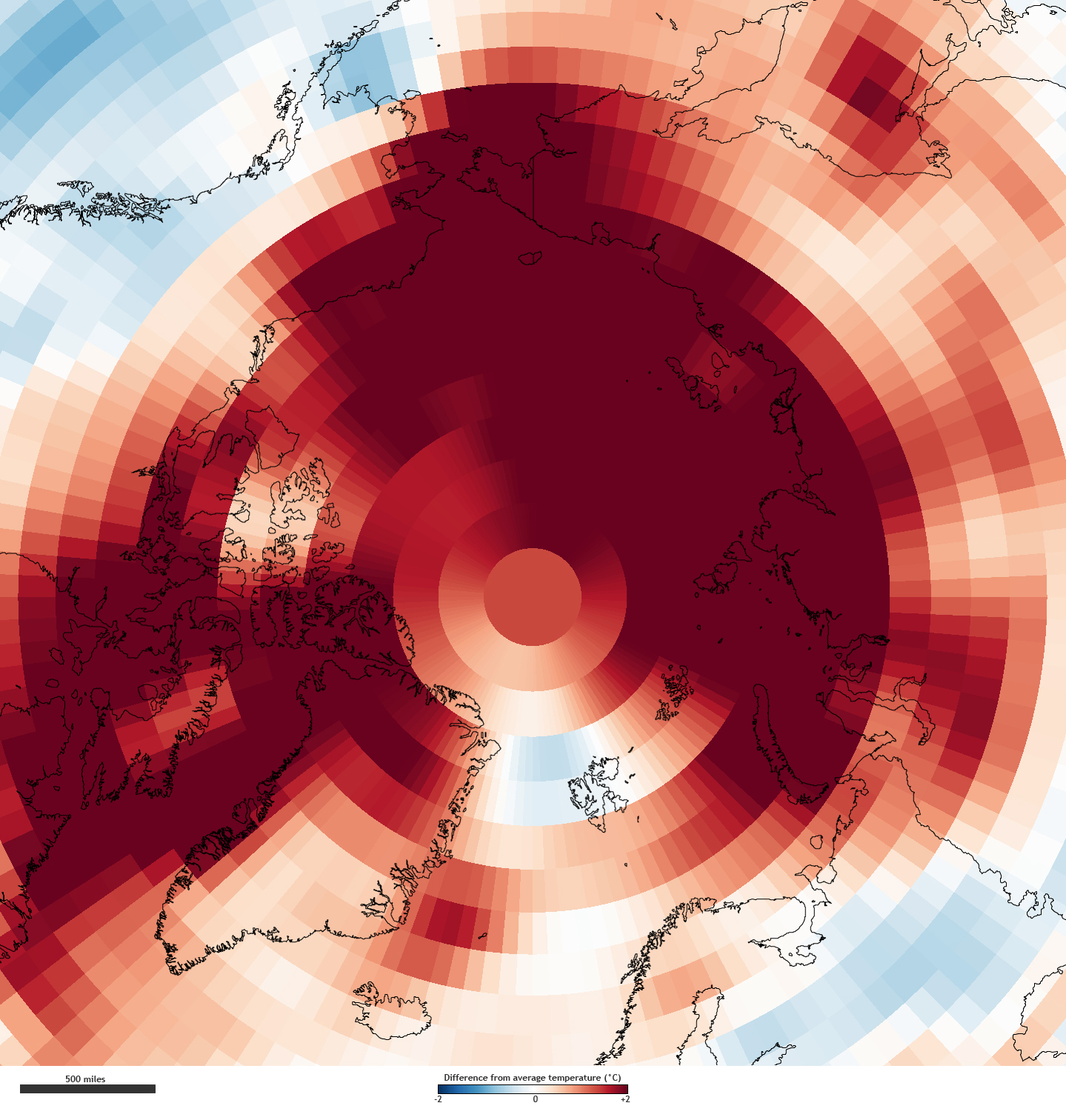
Due to climate change in the Arctic, this polar region is expected to become "profoundly different" by 2050. The speed of change is "among the highest in the world", with warming occurring at 3-4 times faster than the global average. This warming has already resulted in the profound Arctic sea ice decline, the accelerating melting of the Greenland ice sheet and the thawing of the permafrost landscape. These ongoing transformations are expected to be irreversible for centuries or even millennia.
Natural life in the Arctic is affected greatly. As the tundra warms, its soil becomes more hospitable to earthworms and larger plants, and the boreal forests spread to the north - yet this also makes the landscape more prone to wildfires, which take longer to recover from than in the other regions. Beavers also take advantage of this warming to colonize the Arctic rivers, and their dams contributing to methane emissions due to the increase in stagnant waters. The Arctic Ocean has experienced a large increase in the marine primary production as warmer waters and less shade from sea ice benefit phytoplankton. At the same time, it is already less alkaline than the rest of the global ocean, so ocean acidification caused by the increasing concentrations is more severe, threatening some forms of zooplankton such as pteropods.
The Arctic Ocean is expected to see its first ice-free events in the near future - most likely before 2050, and potentially in the late 2020s or early 2030s. This would have no precedent in the last 700,000 years. Some sea ice regrows every Arctic winter, but such events are expected to occur more and more frequently as the warming increases. This has great implications for the fauna species which are dependent on sea ice, such as polar bears. For humans, trade routes across the ocean will become more convenient. Yet, multiple countries have infrastructure in the Arctic which is worth billions of dollars, and it is threatened with collapse as the underlying permafrost thaws. The Arctic's indigenous people have a long relationship with its icy conditions, and face the loss of their cultural heritage.
Further, there are numerous implications which go beyond the Arctic region. Sea ice loss not only enhances warming in the Arctic but also adds to global temperature increase through the ice-albedo feedback. Permafrost thaw results in emissions of and methane that are comparable to those of major countries. Greenland melting is a significant contributor to global sea level rise. If the warming exceeds - or thereabouts, there is a significant risk of the entire ice sheet being lost over an estimated 10,000 years, adding up to global sea levels. Warming in the Arctic may affect the stability of the jet stream, and thus the extreme weather events in midlatitude regions, but there is only "low confidence" in that hypothesis.
Impacts on the physical environment
Warming
The period of 1995–2005 was the warmest decade in the Arctic since at least the 17th century, with temperatures 2 C-change above the 1951–1990 average. Alaska and western Canada's temperature rose by 3 to during that period. 2013 research has shown that temperatures in the region haven't been as high as they currently are since at least 44,000 years ago and perhaps as long as 120,000 years ago. Since 2013, Arctic annual mean surface air temperature (SAT) has been at least 1 C-change warmer than the 1981-2010 mean.
In 2016, there were extreme anomalies from January to February with the temperature in the Arctic being estimated to be between 4-5.8 C-change more than it was between 1981 and 2010. In 2020, mean SAT was 1.9 C-change warmer than the 1981–2010 average. On 20 June 2020, for the first time, a temperature measurement was made inside the Arctic Circle of 38 °C, more than 100 °F. This kind of weather was expected in the region only by 2100. In March, April and May the average temperature in the Arctic was 10 C-change higher than normal. This heat wave, without human – induced warming, could happen only one time in 80,000 years, according to an attribution study published in July 2020. It is the strongest link of a weather event to anthropogenic climate change that had been ever found, for now.
Arctic amplification

Precipitation
Field studies in northwest Greenland have shown that increased summer rainfall can trigger large debris flows and slope failures in permafrost terrain. In 2016–2017, unprecedented rain events near Siorapaluk caused widespread mass movement processes that reshaped the landscape and damaged archaeological sites. Approximately a quarter of the surveyed archaeological landscape was affected, providing an indicator of long-term slope stability since the late Holocene and highlighting how shifts toward rain-dominated precipitation regimes are already altering Arctic geomorphology.
An observed impact of climate change is a strong increase in the number of lightnings in the Arctic. Lightnings increase the risk for wildfires. Some research suggests that globally, a warming greater than 1.5 C-change over the preindustrial level could change the type of precipitation in the Arctic from snow to rain in summer and autumn.
Cryosphere loss

Sea ice

The rate of the decline in entire Arctic ice coverage is accelerating. From 1979 to 1996, the average per decade decline in entire ice coverage was a 2.2% decline in ice extent and a 3% decline in ice area. For the decade ending 2008, these values have risen to 10.1% and 10.7%, respectively. These are comparable to the September to September loss rates in year-round ice (i.e., perennial ice, which survives throughout the year), which averaged a retreat of 10.2% and 11.4% per decade, respectively, for the period 1979–2007.
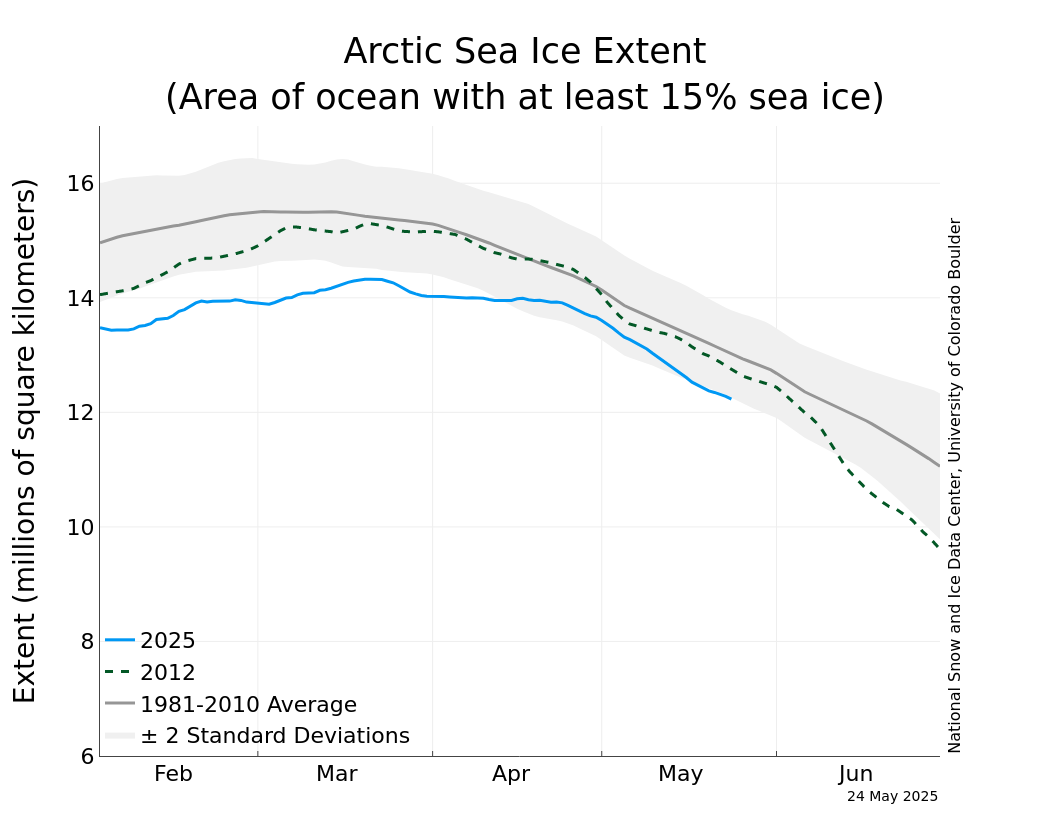
The Arctic sea ice September minimum extent (SIE) (i.e., area with at least 15% sea ice coverage) reached new record lows in 2002, 2005, 2007, 2012 (5.32 million km2), 2016 and 2019 (5.65 million km2). The 2007 melt season let to a minimum 39% below the 1979–2000 average, and for the first time in human memory, the fabled Northwest Passage opened completely. During July 2019 the warmest month in the Arctic was recorded, reaching the lowest SIE (7.5 million km2) and sea ice volume (8900 km3). Setting a decadal trend of SIE decline of −13%. As for now, the SIE has shrink by 50% since the 1970s.
From 2008 to 2011, Arctic sea ice minimum extent was higher than 2007, but it did not return to the levels of previous years. In 2012 however, the 2007 record low was broken in late August with three weeks still left in the melt season. It continued to fall, bottoming out on 16 September 2012 at 3.42 million square kilometers (1.32 million square miles), or 760,000 square kilometers (293,000 square miles) below the previous low set on 18 September 2007 and 50% below the 1979–2000 average.

The sea ice thickness field and accordingly the ice volume and mass, is much more difficult to determine than the extension. Exact measurements can be made only at a limited number of points. Because of large variations in ice and snow thickness and consistency air- and spaceborne-measurements have to be evaluated carefully. Nevertheless, the studies made support the assumption of a dramatic decline in ice age and thickness. While the Arctic ice area and extent show an accelerating downward trend, arctic ice volume shows an even sharper decline than the ice coverage. Since 1979, the ice volume has shrunk by 80% and in just the past decade the volume declined by 36% in the autumn and 9% in the winter. And currently, 70% of the winter sea ice has turned into seasonal ice.
The Arctic Ocean will likely be free of summer sea ice before the year 2100, but many different dates have been projected, with models showing near-complete to complete loss in September from 2035 to some time around 2067. --
Greenland ice sheet

Lakes
A January 2025 study published in the Proceedings of the National Academy of Sciences reported an "abrupt, coherent, climate-driven transformation" from "blue" (more transparent) to "brown" (less transparent) states of lakes in Greenland after a season of both record heat and rainfall drove a state change in these systems.
Biological environment
Impacts on Arctic flora
.png)
.png)
Climate change is expected to have a strong effect on the Arctic's flora, some of which is already being seen. NASA and NOAA have continuously monitored Arctic vegetation with satellite instruments such as Moderate Resolution Imaging Spectroradiometer (MODIS) and Advanced Very-High-Resolution Radiometer (AVHRR). Their data allows scientists to calculate so-called "Arctic greening" and "Arctic browning". From 1985 to 2016, greening has occurred in 37.3% of all sites sampled in the tundra, whereas browning was observed only in 4.7% of the sites - typically the ones that were still experiencing cooling and drying, as opposed to warming and wettening for the rest.
This expansion of vegetation in the Arctic is not equivalent across types of vegetation. A major trend has been from shrub-type plants taking over areas previously dominated by moss and lichens. This change contributes to the consideration that the tundra biome is currently experiencing the most rapid change of any terrestrial biomes on the planet. The direct impact on mosses and lichens is unclear as there exist very few studies at species level, but climate change is more likely to cause increased fluctuation and more frequent extreme events. While shrubs may increase in range and biomass, warming may also cause a decline in cushion plants such as moss campion, and since cushion plants act as facilitator species across trophic levels and fill important ecological niches in several environments, this could cause cascading effects in these ecosystems that could severely affect the way in which they function and are structured.
The expansion of these shrubs can also have strong effects on other important ecological dynamics, such as the albedo effect. These shrubs change the winter surface of the tundra from undisturbed, uniform snow to mixed surface with protruding branches disrupting the snow cover, this type of snow cover has a lower albedo effect, with reductions of up to 55%, which contributes to a positive feedback loop on regional and global climate warming. This reduction of the albedo effect means that more radiation is absorbed by plants, and thus, surface temperatures increase, which could disrupt current surface-atmosphere energy exchanges and affect thermal regimes of permafrost. Carbon cycling is also being affected by these changes in vegetation, as parts of the tundra increase their shrub cover, they behave more like boreal forests in terms of carbon cycling. This is speeding up the carbon cycle, as warmer temperatures lead to increased permafrost thawing and carbon release, but also carbon capturing from plants that have increased growth. It is not certain whether this balance will go in one direction or the other, but studies have found that it is more likely that this will eventually lead to increased in the atmosphere.
However, boreal forests, particularly those in North America, showed a different response to warming. Many boreal forests greened, but the trend was not as strong as it was for tundra of the circumpolar Arctic, mostly characterized by shrub expansion and increased growth. In North America, some boreal forests actually experienced browning over the study period. Droughts, increased forest fire activity, animal behavior, industrial pollution, and a number of other factors may have contributed to browning.
Impacts on terrestrial fauna

Arctic warming negatively affects the foraging and breeding ecology of native Arctic mammals, such as Arctic foxes or Arctic reindeer. In July 2019, 200 Svalbard reindeer were found starved to death apparently due to low precipitation related to climate change. This was only one episode in the long-term decline of the species. United States Geological Survey research suggests that the shrinkage of Arctic sea ice would eventually extirpate polar bears from Alaska, but leave some of their habitat in the Canadian Arctic Archipelago and areas off the northern Greenland coast.
As the pure Arctic climate is gradually replaced by the subarctic climate, animals adapted to those conditions spread to the north. For instance, beavers have been actively colonizing Arctic regions, and as they create dams, they flood areas which used to be permafrost, contributing to its thaw and methane emissions from it. These colonizing species can outright replace native species, and they may also interbreed with their southern relations, like in the case of the Grizzly–polar bear hybrid. This usually has the effect of reducing the genetic diversity of the genus. Infectious diseases, such as brucellosis or phocine distemper virus, may spread to populations previously separated by the cold, or, in case of the marine mammals, the sea ice.
Marine ecosystems

The reduction of sea ice has brought more sunlight to the phytoplankton and increased the annual marine primary production in the Arctic by over 30% between 1998 and 2020. As the result, the Arctic Ocean became a stronger carbon sink over this period; yet, it still accounts for only 5% to 14% of the total ocean carbon sink, although it is expected to play a larger role in the future. By 2100, phytoplankton biomass in the Arctic Ocean is generally expected to increase by ~20% relative to 2000 under the low-emission scenario, and by 30-40% under the high-emission scenario.
Atlantic cod have been able to move deeper into the Arctic due to the warming waters, while the Polar cod and local marine mammals have been losing habitat. Many copepod species appear to be declining, which is also likely to reduce the numbers of fish which prey on them, such as walleye pollock or the arrowtooth flounder. This also affects Arctic shorebirds. For instance, around 9000 puffins and other shorebirds in Alaska died of starvation in 2016, because too many fish have moved to the north. While the shorebirds also appear to nest more successfully due to the observed warming, this benefit may be more than offset by phenological mismatch between shorebirds' and other species' life cycles. Marine mammals such as ringed seals and walruses are also being negatively affected by the warming.
Greenhouse gas emissions from the Arctic
In 2024, the Arctic has transformed from a carbon sink to a carbon source due to the impacts of climate change, mainly rising temperatures and wildfires.
Permafrost thaw

Permafrost is an important component of hydrological systems and ecosystems within the Arctic landscape. In the Northern Hemisphere the terrestrial permafrost domain comprises around 18 million km2. Within this permafrost region, the total soil organic carbon (SOC) stock is estimated to be 1,460-1,600 Pg (where 1 Pg = 1 billion tons), which constitutes double the amount of carbon currently contained in the atmosphere.
In 2023, Woodwell Climate Research Center received a $5 million grant and fellowship from Google.org, the philanthropic arm of Google, to develop an open-access resource that will use satellite data and artificial intelligence in order to track Arctic permafrost thaw in near real-time.
Black carbon

Main article: Black carbon
Black carbon deposits (from the combustion of heavy fuel oil (HFO) of Arctic shipping) absorb solar radiation in the atmosphere and strongly reduce the albedo when deposited on snow and ice, thus accelerating the effect of the melting of snow and sea ice. A 2013 study quantified that gas flaring at petroleum extraction sites contributed over 40% of the black carbon deposited in the Arctic. 2019 research attributed the majority (56%) of Arctic surface black carbon to emissions from Russia, followed by European emissions, and Asia also being a large source. In 2015, research suggested that reducing black carbon emissions and short-lived greenhouse gases by roughly 60 percent by 2050 could cool the Arctic up to 0.2 °C. However, a 2019 study indicates that "Black carbon emissions will continuously rise due to increased shipping activities", specifically fishing vessels.
The number of wildfires in the Arctic Circle has increased. In 2020, Arctic wildfire emissions broke a new record, peaking at 244 megatonnes of carbon dioxide emitted. This is due to the burning of peatlands, carbon-rich soils that originate from the accumulation of waterlogged plants which are mostly found at Arctic latitudes. These peatlands are becoming more likely to burn as temperatures increase, but their own burning and releasing of contributes to their own likelihood of burning in a positive feedback loop. The smoke from wildfires defined as "brown carbon" also increases arctic warming, with its warming effect is around 30% that of black carbon. As wildfires increases with warming this creates a positive feedback loop.
Methane clathrate deposits
Effects on other parts of the world
On ocean circulation

On mid-latitude weather
Impacts on people
Territorial claims
Main article: Territorial claims in the Arctic
Growing evidence that global warming is shrinking polar ice has added to the urgency of several nations' Arctic territorial claims in hopes of establishing resource development and new shipping lanes, in addition to protecting sovereign rights.
As ice sea coverage decreases more and more, year on year, Arctic countries (Russia, Canada, Finland, Iceland, Norway, Sweden, the United States and Denmark representing Greenland) are making moves on the geopolitical stage to ensure access to potential new shipping lanes, oil and gas reserves, leading to overlapping claims across the region.
There is more activity in terms of maritime boundaries between countries, where overlapping claims for internal waters, territorial seas and particularly Exclusive Economic Zones (EEZs) can cause frictions between nations. Currently, official maritime borders have an unclaimed triangle of international waters lying between them, that is at the centerpoint of international disputes.
This unclaimed land can be obtainable by submitting a claim to the United Nations Convention on the Law of the Sea, these claims can be based on geological evidence that continental shelves extend beyond their current maritime borders and into international waters.
Some overlapping claims are still pending resolution by international bodies, such as a large portion containing the north pole that is both claimed by Denmark and Russia, with some parts of it also contested by Canada. Another example is that of the Northwest Passage, globally recognized as international waters, but technically in Canadian waters. This has led to Canada wanting to limit the number of ships that can go through for environmental reasons but the United States disputes that they have the authority to do so, favouring unlimited passage of vessels.
Navigation
The Transpolar Sea Route is a future Arctic shipping lane running from the Atlantic Ocean to the Pacific Ocean across the center of the Arctic Ocean. The route is also sometimes called Trans-Arctic Route. In contrast to the Northeast Passage (including the Northern Sea Route) and the North-West Passage it largely avoids the territorial waters of Arctic states and lies in international high seas.
Governments and private industry have shown a growing interest in the Arctic. Major new shipping lanes are opening up: the northern sea route had 34 passages in 2011 while the Northwest Passage had 22 traverses, more than any time in history. Shipping companies may benefit from the shortened distance of these northern routes. Access to natural resources will increase, including valuable minerals and offshore oil and gas. Finding and controlling these resources will be difficult with the continually moving ice. Tourism may also increase as less sea ice will improve safety and accessibility to the Arctic.
The melting of Arctic ice caps is likely to increase traffic in and the commercial viability of the Northern Sea Route. One study, for instance, projects, "remarkable shifts in trade flows between Asia and Europe, diversion of trade within Europe, heavy shipping traffic in the Arctic and a substantial drop in Suez traffic. Projected shifts in trade also imply substantial pressure on an already threatened Arctic ecosystem."
Infrastructure

Toxic pollution
Impacts on indigenous peoples
As climate change speeds up, it is having more and more of a direct impact on societies around the world. This is particularly true of people that live in the Arctic, where increases in temperature are occurring at faster rates than at other latitudes in the world, and where traditional ways of living, deeply connected with the natural arctic environment are at particular risk of environmental disruption caused by these changes.
The warming of the atmosphere and ecological changes that come alongside it presents challenges to local communities such as the Inuit. Hunting, which is a major way of survival for some small communities, will be changed with increasing temperatures. The reduction of sea ice will cause certain species populations to decline or even become extinct. Inuit communities are deeply reliant on seal hunting, which is dependent on sea ice flats, where seals are hunted.
Unsuspected changes in river and snow conditions will cause herds of animals, including reindeer, to change migration patterns, calving grounds, and forage availability. In good years, some communities are fully employed by the commercial harvest of certain animals. The harvest of different animals fluctuates each year and with the rise of temperatures it is likely to continue changing and creating issues for Inuit hunters, as unpredictability and disruption of ecological cycles further complicate life in these communities, which already face significant problems, such as Inuit communities being the poorest and most unemployed of North America.
Other forms of transportation in the Arctic have seen negative impacts from the current warming, with some transportation routes and pipelines on land being disrupted by the melting of ice. Many Arctic communities rely on frozen roadways to transport supplies and travel from area to area. The changing landscape and unpredictability of weather is creating new challenges in the Arctic. Researchers have documented historical and current trails created by the Inuit in the Pan Inuit Trails Atlas, finding that the change in sea ice formation and breakup has resulted in changes to the routes of trails created by the Inuit.
Adaptation
Research
Individual countries within the Arctic zone, Canada, Denmark (Greenland), Finland, Iceland, Norway, Russia, Sweden, and the United States (Alaska) conduct independent research through a variety of organizations and agencies, public and private, such as Russia's Arctic and Antarctic Research Institute. Countries who do not have Arctic claims, but are close neighbors, conduct Arctic research as well, such as the Chinese Arctic and Antarctic Administration (CAA). The United States's National Oceanic and Atmospheric Administration (NOAA) produces an Arctic Report Card annually, containing peer-reviewed information on recent observations of environmental conditions in the Arctic relative to historical records. International cooperative research between nations has also become increasingly important:
- Arctic climate change is summarized by the Intergovernmental Panel on Climate Change (IPCC) in its series of Assessment Reports and the Arctic Climate Impact Assessment.
- European Space Agency (ESA) launched CryoSat-2 on 8 April 2010. It provides satellite data on Arctic ice cover change rates.
- International Arctic Buoy Program: deploys and maintains buoys that provide real-time position, pressure, temperature, and interpolated ice velocity data
- International Arctic Research Center: Main participants are the United States and Japan.
- International Arctic Science Committee: non-governmental organization (NGO) with diverse membership, including 23 countries from 3 continents.
- 'Role of the Arctic Region', in conjunction with the International Polar Year, was the focus of the second international conference on Global Change Research, held in Nynäshamn, Sweden, October 2007.
- SEARCH (Study of Environmental Arctic Change): A research framework originally promoted by several US agencies; an international extension is ISAC (the International Study of Arctic Change).
The 2021 Arctic Monitoring and Assessment Programme (AMAP) report by an international team of more than 60 experts, scientists, and indigenous knowledge keepers from Arctic communities, was prepared from 2019 to 2021. It is a follow-up report of the 2017 assessment, "Snow, Water, Ice and Permafrost in the Arctic" (SWIPA). The 2021 IPCC AR6 WG1 Technical Report confirmed that "[o]bserved and projected warming" were ""strongest in the Arctic". According to an 11 August 2022 article published in Nature, there have been numerous reports that the Arctic is warming from twice to three times as fast as the global average since 1979, but the co-authors cautioned that the recent report of the "four-fold Arctic warming ratio" was potentially an "extremely unlikely event". The annual mean Arctic Amplification (AA) index had "reached values exceeding four" from c. 2002 through 2022, according to a July 2022 article in Geophysical Research Letters.
The 14 December 2021 16th Arctic Report Card produced by the United States's National Oceanic and Atmospheric Administration (NOAA) and released annually, examined the "interconnected physical, ecological and human components" of the circumpolar Arctic. The report said that the 12 months between October 2020 and September 2021 were the "seventh warmest over Arctic land since the record began in 1900". The 2017 report said that the melting ice in the warming Arctic was unprecedented in the past 1500 years. NOAA's State of the Arctic Reports, starting in 2006, updates some of the records of the original 2004 and 2005 Arctic Climate Impact Assessment (ACIA) reports by the intergovernmental Arctic Council and the non-governmental International Arctic Science Committee.
A 2022 United Nations Environment Programme (UNEP) report "Spreading Like Wildfire: The Rising Threat Of Extraordinary Landscape Fires" said that smoke from wildfires around the world created a positive feedback loop that is a contributing factor to Arctic melting. The 2020 Siberian heatwave was "associated with extensive burning in the Arctic Circle". Report authors said that this extreme heat event was the first to demonstrate that it would have been "almost impossible" without anthropogenic emissions and climate change.
References
--
Works cited
- {{Cite book |ref=
|display-editors= 4
|editor1-first= V. |editor1-last= Masson-Delmotte
|editor2-first= P. |editor2-last= Zhai
|editor3-first= A. |editor3-last= Pirani
|editor4-first= S. L. |editor4-last= Connors
|editor5-first= C. |editor5-last= Péan
|editor6-first= S. |editor6-last= Berger
|editor7-first= N. |editor7-last= Caud
|editor8-first= Y. |editor8-last= Chen
|editor9-first= L. |editor9-last= Goldfarb
|editor10-first= M. I. |editor10-last= Gomis
- {{Cite book |chapter-url= https://www.ipcc.ch/report/ar6/wg1/downloads/report/IPCC_AR6_WGI_Chapter_09.pdf |display-authors=4
- {{citation |display-editors=etal}}. Climate Change 2013 Working Group 1 website.
References
- (2022). "Cross-Chapter Paper 6: Polar Regions". Climate Change 2022: Impacts, Adaptation and Vulnerability.
- (2021-05-20). "Arctic warming three times faster than the planet, report warns".
- (2021-12-14). "The Arctic is warming four times faster than the rest of the world".
- (11 August 2022). "The Arctic has warmed nearly four times faster than the globe since 1979". Communications Earth & Environment.
- (25 June 2022). "Annual Mean Arctic Amplification 1970–2020: Observed and Simulated by CMIP6 Climate Models". Geophysical Research Letters.
- (12 March 2020). "Mass balance of the Greenland Ice Sheet from 1992 to 2018". Nature.
- Lindsey, Rebecca. (18 January 2012). "Shrub Takeover One Sign of Arctic Change". [[NOAA]].
- (5 March 2024). "Projections of an ice-free Arctic Ocean". Nature Reviews Earth & Environment.
- (23 August 2005). "Arctic System on Trajectory to New, Seasonally Ice-Free State". [[Eos (journal).
- Butt, F. A.. (2002). "The Sensitivity of the North Atlantic Arctic Climate System to Isostatic Elevation Changes, Freshwater and Solar Forcings". Quaternary Science Reviews.
- (2007). "Recent air-temperature changes in the Arctic". Annals of Glaciology.
- Arctic Climate Impact Assessment (2004): ''Arctic Climate Impact Assessment''. Cambridge University Press, {{ISBN. 0-521-61778-2, siehe [http://www.acia.uaf.edu/pages/scientific.html online] {{Webarchive. link. (28 June 2013)
- [http://www.livescience.com/40676-arctic-temperatures-record-high.html Arctic Temperatures Highest in at Least 44,000 Years], Livescience, 24 October 2013
- (2013). "Unprecedented recent summer warmth in Arctic Canada". Geophysical Research Letters.
- (17 July 2021). "Evaluation of 2-m Air Temperature and Surface Temperature from ERA5 and ERA-I Using Buoy Observations in the Arctic during 2010–2020". Remote Sensing.
- (October 2020). "Surface Air Temperature".
- (22 June 2020). "A Siberian Town Just Hit 100 F Degrees".
- (22 June 2020). "Arctic Circle sees 'highest-ever' recorded temperatures".
- (15 July 2020). "Climate change: Siberian heatwave 'clear evidence' of warming".
- (2020). "Hydrological instability and archaeological impact in Northwest Greenland: Sudden mass movement events signal new concerns for circumpolar archaeology". Quaternary Science Reviews.
- (7 January 2021). "'Drastic' rise in high Arctic lightning has scientists worried".
- (25 Jan 2021). "Review article: Earth's ice imbalance". The Cryosphere.
- (2026). "Ice Sheets - Earth Indicator". National Aeronautics and Space Administration (NASA).
- (2005). "A projection of severe near-surface permafrost degradation during the 21st century". [[Geophysical Research Letters]].
- (2007). "Arctic sea ice decline: Faster than forecast". Geophysical Research Letters.
- (2008). "Accelerated decline in Arctic sea ice cover". Geophysical Research Letters.
- (2008-01-03). "Accelerated decline in the Arctic sea ice cover". Geophysical Research Letters.
- "Record Arctic sea ice minimum confirmed by NSIDC".
- (2018-02-06). "The Arctic sea ice cover of 2016: a year of record-low highs and higher-than-expected lows". The Cryosphere.
- (2020-05-21). "Dramatic decline of Arctic sea ice linked to global warming". Natural Hazards.
- (2020-02-15). "Constraining Uncertainties in CMIP5 Projections of September Arctic Sea Ice Extent with Observations". Journal of Climate.
- (6 October 2009). "Arctic sea ice extent remains low; 2009 sees third-lowest mark". NSIDC.
- Black, Richard. (18 May 2007). "Earth – melting in the heat?". BBC News.
- Meehl, G.A.. (2007). "Climate Change 2007: The Physical Science Basis. Contribution of Working Group I to the Fourth Assessment Report of the Intergovernmental Panel on Climate Change, Chapter 10". [[Cambridge University Press]].
- (April 2004). "Climatology: threatened loss of the Greenland ice-sheet". [[Nature (journal).
- Record Arctic sea ice minimum confirmed by NSIDC
- (2003). "Modeling global sea ice with a thickness and enthalpy distribution model in generalized curvilinear coordinates". Mon. Wea. Rev..
- Masters, Jeff. (19 February 2013). "Arctic sea ice volume now one-fifth its 1979 level". weather underground.
- Reich, Katharine. (2019-11-15). "Arctic Ocean could be ice-free for part of the year as soon as 2044".
- Kirby, Alex. (2020-08-11). "End of Arctic sea ice by 2035 possible, study finds".
- (21 January 2025). "Abrupt transformation of West Greenland lakes following compound climate extremes associated with atmospheric rivers". Proceedings of the National Academy of Sciences of the United States of America.
- (2019-03-30). "Status and trends in Arctic vegetation: Evidence from experimental warming and long-term monitoring". Ambio.
- Gutman, G.Garik. (February 1991). "Vegetation indices from AVHRR: An update and future prospects". Remote Sensing of Environment.
- Sonja, Myers-Smith, Isla H. Kerby, Jeffrey T. Phoenix, Gareth K. Bjerke, Jarle W. Epstein, Howard E. Assmann, Jakob J. John, Christian Andreu-Hayles, Laia Angers-Blondin, Sandra Beck, Pieter S. A. Berner, Logan T. Bhatt, Uma S. Bjorkman, Anne D. Blok, Daan Bryn, Anders Christiansen, Casper T. Cornelissen, J. Hans C. Cunliffe, Andrew M. Elmendorf, Sarah C. Forbes, Bruce C. Goetz, Scott J. Hollister, Robert D. de Jong, Rogier Loranty, Michael M. Macias-Fauria, Marc Maseyk, Kadmiel Normand, Signe Olofsson, Johan Parker, Thomas C. Parmentier, Frans-Jan W. Post, Eric Schaepman-Strub, Gabriela Stordal, Frode Sullivan, Patrick F. Thomas, Haydn J. D. Tommervik, Hans Treharne, Rachael Tweedie, Craig E. Walker, Donald A. Wilmking, Martin Wipf. (2020). "Complexity revealed in the greening of the Arctic". Umeå universitet, Institutionen för ekologi, miljö och geovetenskap.
- (December 2020). "Summer warming explains widespread but not uniform greening in the Arctic tundra biome". Nature Communications.
- (2018-05-24). "Shrub growth and expansion in the Arctic tundra: an assessment of controlling factors using an evidence-based approach.". Jyvaskyla University Open Science Centre.
- (2017-09-25). "Climate warming as a driver of tundra shrubline advance". Journal of Ecology.
- (2014-08-14). "Climate change and climatic events: community-, functional- and species-level responses of bryophytes and lichens to constant, stepwise, and pulse experimental warming in an alpine tundra". Alpine Botany.
- (2014-03-22). "Simulated global change: contrasting short and medium term growth and reproductive responses of a common alpine/Arctic cushion plant to experimental warming and nutrient enhancement". SpringerPlus.
- (2011-04-01). "Tundra vegetation effects on pan-Arctic albedo". Environmental Research Letters.
- (2020-01-15). "Impact of Shrubs on Winter Surface Albedo and Snow Specific Surface Area at a Low Arctic Site: In Situ Measurements and Simulations". Journal of Climate.
- (July 2018). "Accelerating rates of Arctic carbon cycling revealed by long-term atmospheric CO 2 measurements". Science Advances.
- (August 2017). "Shrub growth and expansion in the Arctic tundra: An assessment of controlling factors using an evidence-based approach". Environmental Research Letters.
- (2006-03-24). "The evidence for shrub expansion in Northern Alaska and the Pan-Arctic". Global Change Biology.
- (2016-06-28). "Climate change impacts on wildlife in a High Arctic archipelago – Svalbard, Norway". Global Change Biology.
- [https://www.livescience.com/66047-200-dead-reindeer-norway.html More Than 200 Reindeer Found Dead in Norway, Starved by Climate Change] By Mindy Weisberger. Live Science, 29 July 2019
- DeWeaver, Eric. (2007). "Uncertainty in Climate Model Projections of Arctic Sea Ice Decline: An Evaluation Relevant to Polar Bears". [[United States Department of the Interior]].
- Broder, John. (8 July 2007). "Warming Is Seen as Wiping Out Most Polar Bears". The New York Times.
- (3 July 2023). "Do beaver ponds increase methane emissions along Arctic tundra streams?". Environmental Research Letters.
- Struzik, Ed. (14 February 2011). "Arctic Roamers: The Move of Southern Species into Far North". Yale University.
- Hansen, Kathryn. (26 July 2020). "Phytoplankton Surge in Arctic Waters".
- (10 November 2023). "An Assessment of CO2 Uptake in the Arctic Ocean From 1985 to 2018". Global Biogeochemical Cycles.
- (11 July 2023). "Underestimation of oceanic carbon uptake in the Arctic Ocean: ice melt as predictor of the sea ice carbon pump". The Cryosphere.
- Helen Briggs. (30 May 2019). "Climate change link to puffin deaths".
- (2018). "Effects of environmental conditions on reproductive effort and nest success of Arctic-breeding shorebirds". Ibis.
- (27 July 2021). "Warming Arctic summers unlikely to increase productivity of shorebirds through renesting". Scientific Reports.
- (23 August 2025). "Rising seabed temperatures threaten marine life".
- (14 July 2016). "Walruses in a Time of Climate Change".
- (10 December 2024). "Arctic tundra becoming source of carbon dioxide emissions".
- (24 October 2017). "Terrestrial Permafrost".
- (2020-12-01). "Subsea permafrost carbon stocks and climate change sensitivity estimated by expert assessment". Environmental Research Letters.
- (2014-12-01). "Estimated stocks of circumpolar permafrost carbon with quantified uncertainty ranges and identified data gaps". Biogeosciences.
- (31 October 2019). "Permafrost and the Global Carbon Cycle".
- Freedman, Andrew. (2023-07-24). "Google teams up with climate scientists to monitor permafrost with AI".
- (15 September 2016). "The sources of atmospheric black carbon at a European gateway to the Arctic". Nature Communications.
- (November 2019). "Sources of black carbon in the atmosphere and in snow in the Arctic". Science of the Total Environment.
- Stohl, A.. (2013). "Black carbon in the Arctic: the underestimated role of gas flaring and residential combustion emissions". Atmos. Chem. Phys..
- Stanley, Michael. (2018-12-10). "Gas flaring: An industry practice faces increasing global attention". World Bank.
- (2019-09-24). "Flexpart v10.1 simulation of source contributions to Arctic black carbon". Atmospheric Chemistry and Physics.
- (2017). "The Race to Understand Black Carbon's Climate Impact". ClimateCentral.
- (December 2019). "Reducing black carbon emissions from Arctic shipping: Solutions and policy implications". Journal of Cleaner Production.
- Witze, Alexandra. (2020-09-10). "The Arctic is burning like never before — and that's bad news for climate change". Nature.
- Eckel, Mike. (June 2021). "Russia: Tests Show Arctic Ridge Is Ours". The Washington Post.
- "Territorial Claims in the Arctic Circle: An Explainer".
- (2012). "The Future of Shipping Along the Transpolar Sea Route". The Arctic Yearbook.
- (18 March 2019). "As The Earth Warms, The Lure Of The Arctic's Natural Resources Grows". Popular Science.
- Byers, Michael. "Melting Arctic brings new opportunities".
- (2016-12-01). "Melting Ice Caps and the Economic Impact of Opening the Northern Sea Route". The Economic Journal.
- Hassol, Susan Joy. (2004). "Impacts of a warming Arctic". Cambridge University Press.
- (2001). "Adapting to climate change: social-ecological resilience in a Canadian western Arctic community". Conservation Ecology.
- Farquhar, Samantha D.. (2020-03-18). "Inuit Seal Hunting in Canada: Emerging Narratives in an Old Controversy". Arctic.
- Timonin, Andrey. (2021). "Climate Change in the Arctic and Future Directions for Adaptation: Views From Non-Arctic States". SSRN Electronic Journal.
- Rogers, Sarah. (2014-06-13). "New online atlas tracks Nunavut's centuries-old Inuit trails".
- (11 September 2008). "ESA's ice mission CryoSat-2". esa.int.
- Wininger, Corinne. (26 October 2007). "E SF, VR, FORMAS sign MOU to promote Global Environmental Change Research". innovations-report.de.
- "Arctic Change".
- (2021). "AMAP Arctic Climate Change Update 2021: Key Trends and Impacts". [[Arctic Monitoring and Assessment Programme]] (AMAP).
- (2021). "IPCC AR6 WG1".
- (11 August 2022). "The Arctic has warmed nearly four times faster than the globe since 1979". Communications Earth & Environment.
- (16 July 2022). "Annual Mean Arctic Amplification 1970–2020: Observed and Simulated by CMIP6 Climate Models". Geophysical Research Letters.
- "Arctic temperatures are increasing four times faster than global warming". Los Alamos National Laboratory.
- "Rapid and pronounced warming continues to drive the evolution of the Arctic environment". [[NOAA]].
- (14 December 2021). "2021 Arctic Report Card reveals a (human) story of cascading disruptions, extreme events and global connections".
- Freedman, Andrew. (12 December 2017). "Arctic warming, ice melt 'unprecedented' in at least the past 1,500 years". Mashable.
- "Arctic Report Card: Update for 2017; Arctic shows no sign of returning to reliably frozen region of recent past decades". NOAA.
- (15 October 2004). "Impacts of a Warming Arctic: Arctic Climate Impact Assessment". Cambridge University Press.
- (2022). "Spreading like Wildfire – The Rising Threat of Extraordinary Landscape Fires". United Nations Environment Programme (UNEP).
- (19 March 2022). "Climate change: Wildfire smoke linked to Arctic melting".
- (2021). "Prolonged Siberian heat of 2020 almost impossible without human influence". Climatic Change.
- Borenstein, Seth. [http://abcnews.go.com/Technology/GlobalWarming/wireStory?id=7295178 "Obama Looking at Cooling Air to Fight Warming"], Associated Press via ABC News. (9 April 2009).
- (2001). "Adapting to Climate Change: Social-Ecological Resilience in a Canadian Western Arctic Community". Conservation Ecology.
- Black, Richard. (14 September 2006). "'Drastic' shrinkage in Arctic ice". BBC News.
- "Melting Arctic brings new opportunities – Opinion – Al Jazeera English".
- (1990). "Role of methane clathrates in past and future climates". Climatic Change.
- "Sea Ice Loss (2009) | Catlin Arctic Survey".
- (18 February 2010). "State of the Cryosphere, Is the Cryosphere sending signals about climate change?". National Snow and Ice Data Center.
- Lenton, T. "Geoengineering: a critical review".
- "Global Outlook for Ice and Snow, Chapter 5: Ice in the Sea". United Nations Environment Programme.
- "Greenhouse Effect".
- (2008). "Attribution of polar warming to human influence". Nature Geoscience.
- Amos, Jonathan. (8 April 2011). "New warning on Arctic sea ice melt". BBC News Online.
- "All About Sea Ice". NSIDC.
- "Arctic Sea Ice Extent".
- Eisenman, Ian. (April 2019). "On the reliability of simulated Arctic sea ice in Global Climate Models". [[Geophysical Research Letters]].
- (21 September 2012). "Arctic Sea Ice May Disappear Within 4 Years, According To One Of The World's Leading Sea Ice Researchers – PlanetSave".
- Kennedy, Caitlyn. (1 December 2011). "Sea Ice Declines Boost Arctic Phytoplankton Productivity". [[NOAA]].
- Lindsey, Rebecca. (18 January 2012). "Shrub Takeover One Sign of Arctic Change". [[NOAA]].
- "'Staggering' Arctic ice loss smashes melt records". The Sydney Morning Herald.
- (24 November 2007). "Study: Circulation Shift May Be Melting Arctic Sea Ice". Fox News.
- (2009). "Thinning and volume loss of Arctic sea ice: 2003–2008". Journal of Geophysical Research.
- (27 April 2010). "Winds from Siberia reduce Arctic sea ice cover". The [[Research Council of Norway]].
- Nuttall, Mark. (February 2008). "Adaptation to Climate Change in The Arctic". University of the Arctic.
This article was imported from Wikipedia and is available under the Creative Commons Attribution-ShareAlike 4.0 License. Content has been adapted to SurfDoc format. Original contributors can be found on the article history page.
Ask Mako anything about Climate change in the Arctic — get instant answers, deeper analysis, and related topics.
Research with MakoFree with your Surf account
Create a free account to save articles, ask Mako questions, and organize your research.
Sign up freeThis content may have been generated or modified by AI. CloudSurf Software LLC is not responsible for the accuracy, completeness, or reliability of AI-generated content. Always verify important information from primary sources.
Report