From Surf Wiki (app.surf) — the open knowledge base
Client (computing)
Piece of software accessing a server service
Piece of software accessing a server service
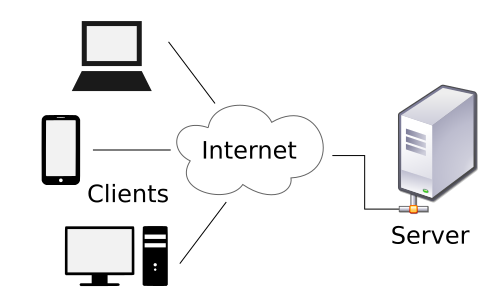
In computing, a client is a piece of computer hardware or software that accesses a service made available by a server as part of the client–server model of computer networks. The server is often (but not always) on another computer system, in which case the client accesses the service by way of a network.
A client is a program that, as part of its operation, relies on sending a request to another program or a computer hardware or software that accesses a service made available by a server (which may or may not be located on another computer). For example, web browsers are clients that connect to web servers and retrieve web pages for display. Email clients retrieve email from mail servers. Online chat uses a variety of clients, which vary on the chat protocol being used. Multiplayer video games or online video games may run as a client on each computer. The term "client" may also be applied to computers or devices that run the client software or users that use the client software.
A client is part of a client–server model, which is still used today. Clients and servers may be computer programs run on the same machine and connect via inter-process communication techniques. Combined with Internet sockets, programs may connect to a service operating on a possibly remote system through the Internet protocol suite. Servers wait for potential clients to initiate connections that they may accept.
The term was first applied to devices that were not capable of running their own stand-alone programs, but could interact with remote computers via a network. These computer terminals were clients of the time-sharing mainframe computer.
Types
| Relies on | |||
|---|---|---|---|
| local storage | Relies on | ||
| local CPU | Fat client | Diskless node | Thin client |
In one classification, client computers and devices are either thick clients, thin clients, or diskless nodes.
Thick
Main article: Thick client
A thick client, also known as a rich client or fat client, is a client that performs the bulk of any data processing operations itself, and does not necessarily rely on the server. The personal computer is a common example of a fat client, because of its relatively large set of features and capabilities and its light reliance upon a server. For example, a computer running an art program (such as Krita or Sketchup) that ultimately shares the result of its work on a network is a thick client. A computer that runs almost entirely as a standalone machine save to send or receive files via a network is by a standard called a workstation.
Thin
Main article: Thin client

A thin client is a minimal sort of client. Thin clients use the resources of the host computer. A thin client generally only presents processed data provided by an application server, which performs the bulk of any required data processing. A device using web application (such as Office Web Apps) is a thin client.
Diskless node
A diskless node is a mixture of the above two client models. Similar to a fat client, it processes locally, but relies on the server for storing persistent data. This approach offers features from both the fat client (multimedia support, high performance) and the thin client (high manageability, flexibility). A device running an online version of the video game Diablo III is an example of diskless node.
References
References
- Zacker, Craig T.. (2009). "Windows Server 2008 Applications Infrastructure Configuration". John Wiley & Sons.
- "client/server".
- (20 October 2005). "Proceedings of the twentieth ACM symposium on Operating systems principles". Association for Computing Machinery.
This article was imported from Wikipedia and is available under the Creative Commons Attribution-ShareAlike 4.0 License. Content has been adapted to SurfDoc format. Original contributors can be found on the article history page.
Ask Mako anything about Client (computing) — get instant answers, deeper analysis, and related topics.
Research with MakoFree with your Surf account
Create a free account to save articles, ask Mako questions, and organize your research.
Sign up freeThis content may have been generated or modified by AI. CloudSurf Software LLC is not responsible for the accuracy, completeness, or reliability of AI-generated content. Always verify important information from primary sources.
Report