From Surf Wiki (app.surf) — the open knowledge base
Clevosaurus
Extinct genus of reptiles

Extinct genus of reptiles
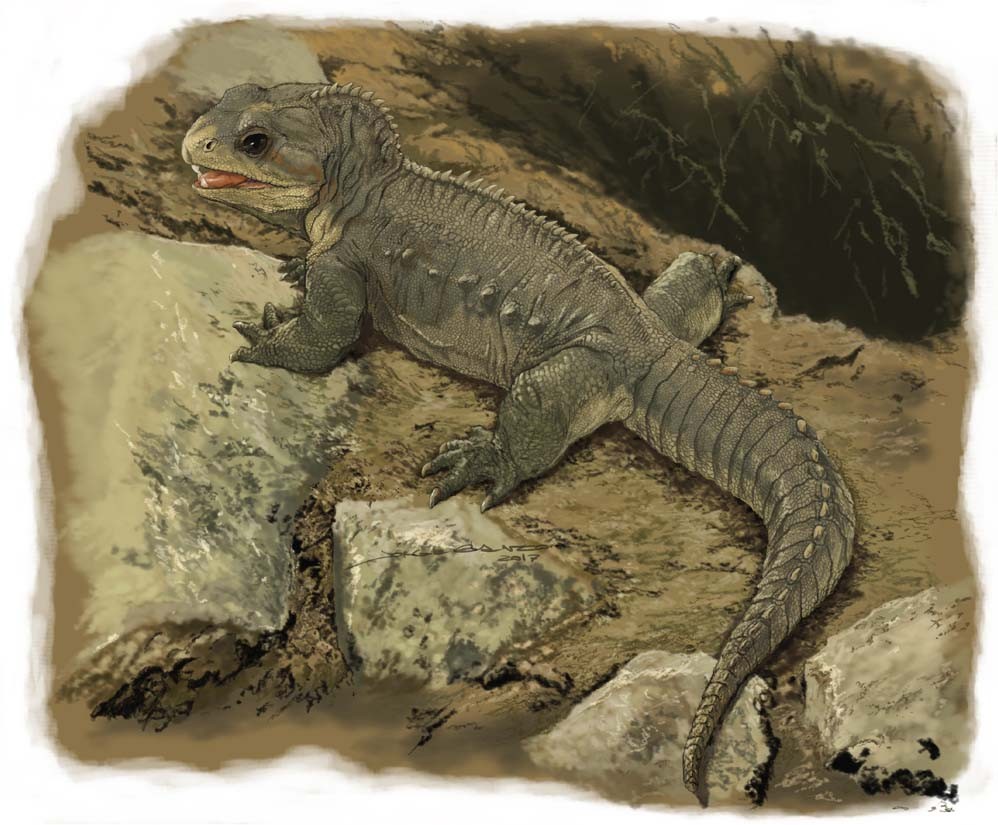
Clevosaurus (meaning "Gloucester lizard") is an extinct genus of rhynchocephalian reptile from the Late Triassic and the Early Jurassic periods. Species of Clevosaurus were widespread across Pangaea, and have been found on all continents except Australia and Antarctica. Five species of Clevosaurus have been found in ancient fissure fill deposits in south-west England and Wales, alongside other sphenodontians, early mammals and dinosaurs. In regards to its Pangaean distribution, C. hadroprodon is the oldest record of a sphenodontian from Gondwana, though its affinity to Clevosaurus has been questioned.[[File:Reconstruction-of-the-skulls-of-lepidosaur-rynchocephalians-A-Clevosaurus-hudsoni.png|left|thumb|Reconstructions of the skulls of C. hudsoni (A) and C. cambrica (B), reconstructed areas in orange.]]
History of discovery
The first species of Clevosaurus to be described was C. hudsoni, which was described by William Elgin Swinton in 1939 from a fissure fill deposit in Cromhall Quarry (Magnesian Conglomerate Formation) in the county of Gloucestershire, England, with the name of the county lending its name to the genus.
Another notable specimen was discovered in 1953 in Cromhall Quarry alongside the holotype of Cryptovaranoides microlanius.
Description
Species of Clevosaurus varied in body size, with Clevosaurus sectumsemper having an estimated total length of 12 cm, while C. hudsoni had a total length of around 25 cm*.* The skull length could range from as little as 1.4 cm in C. sectumsemper and up to 4 cm in C. hudsoni. The reptilian encephalisation quotient (REQ) of C. brasiliensis is much lower than that of the modern tuatara, whose REQ is 0.84–1.16. The teeth of European Clevosaurus tended to be mesio-distally elongated, blade-like, and occluded precisely with the opposite pair of teeth, leaving conspicuous diagonal wear facets and acting as a self-sharpening cutting surface. However, the teeth of C. brasiliensis have a very different morphology with no diagonal wear facets, the teeth of the dentary are all conical excluding the posterior-most tooth which can be up to three-times bigger than any of the other teeth, they also have a unique form of implantation, where the base of the teeth sit deeply within the jaw bones, which is not known of in any other rhynchocephalian.
Paleobiology
Taxonomy
At least 9 species of Clevosaurus are considered valid:
- †Clevosaurus bairdi Sues et al. 1994 McCoy Brook Formation, Canada, Early Jurassic (Hettangian)
- †Clevosaurus brasiliensis Bonaparte and Sues 2006 Caturrita Formation, Brazil, Late Triassic (Norian)
- †Clevosaurus cambrica Keeble et al. 2018 Pant-y-ffynnon Quarry fissure fill, Wales, Late Triassic (Rhaetian)
- †Clevosaurus convallis Saila 2005 St. Bride's Island fissure fill, Wales, Hettangian
- †Clevosaurus hadroprodon Hsiou et al. 2019 Santa Maria Formation, Brazil, Late Triassic (Carnian)
- †Clevosaurus hudsoni Swinton 1939 Cromhall Quarry fissure fill, England, Rhaetian
- †Clevosaurus minor Fraser 1988 Cromhall Quarry fissure fill, England, Rhaetian
- †Clevosaurus sectumsemper Klein et al. 2015 Woodleaze Quarry fissure fill, England, Rhaetian
- †Clevosaurus nicholasi Bhat et al. 2023 Tiki Formation, India, late Carnian-middle Norian The three species known from the Sinemurian aged Lufeng Formation of China (C. mcgilli, C.wangi and C. petilus) are now considered indeterminate within the genus. Indeterminate remains are also known from the Stormberg Group (either Elliot or Clarens Formation) of South Africa, dating to the Hettangian. Indeterminate clevosaur remains, possibly representing Clevosaurus, are also known from the Norian aged Fleming Fjord Group of Jameson Land, east Greenland.
Below is a cladogram of the relationships within Clevosauridae based on the phylogenetic analysis of Hsiou et al. (2015):
"Clevosaurus" latidens was recovered outside of Clevosauridae, as the sister taxon of Opisthodontia.
Clevosaurus is considered to be a member of the group Eusphenodontia by the groups definition, due to it possessing characters not shared with more primitive sphenodontians. By definition, it is excluded from Neosphenodontia.
Position of Clevosaurus within Rhynchocephalia, after DeMar et al. 2022.
References
Additional reading
- Paleofile
- Gill PG, Säilä LK, Corfe IJ, Challands TJ, Williams M, Clemens WA (2006). The fauna and palaeoenvironment of St. Brides Island: Evidence from the lower Jurassic fissure fills of South Wales. In Barrett PM, Evans SE (eds.). Ninth international symposium on Mesozoic terrestrial ecosystems and biota. pp 48−51. London: Natural History Museum.
- Jones MEH (2006) The Early Jurassic clevosaurs from China (Diapsida: Lepidosauria). Natl Mus Nat Hist Sci Bull, 37:548–562.
- Jones MEH (2009). Dentary tooth shape in Sphenodon and its fossil relatives (Diapsida: Lepidosauria: Rhynchocephalia). In Koppe T, Meyer G, Alt KW, (eds). Interdisciplinary Dental Morphology, Frontiers of Oral Biology (vol 13). Greifswald, Germany; Karger. 9–15.
References
- (1995). "First record of the early mesozoic sphenodontian clevosaurus (lepidosauria: rhynchocephalia) from the southern hemisphere". Journal of Paleontology.
- "A new sphenodontian from Brazil is the oldest record of the group in Gondwana".
- (2021-06-03). "The diversity of Triassic South American sphenodontians: a new basal form, clevosaurs, and a revision of rhynchocephalian phylogeny". Journal of Systematic Palaeontology.
- W. E. Swinton. (1939). A new Triassic rhynchocephalian from Gloucestershire. ''Annals and Magazine of Natural History: Zoology, Botany, and Geology'' '''4''':591-594
- (2022). "A Triassic crown squamate". [[Science Advances]].
- (April 2018). "The terrestrial fauna of the Late Triassic Pant-y-ffynnon Quarry fissures, South Wales, UK and a new species of Clevosaurus (Lepidosauria: Rhynchocephalia)". [[Proceedings of the Geologists' Association]].
- (23 March 2023). "Virtual endocasts of Clevosaurus brasiliensis and the tuatara: Rhynchocephalian neuroanatomy and the oldest endocranial record for Lepidosauria". [[The Anatomical Record]].
- (16 June 2020). "Biomechanical properties of the jaws of two species of Clevosaurus and a reanalysis of rhynchocephalian dentary morphospace". [[Palaeontology (journal).
- (2006). "A new species of clevosaurus (lepidosauria: rhynchocephalia) from the upper Triassic of Rio Grande do Sul, Brazil". Palaeontology.
- (2005). "A new species of the sphenodontian reptile ''Clevosaurus'' from the Lower Jurassic of South Wales". Palaeontology.
- (2019-08-14). "A New Clevosaurid from the Triassic (Carnian) of Brazil and the Rise of Sphenodontians in Gondwana". [[Scientific Reports]].
- (2015). "A distinctive Late Triassic microvertebrate fissure fauna and a new species of ''Clevosaurus'' (Lepidosauria: Rhynchocephalia) from Woodleaze Quarry, Gloucestershire, UK". Proceedings of the Geologists' Association.
- (2023-01-02). "A new clevosaurid (Lepidosauria: Rhynchocephalia) from the Upper Triassic of IndiaCitation for this article: Bhat, M. S., Datta, D., Ray, S., & Datta, P. M. (2023) A new clevosaurid (Lepidosauria: Rhynchocephalia) from the Upper Triassic of India. Journal of Vertebrate Paleontology". Journal of Vertebrate Paleontology.
- Jones MEH. 2006 [https://www.researchgate.net/publication/230865919_The_Early_Jurassic_clevosaurs_from_China_Diapsida_Lepidosauria The Early Jurassic clevosaurs from China (Diapsida: Lepidosauria).] ''New Mex. Museum Nat. Hist. Sci. Bull''. 37, 548–562.
- Jésus, Valerian J. P.. (2025-04-15). "Late Triassic small and medium-sized vertebrates from the Fleming Fjord Group of the Jameson Land Basin, central East Greenland". Palaeontologia Electronica.
- Annie Schmaltz Hsiou. (2015). "New Data on the ''Clevosaurus'' (Sphenodontia: Clevosauridae) from the Upper Triassic of Southern Brazil". PLOS ONE.
- (2018). "Taxonomic reassessment of ''Clevosaurus latidens'' Fraser, 1993 (Lepidosauria, Rhynchocephalia) and rhynchocephalian phylogeny based on parsimony and Bayesian inference". Journal of Paleontology.
- (2022-12-31). "A nearly complete skeleton of a new eusphenodontian from the Upper Jurassic Morrison Formation, Wyoming, USA, provides insight into the evolution and diversity of Rhynchocephalia (Reptilia: Lepidosauria)". Journal of Systematic Palaeontology.
This article was imported from Wikipedia and is available under the Creative Commons Attribution-ShareAlike 4.0 License. Content has been adapted to SurfDoc format. Original contributors can be found on the article history page.
Ask Mako anything about Clevosaurus — get instant answers, deeper analysis, and related topics.
Research with MakoFree with your Surf account
Create a free account to save articles, ask Mako questions, and organize your research.
Sign up freeThis content may have been generated or modified by AI. CloudSurf Software LLC is not responsible for the accuracy, completeness, or reliability of AI-generated content. Always verify important information from primary sources.
Report