From Surf Wiki (app.surf) — the open knowledge base
Cleveland

| Field | Value |
|---|---|
| name | Cleveland |
| settlement_type | City |
| image_skyline | {{multiple image |
| border | infobox |
| perrow | 1/3/2/2/1 |
| total_width | 280 |
| caption_align | center |
| image1 | Cleveland skyline, January 2025.jpg |
| caption1 | Downtown Cleveland |
| image2 | Cleveland Playhouse Square (13917560487).jpg |
| caption2 | Playhouse Square |
| image3 | Art museum and lagoon.jpg |
| caption3 | Cleveland Museum of Art |
| image4 | Garfield memorial - 02-29-2025.jpg |
| caption4 | Garfield Memorial |
| image5 | Severance Hall (30706862372).jpg |
| caption5 | Severance Hall |
| image6 | Rock-and-roll-hall-of-fame-sunset.jpg |
| caption6 | Rock and Roll Hall of Fame |
| image7 | West Side Market West 25th Street.jpg |
| caption7 | West Side Market |
| image8 | Cleveland Arcade (51156667640).jpg |
| caption8 | Cleveland Arcade |
| image9 | Cleveland Sign at North Coast Harbor (28120501986).jpg |
| caption9 | North Coast Harbor}} |
| image_flag | Flag of Cleveland, Ohio.svg |
| flag_size | 110px |
| image_seal | Seal of Cleveland, Ohio.svg |
| seal_size | 90px |
| nicknames | The Forest City |
| (for more, see full list) | |
| motto | Progress & Prosperity |
| mapframe | yes |
| mapframe-zoom | 9 |
| mapframe-point | none |
| pushpin_map | Ohio#USA |
| pushpin_relief | yes |
| coordinates | |
| subdivision_type | Country |
| subdivision_name | United States |
| subdivision_type1 | State |
| subdivision_type2 | County |
| subdivision_name1 | Ohio |
| subdivision_name2 | Cuyahoga |
| established_title | Founded |
| established_date | |
| established_title2 | Incorporated (village) |
| established_date2 | |
| established_title3 | Incorporated (city) |
| established_date3 | |
| named_for | Moses Cleaveland |
| government_type | Strong mayor / Council |
| governing_body | Cleveland City Council |
| leader_title | Mayor |
| leader_name | Justin Bibb |
| leader_party | D |
| unit_pref | Imperial |
| area_footnotes | |
| area_total_sq_mi | 82.48 |
| area_total_km2 | 213.62 |
| area_land_sq_mi | 77.73 |
| area_land_km2 | 201.33 |
| area_water_sq_mi | 4.75 |
| area_water_km2 | 12.29 |
| elevation_footnotes | |
| elevation_ft | 653 |
| population_total | 372624 |
| population_as_of | 2020 |
| population_est | 365379 |
| pop_est_as_of | 2024 |
| pop_est_footnotes | |
| population_rank | 53rd in the United States |
| 2nd in Ohio | |
| population_density_sq_mi | 4793.52 |
| population_density_km2 | 1850.78 |
| population_urban | 1712178 (US: 31st) |
| population_density_urban_km2 | 926.1 |
| population_density_urban_sq_mi | 2398.7 |
| population_metro_footnotes | |
| population_metro | 2171877 (US: 34th) |
| population_demonym | Clevelander |
| demographics_type2 | GDP |
| demographics2_footnotes | |
| demographics2_title1 | Metro |
| demographics2_info1 | $139.935 billion (2023) |
| postal_code_type | ZIP Codes |
| postal_code | {{collapsible list |
| title | ZIP Codes |
| frame_style | border:none; padding: 0; |
| list_style | text-align:center;display:none |
| area_code | 216 |
| area_code_type | Area code |
| timezone | EST |
| utc_offset | −5 |
| timezone_DST | EDT |
| utc_offset_DST | −4 |
| website |
the city in Ohio
(for more, see full list) | mapframe-zoom = 9 | mapframe-point = none 2nd in Ohio |44101–44147, 44181, 44188, 44190–44195, 44197–44199 Cleveland is a city in the U.S. state of Ohio and the county seat of Cuyahoga County. Located along the southern shore of Lake Erie, it is situated across the lake from Canada and approximately 60 mi west of the Ohio–Pennsylvania state line. Cleveland is the most populous city on Lake Erie and second-most populous city in Ohio, with a population of 372,624 at the 2020 census. The Cleveland metropolitan area, with an estimated 2.17 million residents, is the 34th-largest metropolitan area in the United States.
Cleveland was founded in 1796 near the mouth of the Cuyahoga River as part of the Connecticut Western Reserve in modern-day Northeast Ohio by General Moses Cleaveland, after whom the city was named. The city's location on the river and the lake shore allowed it to grow into a major commercial and industrial metropolis by the late 19th century, attracting large numbers of immigrants and migrants. It was among the top 10 largest U.S. cities by population for much of the 20th century, a period that saw the development of the city's cultural institutions. By the 1960s, Cleveland's economy began to slow down as manufacturing declined and suburbanization occurred.
Cleveland is a port city, connected to the Atlantic Ocean via the St. Lawrence Seaway. Its economy relies on diverse sectors that include higher education, manufacturing, financial services, healthcare, and biomedicals. The city serves as the headquarters of the Federal Reserve Bank of Cleveland, as well as several major companies. The GDP for Greater Cleveland was US$138.3 billion in 2022. Combined with the Akron metropolitan area, the eight-county Cleveland–Akron metropolitan economy was $176 billion in 2022, the largest in Ohio.
Designated as a global city by the Globalization and World Cities Research Network, Cleveland is home to several major cultural institutions, including the Cleveland Museum of Art, the Cleveland Museum of Natural History, the Cleveland Orchestra, the Cleveland Public Library, Playhouse Square, and the Rock and Roll Hall of Fame, as well as Case Western Reserve University. Known as "The Forest City" among many other nicknames, Cleveland serves as the center of the Cleveland Metroparks nature reserve system. The city's major league professional sports teams include the Cleveland Browns (football; NFL), the Cleveland Cavaliers (basketball; NBA), and the Cleveland Guardians (baseball; MLB).
History
Main article: History of Cleveland
Founding
Cleveland was established on July 22, 1796, by surveyors of the Connecticut Land Company when they laid out Connecticut's Western Reserve into townships and a capital city. They named the settlement "Cleaveland" after their leader, General Moses Cleaveland, a veteran of the American Revolutionary War. Cleaveland oversaw the New England–style design of the plan for what would become the modern downtown area, centered on Public Square, before returning to Connecticut, never again to visit Ohio. The town's name was often shortened to "Cleveland", even by Cleaveland's original surveyors. A common myth emerged that the spelling was altered by The Cleveland Advertiser in order to fit the name on the newspaper's masthead.
The first permanent European settler in Cleveland was Lorenzo Carter, who arrived in May 1797 and built a cabin on the banks of the Cuyahoga River. The emerging community served as an important supply post for the U.S. during the Battle of Lake Erie in the War of 1812. Locals adopted war hero Commodore Oliver Hazard Perry as a civic icon and erected a monument in his honor decades later. Largely through the efforts of the settlement's first lawyer, Alfred Kelley, the village of Cleveland was incorporated on December 23, 1814.
Despite the nearby swampy lowlands and harsh winters, the town's waterfront on Lake Erie proved advantageous, giving it access to Great Lakes trade. It grew rapidly after the 1832 completion of the Ohio and Erie Canal, which linked the Ohio River and the Great Lakes to the Atlantic Ocean via the Erie Canal and Hudson River, and later via the Saint Lawrence Seaway. The town's growth continued with added railroad links. In 1836, Cleveland, then only on the eastern banks of the Cuyahoga, was officially incorporated as a city, and John W. Willey was elected its first mayor. That same year, it nearly erupted into open warfare with neighboring Ohio City over a bridge connecting the two communities. Ohio City remained an independent municipality until its annexation by Cleveland in 1854.
Mid to late 1800s
A center of abolitionist activity, Cleveland (code-named "Station Hope") was a major stop on the Underground Railroad for escaped African American slaves en route to Canada. The city also served as an important center for the Union during the American Civil War. The wartime contributions of those serving the Union from Cleveland and Cuyahoga County was honored with the July 1894 erection of the Soldiers' and Sailors' Monument on Public Square.
The Civil War vaulted Cleveland into the first rank of American manufacturing cities and fueled unprecedented growth. Its prime geographic location as a transportation hub on the Great Lakes played an important role in its development as an industrial and commercial center. In 1870, John D. Rockefeller founded Standard Oil in Cleveland, and in 1885, he moved its headquarters to New York City, which had become a center of finance and business.

Cleveland's economic growth and industrial jobs attracted large waves of immigrants from Southern and Eastern Europe, as well as Ireland. Urban growth was accompanied by significant strikes and labor unrest, as workers demanded better wages and working conditions. Between 1881 and 1886, 70 to 80% of strikes were successful in improving labor conditions in Cleveland. The Cleveland Streetcar Strike of 1899 was one of the more violent instances of labor strife in the city during this period.
Early to mid 1900s
By 1910, Cleveland had become known as the "Sixth City" due to its status at the time as the sixth-largest U.S. city. Its automotive companies included Peerless, Chandler, and Winton, maker of the first car driven across the U.S. Other manufacturing industries in Cleveland included steam cars produced by White and electric cars produced by Baker. The city counted major Progressive Era politicians among its leaders, most prominently the populist Mayor Tom L. Johnson, who was responsible for the development of the Cleveland Mall Plan. The era of the City Beautiful movement in Cleveland architecture saw wealthy patrons support the establishment of the city's major cultural institutions. The most prominent among them were the Cleveland Museum of Art, which opened in 1916, and the Cleveland Orchestra, established in 1918.
.jpg)
In addition to the large immigrant population, African American migrants from the rural South arrived in Cleveland (among other Northeastern and Midwestern cities) as part of the Great Migration for jobs, constitutional rights, and relief from racial discrimination. By 1920, the year in which the Cleveland Indians won their first World Series championship, Cleveland had grown into a densely populated metropolis of 796,841, making it the fifth-largest city in the nation, with a foreign-born population of 30%.
At this time, Cleveland saw the rise of radical labor movements, most prominently the Industrial Workers of the World (IWW), in response to the conditions of the largely immigrant and migrant workers. In 1919, the city attracted national attention amid the First Red Scare for the Cleveland May Day Riots, in which local socialist and IWW demonstrators clashed with anti-socialists. The riots occurred during the broader strike wave that swept the U.S. that year.
Cleveland's population continued to grow throughout the Roaring Twenties. The decade saw the establishment of the city's Playhouse Square, and the rise of the risqué Short Vincent. The Bal-Masque balls of the avant-garde Kokoon Arts Club scandalized the city. Jazz came to prominence in Cleveland during this period. Prohibition first took effect in Ohio in May 1919 (although it was not well-enforced in Cleveland), became law with the Volstead Act in 1920, and was eventually repealed nationally by Congress in 1933. The ban on alcohol led to the rise of speakeasies throughout the city and organized crime gangs, such as the Mayfield Road Mob, who smuggled bootleg liquor across Lake Erie from Canada into Cleveland.

The era of the flapper marked the beginning of the golden age in Downtown Cleveland retail, centered on major department stores Higbee's, Bailey's, the May Company, Taylor's, Halle's, and Sterling Lindner Davis, which collectively represented one of the largest and most fashionable shopping districts in the country, often compared to New York's Fifth Avenue. In 1929, Cleveland hosted the first of many National Air Races, and Amelia Earhart flew to the city from Santa Monica, California in the Women's Air Derby. The Van Sweringen brothers commenced construction of the Terminal Tower skyscraper in 1926 and oversaw it to completion in 1927. By the time the building was dedicated as part of Cleveland Union Terminal in 1930, the city had a population of over 900,000.
Cleveland was hit hard by the Wall Street Crash of 1929 and the subsequent Great Depression. A center of union activity, the city saw significant labor struggles in this period, including strikes by workers against Fisher Body in 1936 and against Republic Steel in 1937. The city was also aided by major federal works projects sponsored by President Franklin D. Roosevelt's New Deal. In commemoration of the centennial of Cleveland's incorporation as a city, the Great Lakes Exposition debuted in June 1936 at the city's North Coast Harbor, along the Lake Erie shore north of downtown. Conceived by Cleveland's business leaders as a way to revitalize the city during the Depression, it drew four million visitors in its first season, and seven million by the end of its second and final season in September 1937.
.jpg)
On December 7, 1941, Imperial Japan attacked Pearl Harbor and declared war on the U.S. Two of the victims of the attack were Cleveland natives – Rear Admiral Isaac C. Kidd and ensign William Halloran. The attack signaled America's entry into World War II. A major hub of the "Arsenal of Democracy", Cleveland under Mayor Frank Lausche contributed massively to the U.S. war effort as the fifth largest manufacturing center in the nation. During his tenure, Lausche also oversaw the establishment of the Cleveland Transit System, the predecessor to the Greater Cleveland Regional Transit Authority.
Late 1900s to 2000s
After the war, Cleveland initially experienced an economic boom, and businesses declared the city to be the "best location in the nation". In 1949, the city was named an All-America City for the first time, and in 1950, its population reached 914,808. In sports, the Indians won the 1948 World Series, the hockey team, the Barons, became champions of the American Hockey League, and the Browns dominated professional football in the 1950s. As a result, along with track and boxing champions produced, Cleveland was declared the "City of Champions" in sports at this time. Additionally, the 1950s saw the rising popularity of a new music genre that local WJW (AM) disc jockey Alan Freed dubbed "rock and roll".
.jpg)
However, by the 1960s, Cleveland's economy began to slow down, and residents increasingly sought new housing in the suburbs, reflecting the national trends of suburban growth following federally subsidized highways. Industrial restructuring, particularly in the steel and automotive industries, resulted in the loss of numerous jobs in Cleveland and the region, and the city suffered economically. The burning of the Cuyahoga River in June 1969 brought national attention to the issue of industrial pollution in Cleveland and served as a catalyst for the American environmental movement.
Housing discrimination and redlining against African Americans led to racial unrest in Cleveland and numerous other Northern U.S. cities. In Cleveland, the Hough riots erupted from July 18 to 24, 1966, and the Glenville Shootout took place on July 23, 1968. In November 1967, Cleveland became the first major American city to elect an African American mayor, Carl B. Stokes, who served from 1968 to 1971 and played an instrumental role in restoring the Cuyahoga River.
During the 1970s, Cleveland became known as "Bomb City U.S.A." due to several bombings that shook the city, mostly due to organized crime rivalries. In December 1978, during the turbulent tenure of Dennis Kucinich as mayor, Cleveland became the first major American city since the Great Depression to enter into a financial default on federal loans. The national recession of the early 1980s "further eroded the city's traditional economic base." While unemployment during the period peaked in 1983, Cleveland's rate of 13.8% was higher than the national average due to the closure of several steel production centers.
The city began a gradual economic recovery under Mayor George V. Voinovich in the 1980s. Downtown saw the construction of the Key Tower and 200 Public Square skyscrapers, as well as the development of the Gateway Sports and Entertainment Complex – consisting of Progressive Field and Rocket Arena – and North Coast Harbor, including the Rock and Roll Hall of Fame, Cleveland Browns Stadium, and the Great Lakes Science Center. Although the city emerged from default in 1987, it later suffered from the impact of the subprime mortgage crisis and the Great Recession.
Nevertheless, by the turn of the 21st century, Cleveland succeeded in developing a more diversified economy and gained a national reputation as a center for healthcare and the arts. The city's downtown and several neighborhoods have experienced significant population growth since 2010, while overall population decline has slowed. Challenges remain for the city, with improvement of city schools, economic development of neighborhoods, and continued efforts to tackle poverty, homelessness, and urban blight being top municipal priorities.
Geography

According to the U.S. Census Bureau, the city has a total area of 82.47 sqmi, of which 77.70 sqmi is land and 4.77 sqmi is water. The shore of Lake Erie is 569 ft above sea level; however, the city lies on a series of irregular bluffs lying roughly parallel to the lake. In Cleveland these bluffs are cut principally by the Cuyahoga River, Big Creek, and Euclid Creek.
The land rises quickly from the lake shore elevation of 569 feet. Public Square, less than 1 mi inland, sits at an elevation of 650 ft, and Hopkins Airport, 5 mi inland from the lake, is at an elevation of 791 ft.
Cleveland borders several inner-ring and streetcar suburbs. To the west, it borders Lakewood, Rocky River, and Fairview Park, and to the east, it borders Shaker Heights, Cleveland Heights, South Euclid, and East Cleveland. To the southwest, it borders Linndale, Brooklyn, Parma, and Brook Park. To the south, the city borders Newburgh Heights, Cuyahoga Heights, and Brooklyn Heights and to the southeast, it borders Warrensville Heights, Maple Heights, and Garfield Heights. To the northeast, along the shore of Lake Erie, Cleveland borders Bratenahl and Euclid.
Architecture
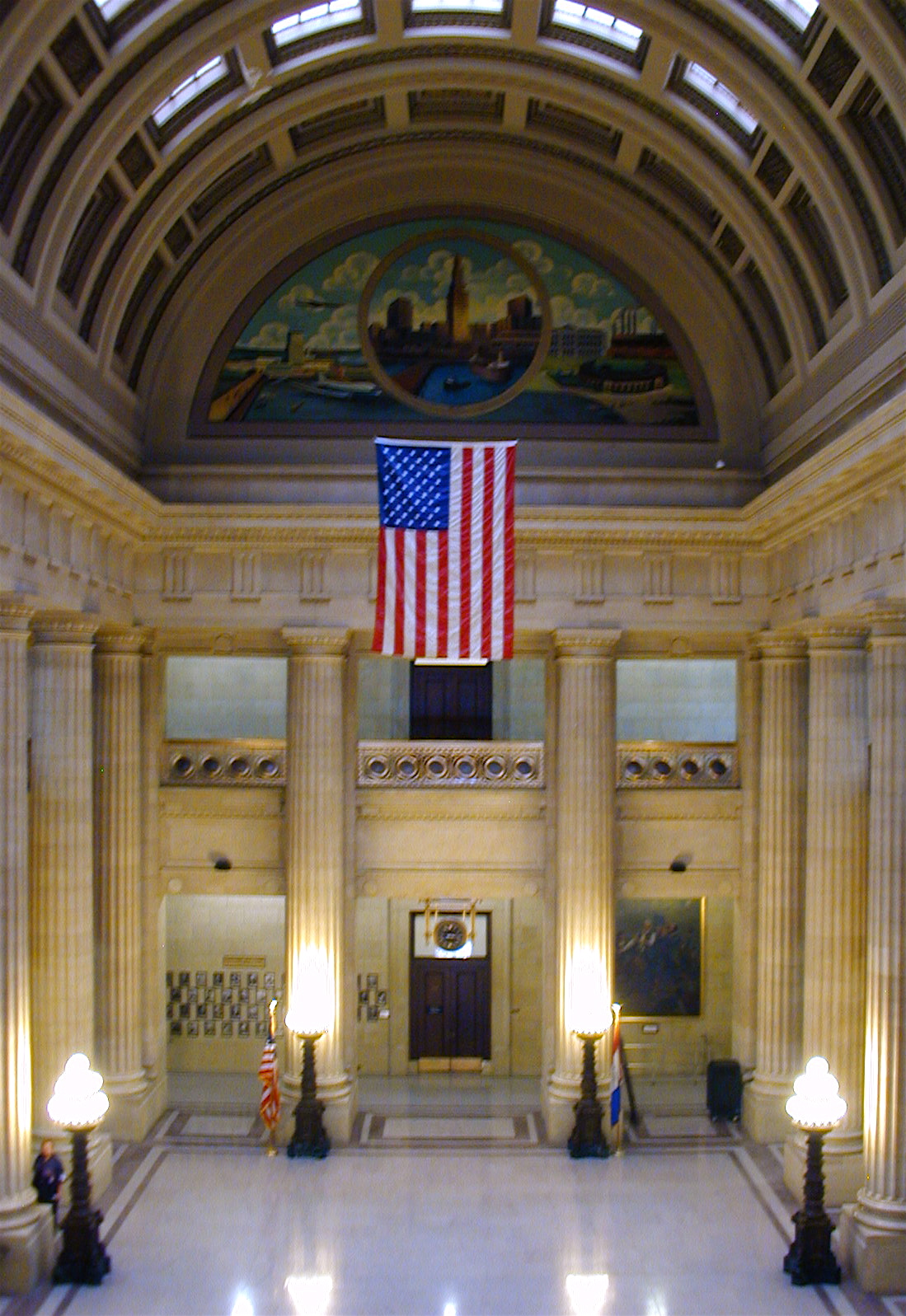
Cleveland's downtown architecture is diverse. Many of the city's government and civic buildings, including City Hall, the Cuyahoga County Courthouse, the Cleveland Public Library, and Public Auditorium, are clustered around the open Cleveland Mall and share a common neoclassical architecture. They were built in the early 20th century as the result of the 1903 Group Plan. They constitute one of the most complete examples of City Beautiful design in the U.S.
Completed in 1927 and dedicated in 1930 as part of the Cleveland Union Terminal complex, the Terminal Tower is a prototypical Beaux-Arts skyscraper. It was the tallest building in North America outside New York City until 1964 and the tallest in the city until 1991. Key Tower (the tallest building in Ohio) and 200 Public Square combine elements of Art Deco architecture with postmodern designs. The city's latest major skyscraper – the Sherwin-Williams Headquarters – was completed in 2024.
Running east from Public Square through University Circle is Euclid Avenue, which was known as "Millionaires' Row" for its prestige and elegance as a residential street. In the late 1880s, writer Bayard Taylor described it as "the most beautiful street in the world."
Nicknamed Cleveland's "Crystal Palace", the five-story Cleveland Arcade (also known as the Old Arcade) was built in 1890 and renovated in 2001 as a Hyatt Regency Hotel. Another major architectural landmark, the Cleveland Trust Company Building, was completed in 1907 and renovated in 2015 as a downtown Heinen's supermarket. Cleveland's historic ecclesiastical architecture includes the Presbyterian Old Stone Church, the onion-domed St. Theodosius Russian Orthodox Cathedral, and the Roman Catholic Cathedral of St. John the Evangelist along with several other ethnically inspired Catholic churches.
File:Arcade (48249762776).jpg|Cleveland Arcade, 1890 File:Cleveland Trust Company Building, Euclid Avenue and East 9th Street, Cleveland, OH.jpg|Cleveland Trust Company Building, 1907 File:Palace lobby.jpg|Connor Palace Theatre, 1922 File:Cleveland Public Square Fountain (29744768716).jpg|Tower City Center, 1929 File:Grand Foyer, Severance Hall, University Circle, Cleveland, OH - 52992001701.jpg|Grand foyer of Severance Hall, 1931
Neighborhoods
Main article: Neighborhoods in Cleveland

The Cleveland City Planning Commission has officially designated 34 neighborhoods in Cleveland. Centered on Public Square, Downtown Cleveland is the city's central business district, encompassing a wide range of subdistricts, such as the Nine-Twelve District, the Campus District, the Civic Center, East 4th Street, and Playhouse Square. It also historically included the lively Short Vincent entertainment district. Mixed-use areas, such as the Warehouse District and the Superior Arts District, are occupied by industrial and office buildings as well as restaurants, cafes, and bars. The number of condominiums, lofts, and apartments has been on the increase since 2000 and especially 2010, reflecting downtown's growing population.
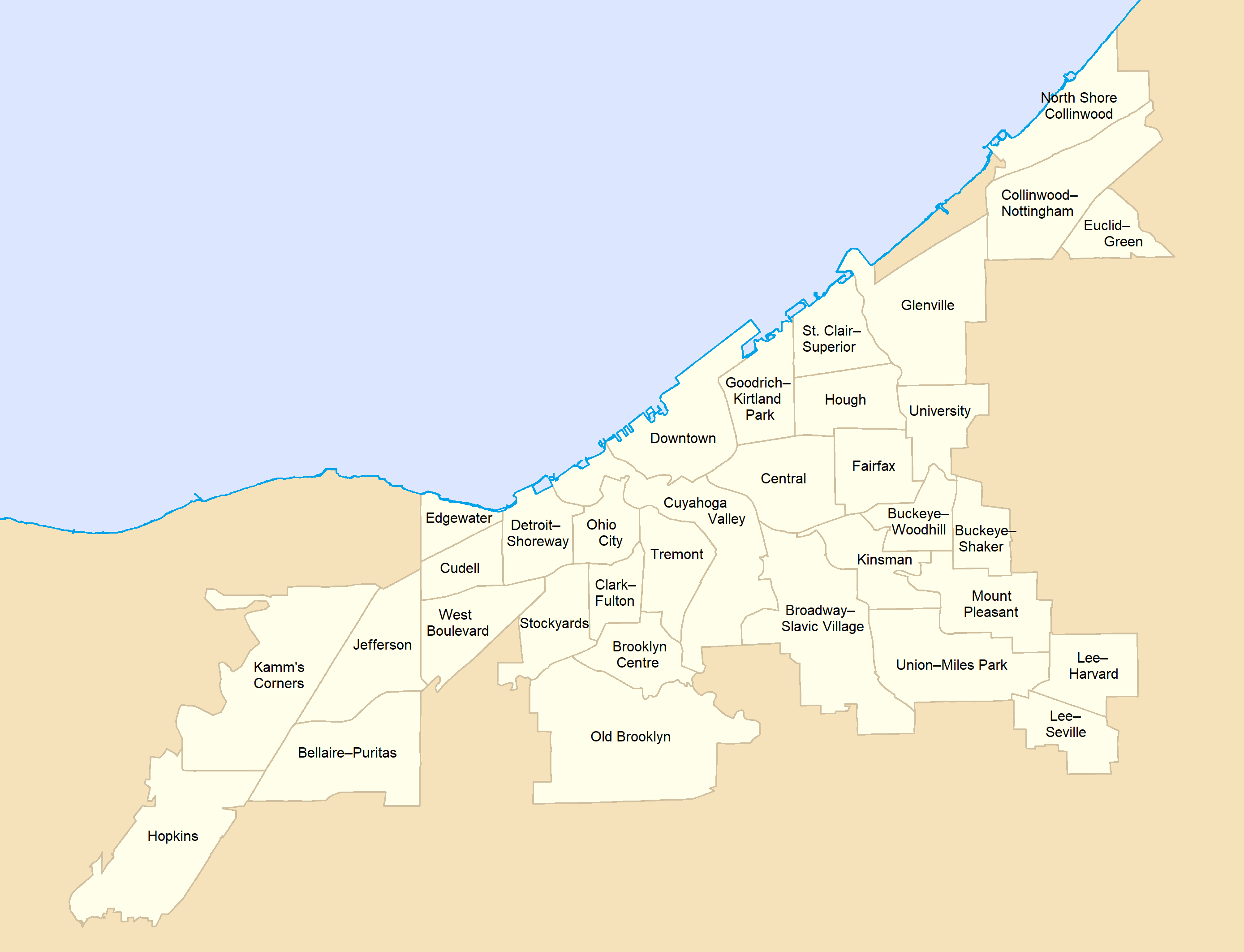
Clevelanders geographically define themselves in terms of whether they live on the east or west side of the Cuyahoga River. The East Side includes the neighborhoods of Buckeye–Shaker, Buckeye–Woodhill, Central, Collinwood (including Nottingham), Euclid–Green, Fairfax, Glenville, Goodrich–Kirtland Park (including Asiatown), Hough, Kinsman, Lee–Miles (including Lee–Harvard and Lee–Seville), Mount Pleasant, St. Clair–Superior, Union–Miles Park, and University Circle (including Little Italy). The West Side includes the neighborhoods of Brooklyn Centre, Clark–Fulton, Cudell, Detroit–Shoreway, Edgewater, Ohio City, Old Brooklyn, Stockyards, Tremont (including Duck Island), West Boulevard, and the four neighborhoods colloquially known as West Park: Kamm's Corners, Jefferson, Bellaire–Puritas, and Hopkins. The Cuyahoga Valley neighborhood (including Whiskey Island and the Flats) is situated between the East and West Sides, while Broadway–Slavic Village is sometimes referred to as the South Side.
Several neighborhoods have begun to attract the return of the middle class that left the city for the suburbs in the 1960s and 1970s. These neighborhoods are on both the West Side (Ohio City, Tremont, Detroit–Shoreway, and Edgewater) and the East Side (Collinwood, Hough, Fairfax, and Little Italy). Much of the growth has been spurred on by attracting creative class members, which has facilitated new residential development and the transformation of old industrial buildings into loft spaces for artists.
Climate
| Cleveland | 22.3|35.8|2.99 | 23.5|38.5|2.49 | 30.7|47.1|3.06 | 40.8|60.1|3.75 | 51.4|71.1|3.79 | 61.1|79.8|3.83 | 65.8|83.7|3.67 | 63.9|82.0|3.56 | 57.1|75.6|3.93 | 46.5|63.7|3.60 | 36.7|51.3|3.37 | 28.2|40.4|2.99 Typical of the Great Lakes Region, Cleveland exhibits a continental climate with four distinct seasons, which lies in the humid continental (Köppen Dfa) zone. The climate is transitional with the Cfa humid subtropical climate. Summers are hot and humid, while winters are cold and snowy. Due to its proximity to Lake Erie, Cleveland experiences milder temperatures than much of Ohio, with relatively cooler summers and warmer winters. East of the mouth of the Cuyahoga, the land elevation rises rapidly in the south. Together with the prevailing winds off Lake Erie, this feature is the principal contributor to the lake-effect snow that is typical in Cleveland (especially on the city's East Side) from mid-November until the surface of the lake freezes, usually in late January or early February. The lake effect causes a relative differential in geographical snowfall totals across the city. On the city's far West Side, the Hopkins neighborhood only reached 100 in of snowfall in a season three times since record-keeping for snow began in 1893. By contrast, seasonal totals approaching or exceeding 100 in are not uncommon as the city ascends into the Heights on the east, where the region known as the "Snow Belt" begins. Extending from the city's East Side and its suburbs, the Snow Belt reaches up the Lake Erie shore as far as Buffalo.
The all-time record high in Cleveland of 104 °F was established on June 25, 1988, and the all-time record low of -20 °F was set on January 19, 1994. On average, July is the warmest month with a mean temperature of 74.5 °F, and January, with a mean temperature of 29.1 °F, is the coldest. Normal yearly precipitation based on the 30-year average from 1991 to 2020 is 41.03 in. The least precipitation occurs on the western side and directly along the lake, and the most occurs in the eastern suburbs. Parts of Geauga County to the east receive over 44 in of liquid precipitation annually.
| Jan record high F = 73 | Feb record high F = 77 | Mar record high F = 83 | Apr record high F = 88 | May record high F = 93 | Jun record high F = 104 | Jul record high F = 103 | Aug record high F = 102 | Sep record high F = 101 | Oct record high F = 93 | Nov record high F = 82 | Dec record high F = 77 | year record high F = 104 | Jan avg record high F = 58.9 | Feb avg record high F = 60.8 | Mar avg record high F = 70.8 | Apr avg record high F = 80.3 | May avg record high F = 86.7 | Jun avg record high F = 91.8 | Jul avg record high F = 92.7 | Aug avg record high F = 91.3 | Sep avg record high F = 88.8 | Oct avg record high F = 80.5 | Nov avg record high F = 68.9 | Dec avg record high F = 60.0 | year avg record high F = 93.9 | Jan avg record low F = 1.3 | Feb avg record low F = 4.0 | Mar avg record low F = 12.2 | Apr avg record low F = 25.9 | May avg record low F = 36.2 | Jun avg record low F = 45.9 | Jul avg record low F = 53.3 | Aug avg record low F = 51.6 | Sep avg record low F = 43.0 | Oct avg record low F = 32.1 | Nov avg record low F = 20.8 | Dec avg record low F = 9.8 | year avg record low F = −2.2 | Jan record low F = −20 | Feb record low F = −17 | Mar record low F = −5 | Apr record low F = 10 | May record low F = 25 | Jun record low F = 31 | Jul record low F = 41 | Aug record low F = 38 | Sep record low F = 32 | Oct record low F = 19 | Nov record low F = 0 | Dec record low F = −15 | year record low F = -20 | Jan snow depth inch = 7.5 | Feb snow depth inch = 7.5 | Mar snow depth inch = 5.3 | Apr snow depth inch = 1.1 | May snow depth inch = 0.0 | Jun snow depth inch = 0.0 | Jul snow depth inch = 0.0 | Aug snow depth inch = 0.0 | Sep snow depth inch = 0.0 | Oct snow depth inch = 0.0 | Nov snow depth inch = 1.5 | Dec snow depth inch = 4.5 | year snow depth inch = 10.8
| Climate data for Cleveland | Month | Jan | Feb | Mar | Apr | May | Jun | Jul | Aug | Sep | Oct | Nov | Dec | Year | Average sea temperature °F (°C) | Mean daily daylight hours | Source: Weather Atlas |
|---|---|---|---|---|---|---|---|---|---|---|---|---|---|---|---|---|---|
| 34.0 | |||||||||||||||||
| (1.1) | 33.2 | ||||||||||||||||
| (0.6) | 33.5 | ||||||||||||||||
| (0.8) | 40.6 | ||||||||||||||||
| (4.8) | 50.5 | ||||||||||||||||
| (10.3) | 66.5 | ||||||||||||||||
| (19.2) | 76.2 | ||||||||||||||||
| (24.5) | 76.3 | ||||||||||||||||
| (24.6) | 71.2 | ||||||||||||||||
| (21.8) | 62.0 | ||||||||||||||||
| (16.7) | 50.5 | ||||||||||||||||
| (10.3) | 39.3 | ||||||||||||||||
| (4.1) | 52.8 | ||||||||||||||||
| (11.6) | |||||||||||||||||
| 10.0 | 11.0 | 12.0 | 13.0 | 15.0 | 15.0 | 15.0 | 14.0 | 12.0 | 11.0 | 10.0 | 9.0 | 12.3 |
Environment

With its extensive cleanup of its Lake Erie shore and the Cuyahoga River, Cleveland has been recognized by national media as an environmental success story and a national leader in environmental protection. Since the city's industrialization, the Cuyahoga River had become so affected by industrial pollution that it "caught fire" a total of 13 times beginning in 1868. It was the river fire of June 1969 that spurred the city to action under Mayor Carl B. Stokes, and played a key role in the passage of the Clean Water Act in 1972 and the National Environmental Policy Act later that year. Since that time, the Cuyahoga has been extensively cleaned up through the efforts of the city and the Ohio Environmental Protection Agency (OEPA).
In addition to continued efforts to improve freshwater and air quality, Cleveland is now exploring renewable energy. The city's two main electrical utilities are FirstEnergy and Cleveland Public Power. Its climate action plan, updated in December 2018, has a 2050 target of 100% renewable power, along with reduction of greenhouse gases to 80% below the 2010 level. In recent decades, Cleveland has been working to address the issue of harmful algal blooms on Lake Erie, fed primarily by agricultural runoff, which have presented new environmental challenges for the city and for northern Ohio.
Demographics
Main article: Demographics of Cleveland
|align-fn=center
| Race/ethnicity | 2020 | 2010 | title=Race and Hispanic Origin for Selected Cities and Other Places: Earliest Census to 1990 | publisher=United States Census Bureau | url=https://www.census.gov/population/www/documentation/twps0076/twps0076.html | url-status=dead | archive-url=https://web.archive.org/web/20120812191959/http://www.census.gov/population/www/documentation/twps0076/twps0076.html | archive-date=August 12, 2012 }} | 1970 | 1940 |
|---|---|---|---|---|---|---|---|---|---|---|
| White (non-Hispanic) | 32.1% | 33.4% | 47.8% | 59.4% | 90.2% | |||||
| Black or African American (non-Hispanic) | 47.5% | 52.4% | 46.6% | 38.3% | 9.6% | |||||
| Hispanic or Latino | 13.1% | 10.0% | 4.6% | 1.9% | 0.1% | |||||
| Asian (non-Hispanic) | 2.8% | 1.8% | 1.0% | 0.6% | - | |||||
| Native American (non-Hispanic) | 0.2% | 0.2% | 0.3% | 0.2% | – | |||||
| Two or more races (non-Hispanic) | 3.8% | 1.8% | – | – | – |
Cleveland has seen a population decline over the past century. According to the 1950 Census, Cleveland's population was 914,808. By 1980, this number had fallen to 573,822. According to the 2020 census, there were 372,624 people and 170,549 households in Cleveland. The population density was 4901.51 PD/sqmi. The median household income was $30,907 and the per capita income was $21,223. 32.7% of the population was living below the poverty line. Of the city's population over the age of 25, 17.5% held a bachelor's degree or higher, and 80.8% had a high school diploma or equivalent. The median age was 36.6 years.
, the racial and ethnic composition of the city was 47.5% African American, 32.1% non-Hispanic white, 13.1% Hispanic or Latino, 2.8% Asian, 0% Pacific Islander, 0.2% Native American, and 3.8% from two or more races. 85.3% of Clevelanders age five and older spoke only English at home, while 14.7% spoke a language other than English, including Spanish, Arabic, Chinese, Hungarian, Albanian, and various Slavic languages (Russian, Polish, Serbian, Croatian, and Slovene). The city's spoken accent is an advanced form of Inland Northern American English, similar to other Great Lakes cities, but distinctive from the rest of Ohio.
Ethnicity
In the 19th and early 20th centuries, Cleveland saw a massive influx of immigrants from Ireland, Italy, and the Austro-Hungarian, German, Russian, and Ottoman empires, most of whom were attracted by manufacturing jobs. As a result, Cleveland and Cuyahoga County today have substantial communities of Irish (especially in West Park), Italians (especially in Little Italy), Germans, and several Central-Eastern European ethnicities, including Czechs, Hungarians, Lithuanians, Poles, Romanians, Russians, Rusyns, Slovaks, Ukrainians, and ex-Yugoslav groups, such as Slovenes, Croats and Serbs. The presence of Hungarians within Cleveland proper was, at one time, so great that the city boasted the highest concentration of Hungarians in the world outside of Budapest. Cleveland has a long-established Jewish community, historically centered on the East Side neighborhoods of Glenville and Kinsman, but now mostly concentrated in East Side suburbs such as Cleveland Heights and Beachwood, location of the Maltz Museum of Jewish Heritage.
The availability of jobs attracted African Americans from the South. Between 1910 and 1970, the black population of Cleveland, largely concentrated on the city's East Side, increased significantly as a result of the First and Second Great Migrations. Cleveland's Latino community consists primarily of Puerto Ricans, as well as smaller numbers of immigrants from Mexico, Cuba, the Dominican Republic, South and Central America, and Spain. The city's Asian community, centered on historical Asiatown, consists of Chinese, Koreans, Vietnamese, and other groups. Additionally, the city and the county have significant communities of Albanians, Arabs (especially Lebanese, Syrians, and Palestinians), Armenians, French, Greeks, Iranians, Scots, Turks, and West Indians. A 2020 analysis found Cleveland to be the most ethnically and racially diverse major city in Ohio.
Religion
The influx of immigrants in the 19th and early 20th centuries drastically transformed Cleveland's religious landscape. From a homogeneous settlement of New England Protestants, it evolved into a city with a diverse religious composition. The predominant faith among Clevelanders today is Christianity, with Jewish, Muslim, Hindu, and Buddhist minorities.
Immigration
Within Cleveland, the neighborhoods with the highest foreign-born populations are Asiatown/Goodrich–Kirtland Park (32.7%), Clark–Fulton (26.7%), West Boulevard (18.5%), Brooklyn Centre (17.3%), Downtown (17.2%), University Circle (15.9%, with 20% in Little Italy), and Jefferson (14.3%). Recent waves of immigration have brought new groups to Cleveland, including Ethiopians and South Asians, as well as immigrants from Russia and the former USSR, Southeast Europe (especially Albania), the Middle East, East Asia, and Latin America. In the 2010s, the immigrant population of Cleveland and Cuyahoga County began to see significant growth. A 2019 study found Cleveland to be the city with the shortest average processing time in the nation for immigrants to become U.S. citizens. The city's annual One World Day in Rockefeller Park includes a naturalization ceremony of new immigrants.
Economy
Main article: Economy of Greater Cleveland

Cleveland's location on the Cuyahoga River and Lake Erie has been key to its growth as a major commercial center. Steel and many other manufactured goods emerged as leading industries. The city has since diversified its economy in addition to its manufacturing sector.
Established in 1914, the Federal Reserve Bank of Cleveland is one of 12 U.S. Federal Reserve Banks. Its downtown building, located on East 6th Street and Superior Avenue, was completed in 1923 by the Cleveland architectural firm Walker and Weeks. The headquarters of the Federal Reserve System's Fourth District, the bank employs 1,000 people and maintains branch offices in Cincinnati and Pittsburgh.

Cleveland and Cuyahoga County are home to Fortune 500 companies Cleveland-Cliffs, Progressive, Sherwin-Williams, Parker-Hannifin, KeyCorp, and Travel Centers of America. Other large companies based in the city and the county include Aleris, American Greetings, Applied Industrial Technologies, Eaton, Forest City Realty Trust, Heinen's Fine Foods, Hyster-Yale Materials Handling, Lincoln Electric, Medical Mutual of Ohio, Moen Incorporated, NACCO Industries, Nordson Corporation, OM Group, Swagelok, Kirby Company, Things Remembered, Third Federal S&L, TransDigm Group, and Vitamix. NASA maintains the Glenn Research Center in Cleveland. Jones Day, one of the largest law firms in the U.S., was founded in Cleveland in 1893.
Healthcare
Healthcare plays a major role in Cleveland's economy. The city's "Big Three" hospital systems are the Cleveland Clinic, University Hospitals, and MetroHealth. The Cleveland Clinic is the largest private employer in the state of Ohio, with a workforce of over 55,000 . It carries the distinction of being one of the best hospital systems in the world. The clinic is led by Croatian-born president and CEO Tomislav Mihaljevic and it is affiliated with Case Western Reserve University School of Medicine.
University Hospitals includes the University Hospitals Cleveland Medical Center and its Rainbow Babies & Children's Hospital. Cliff Megerian serves as that system's CEO. MetroHealth on the city's west side is led by president and CEO Christine Alexander-Rager. Formerly known as City Hospital, it operates one of two Level I trauma centers in the city, and has various locations throughout Greater Cleveland.
In 2013, Cleveland's Global Center for Health Innovation opened with 235000 sqft of display space for healthcare companies across the world. To take advantage of the proximity of universities and other medical centers in Cleveland, the Veterans Administration moved the region's VA hospital from suburban Brecksville to a new facility in University Circle.
Arts and culture
Theater and performing arts

Cleveland's Playhouse Square is the second largest performing arts center in the U.S. behind New York City's Lincoln Center. It includes the State, Palace, Allen, Hanna, and Ohio theaters. The theaters host Broadway musicals, special concerts, speaking engagements, and other events throughout the year. Playhouse Square's resident performing arts companies include Cleveland Ballet, the Cleveland International Film Festival, the Cleveland Play House, Cleveland State University Department of Theatre and Dance, DANCECleveland, the Great Lakes Theater Festival, and the Tri-C Jazz Fest. A city with strong traditions in theater and vaudeville, Cleveland has produced many renowned performers, most prominently comedian Bob Hope.
Outside Playhouse Square is Karamu House, the oldest African American theater in the nation, established in 1915. On the West Side, the Gordon Square Arts District in the Detroit–Shoreway neighborhood is the location of the Capitol Theatre, the Near West Theatre, and an Off-Off-Broadway playhouse, the Cleveland Public Theatre. The Dobama Theatre and the Beck Center for the Arts are based in Cleveland's streetcar suburbs of Cleveland Heights and Lakewood respectively.
Music

The Cleveland Orchestra is widely considered one of the world's finest orchestras, and often referred to as the finest in the nation. It is one of the "Big Five" major orchestras in the U.S. The orchestra plays at Severance Hall in University Circle during the winter and at Blossom Music Center in Cuyahoga Falls during the summer. The city is also home to the Cleveland Pops Orchestra, Apollo's Fire Baroque Orchestra, the Cleveland Youth Orchestra, the Contemporary Youth Orchestra, the Cleveland Youth Wind Symphony, and the biennial Cleveland International Piano Competition which has, in the past, often featured the Cleveland Orchestra.
One Playhouse Square, now the headquarters for Cleveland's public broadcasters, was initially used as the broadcast studios of WJW (AM), where disc jockey Alan Freed first popularized the term "rock and roll". Beginning in the 1950s, Cleveland gained a strong reputation as a key breakout market for rock music. Its popularity in the city was so great that Billy Bass, the program director at the WMMS radio station, referred to Cleveland as "The Rock and Roll Capital of the World". The Cleveland Agora Theatre and Ballroom has served as a major venue for rock concerts in the city since the 1960s.{{cite web |url= https://case.edu/ech/articles/a/agoraagora-ballroom |title= AGORA/AGORA BALLROOM |author= Christopher Roy |date= August 8, 2023 |publisher= Case Western Reserve University |access-date=January 9, 2026 |url-status=live |archive-url= https://web.archive.org/web/20260109082222/https://case.edu/ech/articles/a/agoraagora-ballroom |archive-date=January 9, 2026 }} From 1974 through 1980, the city hosted the World Series of Rock at Cleveland Municipal Stadium.
Jazz and R&B have a long history in Cleveland. Many major figures in jazz performed in the city, including Louis Armstrong, Cab Calloway, Duke Ellington, Ella Fitzgerald, Dizzy Gillespie, and Billie Holiday. Legendary pianist Art Tatum regularly played in Cleveland clubs in the 1930s, and gypsy jazz guitarist Django Reinhardt gave his U.S. debut performance in Cleveland in 1946. Prominent jazz artist Noble Sissle was a graduate of Cleveland Central High School, and Artie Shaw worked and performed in Cleveland early in his career. The Tri-C Jazz Fest has been held annually in Cleveland at Playhouse Square since 1980, and the Cleveland Jazz Orchestra was established in 1984.
The city has a history of polka music being popular both past and present and is the location of the Polka Hall of Fame. There is even a subgenre called Cleveland-style polka, named after the city. The music's popularity is due in part to the success of Frankie Yankovic, a Cleveland native who was considered "America's Polka King".
There is a significant hip hop music scene in Cleveland. In 1997, the Cleveland hip hop group Bone Thugs-n-Harmony won a Grammy for their song "Tha Crossroads".
Film and television
The first film shot in Cleveland was in 1897 by the company of Ohioan Thomas Edison. Before Hollywood became the center for American cinema, filmmaker Samuel Brodsky and playwright Robert McLaughlin operated a film studio at the Andrews mansion on Euclid Avenue (now the WEWS-TV studio). There they produced major silent-era features, such as Dangerous Toys (1921), which are now considered lost. Brodsky also directed the weekly Plain Dealer Screen Magazine that ran in theaters in Cleveland and Ohio from 1917 to 1924. In addition, Cleveland hosted over a dozen sponsored film studios, including Cinécraft Productions, which still operates in Ohio City.
In the "talkie" era, Cleveland featured in several major studio films, such as Michael Curtiz's pre-Code classic Goodbye Again (1933) with Warren William and Joan Blondell. Players from the 1948 Cleveland Indians appeared in The Kid from Cleveland (1949). Billy Wilder's The Fortune Cookie (1966) was set and filmed in the city and marked the first onscreen pairing of Walter Matthau and Jack Lemmon. Labor struggles in Cleveland were depicted in Native Land (1942), narrated by Paul Robeson, and in Norman Jewison's F.I.S.T. (1978) with Sylvester Stallone. Clevelander Jim Jarmusch's Stranger Than Paradise (1984) – a deadpan comedy about two New Yorkers who travel to Florida by way of Cleveland – was a favorite of the Cannes Film Festival. Major League (1989) reflected the perennial struggles of the Cleveland Indians, while American Splendor (2003) reflected the life of Cleveland graphic novelist Harvey Pekar. Kill the Irishman (2011) depicted the 1970s turf war between Danny Greene and the Cleveland crime family.
Cleveland has doubled for other locations in films. The wedding and reception scenes in The Deer Hunter (1978), while set in suburban Pittsburgh, were shot in Cleveland's Tremont neighborhood. A Christmas Story (1983) was set in Indiana, but drew many external shots from Cleveland. The opening shots of Air Force One (1997) were filmed in and above Severance Hall, and Judas and the Black Messiah (2021) was filmed in Cleveland, although set in Chicago. Downtown Cleveland doubled for Manhattan in Spider-Man 3 (2007), The Avengers (2012), and The Fate of the Furious (2017), and for Metropolis in James Gunn's Superman (2025). Future productions are handled by the Greater Cleveland Film Commission at the Leader Building on Superior Avenue.
In television, the city is the setting for the popular network sitcom The Drew Carey Show, starring Cleveland native Drew Carey. Hot in Cleveland, a comedy that aired on TV Land, premiered on June 16, 2010, and ran for six seasons until its finale on June 3, 2015. Cleveland Hustles, the CNBC reality show co-created by LeBron James, was filmed in the city.
Literature
Cleveland has a thriving literary and poetry community, with regular poetry readings at bookstores, coffee shops, and various other venues. In 1925, Russian Futurist poet Vladimir Mayakovsky came to Cleveland and gave a poetry recitation to the city's ethnic working class, as part of his trip to America. The Cleveland State University Poetry Center serves as an academic center for poetry in the city.
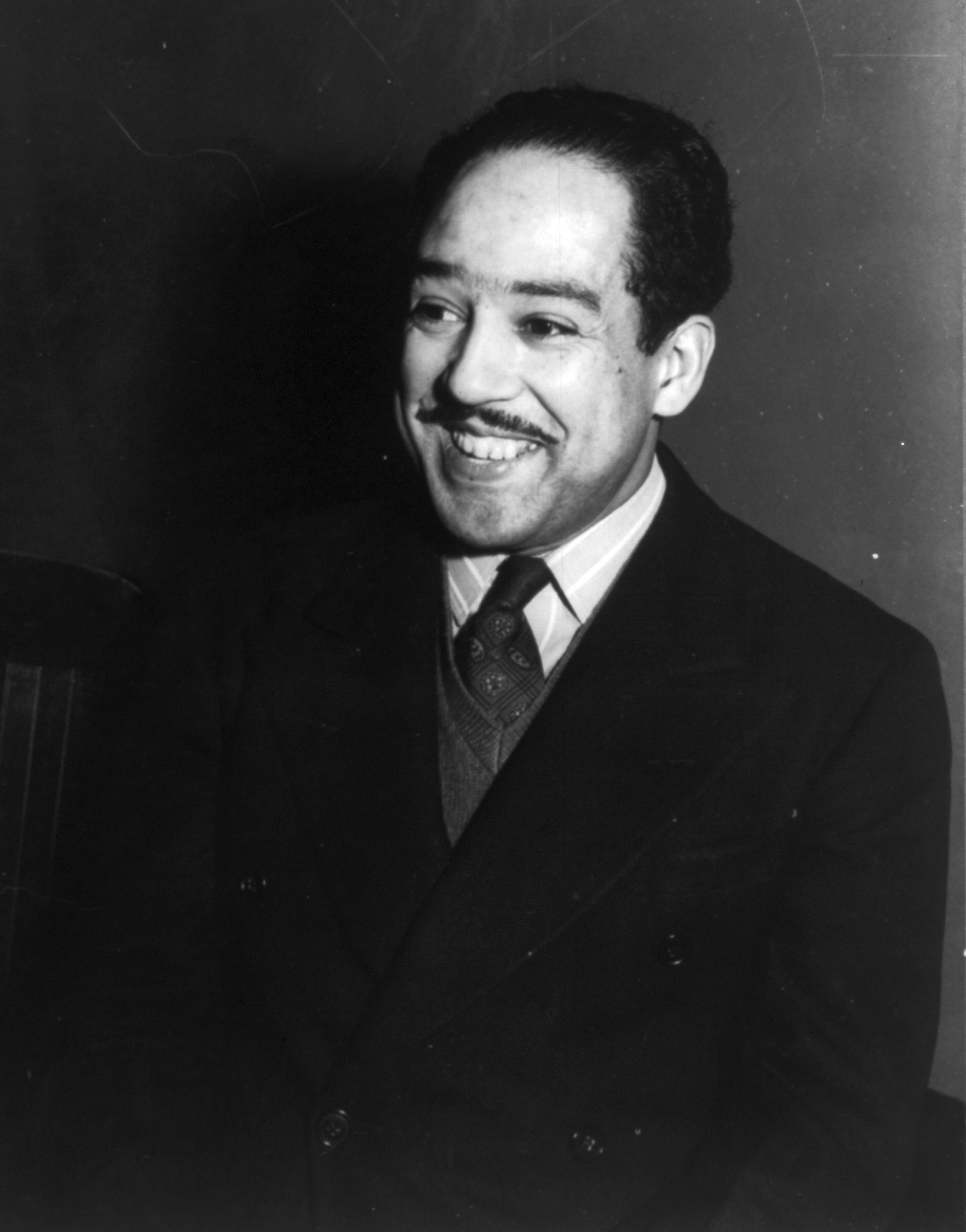
Langston Hughes, preeminent poet of the Harlem Renaissance and child of an itinerant couple, lived in Cleveland as a teenager and attended Central High School in Cleveland in the 1910s. At Central High, the young writer was taught by Helen Maria Chesnutt, daughter of Cleveland-born African American novelist Charles W. Chesnutt. Hughes authored some of his earliest poems, plays, and short stories in Cleveland and contributed to the school newspaper. The African American avant-garde poet Russell Atkins lived in the city as well.
The American modernist poet Hart Crane was born in nearby Garrettsville, Ohio in 1899. His adolescence was divided between Cleveland and Akron before he moved to New York City in 1916. Cleveland was the home of Joe Shuster and Jerry Siegel, who created the comic book character Superman in 1933. Harlan Ellison, noted author of speculative fiction, was born in Cleveland in 1934. As a young man, he published a series of short stories appearing in the Cleveland News, and performed in a number of productions for the Cleveland Play House.
Cleveland is the site of the Anisfield-Wolf Book Award, which recognizes books that have contributed to the understanding of racism and human diversity. Presented by the Cleveland Foundation, it remains the only American book prize focusing on works that address racism and diversity.
Museums and galleries
Cleveland has two main art museums. The Cleveland Museum of Art is a major American art museum, with a collection that includes more than 60,000 works of art. The Museum of Contemporary Art Cleveland showcases established and emerging artists, particularly from the Cleveland area, through hosting and producing temporary exhibitions. Both museums offer free admission to visitors.
The two museums are part of Cleveland's University Circle, a 550 acre concentration of cultural, educational, and medical institutions located 5 mi east of downtown. In addition to the art museums, the neighborhood includes the Cleveland Botanical Garden, Case Western Reserve University, University Hospitals, Severance Hall, the Maltz Performing Arts Center, the Cleveland Museum of Natural History, and the Western Reserve Historical Society. Also located at University Circle is the Cleveland Cinematheque at the Cleveland Institute of Art.
The I. M. Pei-designed Rock and Roll Hall of Fame is located on Cleveland's Lake Erie waterfront at North Coast Harbor downtown. Neighboring attractions include Cleveland Browns Stadium, the Great Lakes Science Center, the Steamship Mather Museum, the International Women's Air & Space Museum, and the , a World War II submarine. Designed by architect Levi T. Scofield, the Soldiers' and Sailors' Monument at Public Square is Cleveland's major Civil War memorial and a major attraction in the city. Other city attractions include Grays Armory, the Cleveland Masonic Temple, and the Children's Museum of Cleveland. A Cleveland holiday attraction, especially for fans of Jean Shepherd's A Christmas Story, is the Christmas Story House and Museum in Tremont.
Annual events
.jpg)
Cleveland hosts the WinterLand holiday display lighting festival annually at Public Square. The Cleveland International Film Festival has been held in the city since 1977, and the Cleveland Silent Film Festival has been held since 2022. The Cleveland National Air Show, an indirect successor to the National Air Races, has been held at the city's Burke Lakefront Airport since 1964. The Great Lakes Burning River Fest, a two-night music and beer festival at Whiskey Island, has been sponsored by the Great Lakes Brewing Company since 2001.
Many ethnic festivals are held in Cleveland throughout the year. These include the annual Feast of the Assumption in Little Italy, Russian Maslenitsa in Rockefeller Park, the Puerto Rican Parade and Cultural Festival in Clark–Fulton, the Cleveland Asian Festival in Asiatown, the Tremont Greek Fest, and the St. Mary Romanian Festival in West Park. Cleveland also hosts annual Polish Dyngus Day and Slovene Kurentovanje celebrations. The city's annual Saint Patrick's Day parade brings hundreds of thousands to the streets of Downtown. The Cleveland Thyagaraja Festival held each spring at Cleveland State University is the largest Indian classical music and dance festival in the world outside of India. Since 1946, the city has annually marked One World Day in the Cleveland Cultural Gardens in Rockefeller Park, celebrating all of its ethnic communities.
Cuisine

Cleveland's mosaic of ethnic communities and their various culinary traditions have long played an important role in defining the city's cuisine. Local mainstays include an abundance of Slavic, Hungarian, and Central-Eastern European contributions, such as kielbasa, stuffed cabbage, pierogies, goulash, and chicken paprikash. Italian, German, Irish, and Jewish cuisines are also prominent in Cleveland, as are Lebanese, Greek, Chinese, Puerto Rican, Mexican, and numerous other ethnic cuisines. Vendors at the West Side Market in Ohio City offer many ethnic foods for sale. In addition, the city boasts a vibrant barbecue and soul food scene.
Slyman's Deli on Cleveland's near East Side is notable for its corned beef sandwich, with patrons including former US Presidents George W. Bush and Joe Biden. Another celebrated sandwich, the Polish Boy, is a popular street food and Cleveland original frequently sold at downtown hot dog carts and stadium concession stands. Brown stadium mustard is synonymous with Cleveland, especially Bertman Original Ballpark Mustard. Another notable local food item with Depression-era roots is city chicken.
With its blue-collar roots well intact, and plenty of Lake Erie perch and walleye available, the tradition of Friday night fish fries remains alive and thriving in Cleveland, particularly in ethnic parish-based settings, especially during the season of Lent. Clambakes are likewise embedded into the city's culinary culture. For dessert, the Cleveland Cassata Cake is a unique treat invented in the local Italian community and served in Italian establishments throughout the city. Another popular dessert, the locally crafted Russian Tea Biscuit, is common in many Jewish bakeries in Cleveland.
Cleveland is noted in the world of celebrity food culture. Famous local figures include chef Michael Symon and food writer Michael Ruhlman, both of whom achieved local and national attention for their contributions to the culinary world. In 2007, Symon helped gain the spotlight when he was named "The Next Iron Chef" on the Food Network. That same year, Ruhlman collaborated with Anthony Bourdain, to do an episode of his Anthony Bourdain: No Reservations focusing on Cleveland's restaurant scene.
Breweries
Ohio produces the fifth most beer in the U.S., with its largest brewery being Cleveland's Great Lakes Brewing Company. Cleveland has had a long history of brewing, tied to many of its ethnic immigrants, and has reemerged as a regional leader in production. Dozens of breweries exist within city limits, including large producers such as Market Garden Brewery and Platform Beer Company. Although breweries can be found throughout the city, the highest concentration is in the Ohio City neighborhood. Cleveland hosts expansions from other countries as well, including the Scottish BrewDog and German Hofbrauhaus.
Sports
Main article: Sports in Cleveland
Cleveland's major professional sports teams are the Cleveland Guardians (Major League Baseball), the Cleveland Browns (National Football League), and the Cleveland Cavaliers (National Basketball Association). Other professional teams include the Cleveland Monsters (American Hockey League), the Cleveland Charge (NBA G League), the Cleveland Crunch (Major League Indoor Soccer), Cleveland SC (National Premier Soccer League), and the Cleveland Fusion (Women's Football Alliance). Local sporting venues include Progressive Field, Huntington Bank Field, Rocket Arena, the Wolstein Center, and Public Auditorium.
Professional
Major League
| Club | Sport | League | Venue | Est. in CLE | Championships |
|---|---|---|---|---|---|
| (in Cleveland) | |||||
| Cleveland Browns | Football | National Football League | Huntington Bank Field | 1946 | 8 |
| (4 AAFC, 4 NFL) | |||||
| Cleveland Cavaliers | Basketball | National Basketball Association | Rocket Arena | 1970 | 1 |
| Cleveland WNBA team | Basketball | Women's National Basketball Association | Rocket Arena | 2028 | 0 |
| Cleveland Guardians | Baseball | Major League Baseball | Progressive Field | 1901 | 2 |
Minor League
| Club | Sport | League | Venue | Est. in CLE | Championships |
|---|---|---|---|---|---|
| (in Cleveland) | |||||
| Cleveland Charge | Basketball | NBA G League | Public Auditorium | 2021 | 0 |
| Cleveland Monsters | Ice hockey | American Hockey League | Rocket Arena | 2007 | 1 |
| Cleveland Crunch | Indoor Soccer | Major League Indoor Soccer | Wolstein Center | 1989 | 5 |
| (3 NPSL, 1 M2, 1 MLIS) | |||||
| Cleveland Pro Soccer | Soccer | MLS Next Pro | TBA | 2022 | 0 |
The Cleveland Guardians – known as the Indians from 1915 to 2021 – won the World Series in 1920 and 1948. They also won the American League pennant, making the World Series in the 1954, 1995, 1997, and 2016 seasons. Between 1995 and 2001, the team sold out 455 consecutive games, a Major League Baseball record that stood until 2008.
Historically, the Browns have been among the most successful franchises in American football history, winning eight titles during a short period of time – 1946, 1947, 1948, 1949, 1950, 1954, 1955, and 1964. The Browns have never played in a Super Bowl, getting close five times by making it to the NFL/AFC Championship Game in 1968, 1969, 1986, 1987, and 1989. Former owner Art Modell's relocation of the Browns after the 1995 season caused tremendous heartbreak and resentment among local fans. After a series of lawsuits, a compromise was reached between Modell, Cleveland mayor Michael R. White, and NFL and Commissioner Paul Tagliabue to bring back the Browns beginning in the 1999 season, retaining all team history. In Cleveland's earlier football history, the Cleveland Bulldogs won the NFL Championship in 1924, and the Cleveland Rams won the NFL Championship in 1945 before relocating to Los Angeles.
The Cavaliers won the Eastern Conference in 2007, 2015, 2016, 2017 and 2018 but were defeated in the NBA Finals by the San Antonio Spurs and then by the Golden State Warriors, respectively. The Cavs won the Conference again in 2016 and won their first NBA Championship coming back from a 3–1 deficit, finally defeating the Golden State Warriors. Afterwards, over 1.3 million people attended a parade held in the Cavs' honor on June 22, 2016, in downtown Cleveland. Previously, the Cleveland Rosenblums dominated the original American Basketball League, and the Cleveland Pipers, owned by George Steinbrenner, won the American Basketball League championship in 1962.
The Cleveland Monsters of the American Hockey League won the 2016 Calder Cup. They were the first Cleveland AHL team to do so since the 1964 Barons.
College
| Club | Sport | League | Venue |
|---|---|---|---|
| Cleveland State Vikings | 19 Varsity | ||
| (8 men's, 10 women's, 1 co-ed) | NCAA Division I | ||
| (Horizon League) | various – including: | ||
| Krenzler Field (soccer) | |||
| Wolstein Center (men's and women's basketball) | |||
| Woodling Gym (wrestling and volleyball) | |||
| Case Western Reserve Spartans | 17 Varsity | ||
| (9 men's, 8 women's) | NCAA Division III | ||
| (University Athletic Association) | various – including: | ||
| DiSanto Field (football, soccer) | |||
| Veale Athletic Center (men's and women's basketball) |
Collegiately, NCAA Division I Cleveland State Vikings have 19 varsity sports, nationally known for their Cleveland State Vikings men's basketball team. NCAA Division III Case Western Reserve Spartans have 17 varsity sports, most known for their Case Western Reserve Spartans football team. The headquarters of the Mid-American Conference (MAC) are in Cleveland. The conference stages both its men's and women's basketball tournaments at Rocket Arena.
Annual and special events
The Cleveland Marathon has been hosted annually since 1978, and a monument commemorating one of Cleveland's most prominent track and field athletes, Jesse Owens, stands at the city's Fort Huntington Park. The second American Chess Congress, a predecessor to the U.S. Championship, was held in Cleveland in 1871, and won by George Henry Mackenzie. The 1921 and 1957 U.S. Open Chess Championships took place in the city, and were won by Edward Lasker and Bobby Fischer, respectively. The Cleveland Open is held annually. In 2014, Cleveland hosted the ninth official Gay Games ceremony. In July 2024, the city hosted the Pan American Masters Games.
Parks and recreation
.jpg)
Known locally as the "Emerald Necklace", the Olmsted-inspired Cleveland Metroparks encircle Cleveland and Cuyahoga County. The city proper encompasses the Metroparks' Brookside and Lakefront Reservations, as well as significant parts of the Rocky River, Washington, and Euclid Creek Reservations. The Lakefront Reservation, which provides public access to Lake Erie, consists of four parks: Edgewater Park, Whiskey Island–Wendy Park, East 55th Street Marina, and Gordon Park.
Three more parks fall under the jurisdiction of the Euclid Creek Reservation: Euclid Beach, Villa Angela, and Wildwood Marina. Further south, bike and hiking trails in the Brecksville and Bedford Reservations, along with Garfield Park, provide access to trails in the Cuyahoga Valley National Park. Also included in the Metroparks system is the Cleveland Metroparks Zoo, established in 1882. Located in Big Creek Valley, the zoo has one of the largest collections of primates in North America.
In addition to the Metroparks, the Cleveland Public Parks District oversees the city's neighborhood parks, the largest of which is the historic Rockefeller Park. The latter is notable for its late 19th century landmark bridges, the Rockefeller Park Greenhouse, and the Cleveland Cultural Gardens, which celebrate the city's ethnic diversity. Just outside of Rockefeller Park, the Cleveland Botanical Garden in University Circle, established in 1930, is the oldest civic garden center in the nation. In addition, the Greater Cleveland Aquarium, located in the historic FirstEnergy Powerhouse in the Flats, is the only independent, free-standing aquarium in the state of Ohio.
Government and politics
Government and courts
Cleveland operates on a mayor–council (strong mayor) form of government, in which the mayor is the chief executive and the city council serves as the legislative branch. City council members are elected from 17 wards to four-year terms. From 1924 to 1931, the city briefly experimented with a council–manager government under William R. Hopkins and Daniel E. Morgan before returning to the mayor–council system.
Cleveland is served by Cleveland Municipal Court, the first municipal court in the state. The city also anchors the U.S. District Court for the Northern District of Ohio, based at the Carl B. Stokes U.S. Courthouse and the historic Howard M. Metzenbaum U.S. Courthouse. The Chief Judge for the Northern District is Sara Elizabeth Lioi and the Clerk of Court is Sandy Opacich. The U.S. Attorney is Carol Skutnik and the U.S. Marshal is Peter Elliott.
Politics
The office of the mayor has been held by Justin Bibb since 2022. Previous mayors include progressive Democrat Tom L. Johnson, World War I-era War Secretary and BakerHostetler founder Newton D. Baker, U.S. Supreme Court Justice Harold Hitz Burton, two-term Ohio Governor and Senator Frank J. Lausche, former U.S. Health, Education, and Welfare Secretary Anthony J. Celebrezze, two-term Ohio Governor and Senator George V. Voinovich, former U.S. Congressman Dennis Kucinich, and Carl B. Stokes, the first African American mayor of a major U.S. city. Frank G. Jackson was the city's longest-serving mayor.
The President of Cleveland City Council is Blaine Griffin, the council Majority Leader is Kerry McCormack, and the Majority Whip is Jasmin Santana. Patricia Britt serves as the Clerk of Council.
Historically, from the Civil War era to the 1940s, Cleveland had been dominated by the Republican Party, with the notable exceptions of the Johnson and Baker mayoral administrations. Businessman and Senator Mark Hanna was among Cleveland's most influential Republican figures, both locally and nationally. Another nationally prominent Ohio Republican, former U.S. President James A. Garfield, was born in Cuyahoga County's Orange Township (today the Cleveland suburb of Moreland Hills). His resting place is the James A. Garfield Memorial in Cleveland's Lake View Cemetery.
Today Cleveland is a major stronghold for the Democratic Party in Ohio. Although local elections are nonpartisan, Democrats still dominate every level of government. Politically, Cleveland and several of its neighboring suburbs comprise Ohio's 11th congressional district. The district is represented by Shontel Brown, one of five Democrats representing the state of Ohio in the U.S. House of Representatives.
Cleveland has hosted three Republican national conventions, in 1924, 1936, and 2016. Additionally, the city hosted the 1864 Radical Democratic National Convention. Although Cleveland has not hosted a national convention for the Democrats, it has hosted several national election debates, including the second 1980 U.S. presidential debate, the 2004 U.S. vice presidential debate, one 2008 Democratic primary debate, and the first 2020 U.S. presidential debate. Founded in 1912, the City Club of Cleveland provides a platform for national and local debates and discussions. Known as Cleveland's "Citadel of Free Speech", it is one of the oldest continuous independent free speech and debate forums in the country.
Public safety
Police and law enforcement{{anchor|Crime}}
Main article: Cleveland Division of Police
Like in other major American cities, crime in Cleveland is concentrated in areas with higher rates of poverty and lower access to jobs. In recent decades, the rate of crime in the city, although higher than the national average, experienced a significant decline, following a nationwide trend in falling crime rates. However, as in other major U.S. cities, crime in Cleveland saw an abrupt rise in 2020–21.
Cleveland's law enforcement agency is the Cleveland Division of Police, established in 1866. The division had roughly 1,100 sworn officers as of 2024, covering five police districts. The district system was introduced in the 1930s by Cleveland Public Safety Director Eliot Ness (of the Untouchables), who later ran for mayor of Cleveland in 1947. The Chief of Police is Dorothy A. Todd. In addition, the Cuyahoga County Sheriff's Office is based in Downtown Cleveland at the Justice Center Complex.
Fire department
Main article: Cleveland Division of Fire
Cleveland is served by the firefighters of the Cleveland Division of Fire, established in 1863. The fire department operates out of 22 active fire stations throughout the city in five battalions. Each Battalion is commanded by a Battalion Chief, who reports to an on-duty Assistant Chief.
The Division of Fire operates a fire apparatus fleet of twenty-two engine companies, eight ladder companies, three tower companies, two task force rescue squad companies, hazardous materials ("haz-mat") unit, and numerous other special, support, and reserve units. The Chief of Department is Anthony Luke.
Emergency medical services
Main article: Cleveland EMS
Cleveland EMS is operated by the city as its own municipal third-service EMS division. Cleveland EMS is the primary provider of Advanced Life Support and ambulance transport within the city of Cleveland, while Cleveland Fire assists by providing fire response medical care. Although a merger between the fire and EMS departments was proposed in the past, the idea was subsequently abandoned.
Military
Cleveland serves as headquarters to Coast Guard District 9 and is responsible for all U.S. Coast Guard operations on the five Great Lakes, the Saint Lawrence Seaway, and surrounding states accumulating 6,700 miles of shoreline and 1,500 miles of international shoreline with Canada. It reports up through the U.S. Department of Homeland Security. Station Cleveland Harbor, located in North Coast Harbor, has a responsibility covering about 550 square miles of the federally navigable waters of Lake Erie, including the Cuyahoga and Rocky rivers, as well as a number of their tributaries.
Education
Primary and secondary
Cleveland is served by the Cleveland Metropolitan School District. It is the only K–12 district in Ohio under the direct control of the mayor, who appoints a school board. Approximately 1 sqmi of Cleveland's Buckeye–Shaker neighborhood is part of the Shaker Heights City School District. The area, which has been a part of the Shaker school district since the 1920s, permits these Cleveland residents to pay the same school taxes as the Shaker residents, as well as vote in the Shaker school board elections.
There are several private and parochial schools in Cleveland. These include Benedictine High School, Cleveland Central Catholic High School, Eleanor Gerson School, St. Ignatius High School, St. Joseph Academy, Villa Angela-St. Joseph High School, and St. Martin de Porres.
Colleges and universities
Cleveland is home to a number of colleges and universities. Most prominent among them is Case Western Reserve University (CWRU), a widely recognized research and teaching institution based in University Circle with several major graduate programs.
University Circle also contains the Cleveland Institute of Art and the Cleveland Institute of Music. Downtown Cleveland is home to Cleveland State University, a public research university with eight constituent colleges, and the metropolitan campus of Cuyahoga Community College. Ohio Technical College is also based in Cleveland. Cleveland's suburban universities and colleges include Baldwin Wallace University in Berea, John Carroll University in University Heights, and Ursuline College in Pepper Pike.
Public library system
Main article: Cleveland Public Library
Established in 1869, the Cleveland Public Library is one of the largest public libraries in the nation with a collection of over 13 million materials in 2023. It holds the Northeast Ohio Broadcast Archives, and the John G. White Special Collection, with the largest chess library in the world and a rare collection of folklore and books on the Middle East and Eurasia. The library's main building was designed by Walker and Weeks and dedicated in 1925, under head librarian Linda Eastman, the first woman to lead a major library system in the U.S. Between 1904 and 1920, 15 libraries built with funds from Andrew Carnegie were opened in the city. Known as the "People's University", the library presently maintains 27 branches. It serves as the headquarters for the CLEVNET library consortium, which includes 47 public library systems in Northeast Ohio.
Media
Cleveland's primary daily newspaper is The Plain Dealer and its associated online publication, Cleveland.com. Defunct major newspapers include the Cleveland Press and the Cleveland News. Additional publications include Cleveland Magazine, a regional culture magazine published monthly; Crain's Cleveland Business, a weekly business newspaper; and Cleveland Scene, a free alternative weekly paper which absorbed its competitor, the Cleveland Free Times, in 2008. The digital Belt Magazine was founded in Cleveland in 2013. Time magazine was published in Cleveland from 1925 to 1927.
Several ethnic publications are based in Cleveland. These include the Call and Post, a weekly newspaper that primarily serves the city's African American community; the Cleveland Jewish News, a weekly Jewish newspaper; the bi-weekly Russian-language Cleveland Russian Magazine; the Mandarin Erie Chinese Journal; La Gazzetta Italiana in English and Italian; the Ohio Irish American News; and the Spanish language Vocero Latino News.
TV
The Cleveland-area television market is served by 11 full power stations, including WKYC (NBC), WEWS-TV (ABC), WJW (Fox), WDLI-TV (Bounce), WOIO (CBS), WVPX-TV (Ion), WVIZ (PBS), WUAB (MyNetworkTV), WRLM (TCT), WBNX-TV (CW), and WQHS-DT (Univision). the market, which includes the Akron and Canton areas, was the 19th-largest in the country, as measured by Nielsen Media Research.
The Mike Douglas Show, a nationally syndicated daytime talk show, began in Cleveland in 1961 on KYW-TV (now WKYC), while The Morning Exchange on WEWS-TV served as the model for Good Morning America. Tim Conway and Ernie Anderson first established themselves in Cleveland while working together at KYW-TV and later WJW-TV (now WJW). Anderson both created and performed as the immensely popular Cleveland horror host Ghoulardi on WJW-TV's Shock Theater, and was later succeeded by the long-running late night duo Big Chuck and Lil' John. Another Anderson protégé – Ron Sweed – would become a popular Cleveland late night movie host in his own right as "The Ghoul".
Radio
Cleveland is directly served by 29 full power AM and FM radio stations, 21 of which are licensed to the city. Music stations – which are frequently the highest-rated in the market – include WQAL (hot adult contemporary), WDOK (adult contemporary), WKLV-FM (Christian contemporary - K-Love), WAKS (contemporary hits), WHLK (adult hits), WMJI (classic hits), WMMS (active rock/hot talk), WNCX (classic rock), WNWV (alternative rock), WGAR-FM (country), WZAK (urban adult contemporary), WENZ (mainstream urban), WCSB (jazz), WCLV (classical), WABQ (urban gospel), and WJMO (Spanish/Tropical). WMMS also serves as the FM flagship for the Cleveland Cavaliers and the Cleveland Guardians, WNCX is an FM flagship for the Cleveland Browns, and WJMO is the Spanish flagship for the Browns and Cavaliers.
News/talk stations include WHK, WTAM, and WERE. During the Golden Age of Radio, WHK was the first radio station to broadcast in Ohio, and one of the first in the country. WTAM is the AM flagship for both the Cleveland Cavaliers and the Cleveland Guardians. Sports stations include WKNR (ESPN), WARF (Fox/VSiN) and WKRK-FM (WW1), with WKNR and WKRK-FM serving as co-flagship stations for the Cleveland Browns, and WARF – though primarily an English language station – airing Spanish broadcasts of Cleveland Guardians home games. Religious stations include WHKW, WCCR, and WCRF.
As the regional NPR affiliate, WKSU serves all of Northeast Ohio (including both the Cleveland and Akron markets). College stations include WBWC (Baldwin Wallace), WJCU (John Carroll), and WRUW-FM (Case Western Reserve).
Transportation
Main article: Transportation in Cleveland
Transit

Cleveland has a bus and rail mass transit system operated by the Greater Cleveland Regional Transit Authority (RTA). The rail portion is officially called the RTA Rapid Transit, but local residents refer to it as The Rapid. It consists of three light rail lines, known as the Blue, Green, and Waterfront Lines, and a heavy rail line, the Red Line. In 2008, RTA completed the HealthLine, a bus rapid transit line, for which naming rights were purchased by the Cleveland Clinic and University Hospitals. It runs along Euclid Avenue from downtown through University Circle, ending at the Louis Stokes Station at Windermere in East Cleveland. In 1968, Cleveland became the first city in the nation to have a direct rail transit connection linking the city's downtown to its major airport.
Walkability
In 2021, Walk Score ranked Cleveland the 17th most walkable of the 50 largest cities in the U.S., with a Walk Score of 57, a Transit Score of 45, and a Bike Score of 55 (out of a maximum of 100). Cleveland's most walkable areas can be found in the Downtown, Ohio City, Detroit–Shoreway, University Circle, and Buckeye–Shaker neighborhoods. Like other major cities, the urban density of Cleveland reduces the need for private vehicle ownership. In 2016, 23.7% of Cleveland households lacked a car, while the national average was 8.7%. Cleveland averaged 1.19 cars per household in 2016, compared to a national average of 1.8.
Roads
.jpg)
Cleveland's road system consists of numbered streets running roughly north–south, and named avenues, which run roughly east–west. The numbered streets are designated "east" or "west", depending on where they lie in relation to Ontario Street, which bisects Public Square. The two downtown avenues which span the Cuyahoga change names on the west side of the river. Superior Avenue becomes Detroit Avenue on the West Side, and Carnegie Avenue becomes Lorain Avenue. The bridges that make these connections are the Hope Memorial (Lorain–Carnegie) Bridge and the Veterans Memorial (Detroit–Superior) Bridge.
Freeways
Cleveland is served by three two-digit interstate highways – I-71, I-77, and I-90 – and by two three-digit interstates – I-480 and I-490. Running due east–west through the West Side suburbs, I-90 turns northeast at the junction with I-490, and is known as the Cleveland Inner Belt. The Cleveland Memorial Shoreway carries SR 2 along its length, and at varying points carries US 6, US 20 and I-90. At the junction with the Shoreway, I-90 makes a 90-degree turn in the area known as Dead Man's Curve, then continues northeast. The Jennings Freeway (SR 176) connects I-71 just south of I-90 to I-480. A third highway, the Berea Freeway (SR 237 in part), connects I-71 to the airport and forms part of the boundary between Brook Park and Cleveland's Hopkins neighborhood.
Airports
Cleveland is a major North American air market, serving 4.93 million people. Cleveland Hopkins International Airport is the city's primary major airport and an international airport that serves the broader region. Originally known as Cleveland Municipal Airport, it was the first municipally owned airport in the country. Cleveland Hopkins is a significant regional air freight hub hosting FedEx Express, UPS Airlines, U.S. Postal Service, and major commercial freight carriers. In addition to Hopkins, Cleveland is served by Burke Lakefront Airport, on the north shore of downtown between Lake Erie and the Shoreway. Burke is primarily a commuter and business airport.
Seaport
Main article: Port of Cleveland
.jpg)
The Port of Cleveland, at the Cuyahoga River's mouth, is a major bulk freight and container terminal on Lake Erie, receiving much of the raw materials used by the region's manufacturing industries. The Port of Cleveland is the only container port on the Great Lakes with bi-weekly container service between Cleveland and the Port of Antwerp in Belgium on a Dutch service called the Cleveland-Europe Express. In addition to freight, the Port of Cleveland welcomes regional and international tourists who pass through the city on Great Lakes cruises.
Intercity rail and bus
Cleveland has a long history as a major railroad hub in North America. Today, Amtrak provides service to Cleveland, via the Capitol Limited and Lake Shore Limited routes, which stop at Cleveland Lakefront Station. Additionally, Cleveland hosts several inter-modal freight railroad terminals, for Norfolk Southern, CSX and several smaller companies.
National intercity bus service is provided by Greyhound from its downtown bus station. Akron Metro, Brunswick Transit Alternative, Laketran, Lorain County Transit, and Medina County Transit provide connecting bus service to the Greater Cleveland Regional Transit Authority. Geauga County Transit and Portage Area Regional Transportation Authority (PARTA) also offer connecting bus service in their neighboring areas.
International relations

Cleveland maintains cultural, economic, and educational ties with 27 sister cities around the world. It concluded its first sister city partnership with Lima, Peru, in 1964. In addition, Cleveland hosts the Consulate General of the Republic of Slovenia, which, until Slovene independence in 1991, served as an official consulate for Tito's Yugoslavia. The Cleveland Clinic operates the Cleveland Clinic Abu Dhabi hospital, two outpatient clinics in Toronto, and a hospital campus in London. The Cleveland Council on World Affairs was established in 1923.
Historically, Cleveland industrialist Cyrus S. Eaton, an apprentice of John D. Rockefeller, played a significant role in promoting dialogue between the U.S. and the Soviet Union during the Cold War. In October 1915 at Cleveland's Bohemian National Hall, Czech American and Slovak American representatives signed the Cleveland Agreement, calling for the formation of a joint Czech and Slovak state.
| Sister cities of Cleveland |
|---|
Notes
References
Works cited
References
- (June 5, 2020). "Forest City". [[Case Western Reserve University]].
- (October 3, 2022). "Municipal Symbols". Case Western Reserve University.
- "ArcGIS REST Services Directory". [[United States Census Bureau]].
- {{GNIS. 1066654
- "2020 Population and Housing State Data". United States Census Bureau.
- "Total Real Gross Domestic Product for Cleveland-Elyria, OH (MSA)". [[Bureau of Economic Analysis.
- "ZIP Code Lookup". USPS.
- "Cleveland city, Ohio". [[United States Census Bureau]].
- (March 13, 2025). "Metropolitan and Micropolitan Statistical Areas Population Totals: 2020-2024". [[United States Census Bureau]], Population Division.
- (February 25, 2019). "Immigration and Migration". [[Case Western Reserve University]].
- Gibson, Campbell. (June 1998). "Population of the 100 Largest Cities and Other Urban Places in the United States: 1790 to 1990". United States Census Bureau.
- Hammack, David C.. (May 28, 2018). "Economy". Case Western Reserve University.
- "Total Real Gross Domestic Product for Akron, OH (MSA)". US Bureau of Economic Analysis (BEA).
- "The World According to GaWC 2020". Globalization and World Cities.
- (January 20, 2019). "Cleaveland, Moses". Case Western Reserve University.
- Burton, Abby. (November 25, 2019). "CLE Myths: The "A" In Cleaveland".
- Bourne, Henry E.. (1896). "The Story of Cleveland".
- (January 20, 2019). "War of 1812". Case Western Reserve University.
- (June 18, 2018). "Perry Monument". Case Western Reserve University.
- (February 7, 2019). "Ohio and Erie Canal". Case Western Reserve University.
- (April 5, 2022). "Timeline". Case Western Reserve University.
- (November 18, 2019). "Columbus Street Bridge". Case Western Reserve University.
- Wyatt-Brown, Bertram. (May 31, 2019). "Abolitionism". Case Western Reserve University.
- "In Search of the Underground Railroad". Cleveland State University.
- "Abraham Lincoln in Cleveland: Remembering a Slain President". Cleveland State University.
- (May 22, 2018). "Soldiers' and Sailors' Monument". Case Western Reserve University.
- "American Experience: Rockefellers Timeline". PBS.
- Harrison, Dennis I.. (January 29, 2021). "Labor". Case Western Reserve University.
- (May 22, 2018). "Streetcar Strike of 1899". Case Western Reserve University.
- (February 27, 2023). "Cleveland Nicknames and Slogans". Case Western Reserve University.
- (September 19, 2021). "Johnson, Tom L". Case Western Reserve University.
- (July 15, 2019). "African Americans". Case Western Reserve University.
- (January 1, 2006). "Foreign-Born Population in Selected Ohio Cities, 1870 to 2000: A Brief Descriptive Report". Cleveland State University.
- (May 19, 2019). "May Day Riots". Case Western Reserve University.
- "May Day Riot". Cleveland State University.
- (May 31, 2019). "Playhouse Square". Case Western Reserve University.
- (May 22, 2018). "Short Vincent". Case Western Reserve University.
- Miller, Marilyn. "Short Vincent: A Walk on Cleveland's Historic Wild Side". Cleveland State University.
- "The Kokoon Arts Klub". Cleveland State University.
- Theiss, Evelyn. (February 5, 2012). "In Cleveland's 'second downtown,' jazz once filled the air: Elegant Cleveland". [[The Plain Dealer]].
- (June 18, 2018). "Prohibition Amendment". Case Western Reserve University.
- Kelly, Ralph. (December 28, 1933). "Murder in Cleveland: The Prohibition Toll. Chapter 3—Rise of the Rum Kings; the 'Bloody Corner". The Plain Dealer.
- "Downtown Department Stores: Cleveland's Fifth Avenue". Cleveland State University.
- "Cleveland National Air Races". Cleveland State University.
- Guerrieri, Vince. (July 2021). "The Rise and Fall of the Cleveland Air Races". Ohio Magazine.
- (March 21, 2019). "Great Lakes Exposition". Case Western Reserve University.
- (May 11, 2018). "Greater Cleveland Regional Transit Authority". Case Western Reserve University.
- (April 4, 2019). "Cleveland Electric Illuminating Co". Case Western Reserve University.
- Schneider, Russell. (November 3, 1991). "Those Championship Seasons: Cleveland's Rich Sports History". The Plain Dealer.
- (May 11, 2018). "Freed, Alan". Case Western Reserve University.
- (June 14, 2018). "Suburbs". Case Western Reserve University.
- Maag, Christopher. (June 20, 2009). "From the Ashes of '69, Cleveland's Cuyahoga River Is Reborn". [[The New York Times]].
- Eddings, Amy. (November 14, 2017). "Divided by Design: Tracking Neighborhood Racial Segregation in Cleveland". [[Ideastream]].
- (November 11, 2020). "Hough Riots". Case Western Reserve University.
- (July 1, 2020). "Glenville Shootout". Case Western Reserve University.
- "Carl B. Stokes and the 1969 River Fire". [[National Park Service]].
- (May 6, 2021). "Bomb City U.S.A.: The untold story of Cleveland's mobster dynasty". [[WKYC]].
- (May 12, 2018). "Mayoral Administration of Dennis J. Kucinich". Case Western Reserve University.
- Fobes, Jon. (February 8, 2009). "Unemployment hits nearly every area in Ohio, analysis of new claims finds". The Plain Dealer.
- (February 10, 2020). "Fisher Body Division of General Motors Corp". Case Western Reserve University.
- (February 21, 2019). "Mayoral Administration of George V. Voinovich". Case Western Reserve University.
- Kotlowitz, Alex. (March 4, 2009). "All Boarded Up: How Cleveland is Dealing With Mass Foreclosure". The New York Times.
- Michener, Charles. (April 2011). "Cleveland's Signs of Renewal".
- "Census 2020 in Cleveland". Cleveland City Planning Commission.
- Morris, Conor. (June 27, 2023). "Cleveland Mayor Justin Bibb announces five picks for CMSD Board of Education". Ideastream.
- Buckley, Bri. (November 28, 2023). "Cleveland homeless shelters near capacity". [[WKYC]].
- Daprile, Lucas. (June 4, 2022). "Cleveland poised to move forward with plans to demolish blighted buildings, but will $15 million be enough?". The Plain Dealer.
- "US Gazetteer files 2010". United States Census Bureau.
- "Cleveland-Hopkins International Airport". AirNav.
- (May 22, 2018). "Mall". Case Western Reserve University.
- Raponi, Richard. "Key Tower: Cesar Pelli's Nod to Art Deco-Era Manhattan". Cleveland State University.
- Raponi, Richard. "200 Public Square". Cleveland State University.
- Sims, Megan. (October 30, 2024). "Signs of change in downtown Cleveland". The Plain Dealer.
- Rose, Danielle. "Millionaires' Row: Cleveland's Famous Euclid Avenue". Cleveland State University.
- Florence, Cheyenne. "The Arcade: Cleveland's Crystal Palace". Cleveland State University.
- "Cleveland Trust Company Building". Cleveland State University.
- Raponi, Richard. "Old Stone Church". Cleveland State University.
- "St. Theodosius Cathedral". Cleveland State University.
- "Cleveland Sacred Landmarks". Cleveland State University.
- "Urban Tree Canopy Assessment Update: Cleveland Neighborhoods". Cuyahoga County Planning Commission.
- Roy, Chris. "The Theatrical Grill". Cleveland State University.
- Exner, Rich. (May 13, 2016). "How downtown Cleveland is changing: by the numbers". The Plain Dealer.
- Exner, Rich. (November 7, 2023). "Get to know Cleveland's East Side". The Plain Dealer.
- Exner, Rich. (November 1, 2023). "Get to know Cleveland's West Side". The Plain Dealer.
- Nalewicki, Jennifer. (July 27, 2018). "Vibrant Art Installations Infuse New Life into Abandoned Houses in This Cleveland Neighborhood".
- Glusac, Elaine. (November 15, 2017). "A Cleveland Arts District Hustles and Rebounds". The New York Times.
- (June 2006). "World Map of Köppen – Geiger Climate Classification". Meteorologische Zeitschrift.
- "NOAA National Centers for Environmental Information State Climate Summaries 2022". [[National Centers for Environmental Information]].
- "Cleveland Snowfall Statistics". [[National Weather Service]].
- Johnson, Mark. "Where is Northern Ohio's Snow Belt?".
- Smith, Susan. (June 26, 1988). "Akron, State Blanketed in 3-Digit Heat". [[Akron Beacon Journal]].
- Mio, Lou. (January 20, 1994). "Stopped Cold: All-Time Lows Shiver Ohio, But Forecast's for 'Warming'". The Plain Dealer.
- "NOWData – NOAA Online Weather Data". National Weather Service.
- "Precipitation: Annual Climatology (1971–2000)". PRISM Climate Group, [[Oregon State University]].
- "NOWData – NOAA Online Weather Data". National Oceanic and Atmospheric Administration.
- "Station: Cleveland, OH". National Oceanic and Atmospheric Administration.
- "WMO Climate Normals for CLEVELAND/HOPKINS INTL AP, OH 1961–1990". National Oceanic and Atmospheric Administration.
- "Cleveland, Ohio, USA – Monthly weather forecast and Climate data". Weather Atlas.
- Grant, Julie. (April 21, 2017). "How a Burning River Helped Create the Clean Water Act".
- Piepenburg, Erik. (June 7, 2019). "A Cleveland River Once Oozed and Burned. It's Now a Hot Spot.". The New York Times.
- Gearino, Dan. (September 22, 2018). "100% Renewable Energy: Cleveland Sets a Big Goal as It Sheds Its Fossil Fuel Past".
- Vandenberge, Jordan. (August 10, 2020). "Local company developing antidote to Lake Erie algal blooms". WEWS-TV.
- "Cleveland". United States Census Bureau.
- "Race and Hispanic Origin for Selected Cities and Other Places: Earliest Census to 1990". United States Census Bureau.
- "Facts by Decade — 1950 Census". U.S. Census Bureau.
- (1983). "1980 Census of Population — Characteristics of the Population: Ohio". U.S. Department of Commerce, Bureau of the Census.
- Smith, Zachary. (March 31, 2022). "Every Ohio city ranked for median age, youth, seniors – new census estimates". The Plain Dealer.
- Polk, Mike Jr.. (October 22, 2020). "Mike Polk Jr. investigates the 'Cleveland Accent'". WKYC.
- McIntyre, Michael K.. (January 13, 2017). "Clevelanders probably think they don't have an accent, but we do, and so do others in the Midwest". The Plain Dealer.
- (May 11, 2018). "Hungarians". Case Western Reserve University.
- (May 11, 2018). "Jews & Judaism". Case Western Reserve University.
- (May 11, 2018). "Hispanic Community". Case Western Reserve University.
- (May 11, 2018). "Asiatown". Case Western Reserve University.
- (May 11, 2018). "Albanians". Case Western Reserve University.
- (May 11, 2018). "Arab Americans". Case Western Reserve University.
- (January 10, 2021). "Armenians". Case Western Reserve University.
- (May 11, 2018). "French". Case Western Reserve University.
- (May 11, 2018). "Greeks". Case Western Reserve University.
- Vandenberge, Jordan. (January 3, 2020). "Iranian-Americans in Cleveland keeping close eye on rising tensions between US, Iran". WEWS-TV.
- (October 2, 2019). "Turks in Cleveland". Case Western Reserve University.
- Mosby, Chris. (January 23, 2020). "3 Ohio Cities Among Nation's Most Diverse: U.S. News".
- (May 12, 2018). "Religion". Case Western Reserve University.
- "National Origin in Cleveland, Ohio". Statistical Atlas.
- Drown, Hannah. (August 26, 2019). "New Ethiopian Cultural Garden first in Cleveland to represent an African nation". [[The Plain Dealer]].
- (February 21, 2019). "Indians (Asian)". Case Western Reserve University.
- (May 30, 2023). "Russians". Case Western Reserve University.
- (October 7, 2019). "Soviet and Post-Soviet Immigration". Case Western Reserve University.
- Exner, Rich. (April 2, 2018). "Among counties, Cuyahoga near top in Midwest for attracting immigrants". The Plain Dealer.
- Cho, Janet H.. (February 7, 2019). "Cleveland is the No. 1 city for immigrants to become U.S. citizens, study says". The Plain Dealer.
- (January 10, 2022). "Cleveland Cultural Gardens". Case Western Reserve University.
- Stapleton, Darwin H.. (May 11, 2018). "Industry". Case Western Reserve University.
- (June 29, 2023). "About Us". Federal Reserve Bank of Cleveland.
- (May 31, 2019). "Federal Reserve Bank of Cleveland". Case Western Reserve University.
- "Firm History". Jones Day.
- Walsh, Jonathan. (February 1, 2019). "Comparing prices at the big 3 local hospitals: Are you getting the best rates and what do the prices really mean?". WEWS-TV.
- (December 2022). "Ohio Major Employers". Ohio Department of Development.
- Washington, Julie. (March 1, 2024). "Cleveland Clinic is No. 2 in world after Mayo Clinic". The Plain Dealer.
- Segall, Grant. (April 26, 2018). "New Cleveland Clinic chief Dr. Tomislav Mihaljevic perplexed friends by leaving Harvard for the North Coast: My Cleveland". The Plain Dealer.
- Jain, Mukesh. (March 29, 2021). "Academic Life & Leadership: A Dialogue with Cliff A. Megerian, MD, FACS". [[University Hospitals Cleveland Medical Center.
- Wizner, Taylor. (October 8, 2024). "MetroHealth appoints longtime exec Dr. Christine Alexander-Rager as new CEO". Ideastream.
- Stewart, Shannon. "Metro Health Medical Center". Cleveland State University.
- Ross, Casey. (April 29, 2016). "Level 1 trauma: How University Hospitals' new facility has impacted MetroHealth, delivery of care citywide". The Plain Dealer.
- Suchetka, Diane. (October 2, 2013). "After years of hurdles, Cleveland's medical mart officially opens with an Oct. 8 ribbon-cutting". The Plain Dealer.
- "V.A. and Military Hospitals of Greater Cleveland". Cleveland State University.
- "Playhouse Square". Cleveland State University.
- "Resident Companies". Playhouse Square Center.
- (May 10, 2000). "Bob Hope and the American Variety: Early Life". [[Library of Congress]].
- (April 5, 2021). "Karamu House". Case Western Reserve University.
- Mansfield, Herbert. (May 12, 2018). "Theater". Case Western Reserve University.
- Allen, David. (October 9, 2020). "The Cleveland Orchestra, America's Finest, Restarts Recording". The New York Times.
- "Mission & History". The Cleveland Orchestra.
- "About". Piano Cleveland.
- (May 13, 2023). "Rock 'n' Roll". Case Western Reserve University.
- (June 29, 2018). "Jazz". Case Western Reserve University.
- Meiksins, Robin. "Django Reinhardt at the Music Hall". Cleveland State University.
- Valencic, Joseph. (June 18, 2018). "Polkas". Case Western Reserve University.
- "Bone Thugs-N-Harmony {{!}} Biography & History".
- (May 30, 2023). "Cleveland on Film". Case Western Reserve University.
- (July 2, 2021). "Andrews's Folly". Case Western Reserve University.
- Dubelko, Jim. "Cinecraft Productions: The Historic Film Company produced by a Love Story". Cleveland State University.
- Morona, Joey. (June 24, 2024). "It's a bird! It's a plane! No, it's Superman strolling the streets of Cleveland". The Plain Dealer.
- Stanley, Alessandra. (June 15, 2010). "Stay. Eat. Make Yourself at Home. Maybe Find a Man". The New York Times.
- Rice, Lynette. (June 17, 2010). "'Hot in Cleveland' attracts record ratings for TV Land". Hollywood Insider.
- Andreeva, Nellie. (November 17, 2014). "'Hot In Cleveland' To End Run After Six Seasons On TV Land". Deadline Hollywood.
- "Cleveland Poetics".
- Shakarian, Pietro A.. "Mayakovsky in Cleveland: A Fiery Futurist's Discovery of the Forest City". Cleveland State University.
- (January 18, 2019). "Through the Brooklyn Bridge. Here Stood Mayakovsky". [[Harriman Institute]] ([[Columbia University]]).
- "Mission". [[Cleveland State University Poetry Center]].
- (February 14, 2022). "Hughes, (James) Langston". Case Western Reserve University.
- Ronnick, Michele Valerie. "Within CAMWS Territory: Helen M. Chesnutt (1880–1969), Black Latinist". [[Classical Association of the Middle West and South.
- Perkovic, John. (October 24, 2013). "Cleveland home of literary great Langston Hughes on the market for $85,000". The Plain Dealer.
- (May 11, 2018). "Literature". Case Western Reserve University.
- (March 3, 2023). "Crane, Hart". Case Western Reserve University.
- (May 12, 2018). "Superman". Case Western Reserve University.
- Gustines, George Gene. (August 1, 2025). "Superman's Earthly Birthplace? It's Cleveland, and It's Embracing Its Hero.". The New York Times.
- Dawidziak, Mark. (June 28, 2018). "Harlan Ellison, fiery and brilliant writer from Cleveland, dead at 84". The Plain Dealer.
- "About". [[Anisfield-Wolf Book Award]].
- Marino, Jacqueline. (September 9, 2013). "The Biggest Little-Known Book Award".
- (July 13, 2021). "Collection Online Guide and FAQs". Cleveland Museum of Art.
- "About MOCA Cleveland: The Art + Ideas of Our Time". Museum of Contemporary Art Cleveland.
- (October 5, 2012). "Museum History". Cleveland Museum of Art.
- "About the Cinematheque". [[Cleveland Institute of Art]].
- Fearing, Heidi K.. "Grays Armory". Cleveland State University.
- "Masonic Temple". Cleveland State University.
- "Museum History, Vision & Mission".
- "About". A Christmas Story House and Museum.
- "About". WinterLand CLE.
- "History". [[Cleveland International Film Festival]].
- McLaughlin, Kevin. (March 11, 2025). "Cleveland Silent Film Festival partners with Cleveland Public Library". The Land.
- (March 21, 2019). "Cleveland Air Show". Case Western Reserve University.
- "Our History". [[Great Lakes Brewing Company]].
- Litt, Steven. (July 30, 2024). "Is Cleveland's Little Italy in danger of being loved to death?". The Plain Dealer.
- DeMarco, Laura. (February 14, 2018). "Russian Maslenitsa Festival in Rockefeller Park celebrates end of winter". The Plain Dealer.
- "Puerto Rican Parade & Cultural Festival". Destination Cleveland.
- "Cleveland Asian Festival". Destination Cleveland.
- Abusada, Abusada. (May 28, 2022). "Tremont's Greek Fest is officially back". WEWS-TV.
- Valentic, Stefanie. (August 19, 2019). "West Park Romanian festival celebrates 14 years of tradition". The Plain Dealer.
- "History". Cleveland Dyngus Day.
- "Our History". Cleveland Kurentovanje.
- "About Us". Cleveland St. Patrick's Day Parade.
- DeJong, Lisa. (March 30, 2016). "Cleveland Thyagaraja Festival". The Plain Dealer.
- Snook, Debbi. (May 27, 2012). "Cleveland's West Side Market feeds bellies and our souls with its rich ethnic heritage". The Plain Dealer.
- (February 3, 2020). "Top 20 Soul Food Restaurants in Greater Cleveland according to Yelp". The Plain Dealer.
- Goodrich, Barry. (January 22, 2020). "Classic Cleveland Restaurants: Slyman's Restaurants".
- Axelrod, Ben. (April 11, 2023). "Cleveland's Polish Boy named one of world's 10 best hot dogs". WKYC.
- Chakerian, Peter. (March 22, 2024). "No hot-doggin' it, we definitely 'cut the mustard' in The Land". The Plain Dealer.
- Frederick, Missy. (May 5, 2017). "What Is City Chicken, Really?: How a Depression-era dish conquered Cleveland".
- "2023 Cleveland Fish Fry Guide".
- Trattner, Douglas. (October 3, 2024). "How Cleveland Became a Clambake Capital of America".
- Zaleski, Annie. (September 28, 2016). "How Did the Cleveland Clambake Even Become a Thing?".
- Wolfe, Paris. (March 10, 2023). "Cleveland Cassata Cake is a local invention". The Plain Dealer.
- Bania-Dobyns, Sarah. (September 22, 2021). "If you want this delectable Jewish pastry, you'll have to go to Cleveland". [[The Jerusalem Post]].
- Eng, Monica. (January 29, 2008). "Hot new dining city: Cleveland?!". [[Chicago Tribune]].
- (April 14, 2021). "Ohio craft-beer production ranks 5th in U.S.; 3 breweries in top 50". The Plain Dealer.
- (August 17, 2017). "Vintage pictures of Cleveland's historic breweries". The Plain Dealer.
- (April 6, 2021). "10 Breweries with outdoor seating in and around Ohio City". The Plain Dealer.
- (February 26, 2021). "Hofbrauhaus Cleveland set to reopen next week". The Plain Dealer.
- (April 13, 2021). "BrewDog confirms Cleveland expansion". The Plain Dealer.
- Burt, Bill. (September 9, 2008). "Sellouts! Record 456 and counting for Sox". Eagle Tribune.
- Walker, James. (July 13, 2010). "Take your pick recap: LeBron vs. Modell". [[ESPN]].
- Kroll, John. (September 6, 2012). "When Art Modell moved his Cleveland Browns team to Baltimore: How The Plain Dealer reported it". The Plain Dealer.
- (May 11, 2018). "Cleveland Bulldogs". Case Western Reserve University.
- (March 10, 2021). "Cleveland Rams". Case Western Reserve University.
- Hoppert, Melissa. (June 22, 2016). "Cavaliers Parade Caps Off Cleveland Victory Party". The New York Times.
- Wright, Branson. (June 11, 2016). "Lake Erie Monsters win Calder Cup title with 1–0 OT victory over Hershey". The Plain Dealer.
- (August 2, 2023). "Athletics". Cleveland State University.
- (May 20, 2023). "CWRU Athletics". Case Western Reserve University.
- "History of the MAC".
- (May 22, 2018). "Rite Aid Cleveland Marathon and 10K". Case Western Reserve University.
- Dubelko, Jim. "Jesse Owens: The Cleveland Years". Cleveland State University.
- (April 7, 2018). "George Henry Mackenzie". [[World Chess Hall of Fame]].
- Hanken, Jerry. (June 13, 2008). "Big Time chess returns to Cleveland". The United States Chess Federation.
- "Federation of Gay Games – Gay Games IX – Cleveland".
- Bona, Marc. (August 30, 2022). "Pan-American Masters Games choose Cleveland as 1st U.S. competition site". The Plain Dealer.
- "Lakefront Reservation". Cleveland Metroparks.
- "Euclid Creek Reservation". Cleveland Metroparks.
- "Mountain Biking". Cleveland Metroparks.
- "Cleveland Metroparks Zoo". [[Destination Cleveland]].
- (November 11, 2020). "Rockefeller Park". Case Western Reserve University.
- (May 26, 2022). "Cleveland Botanical Garden". Case Western Reserve University.
- Ondrey, Thomas. (May 19, 2012). "Underwater wonders among the newcomers in Northeast Ohio". The Plain Dealer.
- Richardson, James F.. (June 18, 2018). "Politics". Case Western Reserve University.
- "Court History". Cleveland Municipal Court.
- (June 7, 2023). "U.S. District Judge Sara Lioi Sworn In as Chief Judge". United States District Court for the Northern District of Ohio.
- Ferrise, Adam. (January 6, 2025). "New interim federal prosecutor in northern Ohio takes over". The Plain Dealer.
- (October 2020). "Northern District of Ohio United States Marshal – Peter J. Elliott". U.S. Marshals Service.
- Castele, Nick. (January 3, 2022). "Justin Bibb sworn in as Cleveland's new mayor". Ideastream.
- Vosburgh, Mark. (December 13, 2021). "Frank Jackson: Man, mayor and mystery". The Plain Dealer.
- "Leadership". Cleveland City Council.
- "Clerk of Council". Cleveland City Council.
- Hardison, Ashley. "James A. Garfield Memorial". Cleveland State University.
- Eaton, Sabrina. (November 8, 2022). "U.S. Rep. Shontel Brown wins reelection in 11th congressional district". The Plain Dealer.
- (July 8, 2014). "2016 Republican Convention in Cleveland: 5 Things to Know".
- (May 11, 2018). "Cleveland Convention". Case Western Reserve University.
- Bamforth, Emily. (July 27, 2020). "First 2020 presidential debate will be in Cleveland". The Plain Dealer.
- (August 6, 2020). "City Club of Cleveland". Case Western Reserve University.
- "Mission & Vision". [[City Club of Cleveland]].
- "Neighborhoods and Violent Crime". [[United States Department of Housing and Urban Development]].
- Wells, Michael V.. (May 11, 2018). "Crime". Case Western Reserve University.
- Higgs, Robert. (January 30, 2019). "Cleveland's rates for nearly all violent crimes, property crimes dropped again in 2018". The Plain Dealer.
- Smith, Shannon. (January 4, 2021). "Cleveland's rise in violent crime makes national headlines, city leaders react". [[WOIO]].
- (May 31, 2019). "Cleveland Police Department". Case Western Reserve University.
- (2019). "Cleveland Police Districts". City of Cleveland.
- "Eliot Ness and his role in Cleveland history". Cleveland Police Museum.
- "Division of Police". City of Cleveland.
- "About Us".
- (May 22, 2018). "Cleveland Fire Department". Case Western Reserve University.
- "Division of Fire". City of Cleveland.
- "Cleveland Fire Stations". City of Cleveland.
- (November 1, 2022). "Anthony P. Luke sworn in as Cleveland's new fire chief". WKYC.
- "Cleveland EMS History". Cleveland Association of Rescue Employees.
- Atassi, Leila. (April 13, 2014). "Cuyahoga Prosecutor says former Cleveland Fire Chief Paul Stubbs ignored payroll abuses; Mayor has remained steadfast in defense". The Plain Dealer.
- "Station Cleveland Harbor".
- (November 11, 2020). "Cleveland Public Schools". Case Western Reserve University.
- (April 25, 2010). "Shaker Heights City School District". The Plain Dealer.
- (May 11, 2018). "Education". Case Western Reserve University.
- (May 11, 2018). "Higher Education". Case Western Reserve University.
- (June 26, 2023). "Ohio Technical College School History". [[Ohio Technical College]].
- (2024). "2023 CPL Annual Report". [[Cleveland Public Library]].
- (December 19, 2024). "Northeast Ohio Broadcast Archives: Library Seeks a Sustainable Path Forward". Cleveland Public Library.
- Bash, Homa. (June 12, 2019). "Did you know? Cleveland is home to the world's largest chess collection".
- (May 12, 2018). "White, John Griswold". Case Western Reserve University.
- (April 3, 2020). "Eastman, Linda Anne". Case Western Reserve University.
- (July 8, 2019). "Cleveland had 15 Carnegie libraries: See them then and now". The Plain Dealer.
- (November 18, 2019). "Cleveland Public Library". Case Western Reserve University.
- (March 28, 2023). "What is CLEVNET?". [[CLEVNET]].
- (November 18, 2019). "Plain Dealer". Case Western Reserve University.
- (November 11, 2020). "Cleveland Press". Case Western Reserve University.
- (March 9, 2021). "Cleveland News". Case Western Reserve University.
- "About Us".
- "Crain's Cleveland Business". Crain's Cleveland Business.
- (May 12, 2018). "Scene". Case Western Reserve University.
- "About Us".
- (May 12, 2018). "Time". Case Western Reserve University.
- (May 22, 2018). "Cleveland Call & Post". Case Western Reserve University.
- (May 11, 2018). "Cleveland Jewish News". Case Western Reserve University.
- "Cleveland Russian Magazine".
- "About".
- "About Us". La Gazzetta Italiana.
- "Ohio Irish American News". Ohio Irish American News.
- "Vocero Latino News". Vocero Latino News.
- (2021). "2021 Neilsen DMA Ratings". Out-of-Home Advertising Association of America.
- Weiner, Tim. (August 12, 2006). "Mike Douglas, TV Host and Pop Singer, Dies at 81". The New York Times.
- Livingston, Tommy. (July 19, 2019). "Fred Griffith, former host of The Morning Exchange, dies at 90". WEWS-TV.
- DeNatale, Dave "Dino". (April 2, 2019). "Legendary Cleveland television personality Ron 'The Ghoul' Sweed passes away". WKYC.
- (July 1, 2010). "Classical Pick: Radio Days".
- "Cleveland Radio Stations". Radio Station World.
- (2019). "Ratings: #34 Cleveland". Radio Online.
- (June 22, 2021). "WHK". Case Western Reserve University.
- "List of the Pioneer Broadcast Service Stations". United States Early Radio History.
- (2023). "Broadcast". NBA Media Ventures, LLC.
- (2023). "Guardians Radio Affiliates". MLB Advanced Media, LP.
- Yarborough, Chuck. (September 2, 2011). "WKRK FM/92.3 The Fan replaces rock with sports talk". The Plain Dealer.
- Grossi, Tony. (March 28, 2013). "ESPN 850 WKNR is the new radio home of the Cleveland Browns". ESPN.
- Press Release. (March 28, 2013). "Browns Enter into Groundbreaking Radio Partnership With ESPN 850 WKNR And CBS Radio's 92.3 The Fan And 98.5 WNCX". [[CBS Radio]].
- (March 28, 2022). "Northeast Ohio NPR programming shifts from WCPN to WKSU, classical music now on 90.3 FM". Akron Beacon Journal.
- "RTA HealthLine: About". [[Greater Cleveland Regional Transit Authority]].
- "Living in Cleveland". Walk Score.
- (December 9, 2014). "Car Ownership in U.S. Cities Data and Map". Governing.
- (June 29, 2018). "Street Names". Case Western Reserve University.
- Rotman, Michael. "Lorain-Carnegie Bridge: Home of the Guardians". Cleveland State University.
- "Detroit-Superior Bridge: The City's First High-Level Bridge". Cleveland State University.
- Lanese, Jim. "The Cleveland Inner Belt: Future Interstate Highways Merge in the City". Cleveland State University.
- (May 11, 2018). "Memorial Shoreway". Case Western Reserve University.
- Dorwart, Laura. (May 29, 2018). "Why This Cleveland Roadway Is Known as 'Dead Man's Curve'".
- Roy, Christopher. (March 12, 2022). "Hopkins Neighborhood". Case Western Reserve University.
- "Cleveland". The Center for Cleveland.
- Culley, Jim. (May 10, 2022). "Cleveland Hopkins International Airport". [[Case Western Reserve University]].
- (June 25, 2020). "Burke Lakefront Airport". Case Western Reserve University.
- "About". [[Port of Cleveland]].
- "Cleveland-Europe Express". Port of Cleveland.
- "Great Lakes Cruising". Port of Cleveland.
- "CSX Intermodal Terminal Details". [[CSX]].
- "Cleveland, OH: Terminals & Schedules". [[Norfolk Southern]].
- "Getting to Cleveland". Destination Cleveland.
- "Out-of-County Transfers". Greater Cleveland Regional Transit Authority.
- (December 14, 2023). "Cleveland Sister City Partnerships". Case Western Reserve University.
- (May 11, 2018). "Slovenes". Case Western Reserve University.
- Coutré, Lydia. (February 15, 2023). "Cleveland Clinic London to open second outpatient building this fall". Crain's Cleveland Business.
- (May 11, 2018). "Cleveland Council on World Affairs". Case Western Reserve University.
- (July 30, 2019). "Eaton, Cyrus Stephen". Case Western Reserve University.
- Burik, Paul. (October 3, 2020). "Cleveland Agreement of 1915". Case Western Reserve University.

This article was imported from Wikipedia and is available under the Creative Commons Attribution-ShareAlike 4.0 License. Content has been adapted to SurfDoc format. Original contributors can be found on the article history page.
Ask Mako anything about Cleveland — get instant answers, deeper analysis, and related topics.
Research with MakoFree with your Surf account
Create a free account to save articles, ask Mako questions, and organize your research.
Sign up freeThis content may have been generated or modified by AI. CloudSurf Software LLC is not responsible for the accuracy, completeness, or reliability of AI-generated content. Always verify important information from primary sources.
Report