From Surf Wiki (app.surf) — the open knowledge base
Clean and jerk
Composite of two weightlifting movements

Composite of two weightlifting movements
The clean and jerk is a composite of two weightlifting movements, most often performed with a barbell: the clean and the jerk. During the clean, the lifter moves the barbell from the floor to a racked position across the deltoids, without resting fully on the clavicles. During the jerk, the lifter raises the barbell to a stationary position above the head, finishing with straight arms and legs, and the feet in the same plane as the torso and barbell.
Of the several variants of the lift, the most common is the Olympic clean and jerk, which, with the snatch, is included in Olympic weightlifting events. Clean and jerk is most commonly performed with a squat clean and a split jerk.
Clean
.JPG)
The first part of clean and jerk is the clean, which moves the barbell from the ground to shoulder height. To execute a clean, a lifter grasps the barbell just outside the legs, typically using a hook grip. Once the barbell is above the knees, the lifter extends explosively, raising the bar as high as possible before quickly dropping into a squat and receiving it in a "racked" position in front of the neck and resting on the shoulders. To complete the clean, the lifter stands, often propelling the bar upward from the shoulders slightly as the erect position is attained and shifting the grip slightly wider and the feet slightly closer together in preparation for the jerk.
Jerk
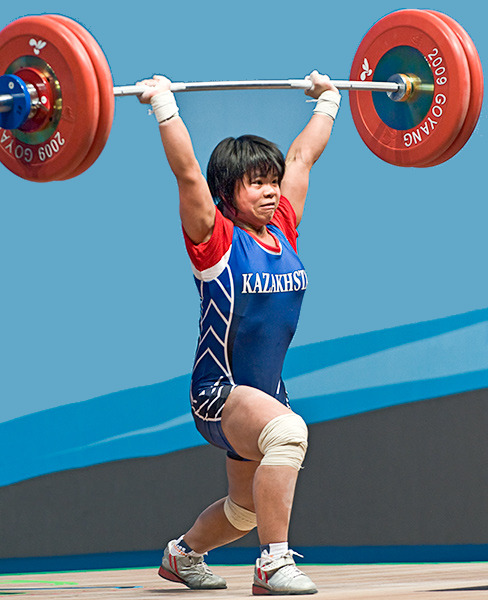
The jerk is a movement that lifts a barbell from the shoulder to the overhead position. It starts from the "front rack" position, which is the finishing position of the clean. The lift begins with the dip-drive phase – the lifter dips a few inches by bending the knees, keeping the back vertical, before driving the barbell explosively upward by straightening the legs. The lifter continues driving the barbell upward by lifting it off the shoulder with the arms, and once the barbell has passed the head, the lifter dips underneath the bar and moves the body into a stable receiving position. How the body moves into the receiving position depends on the style of jerk (split jerk, power jerk, or squat jerk) being performed, with split jerk being the most common. The bar is received overhead on straight arms; once stable, the lifter recovers to a normal standing position, with the legs in the same vertical plane as the rest of the body.
Variants
Clean
The clean in clean and jerk implies a squat clean. The start of squat clean is similar to a deadlift, the lifter then fully extends and shrugs to pull, moves the bar up while dropping the body under the bar, catching it between the shoulders and clavicles with the elbows up in a squat, before standing up with the bar.
The hang clean is similar to the squat clean, with the difference being beginning the movement with the barbell off the ground; hanging from the arms. Because one can no longer rely on the initial pull from the floor to hoist the bar sufficiently high, successful execution of the hang clean relies on a powerful extension of the hips and a strong consecutive pull.
In split clean, the legs are split during the lift, with one leg forward and the other leg backward before moving to a standing position. It was more common in the past for clean and jerk, but it is now rare. It may be performed by those who do not have the flexibility or are too tall to perform a squat in the clean well.
The continental clean involves lifting the bar from the floor to the final clean position by any method of the lifter's choosing so long as the bar is not upended and does not touch the ground. The bar may be rested on the legs, stomach, or belt. Hands may be removed and replaced. The continental clean plays a special role in strongman training, where the use of a thick axle bar makes the additional steps of a continental clean necessary.
power_cleanThe power clean which is similar to the traditional clean, differs in the catch position of the barbell. To execute the power clean, the lifter needs to catch the bar at or above half squat height, where the hips are positioned above knees as the bar lands on your shoulders. To do so, the lifter must pull the bar up higher in order to catch it, making this a difficult but great exercise to develop a strong pull.
muscle_cleanThe muscle clean to be executed needs extra upper body strength, where once you’ve extended your knees and hips for that initial upwards drive, they must remain that way. Without dropping into a partial squat to catch the bar on your shoulders, you have to purely rely on your upper body strength to get the bar onto your shoulders, making it an extremely difficult movement to execute.
Jerk
The split jerk is the most common of the three forms of jerk used in competitions, therefore the term jerk normally implies a split jerk unless an athlete prefers a different style of jerk. In split jerk, the lifter dips down their hips and propels the barbell upward by performing a short jump. The lifter then 'splits' their legs and catches the bar with straight arms above their head. The split in the split jerk is not as deep as in split clean or split snatch, and moving too low in split jerk can lead to injury.

In the power jerk or push jerk, the lifter performs the same dip and jump movement, but unlike the split jerk, the lifter catches the barbell in a partial squat position. Power jerk may be used synonymously with push jerk, but a distinction may be made with push jerk being a type of power jerk where the feet stayed connected to the platform instead of being lifted.
The squat jerk is like the power jerk in how the lifter catches the barbell in a squat position, but unlike the power jerk, the lifter catches the barbell in a full squat position with the barbell locked out above their head. The squat jerk requires considerable shoulder stability and flexibility to avoid injury, and it is therefore practiced only by a small minority of lifters.
Single arm
A single arm is used instead of two. The weight lifted is usually a dumbbell or kettlebell. A barbell can also be used. The movement is broadly similar to the two armed clean and jerk, although there are various changes to the range of movement and posture. As a form of unilateral exercise, a single arm clean and jerk can be beneficial for core strength as the lifter has to work to stabilise the off-centred weight. It can also help to reduce an excessive strength imbalance which has developed between the different sides of the body. For example, in a two armed clean and jerk, there may be a muscle imbalance meaning that the right arm is performing an excessively large amount of the work and the left arm an excessively small amount. By using the single arm style and alternating between each arm, it can be ensured that each arm is performing the same amount of work.
World records
Source:
Men
| Weight class | Name | Lift |
|---|---|---|
| 55 kg | Om Yun-chol | 166 kg |
| 61 kg | Hampton Morris | 176 kg |
| 67 kg | Ri Won-ju | 188 kg |
| 73 kg | Rahmat Erwin Abdullah | 201 kg |
| 81 kg | Rahmat Erwin Abdullah | 209 kg |
| 89 kg | Karlos Nasar | 223 kg |
| 90 kg | Anatoly Khrapaty | 235 kg |
| 96 kg | Tian Tao | 231 kg |
| 102 kg | Liu Huanhua | 232 kg |
| 109 kg | Ruslan Nurudinov | 242 kg |
| 109+ kg | Lasha Talakhadze | 267 kg |
Women
| Weight class | Name | Lift |
|---|---|---|
| 45 kg | Won Hyon-sim | 109 kg |
| 49 kg | Ri Song-gum | 125 kg |
| 55 kg | Kang Hyon-gyong | 131 kg |
| 59 kg | Kuo Hsing-chun | 140 kg |
| 64 kg | Ri Suk | 146 kg |
| 71 kg | Song Kuk-hyang | 154 kg |
| 76 kg | Zhang Wangli | 156 kg |
| 81 kg | Liang Xiaomei | 161 kg |
| 87 kg | World standard | 164 kg |
| 87+ kg | Li Wenwen | 187 kg |
References
References
- https://www.olympics.com/en/news/weightlifting-olympics-rules-history-snatch-clean-and-jerk
- (2012). "Olympic weightlifting for sports". Catalyst Athletics.
- Burgener, Beau. (August 29, 2023). "What is a jerk". CrossFit.
- Foreman, Matt. (March 30, 2015). "The Jerk Technique Nobody Talks". Catalyst Athletics.
- "Key Issues of Jerk Technique". Training Weightlifting.
- Wuebben, Joe. (October 23, 2019). "The Squat Clean: How To Do It & Why Your Workout Needs It". Onnit Academy.
- Zachwalinski, Aurélien. (July 5, 2023). "How to Do the Clean & Jerk for Total-Body Strength and Power". Breaking Muscle.
- Schmitz, Jim. "Split Lifting Technique". Iron Mind.
- (2014). "Official Rulebook of the USAWA". Al Myers.
- (11 January 2021). "How to Power Clean like Chinese Olympic Weightlifters".
- (25 March 2022). "So, You Think You’re Good at the Power Clean?". SportsEdTV.
- (2 October 2024). "15 Clean Exercise Variations". Lisanne Van Ingen for www.mirafit.co.uk.
- "Split Jerk". Catalyst Athletics.
- Everett, Greg. (September 6, 2018). "Split Jerk, Power Jerk & Squat Jerk: Why & Who". Catalyst Athleteics.
- Miller, Carl. (2011). "The Sport of Olympic-Style Weightlifting". Sunstone Press.
- "Unilateral Dumbbell Clean and Jerk".
- (18 September 2007). "Power Training: Build Bigger Stronger Muscles Through Performance Based Conditioning". Rodale.
- "Senior Men's World Records". iwf.sport.
- "European Championships since 1907". chidlovski.net.
This article was imported from Wikipedia and is available under the Creative Commons Attribution-ShareAlike 4.0 License. Content has been adapted to SurfDoc format. Original contributors can be found on the article history page.
Ask Mako anything about Clean and jerk — get instant answers, deeper analysis, and related topics.
Research with MakoFree with your Surf account
Create a free account to save articles, ask Mako questions, and organize your research.
Sign up freeThis content may have been generated or modified by AI. CloudSurf Software LLC is not responsible for the accuracy, completeness, or reliability of AI-generated content. Always verify important information from primary sources.
Report