From Surf Wiki (app.surf) — the open knowledge base
Claude Bernard
French physiologist (1813–1878)

French physiologist (1813–1878)
| Field | Value |
|---|---|
| image | Claude Bernard.jpg |
| birth_date | |
| birth_place | Saint-Julien, Rhône, France |
| death_date | |
| death_place | Paris, France |
| spouse | |
| children | Two daughters, Jeanne-Henriette and Marie-Claude, and a son who died in infancy |
| patrons | Louis Napoleon |
| field | Physiology |
| work_institutions | Muséum national d'Histoire naturelle |
| alma_mater | University of Paris |
| known_for | Milieu intérieur (internal environment) |
| prizes | Baly Medal (1869) |
| Copley Medal (1876) | |
| signature | Claude Bernard signature.svg |
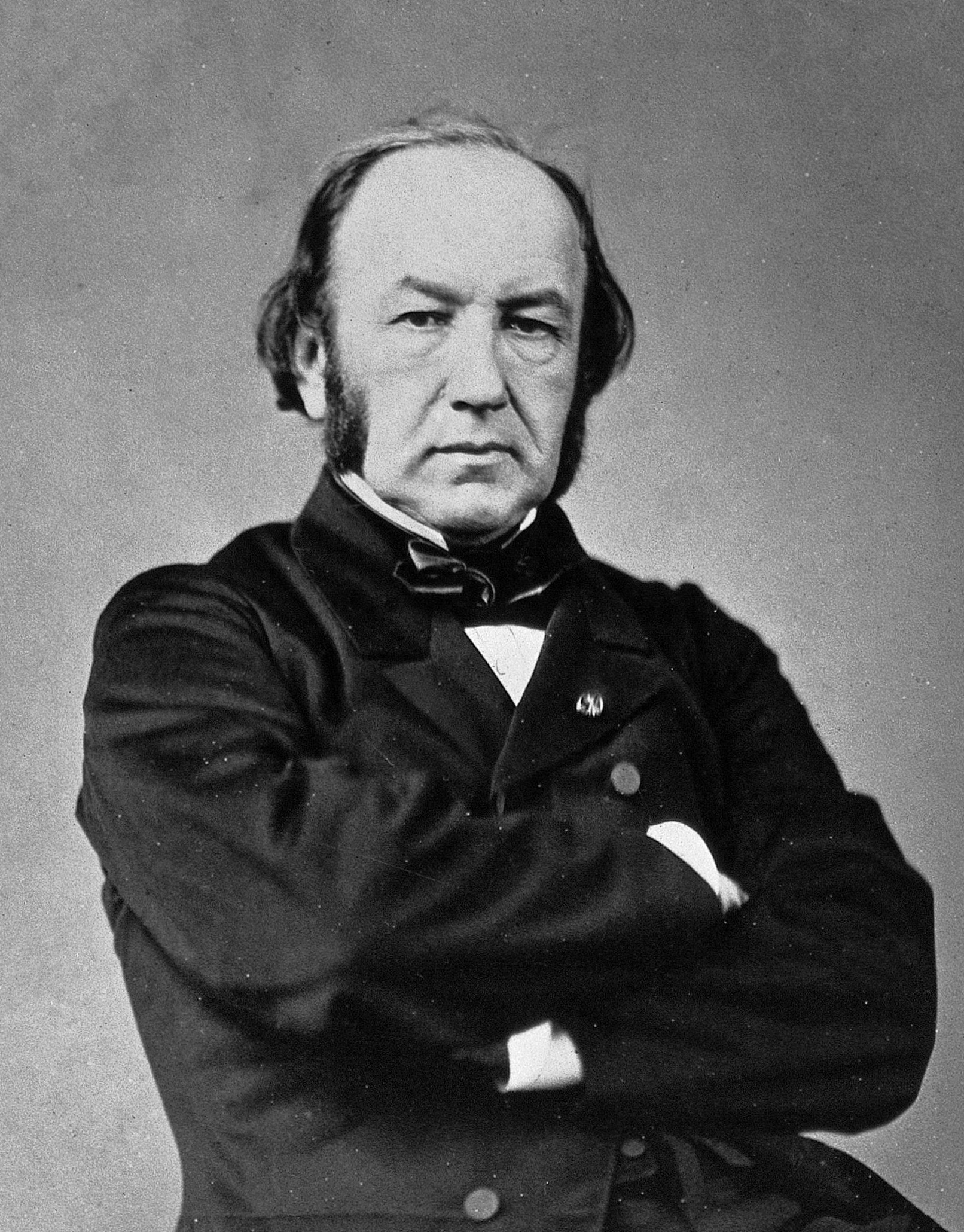
Copley Medal (1876) Claude Bernard (; 12 July 1813 – 10 February 1878) was a French physiologist. I. Bernard Cohen of Harvard University called Bernard "one of the greatest of all men of science". He originated the term milieu intérieur and the associated concept of homeostasis (the latter term being coined by Walter Cannon).
Life
Bernard was born in 12 July 1813 in the village of Saint-Julien, near Villefranche-sur-Saône. He received his early education in the Jesuit school of that town, then attended college at Lyon, which he soon left to become assistant in a druggist's shop. and even humorously referred to by his colleagues as a "great priest of atheism". Despite this, after his death Cardinal Ferdinand Donnet claimed Bernard was a fervent Catholic, with a biographical entry in the Catholic Encyclopedia. His leisure hours were devoted to the composition of a vaudeville comedy, and the success it achieved moved him to attempt a prose drama in five acts, Arthur de Bretagne. was published only after his death. A second edition appeared in 1943.
In 1834, at the age of twenty-one, he went to Paris to present this play to critic Saint-Marc Girardin, but was dissuaded from adopting literature as a profession. Girardin urged him to take up the study of medicine instead. Bernard followed his advice, later becoming an interne at the Hôtel-Dieu de Paris. There, he met physiologist François Magendie, who served as physician at the hospital. Bernard became preparateur (lab assistant) at the Collège de France in 1841.
In 1845, he married Marie Françoise "Fanny" Martin for convenience; the marriage was arranged by a colleague and her dowry helped finance his experiments. In 1847 he was appointed Magendie's deputy-professor at the college, and in 1855 he succeeded him as full professor. In 1860, Bernard was elected an international member of the American Philosophical Society. His field of research was considered inferior at the time, and the laboratory assigned to him was a "regular cellar."
Bernard was chosen around this time to be the inaugural Chair of physiology at the Sorbonne, but no laboratory was provided for his use. After speaking with Bernard in 1864, Louis Napoleon built a laboratory at the Muséum national d'Histoire naturelle in the Jardin des Plantes for him. At the same time, Napoleon III established a professorship which Bernard accepted, leaving the Sorbonne in 1868. In the same year, he was also admitted a member of the Académie française and elected a foreign member of the Royal Swedish Academy of Sciences.
When he died on 10 February 1878, he was given a public funeral, which France had never allowed for a man of science. He was interred in Père Lachaise Cemetery in Paris.
Career


Bernard's first major work was on the functions of the pancreas. His discovery that the juices of the pancreas play a significant role in the digestive process won him the prize for experimental physiology from the French Academy of Sciences. Bernard also discovered that introducing ether into the stomach or duodenum induced pancreatic secretions. The physiologist William Bayliss credited Bernard's work as influential in the latter's discovery of secretin, the first hormone to be isolated.
In perhaps his most famous experiment, Bernard discovered the glycogenic function of the liver. The liver, in addition to secreting bile, also produces the sugars that can cause hyperglycemia, which helped advance study of diabetes mellitus and its causes. In 1851, while examining the effects produced in the temperature of various parts of the body by each section of the nerve or nerves belonging to them, Bernard noticed that division of the cervical sympathetic nerve resulted in more active circulation and more forcible pulsation of the arteries in certain parts of the head. A few months later, he observed that electrical excitation of the upper portion of the divided nerve had the contrary effect. This discovery of the vasomotor system also established the existence of both vasodilator and vasoconstrictor nerves.
Bernard's scientific discoveries were made through vivisection, of which he was the primary proponent in Europe at the time. In his description of the single-mindedness of scientists trying to prove their theories, he wrote: "[h]e does not hear the animals' cries of pain. He is blind to the blood that flows." His use of vivisection disgusted his wife and daughters, who returned at home once to discover that he had vivisected the family dog. The couple was officially separated in 1869 and his wife went on to actively campaign against the practice of vivisection. Some in the scientific community were also uncomfortable with the practice. The physician-scientist George Hoggan spent four months observing and working in Bernard's laboratory, later writing that his experiences there had "prepared [him] to see not only science, but even mankind, perish rather than have recourse to such means of saving it." Hoggan was a founding member of the National Anti-Vivisection Society in the mid-1870s.
Milieu intérieur, the "internal environment", is the key concept with which Bernard is associated. He explained that the body is "relatively independent" of the outside world, and that a healthy "internal environment" adapts to deficiencies in the surrounding environment, thus keeping the physiology balanced. This is the underlying principle of what would later be called homeostasis, a term coined by Walter Cannon.
Bernard was also interested in the physiological action of poisons, particularly curare and carbon monoxide gas. He is credited with first describing carbon monoxide's affinity for hemoglobin in 1857, although James Watt had drawn similar conclusions about hydrocarbonate's affinity for blood acting as "an antidote to the oxygen" in 1794 prior to the discoveries of carbon monoxide and hemoglobin.
Throughout his career, Bernard sought to establish the use in medicine of what would later become the scientific method. In An Introduction to the Study of Experimental Medicine (1865), he emphasized the importance of trusting evidence over clout, even if it "contradicts a prevailing theory," as "[t]heories are only hypotheses" proven or disproven by facts. He criticized scientists who cherry-picked their data only to prove their own hypotheses. Unlike many scientific writers of his time, Bernard wrote using the first person when discussing his own experiments and thoughts.
References
References
- Bernard, Claude. (1957). "An Introduction to the Study of Experimental Medicine". [[Dover Publications]].
- (1 September 1998). "Claude Bernard and the constancy of the internal environment". [[The Neuroscientist]].
- Billman, George E.. (2020). "Homeostasis: The Underappreciated and Far Too Often Ignored Central Organizing Principle of Physiology". [[Frontiers in Physiology]].
- (June 1914). "Claude Bernard". Bonnier Corporation.
- Simmons, John G.. (2002). "Doctors and Discoveries: Lives That Created Today's Medicine". Houghton Mifflin Harcourt.
- Donnet, Vincent. (1998). "Claude Bernard était-il athée?". [[Histoire des Sciences Médicales]].
- "Claude Bernard". Catholic Encyclopedia.
- Marduel, Marie-Aymée. (2006). "Claude Bernard, un physiologiste natif du Beaujolais: Sa famille, sa vie, son oeuvre". Marie-Aymée Marduel.
- Bernard, Claude. "Arthur de Bretagne". E. Dentu.
- Bernard, Claude. "Arthur de Bretagne". J.-M. Le Goff.
- "Member History". [[American Philosophical Society]].
- (2003-03-01). "Life of Pasteur 1928". Kessinger.
- {{cite EB1911
- (1847). "Comptes rendus hebdomadaires des séances de l'Académie des sciences". Académie des sciences.
- [[W M Bayliss]], [[E H Starling]] [https://pmc.ncbi.nlm.nih.gov/articles/PMC1540572/ The mechanism of pancreatic secretion] [[J Physiol]]. 1902 Sep 12;28(5):325–353
- Young, F. G.. (22 June 1957). "Claude Bernard and the Discovery of Glycogen". [[British Medical Journal]].
- (November 1985). "Hyperglycaemia: Imitating Claude Bernard's Piqûre with drugs". Journal of the Autonomic Nervous System.
- (2002). "Awe for the Tiger, Love for the Lamb: A Chronicle of Sensibility to Animals". UBC Press.
- Midgley, Mary. (1998). "Animals and Why They Matter". University of Georgia Press.
- Miller, Richard. (24 March 2024). "The Role of Women in the History of the Animal Rights Movement". Chicago Center of Musculoskeletal Pain.
- Hoggan, George. (2 February 1875). "Letter". Morning Post.
- Preece, Rod. (2011). "Animal Sensibility and Inclusive Justice in the Age of Bernard Shaw". UBC Press.
- (2013). "Encyclopedia of Animal Rights and Animal Welfare". Routledge.
- Bernard, Claude. (1974). "Lectures on the Phenomena of Life Common to Animals and Plants". Charles C Thomas.
- (2013). "Heart Rate Variability". Springer Science & Business Media.
- Otterbein, Leo E.. (April 2002). "Carbon Monoxide: Innovative Anti-inflammatory Properties of an Age-Old Gas Molecule". Antioxidants & Redox Signaling.
- (1794). "Considerations on the Medicinal Use of Factitious Airs: And on the Manner of Obtaining Them in Large Quantities". Bulgin and Rosser.
- Pearce, J. M. S.. (8 December 2017). "History of Neurology: Claude Bernard". Advances in Clinical Neuroscience and Rehabilitation.
- Bernard, Claude. (1865). "Introduction à l'étude de la médecine expérimentale". J.-B. Baillière.
- Bernard (1957), p. 164.
- Bernard (1957), pp. 56, 165.
- Bernard (1957), p. 38.
- Bernard (1957)
This article was imported from Wikipedia and is available under the Creative Commons Attribution-ShareAlike 4.0 License. Content has been adapted to SurfDoc format. Original contributors can be found on the article history page.
Ask Mako anything about Claude Bernard — get instant answers, deeper analysis, and related topics.
Research with MakoFree with your Surf account
Create a free account to save articles, ask Mako questions, and organize your research.
Sign up freeThis content may have been generated or modified by AI. CloudSurf Software LLC is not responsible for the accuracy, completeness, or reliability of AI-generated content. Always verify important information from primary sources.
Report