From Surf Wiki (app.surf) — the open knowledge base
Classical planet
Planets visible to the naked eye
Planets visible to the naked eye
A classical planet is an astronomical object that is visible to the naked eye and moves across the sky and its backdrop of fixed stars (the common stars which seem still in contrast to the planets), appearing as wandering stars. Visible to humans on Earth there are seven classical planets (the seven luminaries). They are from brightest to dimmest: the Sun, the Moon, Venus, Jupiter, Mercury, Mars and Saturn.
Greek astronomers such as Geminus and Ptolemy recorded these classical planets during classical antiquity, introducing the term planet, which means 'wanderer' in Greek (πλάνης grc and πλανήτης grc), expressing the fact that these objects move across the celestial sphere relative to the fixed stars. Therefore, the Greeks were the first to document the astrological connections to the planets' visual detail.
Through the use of telescopes other celestial objects like the classical planets were found, starting with the Galilean moons in 1610. Today the term planet is used considerably differently, with a planet being defined as a natural satellite directly orbiting the Sun (or other stars) and having cleared its own orbit. Therefore, only five of the seven classical planets remain recognized as planets, alongside Earth, Uranus, and Neptune.
History
Babylonian
Main article: Babylonian astronomy
The Babylonians recognized seven planets. A bilingual list in the British Museum records the seven Babylonian planets in the following order:
- The Moon, Sin.
- The Sun, Shamash.
- Jupiter, Merodach.
- Venus, Ishtar.
- Saturn, Ninip.
- Mercury, Nebo.
- Mars, Nergal.
Mandaean
Main article: Mandaean cosmology
In Mandaeism, the names of the seven planets are derived from the seven Babylonian planets. Overall, the seven classical planets (; ࡔࡉࡁࡉࡀࡄࡉࡀ myz, "planets"; or, combined, myz "Seven Planets") are generally not viewed favorably in Mandaeism, since they constitute part of the entourage of Ruha, the Queen of the World of Darkness who is also their mother. However, individually, some of the planets can be associated with positive qualities. The names of the seven planets in Mandaic are borrowed from Akkadian. Some of the names are ultimately derived from Sumerian, since Akkadian had borrowed many deity names from Sumerian.
Each planet is said to be carried in a ship. Drawings of these ships are found in various Mandaean scriptures, such as the Scroll of Abatur. The planets are listed according to the traditional Mandaean order of the planets as mentioned in Masco (2012).
| Planet | Mandaic | Mandaic script | Akkadian | Other names | Associations | ||||||||||
|---|---|---|---|---|---|---|---|---|---|---|---|---|---|---|---|
| Sun | Šamiš | Šamaš | Adunai ← Hebrew Adonai | title=Manichaeans (Marmanaiia), Zoroastrians (Iazuqaiia), Jews, Christians and Other Heretics: A Study in the Redaction of Mandaic Texts | last=Shapira | first=Dan D.Y. | journal=Le Muséon | volume=117 | issue=3–4 | date=2004 | pages=243–280 | doi=10.2143/MUS.117.3.516929 | url=https://poj.peeters-leuven.be/secure/POJ/downloadpdf.php?ticket_id=60d8fdd28336c | url-access=subscription}} | |
| Venus | Libat | Delebat | Amamit (the underworld goddess), Argiuat, Daitia, Kukbat (the diminutive of 'star'), Spindar, ʿstira (i.e., Ishtar or Astarte), and Ruha or Ruha ḏ-qudša (Holy Spirit) | success in love and reproduction | |||||||||||
| Mercury | Nbu (ʿNbu) | ||||||||||||||
| Nabû | Maqurpiil, Mšiha ← Messiah; ʿaṭarid ← Arabic | learning, scribes; Christ and Christianity | |||||||||||||
| Moon | Sin | Sīnu | Agzʿil, Ṭaṭmʿil, Ṣaurʿil, and Sira | miscarriages and abnormal births | |||||||||||
| Saturn | Kiwan | Kayyamānu | Br Šamiš (The Son of the Sun) | Jews; Saturday | |||||||||||
| Jupiter | Bil | Bēlu | Angʿil | male; "hot and moist" | |||||||||||
| Mars | Nirig | Nergallu | Marik | violence; Islam |
Symbols
Main article: Astrological symbols, Planet symbols
The astrological symbols for the classical planets appear in the medieval Byzantine codices in which many ancient horoscopes were preserved.{{cite book The written symbols for Mercury, Venus, Jupiter, and Saturn have been traced to forms found in late Greek papyri.{{cite book
A. S. D. Maunder finds antecedents of the planetary symbols in earlier sources, used to represent the gods associated with the classical planets. Bianchini's planisphere, produced in the 2nd century,{{cite web | access-date = 2010-03-17 A diagram in Johannes Kamateros' 12th century Compendium of Astrology shows the Sun represented by the circle with a ray, Jupiter by the letter zeta (the initial of Zeus, Jupiter's counterpart in Greek mythology), Mars by a shield crossed by a spear, and the remaining classical planets by symbols resembling the modern ones, without the cross-mark seen in modern versions of the symbols. The modern Sun symbol, pictured as a circle with a dot (☉), first appeared in the Renaissance.
Planetary hours
Main article: Planetary hours, Names of the days of the week
The Ptolemaic system used in ancient Greek astronomy placed the planets by order of proximity to Earth in the then-current geocentric model, closest to furthest, as the Moon, Mercury, Venus, Sun, Mars, Jupiter, and Saturn. In addition the day was divided into seven-hour intervals, each ruled by one of the planets, although the order was staggered (see below).
The first hour of each day was named after the ruling planet, giving rise to the names and order of the Roman seven-day week. Modern Latin-based cultures, in general, directly inherited the days of the week from the Romans and they were named after the classical planets; for example, in Spanish Miércoles is Mercury, and in French mardi is Mars-day.
The modern English days of the week were mostly inherited from gods of the old Germanic Norse culture – Wednesday is Wōden’s-day (Wōden or Wettin eqv. Mercury), Thursday is Thor’s-day (Thor eqv. Jupiter), Friday is Frige-day (Frige eqv. Venus). Equivalence here is by the gods' roles; for instance, Venus and Frige were both goddesses of love. It can be correlated that the Norse gods were attributed to each Roman planet and its god, probably due to Roman influence rather than coincidentally by the naming of the planets. A vestige of the Roman convention remains in the English name Saturday.
| Weekday | Planet | Greek god | colspan="2" | Germanic god | Weekday | French name | Roman god | Greek name | Norse name | Saxon name | English name | |||||||
|---|---|---|---|---|---|---|---|---|---|---|---|---|---|---|---|---|---|---|
| dimanche | Sol | Helios | Sól | |||||||||||||||
| lundi | Luna | Selene | Máni | |||||||||||||||
| mardi | Mars | Ares | Týr | |||||||||||||||
| mercredi | Mercury | Hermes | Óðinn | |||||||||||||||
| jeudi | Jupiter | Zeus | Þórr | |||||||||||||||
| vendredi | Venus | Aphrodite | Frigg | |||||||||||||||
| samedi | Saturn | Cronus | Njörðr |
Alchemy
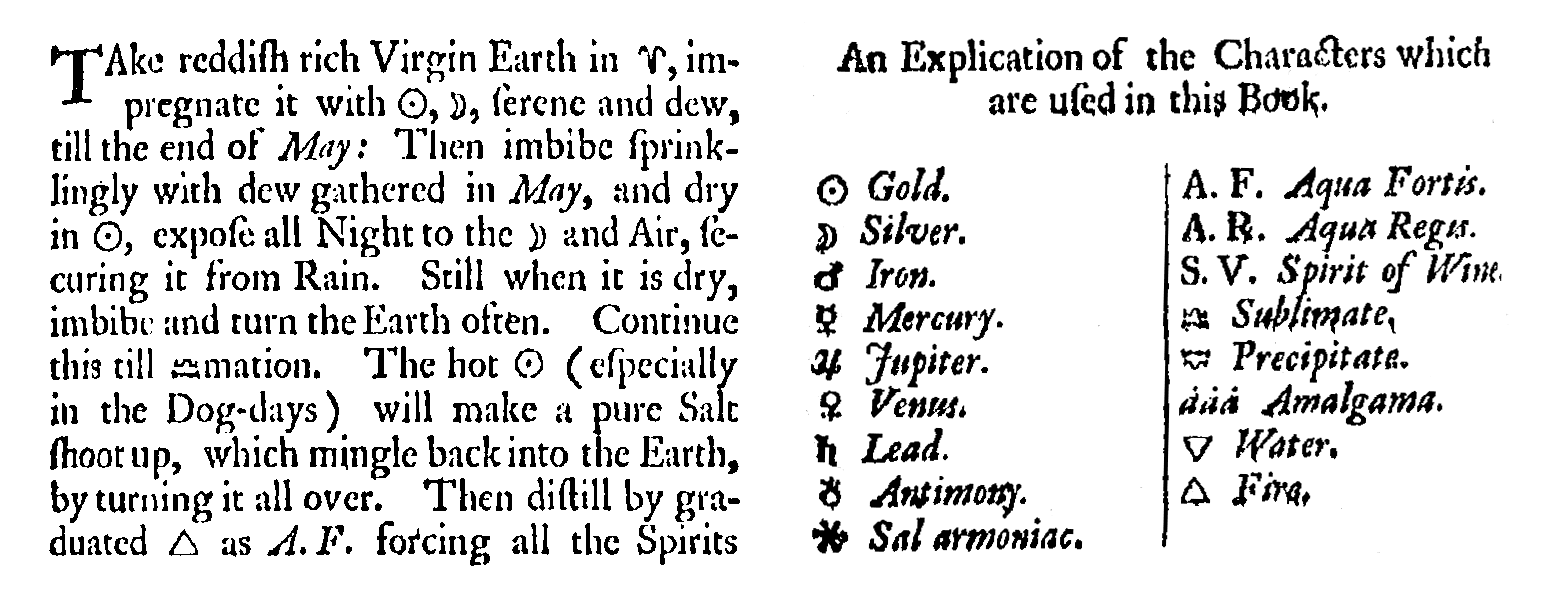
In alchemy, each classical planet (Moon, Mercury, Venus, Sun, Mars, Jupiter, and Saturn) was associated with one of the seven metals known to the classical world. As a result, the alchemical glyphs for the metal and associated planet coincide. Alchemists believed the other elemental metals were variants of these seven (e.g. zinc was known as "Indian tin" or "mock silver").
Alchemy in the Western World and other locations where it was widely practiced was (and in many cases still is) allied and intertwined with traditional Babylonian-Greek style astrology; in numerous ways they were built to complement each other in the search for hidden knowledge (knowledge that is not common i.e. the occult). Astrology has used the concept of classical elements from antiquity up until the present day today. Most modern astrologers use the four classical elements extensively, and indeed they are still viewed as a critical part of interpreting the astrological chart.
.jpg)
Traditionally, each of the seven planets in the Solar System as known to the ancients was associated with, held dominion over, and "ruled" a certain metal.
The list of rulership is as follows:
- The Sun rules Gold ([[Image:Sun symbol (fixed width).svg|20px]])
- The Moon, Silver ([[Image:Moon crescent symbol (fixed width).svg|14px]])
- Mercury, Quicksilver/Mercury ([[Image:Mercury symbol (fixed width).svg|20px]])
- Venus, Copper ([[Image:Venus symbol (fixed width).svg|20px]])
- Mars, Iron ([[Image:Mars symbol (fixed width).svg|16px]])
- Jupiter, Tin ([[Image:Jupiter symbol (fixed width).svg|20px]])
- Saturn, Lead ([[Image:Saturn symbol (fixed width).svg|20px]])
Some alchemists (e.g. Paracelsus) adopted the Hermetic Qabalah assignment between the vital organs and the planets as follows:
| Saturn | Spleen |
|---|
Contemporary astrology
Western astrology
Main article: Planets in astrology
| Planet | last1=Hand | first1=Robert | title=Astrology by Hand | url=https://www.astro.com/astrology/in_astrobyhand35_e.htm | access-date=3 October 2021 | website=Astro.com}} | Detriment sign(s) | last=Burk | first=Kevin | title=Astrology: Understanding the Birth Chart: A Comprehensive Guide to Classical Interpretation | date=2001 | publisher=Llewellyn Worldwide | isbn=978-1-56718-088-6 | pages=81}} | Fall sign |
|---|---|---|---|---|---|---|---|---|---|---|---|---|---|---|---|
| Sun | Leo | Aquarius | Aries | Libra | |||||||||||
| Moon | Cancer | Capricorn | Taurus | Scorpio | |||||||||||
| Mercury | Gemini (diurnal) and Virgo (nocturnal) | Sagittarius (diurnal) and Pisces (nocturnal) | Virgo | Pisces | |||||||||||
| Venus | Libra (diurnal) and Taurus (nocturnal) | Aries (diurnal) and Scorpio (nocturnal) | Pisces | Virgo | |||||||||||
| Mars | Aries (diurnal) and Scorpio (nocturnal) | Libra (diurnal) and Taurus (nocturnal) | Capricorn | Cancer | |||||||||||
| Jupiter | Sagittarius (diurnal) and Pisces (nocturnal) | Gemini (diurnal) and Virgo (nocturnal) | Cancer | Capricorn | |||||||||||
| Saturn | Aquarius (diurnal) and Capricorn (nocturnal) | Leo (diurnal) and Cancer (nocturnal) | Libra | Aries |
Indian astrology
Main article: Navagraha
Indian astronomy and astrology (jyotiṣa) recognise seven visible planets (including the Sun and Moon) and two additional invisible planets (tamo'graha); rahu and ketu.
| Sanskrit Name | English name | Nakshatras | Guna | Represents | Day |
|---|---|---|---|---|---|
| Surya () | Sun | Krittika, Uttara Phalguni and Uttara Ashadha | Sattva | Soul, king, highly placed persons, father, ego | Sunday |
| Chandra () | Moon | Rohini, Hasta and Shravana | Sattva | Emotional Mind, queen, mother. | Monday |
| Mangala () | Mars | Mrigashira, Chitra and Dhanishta | Tamas | energy, action, confidence | Tuesday |
| Budha () | Mercury | Ashlesha, Jyeshta and Revati | Rajas | Communication and analysis, mind | Wednesday |
| Brihaspati () | Jupiter | Punarvasu, Vishakha and Purva Bhadrapada | Sattva | the great teacher, wealth, Expansion, progeny | Thursday |
| Shukra () | Venus | Bharani, Purva Phalguni and Purva Ashadha | Rajas | Feminine, pleasure and reproduction, Luxury, Love, Spouse | Friday |
| Shani () | Saturn | Pushya, Anuradha and Uttara Bhadrapada | Tamas | learning the hard way. Career and Longevity, Contraction | Saturday |
| Rahu () | Ascending/North Lunar Node | Ardra, Swati and Shatabhisha | Tamas | an Asura who does his best to plunge any area of one's life he controls into chaos, works on the subconscious level | none |
| Ketu () | Descending/South Lunar Node | Ashwini, Magha and Mula | Tamas | supernatural influences, works on the subconscious level | none |
Chinese astrology
Main article: Wufang Shangdi
Chinese astronomy and astrology recognise seven visible planets (including the Sun and Moon). Chinese astrology flourished during the Han dynasty (2nd century BC to 2nd century AD).
| English name | Associated element | Chinese Characters | Chinese pinyin | Old astronomical names |
|---|---|---|---|---|
| Mars | Fire | 火星 | Huǒxīng | Yínghuò (熒惑) |
| Mercury | Water | 水星 | Shuǐxīng | Chénxīng (辰星) |
| Jupiter | Wood | 木星 | Mùxīng | Suìxīng (歲星) |
| Venus | Metal or Gold | 金星 | Jīnxīng | Tàibái (太白) |
| Saturn | Earth or Soil | 土星 | Tǔxīng | Zhènxīng (鎮星) |
Naked-eye planets
Main article: Planetae
Mercury and Venus are visible only in twilight hours because their orbits are interior to that of Earth. Venus is the third-brightest object in the sky and the most prominent planet. Mercury is more difficult to see due to its proximity to the Sun. Lengthy twilight and an extremely low angle at maximum elongations make optical filters necessary to see Mercury from extreme polar locations. Mars is at its brightest when it is in opposition, which occurs approximately every twenty-five months. Jupiter and Saturn are the largest of the five planets, but they are farther from the Sun and, therefore, receive less sunlight. Nonetheless, Jupiter is often the next brightest object in the sky after Venus. Saturn's luminosity is often enhanced by its rings, which reflect light to varying degrees depending on their inclination to the ecliptic; however, the rings themselves are not visible to the naked eye from the Earth.
References
References
- Goldstein, Bernard R.. (2007). "What's New in Ptolemy's ''Almagest''". Nuncius.
- Pedersen, Olaf. (2011). "A Survey of the Almagest". Springer Science + Business Media.
- [http://csep10.phys.utk.edu/astr161/lect/classification/classification.html Classification of the Planets]
- {{LSJ. pla/nhs. πλάνης, {{LSJ. planh/ths. πλανήτης. ref.
- Campion, Nicholas. (2022-03-23). "The Planets in Alchemy and Astrology (Medieval and Renaissance)".
- Mackenzie. (1915). "Myths of Babylonia and Assyria".
- Bhayro, Siam. (2020-02-10). "Hellenistic Astronomy". Brill.
- Nasoraia, Brikha H.S.. (2021). "The Mandaean gnostic religion: worship practice and deep thought". Sterling.
- Masco, Maire. (2012). "The Mandaeans: Gnostic astrology as an artifact of cultural transmission". Fluke Press.
- Shapira, Dan D.Y.. (2004). "Manichaeans (''Marmanaiia''), Zoroastrians (''Iazuqaiia''), Jews, Christians and Other Heretics: A Study in the Redaction of Mandaic Texts". [[Le Muséon]].
- Goldstein, Bernard R.. (1967). "The Arabic version of Ptolemy's planetary hypothesis". Transactions of the American Philosophical Society.
- Vigfússon (1874:456).
- Philip Ball, ''The Devil's Doctor: Paracelsus and the World of Renaissance Magic and Science'', {{ISBN. 978-0-09-945787-9
- "Astrology by Hand".
- Burk, Kevin. (2001). "Astrology: Understanding the Birth Chart: A Comprehensive Guide to Classical Interpretation". Llewellyn Worldwide.
- Dalal, Roshen. (2010). "Hinduism: An Alphabetical Guide". Penguin Books.
- "Strengthening Planetary Forces".
- 何, 丙郁. (2003). "Chinese mathematical astrology : reaching out to the stars". Routledge.
- "五行與五星:古代中國眼中的行星".
- "Sky Publishing – Latitude Is Everything".
This article was imported from Wikipedia and is available under the Creative Commons Attribution-ShareAlike 4.0 License. Content has been adapted to SurfDoc format. Original contributors can be found on the article history page.
Ask Mako anything about Classical planet — get instant answers, deeper analysis, and related topics.
Research with MakoFree with your Surf account
Create a free account to save articles, ask Mako questions, and organize your research.
Sign up freeThis content may have been generated or modified by AI. CloudSurf Software LLC is not responsible for the accuracy, completeness, or reliability of AI-generated content. Always verify important information from primary sources.
Report