From Surf Wiki (app.surf) — the open knowledge base
Civitas Schinesghe
Country in central Europe (960–1025)
.jpg)
Country in central Europe (960–1025)
| Field | Value |
|---|---|
| native_name | pl |
| conventional_long_name | Civitas Schinesghe |
| p1 | Polans (western)Polans |
| p2 | LechitesLechitic tribes |
| s1 | Kingdom of Poland |
| year_start | 966 |
| event_start | Baptism of Poland |
| year_end | 1025 |
| event_end | Coronation of Bolesław I the Brave |
| flag_border | no |
| image_coat | Emblem of Civitas Schinesghe.svg |
| symbol_type | Coat of arms |
| () | |
| image_map | Civitas Schinesghe 1000.svg |
| image_map_caption | Duchy of Poland around the year AD 1000 |
| image_map2_caption | Poland in c. 960-996. |
| government_type | Monarchy |
| common_languages | Lechitic languages (including Old Polish) |
| religion | Roman Catholicism (institutional) |
| Slavic paganism | |
| capital | Gniezno |
| leader1 | Mieszko I |
| leader2 | Bolesław I the Brave |
| year_leader1 | c. 960–992 |
| year_leader2 | 992–1025 |
| title_leader | Monarch |
() Slavic paganism
Civitas Schinesghe (; ), commonly referred to in historiography as the Duchy of Poland or the Principality of Poland, was the early medieval polity centered around Gniezno and ruled by the Piast dynasty. It emerged in the 10th century and is considered the predecessor state of the Kingdom of Poland, which was formally established in 1025.
Etymology
Civitas Schinesghe, meaning "Gniezno State", is the earliest recorded name connected with Poland as a political entity. The term originates from around 991–992 and survives in a later papal regesta known as the Dagome iudex (compiled c.1080). In this document, Piast duke Mieszko I and his second wife, Oda of Haldensleben, placed unam civitatem in integro, que vocatur Schinesghe ("a whole state, which is called Schinesghe") under the protection of the Holy See.
Although the proper Latin name for Poland, Polonia, came into use somewhat later and does not appear in the document, the term Schinesghe is generally understood to refer to Gniezno, one of the principal gord strongholds of the West Slavic Polans. Philological analysis suggests that the spelling "Sc" may represent a scribal substitution for "K", which in turn was phonetically interchangeable with "G." On this basis, the original form might have been closer to "Khinesghe" or "Kninesne." Another interpretation views the name as an imperfect Latinization of the Slavic phrases hrady knezske or grody książęce, meaning "ducal gords" (fortified settlements of a duke).
History
In 966, Mieszko I, the ruler of the Polans, accepted Christianity through the auspices of the Roman Church in the Baptism of Poland. According to Gallus Anonymus, it was Mieszko's first wife, Dobrawa, the daughter of Boleslaus I, Duke of Bohemia, who convinced her husband to convert to Christianity. Also, the chronicler, Thietmar of Merseburg, attributed Mieszko's conversion to Dobrawa's influence. The Baptism also had political significance and was most likely intended to bring Mieszko's state closer to the Duchy of Bohemia and to prevent future attacks by the Holy Roman Empire in an attempt to Christianize Mieszko's lands by force. Subsequently, Mieszko's realm was recognised by the papacy and accepted as part of Christendom. In 968, a missionary bishopric was established in Poznań. The regesta titled Dagome iudex first defined Poland's geographical boundaries with its capital in Gniezno and affirmed that the state was under the protection of the Popes.
Following the death of Mieszko I, his eldest son, Bolesław I the Brave, became the next Duke of Poland in 992. Bolesław I quickly consolidated his rule, expelling his stepmother, Oda, and half-brothers from Poland. He also expanded the borders of the early Polish state by taking Lusatia, Moravia, Upper Hungary, and Red Ruthenia. In 1000, he organized the Congress of Gniezno and obtained the right of investiture from Otto III, the Holy Roman Emperor, who assented to the creation of three additional bishoprics in Kraków, Kołobrzeg, and Wrocław and an archdiocese in Gniezno. During the meeting of the two rulers, Otto also bestowed upon Bolesław I royal regalia and a replica of the Holy Lance, which were later used at his coronation as the first King of Poland in 1025, when Bolesław I received permission for his coronation from Pope John XIX, an event that elevated Poland from a duchy to a kingdom.
Territory
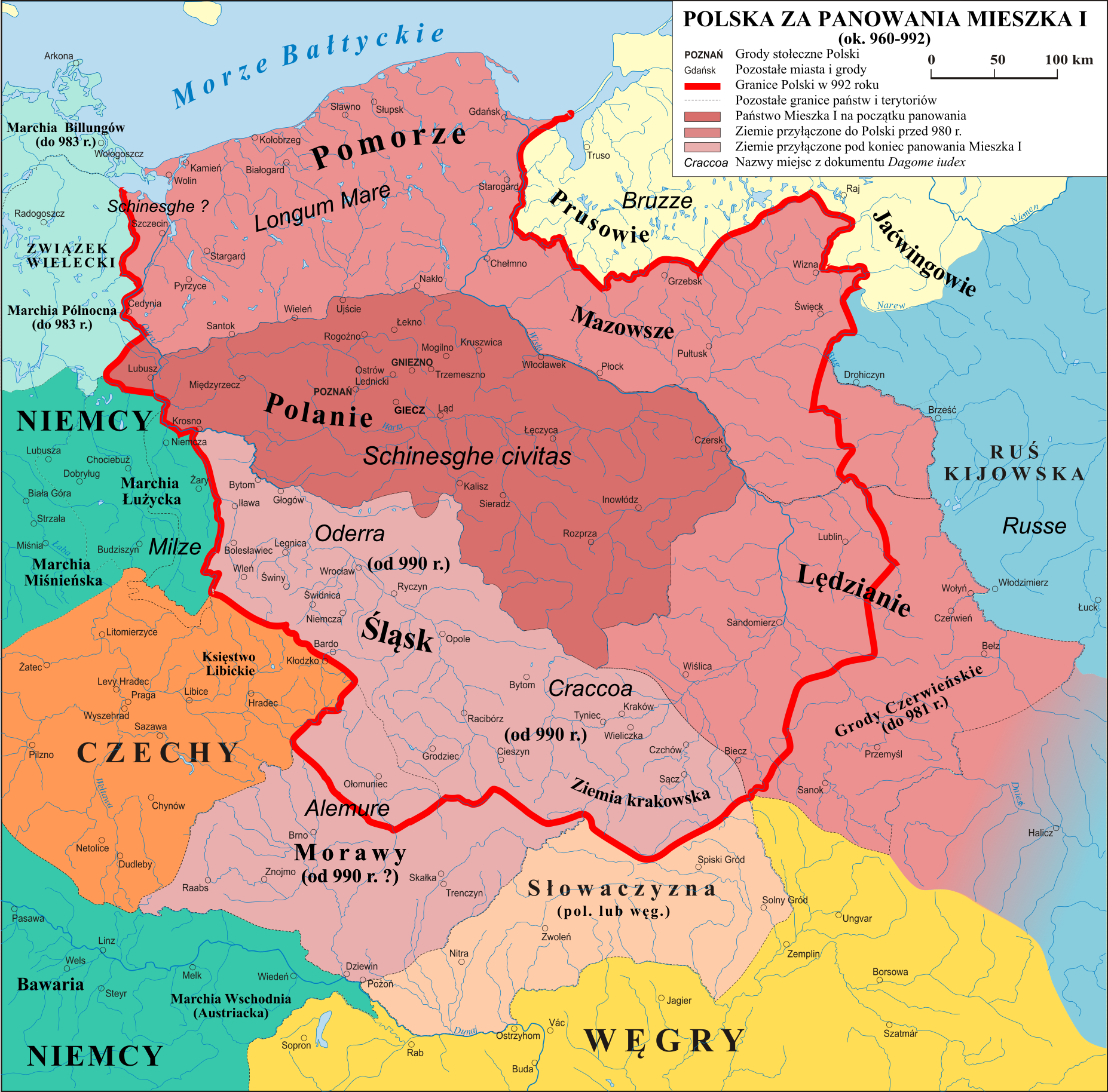
The Dagome iudex outlines the borders of the Polish realm:
- sicuti incipit a primo latere longum mare, "as it starts from the first side of a long sea" (presumably the Pomeranian coast – on the Baltic Sea)
- ''fine '''Bruzze''''' 'end Bruzze' – "along the Prussian borders" (settlement area of the Old Prussians)
- ''usque in locum, qui dicitur '''Russe''''' – "up to a place called Rus' (east of Masovia)
- ''et fines Russe extendente usque in '''Craccoa''''' – " Rus' ends and extending into Kraków"
- et ab ipsa Craccoa usque ad flumen Odde recte – "and from there right along the Oder river"
- in locum, qui dicitur Alemure, "in a place called The Alemure" (sometimes identified as Olomouc in Moravia or possibly Oława in Silesia)
- et ab ipsa Alemura usque in terram Milze recte intra Oddere – "to the Milceni lands" (part of the Imperial Margraviate of Meissen)
- et exinde ducente iuxta flumen Oddera usque in predictam civitate Schinesghe. – "and from its borders along the Oder to aforementioned Schinesghe."
Notes
References
References
- George J. Lerski. (1996). "Historical Dictionary of Poland, 966-1945". Greenwood Press.
- Przemyslaw Wiszewski. (2010). "Domus Bolezlai: Values and social identity in dynastic traditions of medieval Poland (c.966-1138)". BRILL.
- Dowiat, Jerzy. (1961). "Metryka chrztu Mieszka I i jej geneza".
- Ramet, Sabrina. (2017). "The Catholic Church in Polish History. From 966 to the Present". Palgrave Macmillan US.
- (2016). "Great Events in Religion". ABC-CLIO.
- (1974). "Historia Kościoła w Polsce". Pallottinum.
- Davies, Norman. (2005a). "God's Playground: A History of Poland". [[Oxford University Press]].
- Kürbis, B.. "Dagome iudex. Studium krytyczne".
This article was imported from Wikipedia and is available under the Creative Commons Attribution-ShareAlike 4.0 License. Content has been adapted to SurfDoc format. Original contributors can be found on the article history page.
Ask Mako anything about Civitas Schinesghe — get instant answers, deeper analysis, and related topics.
Research with MakoFree with your Surf account
Create a free account to save articles, ask Mako questions, and organize your research.
Sign up freeThis content may have been generated or modified by AI. CloudSurf Software LLC is not responsible for the accuracy, completeness, or reliability of AI-generated content. Always verify important information from primary sources.
Report