From Surf Wiki (app.surf) — the open knowledge base
City of Melbourne
Local government area in Victoria, Australia

Local government area in Victoria, Australia
| Field | Value | ||
|---|---|---|---|
| type | lga | ||
| name | City of Melbourne | ||
| city | Melbourne | state = vic | |
| image | {{multiple image | ||
| border | infobox | ||
| total_width | 280 | ||
| perrow | 1/1 | ||
| caption_align | center | ||
| image1 | Melbourne skyline sor.jpg | ||
| caption1 | Aerial view of the Melbourne skyline from | ||
| Kings Domain, May 2020 | |||
| image2 | MelbLGA-Melbourne.gif | ||
| caption2 | Location in Greater Melbourne | ||
| local_map | yes | ||
| zoom | 11 | ||
| coordinates | pop = 149,615 | ||
| pop_year | pop_footnotes= | area = 37.7 | |
| area_footnotes | |||
| timezone | AEST | utc=+10 | est = 12 August 1842 |
| seat | Melbourne CBD (Town Hall) | ||
| timezone-dst | AEDT | utc-dst=+11 | mayor = Nicholas Reece |
| mayortitle | Lord Mayor | ||
| region | Greater Melbourne | ||
| logo | City of Melbourne Logo.svg | ||
| url | http://www.melbourne.vic.gov.au | ||
| county | Bourke | ||
| stategov | Albert Park | ||
| stategov2 | Brunswick | ||
| stategov3 | Essendon | ||
| stategov4 | Melbourne | ||
| stategov5 | Prahran | ||
| fedgov | Macnamara | ||
| fedgov2 | Maribyrnong | ||
| fedgov3 | Melbourne | ||
| fedgov4 | Wills | ||
| near-nw | Moonee Valley | ||
| near-n | Merri-bek | ||
| near-ne | Darebin | ||
| near-w | Maribyrnong | ||
| near-e | Yarra | ||
| near-sw | Hobsons Bay | ||
| near-s | Port Phillip | ||
| near-se | Stonnington |
the local government area
Kings Domain, May 2020 |timezone-dst=AEDT|utc-dst=+11| mayor = Nicholas Reece | near-nw = Moonee Valley | near-n = Merri-bek | near-ne = Darebin | near-w = Maribyrnong | near-e = Yarra | near-sw = Hobsons Bay | near-s = Port Phillip | near-se = Stonnington


The City of Melbourne is a local government area in Victoria, Australia, located in the central city area of Melbourne. In 2021, the city has an area of 37.7 km2 and had a population of 149,615. The city's motto is "vires acquirit eundo" which means "we gather strength as we go".
The current Lord Mayor is Nicholas Reece, who replaced Sally Capp on 2 July 2024. The Melbourne City Council (MCC) holds office in Melbourne Town Hall.
History
19th century
Melbourne was founded in 1835, during the reign of King William IV, following the arrival of the schooner Enterprize near the present site of the Queen's Wharf. Unlike other Australian capital cities, Melbourne did not originate under official auspices, instead owing its origins to non-indigenous settlers from Tasmania.
Having been a province of New South Wales from its establishment in 1835, affairs of the settlement had been administered by the Parliament of New South Wales. With the growth of the settlement there had been an increasing demand by the inhabitants for greater autonomy over their own affairs. On 12 August 1842, Melbourne was incorporated as a town by Act 6 Victoria No. 7 of the Governor and Legislative Council of New South Wales.
The town of Melbourne was raised to the status of a city by Letters Patent of Queen Victoria dated 25 June 1847, five years after its incorporation as a town. The Letters Patent also constituted the Anglican Diocese of Melbourne and declared Melbourne a cathedral city. A motion was tabled at a meeting of the Town Council to alter the style and title of Melbourne from a town to a city, a draft Bill was approved and transmitted to the Government for introduction to the Legislature. On 3 August 1849, Act 13 Victoria No. 14 was finally assented to as "An Act to effect a change in the Style and Title of the Corporation of Melbourne rendered necessary by the erection of the Town of Melbourne to a City".
The city's initial boundaries, as set down in Act 8 Victoria No. 12 (19 December 1844) extended from Point Ormond in Elwood up Barkly Street and Punt Road to the Yarra River, along the river to Merri Creek at Abbotsford, then west along Brunswick Road to Moonee Ponds Creek, then south past Flemington Bridge to Princes Pier in Port Melbourne. The Act imposed on the Mayor a duty to set up "permanent and conspicuous boundary marks of iron, wood, stone or other durable material" along or near the line of the Town's boundaries—this was undertaken by Mayor James Frederick Palmer and Town Clerk John Charles King on 4 February 1846.
During the 1850s, Collingwood, Fitzroy and Richmond seceded from Melbourne (all are, since 1994, part of the City of Yarra), as did South Melbourne, whilst other parts became parts of the neighbouring districts of St Kilda and Port Melbourne, and the border between Brunswick and Melbourne moved south one block to Park Street.
20th century
On 18 December 1902, King Edward VII conferred the title "Lord Mayor" on the mayor of the City of Melbourne.
On 30 October 1905, Melbourne absorbed two neighbouring council areas. Now included in the City was the Borough of Flemington and Kensington, which had been formed in 1882 when it broke away from the City of Essendon. The second, the Town of North Melbourne, formerly known as Hotham, had been established on 30 September 1859 and been granted town status on 18 December 1874. Both town halls are still in use today as public buildings—the former in Kensington near the present-day Newmarket railway station; the latter in Errol Street, North Melbourne.
The Melbourne and Geelong Corporations Act 1938 allowed for three councillors for each of the eleven wards, with a general election held on 24 August 1939.
The first woman in 125 years to be elected to the council was local businessperson Clare J. Cascarret in 1967. The election was said to have cost her over half a million pounds.

Following a recommendation by the Local Government Advisory Board in 1978, an Order in Council (27 February 1979, effective from 19 May 1979) reduced the wards from eleven to eight. In December 1980, the Hamer Government dismissed the council, and appointed three Commissioners to determine how the boundaries could best be altered to produce more effective local government, with special regard to Melbourne's central business district and its importance to the state, as well as to advise changes needed to the constitution, structure, functions and administration. However, in 1982, with the election of a new Labor government under John Cain, the Act establishing the commission was repealed, and the Melbourne Corporation (Election of Council) Act 1982 established six wards, for which an election was held on 4 December 1982. Three years later, an additional ward was added.
In 1993, the City of Melbourne Act specified new boundaries which saw Melbourne gain Southbank and the Port of Melbourne and lose Carlton North, Flemington and other residential areas; these changes took effect on 18 November 1993. At this time, the city was resubdivided into four wards (Flagstaff, University, Hoddle and Domain), but the ward system was abolished in 2001, with the council having a directly elected Lord Mayor and Deputy Lord Mayor, and seven other councillors. In 2012, the number of Councillors was increased to nine, in addition to the Lord Mayor and Deputy Lord Mayor.
In 1999, local government control of the docks area on the west side of the city was given to the Victorian Government's Docklands Authority.
21st century
In 2005, the council announced the construction of a new 6-star environmental office building, Council House 2, in Little Collins Street.
On 2 July 2007, the suburb of Docklands was re-added to the City's jurisdiction.
On 1 July 2008, a section of Kensington and North Melbourne was transferred to the City of Melbourne from the City of Moonee Valley.
In July 2009, Lord Mayor Robert Doyle unveiled a new corporate identity for the City of Melbourne, costing $239,558.
Building on the council's longstanding interest in environmental issues, on 16 July 2019, the council voted to declare a climate and biodiversity emergency in line with similar declarations made elsewhere.
Following the death of Her Majesty Queen Elizabeth II, the City of Melbourne caused controversy and breached protocol, by failing to lower the Aboriginal and Torres Strait Islander flags to half mast, whilst the Australian flag was lowered in mourning.
Council
Main article: 2024 Melbourne City Council election
The City of Melbourne is an unsubdivided municipality, consisting of a directly elected Lord Mayor and Deputy Lord Mayor, and nine Councillors. Since 2008, all Victorian councillors serve a four-year term. The most recent general election was held on Saturday 26th October 2024, the next election will take place in October 2028.
During a general election, the City of Melbourne holds two simultaneous elections – one to elect the Lord Mayor and Deputy Lord Mayor (leadership team) and the other to elect the nine councillors. All residents are entitled to vote in the election, as well as up to two of each of the following: non-residential owners and occupiers of rateable property. If a corporation solely owns or occupies rateable property in the municipality, then the corporation must appoint two company officers (director and/or company secretary, or equivalent) to represent it and vote on its behalf.
Current composition
The current makeup of the Council is:
| Party | Councillors | |
|---|---|---|
| Team Nick Reece | ||
| Greens | ||
| Innovate Melbourne | ||
| Labor | ||
| Liberal | ||
| Team Kouta | ||
| Team Morgan | ||
| Team Wood | ||
| Total | 11 |
| Party | Councillor | Notes | |
|---|---|---|---|
| Team Nick Reece | Nick Reece | ||
| Team Nick Reece | Roshena Campbell | ||
| Team Nick Reece | Kevin Louey | ||
| Liberal | Owen Guest | ||
| Greens | Olivia Ball | ||
| Team Kouta | Gladys Liu | ||
| Team Wood | Philip Le Liu | ||
| Team Nick Reece | Mark Scott | ||
| Team Morgan | Rafael Camillo | ||
| Innovate Melbourne | Andrew Rowse | ||
| Labor | Davydd Griffiths |
Election results
2024
2020
Demographics
| Selected historical census data for City of Melbourne local government area | Census year | id=LGA24600 | name=City of Melbourne (C) | accessdate=6 December 2017 | quick=on}} | id=LGA24600 | name=City of Melbourne (C) | accessdate=6 December 2017 | quick=on}} | id=LGA24600 | name=City of Melbourne (C) | accessdate=6 December 2017 | quick=on}} | id=LGA24600 | name=Melbourne (C) | accessdate=15 November 2017 | quick=on}} | Cultural and language diversity | Religious affiliation | Median weekly incomes | Dwelling structure |
|---|---|---|---|---|---|---|---|---|---|---|---|---|---|---|---|---|---|---|---|---|---|
| Population | Estimated residents on census night | ||||||||||||||||||||
| LGA rank in terms of size within Victoria | 30th | 25th | 18th | ||||||||||||||||||
| % of Victoria population | 1.32% | 1.45% | 1.75% | 2.29% | |||||||||||||||||
| % of Australian population | 0.32% | 0.36% | 0.44% | 0.58% | |||||||||||||||||
| Ancestry, | |||||||||||||||||||||
| top responses | Chinese | 17.1% | 22.8% | ||||||||||||||||||
| English | 16.8% | 14.1% | |||||||||||||||||||
| Australian | 12.7% | 9.7% | |||||||||||||||||||
| Irish | 7.3% | 6.0% | |||||||||||||||||||
| Scottish | 5.6% | 4.5% | |||||||||||||||||||
| Language, | |||||||||||||||||||||
| top responses | |||||||||||||||||||||
| (other than English) | Mandarin | 4.7% | 8.1% | 10.4% | 18.7% | ||||||||||||||||
| Cantonese | 4.7% | 5.6% | 4.9% | 3.9% | |||||||||||||||||
| Indonesian | 3.1% | 3.1% | 2.7% | 2.2% | |||||||||||||||||
| Italian | 1.8% | 1.4% | |||||||||||||||||||
| Vietnamese | 1.3% | ||||||||||||||||||||
| Korean | 1.2% | 1.4% | 2.1% | ||||||||||||||||||
| Arabic | 1.5% | ||||||||||||||||||||
| Spanish | 1.7% | ||||||||||||||||||||
| Religious affiliation, | |||||||||||||||||||||
| top responses | No religion | 21.1% | 26.6% | 33.8% | 44.5% | ||||||||||||||||
| Catholic | 20.2% | 18.6% | 17.2% | 12.9% | |||||||||||||||||
| Anglican | 11.9% | 8.4% | 6.5% | ||||||||||||||||||
| Buddhism | 6.2% | 7.5% | 7.6% | 6.9% | |||||||||||||||||
| Uniting | 4.0% | ||||||||||||||||||||
| Islam | 3.5% | 4.5% | |||||||||||||||||||
| Hinduism | 4.0% | ||||||||||||||||||||
| Personal income | Median weekly personal income | 566 | 711 | 642 | |||||||||||||||||
| % of Australian median income | 121.5% | 123.2% | 97.0% | ||||||||||||||||||
| Family income | Median weekly family income | 1627 | 1962 | 2062 | |||||||||||||||||
| % of Australian median income | 138.9% | 132.5% | 118.9% | ||||||||||||||||||
| Household income | Median weekly household income | 1081 | 1352 | 1354 | |||||||||||||||||
| % of Australian median income | 105.3% | 109.6% | 94.2% | ||||||||||||||||||
| Dwelling type | Separate house | 5.6% | 3.7% | 5.1% | 2.9% | ||||||||||||||||
| Semi-detached, terrace or townhouse | 21.1% | 16.6% | 16.7% | 12.7% | |||||||||||||||||
| Flat or apartment | 70.4% | 79.2% | 77.9% | 83.4% |
Townships and localities
The 2021 census, the city had a population of 149,615 up from 135,959 in the 2016 census
| Population | Locality | 2016 | 2021 |
|---|---|---|---|
| 18,535 | 16,055 | ||
| Carlton North^ | 6,300 | 6,177 | |
| Docklands | 10,964 | 15,495 | |
| East Melbourne | 4,964 | 4,896 | |
| ^ | 7,719 | 7,025 | |
| 10,812 | 10,745 | ||
| Melbourne CBD^ | 47,285 | 54,941 | |
| North Melbourne | 14,940 | 14,953 | |
| ^ | 7,409 | 7,074 | |
| Port Melbourne^ | 16,175 | 17,633 | |
| South Wharf | 106 | 71 | |
| South Yarra^ | 25,147 | 25,028 | |
| ^ | 18,709 | 22,631 | |
| 5,515 | 8,025 |
^ - Territory divided with another LGA
Population of the urban area
| Year | 1954 | 1958 | 1961 | 1966 | 1971 | 1976 | 1981 | 1986 | 1991 | 1996 | 2001 | 2006 | 2011 | 2016 | 2021 | |||||||||||||||
|---|---|---|---|---|---|---|---|---|---|---|---|---|---|---|---|---|---|---|---|---|---|---|---|---|---|---|---|---|---|---|
| Population |
- Estimates in 1958, 1983 and 1988 Victorian Year Books.
Railway stations

Schools
Public
-
University High School
-
Victorian College for the Deaf
-
Victorian College of the Arts Secondary School
-
Carlton Primary School
-
Carlton Gardens Primary School
-
Docklands Primary School
-
North Melbourne Primary School
-
South Yarra Primary School
Private
- Christ Church Grammar School (Victoria, Primary)
- Eltham College – Year 9 City Campus
- Haileybury College - City Campus
- Melbourne Girls' Grammar School
- Melbourne Grammar School
- Tintern Grammar
- Wesley College – St Kilda Road Campuses
Catholic
- St Aloysius' College
- St Joseph's College
- Simonds Catholic College
- St Michaels Catholic Primary School
Sister cities
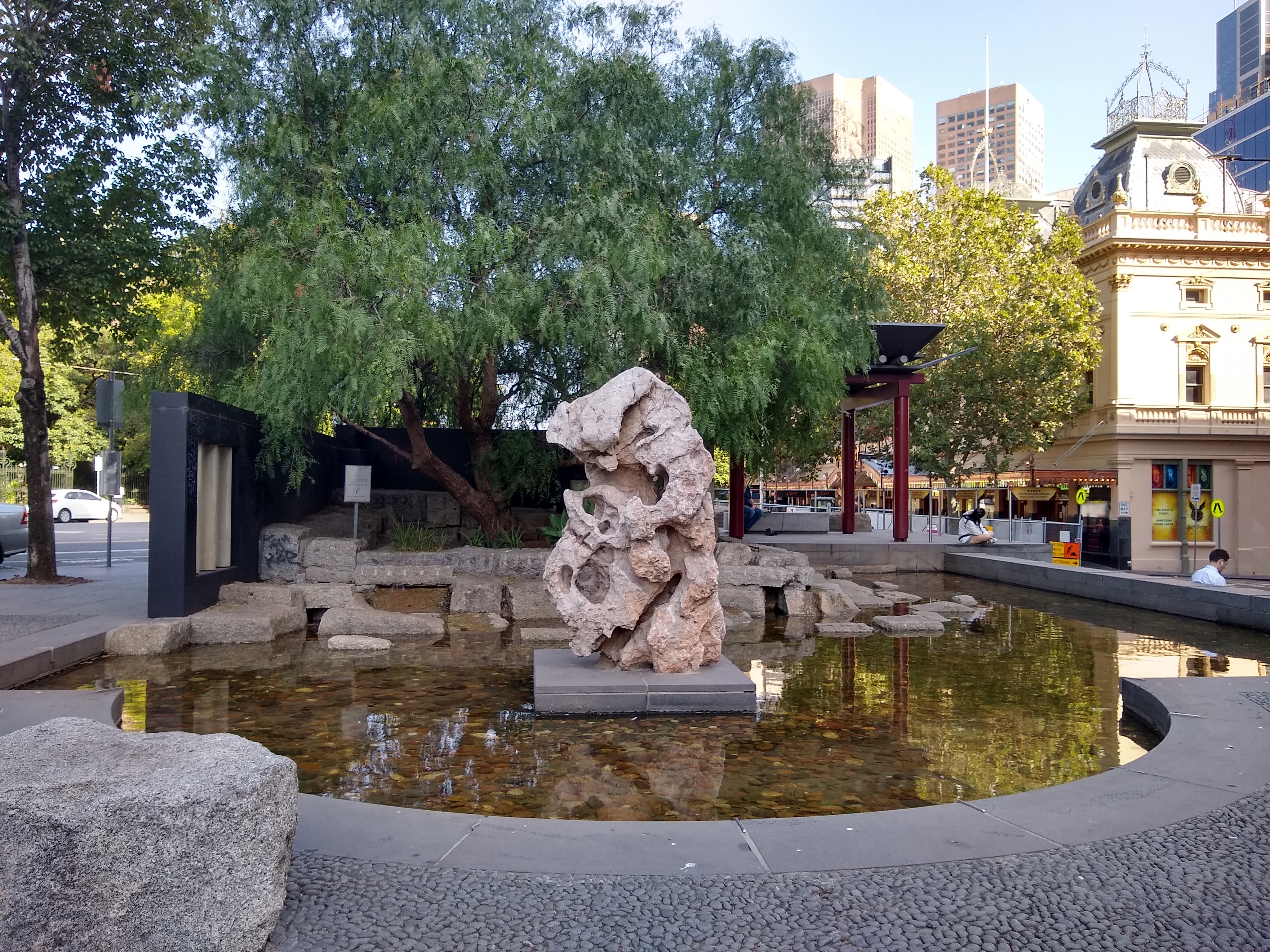
The City of Melbourne has five sister cities:
- Osaka, Japan (established 1978)
- Tianjin, China (established 1980)
- Thessaloniki, Greece (established 1984)
- Boston, Massachusetts, United States (established 1985)
- Milan, Italy (established 2004)
Between 1989 and 2022, the City of Melbourne had a sister city relationship with Saint Petersburg, Russia; this sister city relationship was indefinitely suspended on 1 March 2022, then terminated on 30 May 2023, as a result of the Russian invasion of Ukraine.
In addition to the sister cities, the City of Melbourne also cooperates with:
- New Delhi, India
- Bandung, Indonesia
- Chengdu, China
- Chongqing, China
- Guangzhou, China
- Nanjing, China
- Suzhou, China
- Yokohama, Japan
- Vancouver, Canada
- Los Angeles, United States
- San Francisco, United States
- Seattle, United States
- Auckland, New Zealand
- Chicago, United States
- Ottawa, Canada
- Toronto, Canada
- Liverpool, United Kingdom
- Birmingham, United Kingdom
- San Diego, United States
- Shanghai, China
- Nagoya, Japan
- Kobe, Japan
Notes
References
References
- {{Census 2021 AUS
- "Residents Profiles". City of Melbourne.
- "2021 Melbourne, Census All persons QuickStats {{!}} Australian Bureau of Statistics".
- "Coat of arms".
- (1992). "Victorian Municipal Directory". Arnall & Jackson.
- City of Melbourne. "History and heritage – Melbourne becomes a city".
- (1967-08-31). "First time in 125 years: MELBOURNE HAS LADY COUNCILLOR". Australian Jewish Herald.
- City of Melbourne. (November 1997). "The History of the City of Melbourne".
- (21 October 1999). "Bracks gives control of Docklands back to council". Australian Financial Review.
- Development Victoria. (2019-10-30). "Docklands".
- "Media Release: KENSINGTON AND NORTH MELBOURNE SPLIT NO LONGER".
- "Outcomes of the Kensington Boundary Review".
- "A new icon for global Melbourne". City of Melbourne.
- "Taking bold action on climate change". City of Melbourne.
- "subscription required".
- "Council, mayor and lord mayor history".
- "Melbourne City Council election results 2020".
- {{Census 2001 AUS
- {{Census 2006 AUS
- {{Census 2011 AUS
- {{Census 2016 AUS
- (11 January 2023). "Census {{!}} Australian Bureau of Statistics".
- "About Chinatown {{!}} Chinatown Melbourne - Welcome to Chinatown Melbourne".
- "City of Melbourne — International connections — Sister cities".
- Cosoleto, Tara. (30 May 2023). "Melbourne council cuts ties with Russian sister city over Ukraine war". The Age.
This article was imported from Wikipedia and is available under the Creative Commons Attribution-ShareAlike 4.0 License. Content has been adapted to SurfDoc format. Original contributors can be found on the article history page.
Ask Mako anything about City of Melbourne — get instant answers, deeper analysis, and related topics.
Research with MakoFree with your Surf account
Create a free account to save articles, ask Mako questions, and organize your research.
Sign up freeThis content may have been generated or modified by AI. CloudSurf Software LLC is not responsible for the accuracy, completeness, or reliability of AI-generated content. Always verify important information from primary sources.
Report