From Surf Wiki (app.surf) — the open knowledge base
City of Bradford
City and metropolitan borough in West Yorkshire, England
City and metropolitan borough in West Yorkshire, England
| Field | Value | |||
|---|---|---|---|---|
| name | City of Bradford | |||
| native_name | ||||
| nickname | 'Wool City' | |||
| settlement_type | City and metropolitan borough | |||
| motto | 'Progress-Industry-Humanity' | |||
| image_skyline | {{multiple image | |||
| border | infobox | perrow = 1/2 | total_width = 240 | align=center |
| image1 | A sunny day in Bradford City Park with City Hall (Taken by Flickr user 8th September 2012).jpg | |||
| image2 | View from Queensbury.jpg | |||
| image3 | Overview of Shipley, West Yorkshire.jpg | |||
| image4 | Silsden town hall - geograph.org.uk - 2113803.jpg | |||
| image5 | Keighley - North Street - geograph.org.uk - 505440.jpg | |||
| image6 | All Saints Parish Church, Old Main Street, Bingley - geograph.org.uk - 2042348.jpg | |||
| image7 | Ilkley Moor (29244680701).jpg}} | |||
| image_caption | ||||
| image_blank_emblem | Coat of Arms of Bradford City Council.svg | |||
| blank_emblem_type | Coat of arms | |||
| blank_emblem_size | 150px | |||
| blank_emblem_link | Coat of arms of Bradford | |||
| mapsize | 250px | |||
| mapsize1 | 310px | |||
| pushpin_label_position | ||||
| subdivision_type | Sovereign state | |||
| subdivision_name | United Kingdom | |||
| subdivision_type1 | Country | |||
| subdivision_name1 | England | |||
| subdivision_type2 | Region | |||
| subdivision_name2 | Yorkshire and the Humber | |||
| subdivision_type3 | Ceremonial county | |||
| subdivision_name3 | West Yorkshire | |||
| subdivision_type4 | Historic county | |||
| subdivision_name4 | Yorkshire | |||
| subdivision_type5 | Admin HQ | |||
| subdivision_name5 | Bradford | |||
| government_type | Metropolitan borough, City | |||
| leader_title | Governing body | |||
| leader_name | City of Bradford Metropolitan District Council | |||
| leader_title1 | Council Leader | |||
| leader_name1 | Susan Hinchcliffe (Lab) | |||
| leader_title2 | Lord Mayor | |||
| leader_name2 | Cllr Doreen Lee (Lab) | |||
| leader_title3 | Deputy Lord Mayor | |||
| leader_name3 | Cllr Shabir Hussain (Lab) | |||
| <!-- | leader_title4 | Chief Executive-- | ||
| <!-- | leader_name4 | Kersten England-- | leader_title4 = MPs: | |
| leader_name4 | Anna Dixon (Lab) | |||
| Naz Shah (Lab) | ||||
| Robbie Moore (Con) | ||||
| Judith Cummins (Lab) | ||||
| Imran Hussain (Lab) | ||||
| established_title | Borough charter | |||
| established_date | 1847 | |||
| established_title1 | City status | |||
| established_date1 | 1897 | |||
| established_title2 | City of Bradford Met. District created | |||
| established_date2 | 1974 | |||
| unit_pref | ||||
| area_total_km2 | ||||
| area_total_sq_mi | 143 | |||
| population_as_of | ||||
| population_total | (Ranked ) | |||
| demographics_type1 | Ethnicity (2021) | |||
| demographics1_footnotes | ||||
| demographics1_title1 | Ethnic groups | |||
| demographics_type2 | Religion (2021) | |||
| demographics2_footnotes | ||||
| demographics2_title1 | Religion | |||
| population_density_km2 | 1290 | |||
| population_density_sq_mi | 3341 | |||
| population_blank2_title | Ethnicity | |||
| (2021 census) | ||||
| population_blank2 | ||||
| timezone | Greenwich Mean Time | |||
| utc_offset | +0 | |||
| coordinates | ||||
| postal_code_type | Postcode | |||
| postal_code | BD, LS | |||
| area_codes | 01274 (urban core/wider city) | |||
| 01535 (Keighley) | ||||
| 01943 (Ilkley) | ||||
| blank_name | ISO 3166-2 | |||
| blank_info | GB-BFD | |||
| blank1_name | ONS code | |||
| blank1_info | 00CX (ONS) | |||
| E08000032 (GSS) | ||||
| blank2_name | NUTS 3 | |||
| blank2_info | UKE41 | |||
| blank3_name | OS grid reference | |||
| blank3_info | ||||
| website | www.bradford.gov.uk | |||
| mapframe | yes | |||
| mapframe-zoom | 9 | |||
| footnotes | Click the map for an interactive fullscreen view | |||
| official_name | Bradford |
the metropolitan borough (division of West Yorkshire county)
Naz Shah (Lab) Robbie Moore (Con) Judith Cummins (Lab) Imran Hussain (Lab) | 61.1% White | 32.1% Asian | 2.7% Mixed | 2% Black | 2% other | 33.4% Christianity | 30.5% Islam | 28.2% no religion | 5.5% not stated | 0.9% Sikhism | 0.9% Hinduism | 0.4% other | 0.2% Buddhism | 0.1% Judaism (2021 census) 01535 (Keighley) 01943 (Ilkley) E08000032 (GSS) | mapframe-zoom = 9
Bradford (), also known as the City of Bradford, is a metropolitan borough in West Yorkshire, England. It is named after its largest settlement, Bradford, but covers a larger area which includes the towns and villages of Keighley, Shipley, Bingley, Ilkley, Haworth, Silsden, Queensbury, Thornton and Denholme. Bradford has a population of 528,155, making it the fourth-most populous metropolitan district and the ninth-most populous local authority district in England. It forms part of the West Yorkshire Urban Area conurbation which in 2011 had a population of 1,777,934, and the city is part of the Leeds-Bradford Larger Urban Zone (LUZ), which, with a population of 2,393,300, is the fourth largest in the United Kingdom after London, Birmingham and Manchester.
The city is situated on the edge of the Pennines, and is bounded to the east by the City of Leeds, the south by the Metropolitan Borough of Kirklees and the south west by the Metropolitan Borough of Calderdale. The Pendle borough of Lancashire lies to the west whilst the unitary authority of North Yorkshire lie to the north west and north east of the city. Bradford is the 4th largest metropolitan district in the country, and the contiguous urban area to the north which includes the towns of Shipley and Bingley is heavily populated. The spa town of Ilkley lies further north, whilst the town of Keighley lies to the west. Roughly two thirds of the district is rural, with an environment varying from moorlands in the north and west, to valleys and floodplains formed by the river systems that flow throughout the district. More than half of Bradford's land is green open space, stretching over part of the Airedale and Wharfedale Valleys, across the hills and the Pennine moorland between. The Yorkshire Dales and the Peak District are both in close proximity.
The City of Bradford has architecture designated as being of special or historic importance, most of which were constructed with local stone, with 5,800 listed buildings and 59 conservation areas. The model village of Saltaire has been listed as a UNESCO World Heritage Site. Central Bradford rose to prominence during the 19th century as an international centre of textile manufacture, particularly wool. The area's access to a supply of coal, iron ore and soft water facilitated the growth of Bradford's manufacturing base, which, as textile manufacture grew, led to an explosion in population and was a stimulus to civic investment. However, Bradford has faced similar challenges to the rest of the post-industrial area of northern England, including deindustrialisation, housing problems, and economic deprivation. Wool and textiles still play an important part in the city's economy, but today's fastest-growing sectors include information technology, financial services, digital industries, environmental technologies, cultural industries, tourism and retail headquarters and distribution.
Bradford has experienced significant levels of immigration throughout the 19th and 20th centuries. In the 1840s Bradford's population was significantly increased by migrants from Ireland, particularly rural County Mayo and County Sligo, and by 1851 around 18,000 people of Irish origin resided in the town, representing around 10% of the population, the largest proportion in Yorkshire. Around the same time there was also an influx of German Jewish migrants to the town, and by 1910 around 1,500 people of German origin resided in the city. In the 1950s there was large scale immigration from South Asia and to a lesser extent from Poland. Bradford has the second highest proportion in England and Wales outside London, in terms of population (behind Birmingham) and in percentage (behind Slough, Leicester, Luton and Blackburn with Darwen). An estimated 140,149 people of South Asian origin reside in the city, representing around 26.83% of the city's population. An estimated 352,317 of all White ethnic groups reside in the city which includes people of Polish and Irish origin, representing around 67.44% of the city's population.
Bradford has been designated UK City of Culture for 2025.
History
Bradford was incorporated as a municipal borough in 1847, covering the parishes of Bradford, Horton and Manningham. It became a county borough with the passing of the Local Government Act 1888. The County Borough of Bradford was granted city status by Letters Patent in 1897.
Bradford was expanded in 1882 to include Allerton, Bolton, Bowling, Heaton, Thornbury and Tyersall. In 1899 it was further expanded by adding North Bierley, Eccleshill, Idle, Thornton, Tong, and Wyke. Clayton was added in 1930.
The Brontë sisters, Emily, Anne, and Charlotte were born along with their brother Branwell at 74 Market Street in Thornton, now in Bradford, before moving to the parsonage at Haworth in the heart of West Yorkshire's Brontë Country where they wrote a range of classics of English literature including "Wuthering Heights" and "Jane Eyre".
The city played an important part in the early history of the Labour Party. A mural on the back end of Bradford Playhouse in Little Germany commemorates the centenary of the founding of the Independent Labour Party in Bradford in 1893.
The Bradford Pals were three First World War Pals battalions of Kitchener's Army raised in the city. When the three battalions were taken over by the British Army they were officially named the 16th, 18th and 20th Battalions, The Prince of Wales's Own West Yorkshire Regiment.
On the morning of 1 July 1916, an estimated 1,394 young men from Bradford and District The Bradford Pals, the 16th and 18th Battalions of the Prince of Wales Own West Yorkshire Regiment left their trenches in Northern France to advance across No Man's Land. It was the first hour of the first day of the Battle of the Somme. Of the estimated 1,394 men who left the trenches 1,094 were either killed or injured during the ill-fated attack on the village of Serre.
Other Bradford Battalions involved in the Battle of the Somme were 1st/6th Territorial Battalion of The Prince of Wales's Own West Yorkshire Regiment, based at Belle Vue barracks in Manningham and the 10th Battalion of The Prince of Wales's Own West Yorkshire Regiment. The 1st/6th Territorial Battalion of The Prince of Wales's Own West Yorkshire Regiment first saw action in 1915 at Neuve Chapelle before moving north to Yser Canal near Ypres. The 10th Battalion The Prince of Wales's Own West Yorkshire Regiment was involved in the attack on Fricourt, the 10th West Yorks suffered the highest casualty rate of any battalion on the Somme on 1 July and perhaps the highest battalion casualty list for a single day during the entire war. Nearly 60% of the battalion's casualties were deaths.
In 1919 the Diocese of Bradford was founded, the Church of Saint Peter was then elevated to cathedral status.

The current city boundaries date from 1 April 1974, when the County Borough of Bradford was merged with the borough of Keighley, the urban districts of Baildon, Bingley, Denholme, Ilkley, Shipley and Silsden, along with the Queensbury parts of Queensbury and Shelf Urban District and the parishes of Addingham, and Steeton with Eastburn from Skipton Rural District. Kildwick was part of Bradford at this time, but has since been moved into the Craven District (part of North Yorkshire).
The National Science and Media Museum (formerly the National Museum of Photography, Film and Television) was established in the city in 1983. One of the first cinema shows outside London took place on the site where the museum now stands, in a music hall known as the People's Palace. Today, the National Science and Media Museum hosts the annual Widescreen Weekend film festival.
With a large influx of South Asian immigrants and the Bradford Council's pursuit of a policy of multiculturalism in the 1980s, separatism between ethnic communities became an issue, an issue highlighted by Bradford headteacher Ray Honeyford. In July 2001, ethnic tensions led to rioting. The Ouseley Report, written shortly before the riots broke out, noted that Bradford had become deeply divided by segregated schooling, with communities deeply ignorant of each other, and there was widespread fear of crime and violence which West Yorkshire Police had insufficiently tackled for fear of being branded racist.
In one case, a Bradford man whose car was set on fire following his conversion complained to police, but the officer advised him to "stop being a crusader and move to another place."
In response to the Ouseley Report, approximately £3 million was provided by the Home Office and the Neighbourhood Renewal Fund to regenerate the city. A further £2 billion was invested in regenerating the city centre, building a banqueting hall, new housing, and leisure facilities.
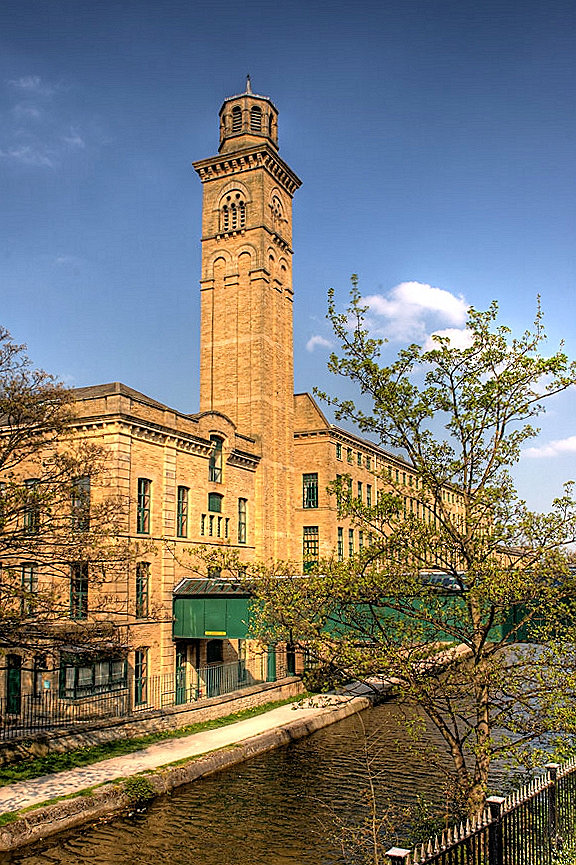
In December 2001, Saltaire was designated a World Heritage Site by UNESCO. This means that the government has a duty to protect the site. The buildings belonging to the model village are individually listed, with the highest level of protection given to the Congregational church (since 1972 known as the United Reformed Church) which is listed as Grade I. The village which includes Salts Mill (pictured right) has survived remarkably complete with Roberts Park on the north side of the river recently restored by Bradford Council.
In October 2007, Bradford was voted the greenest city in the United Kingdom. In the Sustainable Cities Index, compiled by Forum for the Future, the city was revealed to have the lowest environmental impact of any British city. In spite of its undeniably large role in the Industrial Revolution, Bradford's rivers were not polluted beyond redemption, and the streams surrounding the city are now a haven of wildlife. The City of Bradford has areas of green space, and recycling schemes.
Bradford became the world's first UNESCO City of Film in 2009. The designation recognises Bradford's aim to use this history and the local popularity and accessibility of film as a major tool for regeneration, cultural development and social inclusion.
The cinema connections in the city (which is also the home of the National Science and Media Museum) are both historical and contemporary, with ongoing efforts to preserve, promote, and enrich the city's heritage of film. Bradford has been a film location since the beginning of cinema, with its indigenous film industry being traced back to the years around the First World War. By then the residents of Bradford had already witnessed important contributions to cinema development, such as the invention of the Cieroscope in Manningham in 1896.
In April 2021, Little Germany was one of the areas where scenes for the second series of All Creatures Great and Small were being filmed. Some child and adult actors from the theatre school Articulate were to appear in some episodes.
Geography
The City of Bradford is situated on the edge of the Pennines, and is bounded to the east by the City of Leeds, the south by the Metropolitan Borough of Kirklees, and the southwest by the Metropolitan Borough of Calderdale. The Lancashire Borough of Pendle lies to the west, whilst North Yorkshire districts of Craven and Harrogate lie to the north west and north east respectively. Bradford district has 3636 hectares of upland heathland, including Ilkley Moor where the peat bogs rise to 402 m above sea level. Less than 5% of the Bradford district is woodland. Greenspace accounts for 73.8% of the City of Bradford's total area, domestic buildings and gardens comprise 12.1%, and the rest is made up of roads and non-domestic buildings.
Three river systems serve the City of Bradford, along with 23 km of canal. The Airedale towns of Keighley, Bingley and Shipley lie on the River Aire. The River Wharfe runs through Ilkley and Burley in Wharfedale, and tributaries of the River Calder run through the district. Unusually for a major settlement, Bradford is not built on any substantial body of water. The ford from which it takes its name (Broad-Ford) was a crossing of the stream called Bradford Beck.
Parishes
While most of Bradford is unparished, there are parish and town councils for most of the outlying towns and villages in the District. From 2009, the parishes are:
- Addingham
- Baildon
- Burley
- Clayton
- Cullingworth
- Denholme
- Harden
- Haworth, Cross Roads and Stanbury
- Ilkley
- Keighley
- Menston
- Oxenhope
- Sandy Lane
- Silsden
- Steeton with Eastburn
- Trident
- Wilsden
- Wrose
Governance
Parliamentary constituencies
The residents of Bradford are represented in the British Parliament by Members of Parliament (MPs) for five separate parliamentary constituencies. Bradford East is represented by Imran Hussain (Labour), Bradford West is represented by Naz Shah (Labour), Bradford South is represented by Judith Cummins (Labour), Shipley is represented by Anna Dixon (Labour), and Keighley is represented by Robbie Moore (Conservative).
The city played an important part in the early history of the Labour Party. A mural on the back of the Priestley Centre For The Arts (visible from Leeds Road) commemorates the centenary of the founding of the Independent Labour Party in 1893.
Council
Main article: City of Bradford Metropolitan District Council
In 1974, City Of Bradford Metropolitan District Council was created to administer the newly formed metropolitan borough. The County Borough of Bradford was merged with the Borough of Keighley, the Urban Districts of Baildon, Bingley, Denholme, Ilkley, Shipley and Silsden, along with part of Queensbury and Shelf Urban District and part of Skipton Rural District by the Local Government Act 1972. The council, which is based at Bradford City Hall in Centenary Square, governs the whole metropolitan district. The city was granted the right on 18 September 1907 to elect a Lord Mayor.
The city is divided into 30 Electoral Wards, each ward electing three Councillors. Elections are held in May, where one third of the 90 seats (one for each ward) are contested and the successful candidate is elected for a period of four years.
| Party | Seats 2016 | Current Council (2016) | |
|---|---|---|---|
| Labour | 49 | ||
| Conservative | 21 | ||
| Lib Dems | 10 | ||
| Greens | 3 | ||
| Independent | 3 | ||
| The Independents | 2 | ||
| Queensbury Independents | 2 |
Electoral wards
The Metropolitan District is divided into 30 electoral wards.
| Ward name | Area (ha)/mi2 | Population | Population density | |
|---|---|---|---|---|
| (people per hectare) | Ref. | |||
| Baildon | 1086 ha | 12,067 | 14.33 | |
| Bingley | 1241 ha | 13,675 | 11.01 | |
| Bingley Rural | 3164 ha | 15,142 | 4.79 | |
| Bolton and Undercliffe | 326 ha | 15,445 | 47.38 | |
| Bowling and Barkerend | 190 ha | 17,917 | 94.3 | |
| Bradford Moor | 238 ha | 17,497 | 73.52 | |
| City | 464 ha | 18,485 | 39.80 | |
| Clayton and Fairweather Green | 579 ha | 15,191 | 26.24 | |
| Craven | 5008 ha | 15,875 | 3.17 | |
| Eccleshill | 285 ha | 13,278 | 46.58 | |
| Great Horton | 317 ha | 16,019 | 50.47 | |
| Heaton | 613 ha | 16,913 | 27.59 | |
| Idle and Thackley | 685 ha | 14,366 | 20.97 | |
| Ilkley | 1907 ha | 13,828 | 7.25 | |
| Keighley Central | 508 ha | 16,426 | 32.33 | |
| Keighley East | 2345 ha | 15,000 | 6.4 | |
| Keighley West | 939 ha | 16,281 | 17.33 | |
| Little Horton | 309 ha | 16,431 | 53.17 | |
| Manningham | 358 ha | 17,522 | 48.94 | |
| Queensbury | 948 ha | 17,573 | 18.54 | |
| Royds | 347 ha | 15,266 | 43.99 | |
| Shipley | 596 ha | 13,822 | 23.19 | |
| Thornton and Allerton | 1376 ha | 15,108 | 10.98 | |
| Toller | 270 ha | 18,951 | 70.24 | |
| Tong | 1348 ha | 13,823 | 10.25 | |
| Wharfedale | 1573 ha | 11,126 | 7.07 | |
| Wibsey | 278 ha | 13,447 | 48.35 | |
| Windhill and Wrose | 448 ha | 15,244 | 34.03 | |
| Worth Valley | 5989 ha | 15,546 | 2.6 | |
| Wyke | 867 ha | 15,897 | 18.33 |
Possible split of district
Between 2020 and 2022 there was a campaign led by Philip Davies and Robbie Moore, the Conservative MPs for Shipley and Keighley, for their constituencies to break away from Bradford. They claimed the council's focus was too much on Bradford urban area, to the detriment of the smaller centres of Bingley, Ilkley, Keighley, and Shipley, which they said suffered a lack of investment and service cuts as well as council tax hikes. The move for independence was criticised by Bradford City Council. Moore promoted a private member's bill which would have allowed a referendum to be held on the matter, but it did not proceed beyond its second reading in the House of Commons in 2022.
Coat of arms

The coat of arms of Bradford City council is based on that of the former City and County Borough Council, with additions to indicate the merger of eleven Yorkshire councils. The boar's head, as in the former city council's crest, refers to the legend of the boar of Cliffe Wood. This was a ferocious wild boar that terrorised the populace and caused much damage to land and property; so much so that the Lord of the Manor offered a reward for anyone brave enough to slay the boar and bring its head to the Manor House. The mural crown is a frequent symbol of local government, but here also suggests a wellhead. The stag is derived from the device of the Denholme Urban District Council and the arms of the former Borough of Keighley, but represents the District as a whole. The white angora goat is retained from the former arms, recalling that the wool of this animal was used in the local industries. The roses on the collars refer to the Yorkshire rose and the compartment resembles the area's hills and dales.
The original Bradford Coat of Arms had the Latin words 'LABOR OMNIA VINCIT' below it, meaning Work conquers all.
Demography
In the 2021 census, the population of Bradford stood at 333,931, up from 314,58 in 2011, the 2024 population estimate for the city is 347,767. The city has a population density of 5,453/km².
The city of Bradford is 45.8% White according to the latest 2021 census data, with the White British population being 40.5%. 45.3% of the city's population is Asian, primarily from the Pakistani community. 3.2% of the city's population is mixed race, 2.9% is Black, 0.7% is Arab and 2% stated as other.
45.9% of the people living in Bradford are Muslim, 28.1% are Christian, 22.9% are Non Religious, 1.3% are Hindus, 1.3% are Sikhs, 0.2% are Buddhists and 0.3% identify as other.
The area of Bradford with the highest Ethnic White population is Idle, where 91.2% of the population are White, with 50.7% identifying as Christian, 43.8% as Non Religious, and just 2.4% as Muslim. Wyke is second, with 89.7% of people being White, 47.6% being Christian, 45.5% being Non Religious and 5.2% being Muslim. Holmewood is 78.5% White, 43.7% Non Religious, 43.6% Christian and 9.4% Muslim.
Eccleshill is 75.5% White, 42% Non Religious, 38.2% Christian and 17.7% Muslim.
Buttershaw is 62.7% White, 38.4% Christian, 30% Muslim and 29.4% Non Religious.
Clayton is 53.2% White, 36.1% Muslim, 33.7% Christian and 24.7% Non Religious.
Undercliffe is 53% White, 36.5% Muslim, 31.2% Christian, and 26.4% Non Religious.
Bowling is 35% White, 56.5% Muslim, 22.7% Christian and 17.4% Non Religious.
Great Horton is 29.8% White, 61.3% Muslim, 21.9% Christian and 12.2% Non Religious.
Little Horton is 22.4% White, 69.1% Muslim, 19.6% Christian and 9.1% Non Religious.
Heaton is 21.7% White, 73.8% Muslim, 15.4% Christian and 9% Non Religious.
Bradford City Centre is 21.6% White, 60.2% Muslim, 19.3% Christian and 11.5% Non Religious.
Bradford Moor is 12.6% White, 82.4% Muslim, 9.1% Christian and 5.6% Non Religious.
Finally, Toller Lane is the least White area of Bradford, with 10.6% of the population being White, 84.5% being Muslim, 9.4% being Christian and 4.4% being Non Religious.
Main article: Demographics of Bradford

At the 2011 UK census, the City of Bradford had a population of 522,452. Of the 180,246 households in Bradford, 36.5% were married couples living together, 28% were one-person households, 10.8% were lone parents and 8.4% were co-habiting couples, following a similar trend to the rest of England. The population density was 1,290 /km2 and for every 100 females, there were 92.8 males. Of those aged 16–74, 24.5% had no academic qualifications, lower than the 28.9% in all of England. 11.8% of Bradford residents were born outside the United Kingdom, higher than the England average of 9.2%.
The ONS Regional Trends report, published in June 2009, showed that most of the urban core and 41% of the district as a whole were among the most deprived in the country, it also showed that 11% of the district as a whole were among the least deprived in the country. Bradford has one of the highest unemployment rates in England, with the economic inactivity rates of Black, Asian and Minority Ethnic groups standing at over 50% of the working age population.
The crime rate in the City of Bradford is significantly higher than the national average, but lower than that of similar cities such as Manchester or Leeds.
Tourism
Brontë Country is an area including Western parts of the city as well as the area to the west. The City of Bradford includes the town of Haworth and the village of Thornton, the birthplace of the Brontë sisters.
Keighley and Worth Valley Railway, Ilkley's Cow and Calf Rocks, Bradford's National Science and Media Museum, Bradford City Park, Cartwright Hall, Saltaire village (a UNESCO World Heritage Site) and Salts Mill are key attractions that draw visitors from across the globe.
The City of Bradford has also become the first UNESCO City of Film.
Annual events such as the Bradford Literature Festival, Bradford Film Festival, Bradford Festival, Bradford Mela, Bingley Music Live, Ilkley Literature Festival, Haworth's 1940s weekend, Saltaire Festival and special Christmas events take place across the district.
The value of tourism to the district's economy stands at more than £500 million a year, with an estimated 8.6 million day trips within the district. The impact of this is more than 13,500 jobs supported by the tourism and retail sector.
File:Ls straight (5)-2.jpg|National Science and Media Museum in Bradford, the world's first UNESCO City of Film File:Saltaire from Leeds and Liverpool Canal.jpg|Salts Mill in Saltaire, a UNESCO World Heritage Site File:IlkleyCowandCalfRocks.jpg| Cow and Calf Rocks in Ilkley File:Main Street, Haworth, West Yorkshire.jpg| Haworth village centre
Economy
The economy of Bradford is worth around £9.5 billion, contributing around 8.4% of the region's output, and making the district the third largest after Leeds and Sheffield in Yorkshire & Humber. Traditionally based on the wool and textile industries, manufacturing is still strong, accounting for around 1 in 5 jobs. The city's service-sector economy accounts for 77% of the district's 195,000 jobs, with today's fastest-growing sectors including information technology, financial services, tourism and retail headquarters and distribution. The district is home to a number of large businesses with recognised brands operating on a national and international scale such as Morrisons, Pace Plc and Hallmark Cards. Three of the UK's biggest financial institutions are based in Bradford: Yorkshire Building Society, Santander Group and Vanquis Banking Group. It is also home to nationally outstanding cultural businesses, a strong group of new media companies, and a significant national institution in the National Science and Media Museum. Tourism is worth over £400 million to the local economy, and employs over 10,000 people. Bradford's exports are worth almost £700 million.
The city's working-age population has risen by 3.3% since 2000, faster than any UK city outside London, whilst the population of the city itself is growing by twice the national average. Bradford has a younger age profile than the Yorkshire & Humber regional average and the national average, with the younger age groups forming a greater proportion of the population in comparison. Bradford has been named by research group OMIS as one of the top six cities in the UK equipped for future growth, and the CBI reports that business confidence is higher in Bradford than in the UK as a whole, whilst £1.5 billion of construction work is transforming Bradford in a bid to attract further investment.
At the 2001 UK census, Bradford had 326,774 residents aged 16 to 74. 2.5% of these people were students with jobs, 7.6% looking after home or family, 6.1% permanently sick or disabled and 4.5% economically inactive for other reasons. The City of Bradford has a lower economic activity rate than West Yorkshire, the regional average for Yorkshire and the Humber and the national average. Conversely Bradford has a higher economic inactivity rate than all these areas and also has a lower employment rate.
Manufacturing is still strong in Bradford and accounts for almost 12% of all jobs, and the city's service-sector economy accounts for 82% of the district's 192,000 jobs. The entrepreneurial spirit is more present in Bradford than generally in the UK, with start-ups accounting for 12% of the business community.
Bradford's GVA is over £6 billion.
Education
Education in the city is provided for by a number of schools and colleges. State schooling is managed by Bradford local education authority. There are also a number of independent (private) and free schools, such as Bradford Grammar School, Woodhouse Grove School and Bradford Girls Grammar School. Bradford College and the University of Bradford are the main further and higher education providers.
Media
Television
In terms of television, the area is served by BBC Yorkshire and ITV Yorkshire both broadcast from nearby Leeds.
Radio
The radio stations that broadcast to the area are:
BBC Local Radio
- BBC Radio Leeds
Independent Local Radio
- Heart Yorkshire
- Capital Yorkshire
- Hits Radio West Yorkshire
- Greatest Hits Radio West Yorkshire
Community Radio
- Sunrise Radio (for the Asian community)
- BCB 106.6fm
- Drystone Radio (covering Wharfedale)
Newspapers
Local newspapers for the area:
- Telegraph & Argus
- The Yorkshire Post
- Yorkshire Evening Post
Transport
Public transit
Public transport in Bradford is co-ordinated by Metro. Most local train services are run by Northern, with longer-distance services to London King's Cross railway station served by Grand Central from Bradford Interchange and London North Eastern Railway from Bradford Forster Square station.
The Wharfedale line connects direct to Ilkley, Ben Rhydding, Burley-in-Wharfedale, Menston, Guiseley, Baildon, Shipley and Frizinghall railway stations with Bradford Forster Square. The Airedale line connects the stations at Morecambe, Lancaster, Settle, Carlisle, Skipton, Steeton & Silsden, Keighley (change for the Brontë Country and the Keighley & Worth Valley Railway), Crossflatts, Bingley, Saltaire (UNESCO World Heritage Site) and Shipley, continuing to either Frizinghall and Bradford Forster Square or to Leeds to the east of the district. Both Bradford Forster Square and the district's major and busiest railway station Bradford Interchange are served by the Leeds–Bradford lines with direct routes to Leeds, Selby, York, Brough and Hull. Bradford Interchange, via the Calder Valley line, also connects direct to stations at Manchester, Halifax, Rochdale, Burnley, Blackburn, Preston, Poulton-le-Fylde, Blackpool, Huddersfield, Wakefield, Doncaster, Chester, Warrington, and London King's Cross.
There are bus stations in Bradford, Ilkley, Keighley and Shipley. The majority of services are provided by First Bradford and Keighley Bus Company.
Air and water transport
Leeds Bradford Airport itself is located in Yeadon, about 10 mi to the north-east of the city centre, and has both charter and scheduled flights to destinations within Europe plus the United States, Egypt, Pakistan, and Turkey. There are connections to the rest of the world via London Heathrow, Paris-Charles de Gaulle Airport and Amsterdam Airport Schiphol.
There are also navigable waterways that run through the district. The Leeds and Liverpool Canal passes through numerous towns and villages in the borough, with the Grade I listed Five Rise Locks at Bingley generally considered to be one of the finest feats of canal engineering in the country. There are also proposals to restore and re-open the Bradford Canal, which closed in 1922, as part of a wider regeneration of the city.
Roadways
The M606, a spur of the M62 motorway, connects the district with the national motorway network. The M606 was originally laid out to reach the centre of Bradford and beyond, but connects instead to the A6177 Bradford outer ring road, making the motorway one of the shortest in the country at less than 3 mi long. Another motorway was planned in the 1970s, envisaging a link between Bradford, the Aire valley in the north of the district, and the M65 at Colne, roughly mirroring the existing A650 road. It has since been upgraded to be a dual carriageway along much of its length, bypassing the towns of Bingley and Keighley. The A658 road passes through a tunnel underneath the main Leeds Bradford Airport runway as it heads north-east from Bradford to Knaresborough.
Clean air zone
Twin towns
The City of Bradford, and the various towns and villages that make up the Metropolitan District, have Twin Town and Sister City Friendship Agreements with several other communities. Each was originally twinned with a place within the City of Bradford.
| Country | Place | Originally twinned with | Date |
|---|---|---|---|
| Belgium | Verviers | Bradford | 1970 |
| France | Coutances | Ilkley | 1969 |
| France | Eppeville | Wilsden | 1982 |
| France | Poix-du-Nord | Keighley | 1919 |
| France | Roubaix | Bradford | 1969 |
| Germany | Hamm | Shipley | 1976 |
| Germany | Mönchengladbach | Bradford | 1971 |
| Ireland | Galway | Bradford | 1987 |
| Macedonia | Skopje | Bradford | 1963 |
| Pakistan | Mirpur | Bradford | 1998 |
| Peru | Machu Picchu | Haworth | 2005 |
| United States | Haworth | Haworth | 2004 |
| United States | Myrtle Beach | Keighley | 1993 |
Notes
References
- bradfordinfo.com has a range of statistical and other information about the District, and includes a Geographic information system accessible from mapsandstats.com
References
- "The rise and fall of Wool City". Yorkshire Post.
- "Ethnic Group 2011 Census Key Statistics (five categories)".
- "Bradford Local Authority".
- "Bradford Local Authority".
- "Bradford Demographics {{!}} Age, Ethnicity, Religion, Wellbeing".
- "Local Authority Districts, Counties and Unitary Authorities (April 2021) Map in United Kingdom".
- Foundation, Internet Memory. (2 July 2010). "[ARCHIVED CONTENT] UK Government Web Archive – The National Archives".
- "2011 Census - Built-up areas". [[Office for National Statistics.
- "Urban Audit – City Profiles: Leeds". Urban Audit.
- "Bradford – the facts". Yorkshire Forward Government agency.
- "Establishing Significance in Conservation Areas". English Heritage.
- "Bradford and West Yorkshire – Around West Yorkshire – Against the odds?". BBC.
- (13 April 2006). "Bradford and West Yorkshire – History – The Jewish connection!". BBC.
- "Ethnic Group 2011 Census Key Statistics (five categories)".
- Statistics. Ethnic Group 2011 Census Key Statistics (five categories). Table - West Yorkshire Observatory]
- (1 June 2022). "Delight as Bradford is named UK City of Culture 2025". The Telegraph and Argus.
- (3 November 2011). "ILP History: Beginnings in Bradford – ILP". Independentlabour.org.uk.
- (18 March 2015). "Badges tribute to Pals and City fans who joined up and died together in World War One".
- "6th Battalion, West Yorkshire Regiment (Prince of Wales's Own ) in The Great War 1914–1918". The Wartime Memories Project.
- "Prince of Wales's Own (West Yorkshire Regiment)". Warpath.orbat.com.
- "Bradford City of Film". Bradford City of Film.
- "Widescreen Weekend". National Science and Media Museum.
- In 1989, a section of the Muslim community led a campaign against [[Salman Rushdie]]'s ''[[The Satanic Verses]]'', and caught the attention of the international media by publicly burning a copy of the book.Goodhart, David. ''The British Dream''. Atlantic Books, London (2013): p. 157
- (13 February 2009). "What happened to the book burners?". BBC News.
- (11 February 2012). "Death of former head teacher Ray Honeyford sparks schooling debate". Telegraph & Argus.
- (12 July 2001). "Blueprint for 'divided' Bradford". BBC News.
- (2014). "Living among the Breakage: Contextual Theology-Making and Ex-Muslim Christians". Ph.D. Thesis, School of Divinity, University of Edingburg.
- ''Community Cohesion in Crisis: New Dimensions of Diversity and Difference'' ed. John Flint, David Robinson. The Policy Press (2008): p. 42
- Flint & Robinson (2008): p. 43
- (1 January 2004). "Saltaire World Heritage Site". Saltairevillage.info.
- Meneaud, Marc. (20 October 2007). "City tops green list". Bradford Telegraph & Argus.
- (2007). "the sustainablecities index". Forum for the Future.
- (20 October 2007). "And the winner of the award for the greenest city in Britain is ... Bradford". The Guardian.
- "Bradford – greenest city". hippy shopper.
- (30 September 2013). "UK National Commission for UNESCO :: Bradford, UNESCO City of Film". Unesco.org.uk.
- (10 April 2021). "Bradford youngsters join new face in All Creatures Great and Small".
- "Key Figures for Physical Environment –Area: Bradford (Local Authority)". Office for National Statistics.
- "bradford: city for peace/site12-14". Cityforpeace.org.uk.
- {{London Gazette. (1 October 1907)
- "Current political composition". City of Bradford Metropolitan District Council.
- "Population Density, 2001 (UV02) – Area: Baildon (Ward)". Office for National Statistics.
- "Population Density, 2001 (UV02) – Area: Bingley (Ward)". Office for National Statistics.
- "Population Density, 2001 (UV02) – Area: Bingley Rural (Ward)". Office for National Statistics.
- "Population Density, 2001 (UV02) – Area: Bolton and Undercliffe (Ward)". Office for National Statistics.
- "Population Density, 2001 (UV02) – Area: Bowling and Barkerend (Ward)". Office for National Statistics.
- "Population Density, 2001 (UV02) – Area: Bradford Moor (Ward)". Office for National Statistics.
- "Population Density, 2001 (UV02) – Area: City (Ward)". Office for National Statistics.
- "Population Density, 2001 (UV02) – Area: Clayton and Fairweather Green (Ward)". Office for National Statistics.
- "Population Density, 2001 (UV02) – Area: Craven (Ward)". Office for National Statistics.
- "Population Density, 2001 (UV02) – Area: Eccleshill (Ward)". Office for National Statistics.
- "Population Density, 2001 (UV02) – Area: Great Horton (Ward)". Office for National Statistics.
- "Population Density, 2001 (UV02) – Area: Heaton (Ward)". Office for National Statistics.
- "Population Density, 2001 (UV02) – Area: Idle and Thackley (Ward)". Office for National Statistics.
- "Population Density, 2001 (UV02) – Area: Ilkley (Ward)". Office for National Statistics.
- "Population Density, 2001 (UV02) – Area: Keighley Central(Ward)". Office for National Statistics.
- "Population Density, 2001 (UV02) – Area: Keighley East (Ward)". Office for National Statistics.
- "Population Density, 2001 (UV02) – Area: Keighley West (Ward)". Office for National Statistics.
- "Population Density, 2001 (UV02) – Area: Little Horton (Ward)". Office for National Statistics.
- "Population Density, 2001 (UV02) – Area: Manningham (Ward)". Office for National Statistics.
- "Population Density, 2001 (UV02) – Area: Queensbury (Ward)". Office for National Statistics.
- "Population Density, 2001 (UV02) – Area: Royds (Ward)". Office for National Statistics.
- "Population Density, 2001 (UV02) – Area: Shipley (Ward)". Office for National Statistics.
- "Population Density, 2001 (UV02) – Area: Thornton and Allerton (Ward)". Office for National Statistics.
- "Population Density, 2001 (UV02) – Area: Toller (Ward)". Office for National Statistics.
- "Population Density, 2001 (UV02) – Area: Tong (Ward)". Office for National Statistics.
- "Population Density, 2001 (UV02) – Area: Wharfedale (Ward)". Office for National Statistics.
- "Population Density, 2001 (UV02) – Area: Wibsey (Ward)". Neighbourhood.statistics.gov.ukOffice for National Statistics.
- "Population Density, 2001 (UV02) – Area: Windhill and Wrose (Ward)". Office for National Statistics.
- "Population Density, 2001 (UV02) – Area: Worth Valley (Ward)". Office for National Statistics.
- "Population Density, 2001 (UV02) – Area: Wyke (Ward)". Office for National Statistics.
- (5 August 2020). "'It's time for Shipley and Keighley to break away from Bradford Council'". The Telegraph and Argus.
- (23 June 2021). "Campaign to break Shipley and Keighley constituencies away from Bradford Council gathers pace". The Telegraph and Argus.
- (22 February 2022). "Robbie Moore to put plan to take Keighley, Ilkley and Shipley out of Bradford Council control to Parliament". Yorkshire Post.
- "Local Authority Boundaries (Referendums) Bill".
- "Civic Heraldry Of England And Wales – Yorkshire, West Riding (Obsolete)". Civicheraldry.co.uk.
- "Civic Heraldry Of England And Wales – Yorkshire". Civicheraldry.co.uk.
- "Download:output areas 2011 in Yorkshire and The Humber". NOMIS.
- "2011 Census results". Bradford Metropolitan District Council.
- (13 February 2003). "Census 2001 – Profiles – Bradford". Statistics.gov.uk.
- (25 June 2009). "Bradford one of most deprived cities in region (From Bradford Telegraph and Argus)". Thetelegraphandargus.co.uk.
- [http://www.statistics.gov.uk/articles/RegionalTrends/RT41-Article3.pdf] {{webarchive. link. (24 August 2009)
- "Accent Community Partnerships, Bradford". Showcase.hcaacademy.co.uk.
- "Bradford District".
- [http://www.communities.gov.uk/documents/communities/doc/1162085.doc] {{webarchive. link. (13 August 2012)
- "Bradford Crime Statistics & Policing | Local Crime Rates & Stats". UpMyStreet.
- "Manchester Crime Statistics & Policing | Local Crime Rates & Stats". UpMyStreet.
- "Discover Bradford District".
- "Discover Bradford District".
- "Bradford City of Film".
- Mead, Helen. (5 July 2011). "Why tourism is on the increase in the Bradford district". Telegraph & Argus.
- "Bradford a city redefined".
- "Bradford: the facts and figures". Yorkshire Forward.
- [http://bradfordeconomy.com/facts_and_figures/people/current_population] {{webarchive. link. (3 March 2009)
- (13 February 2003). "Census 2001 – Profiles – Bradford". Statistics.gov.uk.
- "First Key Census Statistics for Bradford district".
- "Yorkshire Radio Stations".
- "Assessment".
- [http://www.waterways.org.uk/Restoration/WaterwaysPlannedforRestoration/BradfordCanal] {{webarchive. link. (29 April 2009)
- Bradford Metropolitan District Council. "Bradford Metropolitan District Council | Twin Towns and Villages | Twin Towns and Villages Overview". Bradford.gov.uk.
This article was imported from Wikipedia and is available under the Creative Commons Attribution-ShareAlike 4.0 License. Content has been adapted to SurfDoc format. Original contributors can be found on the article history page.
Ask Mako anything about City of Bradford — get instant answers, deeper analysis, and related topics.
Research with MakoFree with your Surf account
Create a free account to save articles, ask Mako questions, and organize your research.
Sign up freeThis content may have been generated or modified by AI. CloudSurf Software LLC is not responsible for the accuracy, completeness, or reliability of AI-generated content. Always verify important information from primary sources.
Report