From Surf Wiki (app.surf) — the open knowledge base
Cirrocumulus cloud
Genus of high-altitude clouds
Genus of high-altitude clouds
| Field | Value |
|---|---|
| name | Cirrocumulus cloud |
| image location | Cirrocumulus 20040830.jpg |
| image name | Cirrocumulus floccus |
| abbreviation | Cc |
| genus | Cirro- (curl) |
| -cumulus (heaped) | |
| species | * Castellanus |
| variety | * Lacunosus |
| altitude_m | 6,096–15,000 |
| altitude_ft | 20,000–49,000 |
| level | high |
| appearance | Small, flakey, and white high-altitude cumulus patches. |
| precipitation | Occasionally virga. May form ahead of a frontal system, especially together with other cirriform clouds meaning rain in around 10 hours. |
-cumulus (heaped)
- Floccus
- Lenticularis
- Stratiformis
- Undulatus Cirrocumulus is one of the three main genus types of high-altitude tropospheric clouds, the other two being cirrus and cirrostratus. They usually occur at an altitude of 5 to, however they can occur as low as 10000 ft in the arctic and weather reporting standards such as the Canadian MANOBS suggests heights of 29000 ft in summer and 26000 ft in winter. Like lower-altitude cumuliform and stratocumuliform clouds, cirrocumulus signifies convection. Unlike other high-altitude tropospheric clouds like cirrus and cirrostratus, cirrocumulus includes a small amount of liquid water droplets, although these are in a supercooled state. Ice crystals are the predominant component, and typically, the ice crystals cause the supercooled water drops in the cloud to rapidly freeze, transforming the cirrocumulus into cirrostratus. This process can also produce precipitation in the form of a virga consisting of ice or snow. Thus, cirrocumulus clouds are usually short-lived. They usually only form as part of a short-lived transitional phase within an area of cirrus clouds and can also form briefly as a result of the breaking up of part of a cumulonimbus anvil.
Properly, the term cirrocumulus refers to each cloud, but is typically also used to refer to an entire patch of cirrocumulus. When used in this way, each cirrocumulus element is referred to as a "cloudlet".
Appearance
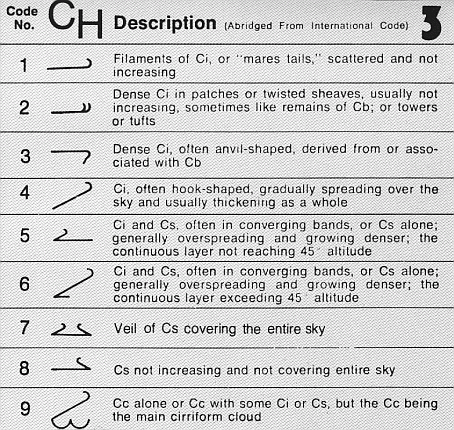
Cirrocumulus is a cloud of the stratocumuliform physical category that shows both stratiform and cumuliform characteristics and typically appears as white, patchy sheets with ripples or tufts without gray shading. Each cloudlet appears no larger than a finger held at arm's length. These often are organized in rows like other cumuliform and stratocumuliform clouds, but since they are so small, cirrocumulus patches take on a finer appearance, sometimes also referred to colloquially as "herringbone" or as a "mackerel sky". Cirrocumulus is coded CH9 for the main genus-type and all subforms.
Cirrocumulus is distinguished from altocumulus in several ways, although the two stratocumuliform genus types can occasionally occur together with no clear demarcation between them. Cirrocumulus generally occur at higher altitudes than altocumulus, thus the "cloudlets" appear smaller, as they are more distant from observation at ground level. They are also colder. Cirrocumulus clouds never cast self-shadows and are translucent to a certain degree. They are also typically found amongst other cirrus clouds in the sky and are usually themselves seen to be transforming into these other types of cirrus. This often occurs at the leading edge of a warm front, where many types of cirriform clouds can be present.

Cirrocumulus clouds tend to reflect the red and yellow colours during a sunset and sunrise, so they have been referred to as "one of the most beautiful clouds". This occurs because they reflect the unscattered rays of light from the early morning or evening sun, and those rays are yellow, orange, red, and sometimes purple.
Forecasting
References
- "Cirrocumulus Clouds". Georgia Institute of Technology.
- Funk, Ted. "Cloud Classifications and Characteristics". NOAA.
- (2 December 2021). "Manual of Surface Weather Observation Standards (MANOBS) 8th Edition, Amendment 2".
- Pretor-Pinney, Gavin. (2009). "The Cloud Collector's Handbook". Sceptre.
- "Cirrocumulus – Meteorology/Climate". University of Maryland Center for Environmental Science.
- (1975). "Cirrocumulus, International Cloud Atlas".
- Ahrens, C. Donald. (February 2006). "Meteorology Today: an Introduction to Weather, Climate, and the Environment". Brooks Cole.
- Palmer, Chad. (October 16, 2005). "Cumulus clouds". USA Today.
- Ahrens, C. Donald. (January 2007). "Essentials of Meteorology: An Invitation to the Atmosphere". Brooks Cole.
- (1975). "Species, International Cloud Atlas".
- (1975). "Varieties, International Cloud Atlas".
- (1975). "Features, International Cloud Atlas".
This article was imported from Wikipedia and is available under the Creative Commons Attribution-ShareAlike 4.0 License. Content has been adapted to SurfDoc format. Original contributors can be found on the article history page.
Ask Mako anything about Cirrocumulus cloud — get instant answers, deeper analysis, and related topics.
Research with MakoFree with your Surf account
Create a free account to save articles, ask Mako questions, and organize your research.
Sign up freeThis content may have been generated or modified by AI. CloudSurf Software LLC is not responsible for the accuracy, completeness, or reliability of AI-generated content. Always verify important information from primary sources.
Report