From Surf Wiki (app.surf) — the open knowledge base
Circular sector
Portion of a disk enclosed by two radii and an arc
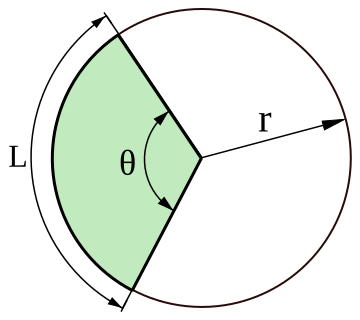
Portion of a disk enclosed by two radii and an arc
A circular sector, also known as circle sector or disk sector or simply a sector (symbol: ⌔), is the portion of a disk (a closed region bounded by a circle) enclosed by two radii and an arc, with the smaller area being known as the minor sector and the larger being the major sector. In the diagram, θ is the central angle, r the radius of the circle, and L is the arc length of the minor sector.
Types
A sector with the central angle of 180° is called a half-disk and is bounded by a diameter and a semicircle. QuadrantSectors with other central angles are sometimes given special names, such as quadrants (90°), sextants (60°), and octants (45°), which come from the sector being one quarter, sixth or eighth part of a full circle, respectively.
Area
The total area of a circle is πr. The area of the sector can be obtained by multiplying the circle's area by the ratio of the angle θ (expressed in radians) and 2π (because the area of the sector is directly proportional to its angle, and 2π is the angle for the whole circle, in radians): A = \pi r^2, \frac{\theta}{2 \pi} = \frac{r^2 \theta}{2}
The area of a sector in terms of L can be obtained by multiplying the total area πr by the ratio of L to the total perimeter 2πr. A = \pi r^2, \frac{L}{2\pi r} = \frac{rL}{2}
Another approach is to consider this area as the result of the following integral: A = \int_0^\theta\int_0^r dS = \int_0^\theta\int_0^r \tilde{r}, d\tilde{r}, d\tilde{\theta} = \int_0^\theta \frac 1 2 r^2, d\tilde{\theta} = \frac{r^2 \theta}{2}
Converting the central angle into degrees gives A = \pi r^2 \frac{\theta^\circ}{360^\circ}
Perimeter
The length of the perimeter of a sector is the sum of the arc length and the two radii: P = L + 2r = \theta r + 2r = r (\theta + 2) where θ is in radians.
Arc length
The formula for the length of an arc is: L = r \theta where L represents the arc length, r represents the radius of the circle and θ represents the angle in radians made by the arc at the centre of the circle.
If the value of angle is given in degrees, then we can also use the following formula by: L = 2 \pi r \frac{\theta}{360^\circ}
Chord length
The length of a chord formed with the extremal points of the arc is given by C = 2R\sin\frac{\theta}{2} where C represents the chord length, R represents the radius of the circle, and θ represents the angular width of the sector in radians.
References
Sources
References
- Dewan, Rajesh K.. (2016). "Saraswati Mathematics". New Saraswati House India Pvt Ltd.
- Uppal, Shveta. (2019). "Mathematics: Textbook for class X". [[National Council of Educational Research and Training]].
- (2002). "Calculus I with Precalculus". [[Cengage.
- Wicks, Alan. (2004). "Mathematics Standard Level for the International Baccalaureate : a text for the new syllabus". Infinity Publishing.com.
This article was imported from Wikipedia and is available under the Creative Commons Attribution-ShareAlike 4.0 License. Content has been adapted to SurfDoc format. Original contributors can be found on the article history page.
Ask Mako anything about Circular sector — get instant answers, deeper analysis, and related topics.
Research with MakoFree with your Surf account
Create a free account to save articles, ask Mako questions, and organize your research.
Sign up freeThis content may have been generated or modified by AI. CloudSurf Software LLC is not responsible for the accuracy, completeness, or reliability of AI-generated content. Always verify important information from primary sources.
Report