From Surf Wiki (app.surf) — the open knowledge base
Circle of stars
Symbolic motif

Symbolic motif
A circle of stars often represents unity, solidarity and harmony in flags, seals and signs, and is also seen in iconographic motifs related to the Woman of the Apocalypse as well as in Baroque allegoric art that sometimes depicts the Crown of Immortality.
Woman of the Apocalypse
.jpg)
The New Testament's Book of Revelation (12:1, 2 & 5) describes the Woman of the Apocalypse: And there appeared a great wonder in heaven; a woman clothed with the sun, and the moon under her feet, and upon her head a crown of twelve stars. And she being with child cried, travailing in birth. .... And she brought forth a man child, who was to rule all nations with a rod of iron:and her child was caught up unto God, and to his throne.{{cite web
The doctrine of the Immaculate Conception was somewhat controversial in the medieval church, and the liturgical Office for the feast was only established in 1615. In 1649, Francisco Pacheco (father-in-law of Velázquez) published his Art of Painting firmly establishing the detailed correct iconography for paintings of the Virgin of the Immaculate Conception, which included the circle of stars (he also advised the inquisition in Seville on artistic matters). This was followed by Murillo and his school in very many paintings, and influenced non-Spanish depictions.
European Flag
The European flag, first adopted by the Council of Europe, consists of 12 golden stars in a circle on a blue background. The stars symbolise the ideals of unity, solidarity and harmony among the peoples of Europe. The number of stars has nothing to do with the number of member countries, though the circle is a symbol of unity.
Arsène Heitz, one of the flag designers, in 1987 revealed that his inspiration was the crown of twelve stars of the Woman of the Apocalypse, often found in modern Marian iconography. However, he did not suggest that the finished design held a religious meaning. Paul M. G. Lévy, the official responsible for the design process, denied any religious inspiration for the flag design. Carlo Curti Gialdino, I Simboli dell'Unione europea, Bandiera - Inno - Motto - Moneta - Giornata. Roma: Istituto Poligrafico e Zecca dello Stato S.p.A., 2005. , pp. 80-85. Gialdino is here cited after a translation of the Italian text published by the Centre Virtuel de la Connaissance sur l'Europe (cvce.eu) "While Count Coudenhove-Kalergi in a personal statement maintained that three leading Catholics within the Council had subconsciously chosen the twelve stars on the model of Apocalypse 12:1, Paul M.G. Lévy, Press Officer of the Council from 1949 to 1966, explained in 1989 that there was no religious intention whatsoever associated with the choice of the circle of twelve stars." Peter Diem, 11 June 2002
Zodiac
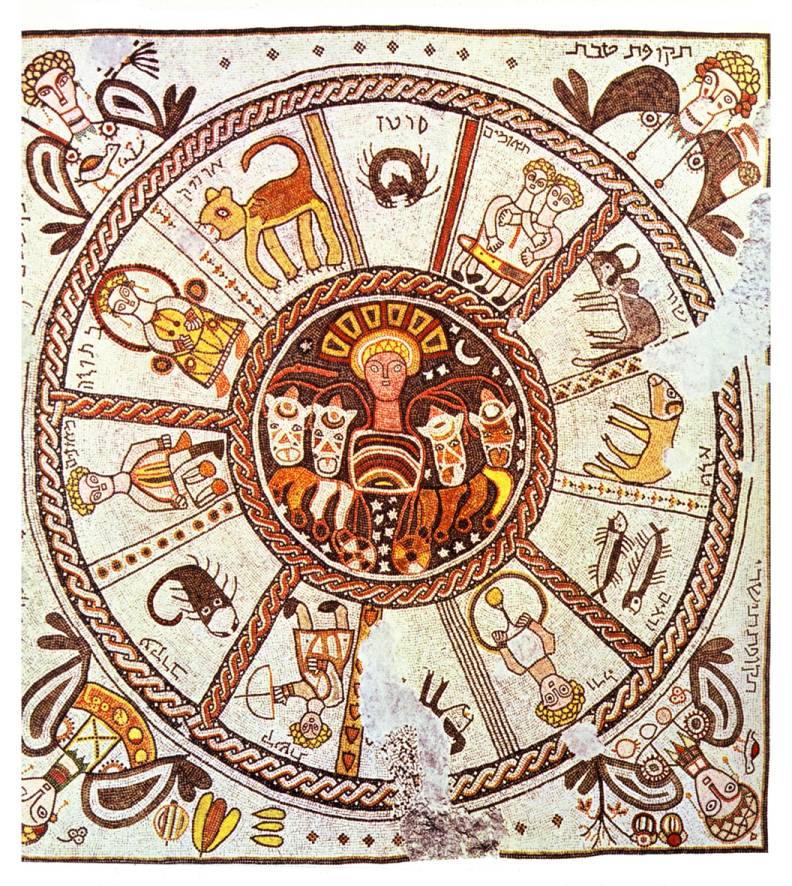
The Zodiac is an ancient circle of stars where some stars are symbolically combined into 12 star signs also known as constellations. The etymology of the term Zodiac comes from the Latin zōdiacus, from the Greek ζῳδιακός [κύκλος], meaning "[circle] of animals", derived from ζῴδιον, the diminutive of ζῷον "animal".
Crown of Immortality
The Crown of Immortality is a separate and earlier motif (and metaphor) which also uses a circle of stars. It has been widely used since the Early Church as a metaphor for the reward awaiting martyrs, but they are not depicted in art wearing a circle of stars. In art the use is mainly in Baroque allegorical compositions, and those with Ariadne.
Art gallery
Religious
File:Mariae Verkuendigung Fuchstal Fresko Magnifikat 2.JPG|A star circle halo is found on a ceiling fresco in an Annunciation Church located in Fuchstal, a Municipality of the Bavarian district of Landsberg, Germany. Image:Maryaltar2.jpg|Blessed Virgin Mary in St Mary's Cathedral, Dublin (Primate of Ireland) with a star circle halo. File:Boms Pfarrkirche Mariengruppe.jpg|Virgin Mary with a crown of stars in France. File:Immortality.jpg|Crown of Immortality, held by the Allegoric figure Eterna (Eternity) on the Swedish House of Knights Fresco by David Klocker Ehrenstrahl File:Gardenenclosed.jpg|"Our Lady the Garden Enclosed", statue of Our Lady of Sorrows at the hermitage church in Warfhuizen, the Netherlands. File:DULURI.JPG|The statue of Our Lady of Sorrows, Żejtun, Malta. File:Blessed mary basilica san julio orta.jpg|Blessed Virgin Mary Basilica di San Giulio, Orta, Italy File:SAAM-1933.4.1 1.jpg|Madonna with Halo of Stars, Italy (17th century). File:William-Adolphe Bouguereau The Virgin With Angels.jpg|Regina Angelorum by William-Adolphe Bouguereau, 1900
Non religious
Flags
File:Flag of Europe.svg|The Flag of Europe with circle of stars representing European unity File:International Paneuropean Union flag.svg|Flag of the Paneuropean Union (the stars were added after the creation of the Flag of Europe) File:Flag of a United States Foreign Service Officer.svg|Flag of United States Foreign Service Officer File:Flag of the Federal Bureau of Investigation.svg|The Flag of FBI (early version of the Flag of the Federal Bureau of Investigation) File:Betsy Ross flag.svg|The Betsy Ross flag (early version of the Flag of the United States) File:Jack of the CSA Navy 1861 1863.svg|CSN Jack, 1861–1863 File:Flag of the Confederate States (1861–1863).svg|Flags of the Confederate States of America, 1861–1863 File:Flag of Missouri.svg|Flag of Missouri File:Flag of Rhode Island.svg|Flag of Rhode Island File:Flag of Georgia (U.S. state).svg|Flag of Georgia File:Flag of the Central Commission for Navigation on the Rhine.svg|Central Commission for Navigation on the Rhine (2015) File:Flag of Myanmar (1974-2010).svg|Flag of Myanmar, Burma, 1974–2010 File:United States yacht flag.svg|United States Yacht Ensign File:Flag of the Cook Islands.svg|Flag of the Cook Islands File:Flag of Cape Verde.svg|Flag of Cape Verde File:Flag of Indiana.svg|Flag of Indiana File:Flag of Louisiana (January 1861).svg|Flag of Louisiana (January 1861, unofficial) File:Flag of Los Ríos, Chile.svg|Flag of Los Ríos Region, Chile File:Flag of the Federal Republic of Southern Cameroons.svg|Flag of Ambazonia File:Flag of the President of the United States.svg|Flag of the president of the United States File:Flag of the Vice President of the United States (1948–1975).svg|Flag of the vice president of the United States, 1948-1975 File:Flag of a United States ambassador.svg|Flag of the Ambassadors of the United States File:Flag of the Governor of Ohio.svg|Flag of the Governor of Ohio File:Flag of Mississippi.svg|Flag of Mississippi File:Flag of Ohio.svg|Flag of Ohio File:Flag of Singapore.svg|Flag of Singapore
Seals
File:New seal of the Federal Bureau of Investigation.svg|The FBI seal where the circle of stars represent unity of 13 original states. File:Seal Of The President Of The Unites States Of America.svg|Seal of the president of the United States File:Seal of the Vice President of the United States (1948-1975).svg|Seal of the vice president of the United States, 1948-1975 File:Coat of arms of Brazil.svg|Coat of arms of Brazil File:U.S. Air Force service mark.svg|Seal of United States Air Force File:Blazon of the Empire of Brazil (1853-1889).svg|Coat of arms of Brazil Imperial Coat of arms, 1853–1889 File:Seal of the President of the Philippines.svg Seal of the President of the Philippines File:Coat of arms of Singapore.svg|Coat of arms of Singapore
References
References
- "History of the European Union flag".
- "FBI Heraldic Circle of Stars".
- "The Revelation of St John".
- "Circle of stars Detailed analysis". www.coleccionbbva.com.
- "What do the 12 stars". www.eduqna.com.
- "The European Flag". The European Union.
- (2004-10-28). "Real politics, at last". [[The Economist]].
- [http://www.jeffreyarmstrong.com/starbasedastrology.htm Jeffrey Armstrong. A Western Master of Eastern Wisdom] {{webarchive. link. (2008-06-08)
This article was imported from Wikipedia and is available under the Creative Commons Attribution-ShareAlike 4.0 License. Content has been adapted to SurfDoc format. Original contributors can be found on the article history page.
Ask Mako anything about Circle of stars — get instant answers, deeper analysis, and related topics.
Research with MakoFree with your Surf account
Create a free account to save articles, ask Mako questions, and organize your research.
Sign up freeThis content may have been generated or modified by AI. CloudSurf Software LLC is not responsible for the accuracy, completeness, or reliability of AI-generated content. Always verify important information from primary sources.
Report