From Surf Wiki (app.surf) — the open knowledge base
Cigarette filter
Filter in cigarettes that reduce nicotine, tar and carbon monoxide

Filter in cigarettes that reduce nicotine, tar and carbon monoxide
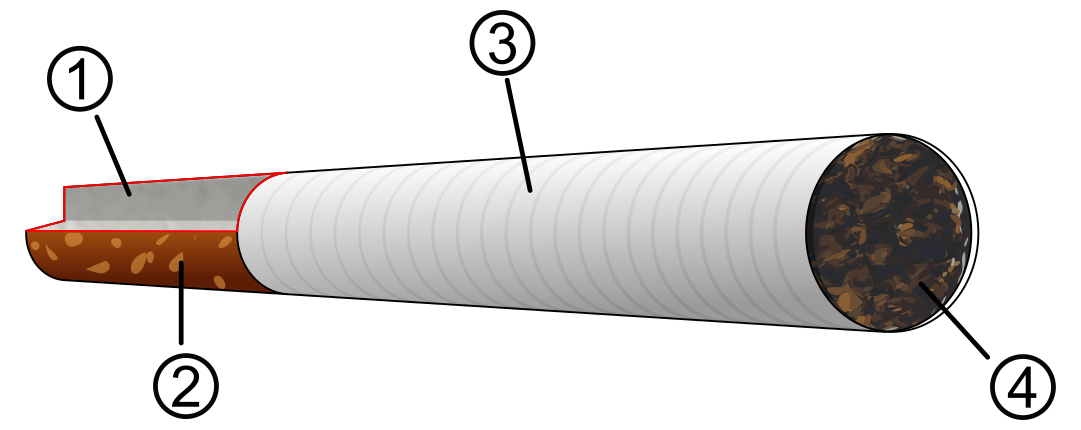
A cigarette filter, also known as a filter tip, is a component of a cigarette, along with tobacco, cigarette paper, capsules and adhesives. Modern filters were introduced in the early 1950s.
Filters may be made from plastic cellulose acetate fiber, paper or activated charcoal (either as a cavity filter or embedded into the plastic cellulose acetate fibers). Macroporous phenol-formaldehyde resins and asbestos have also been used. The plastic cellulose acetate filter and paper modify the particulate smoke phase by particle retention (filtration), and finely divided carbon modifies the gaseous phase (adsorption).
Filters are intended to reduce the harm caused by smoking by reducing harmful chemicals inhaled by smokers. While laboratory tests show a reduction of "tar" and nicotine in cigarette smoke, filters are ineffective at removing gases of low molecular weight, such as carbon monoxide. Most of these measured reductions occur only when the cigarette is smoked on a smoking machine; when smoked by a human, the compounds are delivered into the lungs regardless of whether a filter is used.
Most factory-made cigarettes are equipped with a filter; users who roll their own can buy them from a tobacconist.
History
In 1925, Hungarian inventor Boris Aivaz patented the process of making a cigarette filter from crepe paper.
From 1935, Molins Machine Co Ltd a British company began to develop a machine that made cigarettes incorporating the tipped filter. It was considered a specialty item until 1954, when manufacturers introduced the machine more broadly, following a spate of announcements from doctors and researchers concerning a possible link between lung diseases and smoking. Since filtered cigarettes were considered safer, by the 1960s, they dominated the market. Production of filter cigarettes rose from 0.5 percent in 1950 to 87.7 percent by 1975.
Between the 1930s and the 1950s, most cigarettes were 70 mm long. In the 1980s, many were 80 , long.
Cigarettes filters were originally made of cork and used to prevent tobacco flakes from getting on the smoker's tongue. Many are still patterned to look like cork.
Manufacture

Cigarette filters are usually made from plastic cellulose acetate fibre, or activated charcoal (either as a cavity filter or embedded into the cellulose acetate). Glycerol triacetate may be used as a softener.
The tip paper may be coated with polyvinyl alcohol.
Colour change
The tobacco industry determined that the illusion of filtration was more important than filtration itself. The pH of the cellulose acetate used is modified, so that its colour becomes darker when exposed to smoke (this was invented in 1953 by Claude Teague, The industry wanted filters to be seen as effective for marketing reasons, despite not making smoking any less unhealthy. Teague said that:
Health risks
Main article: Health effects of tobacco
Waste
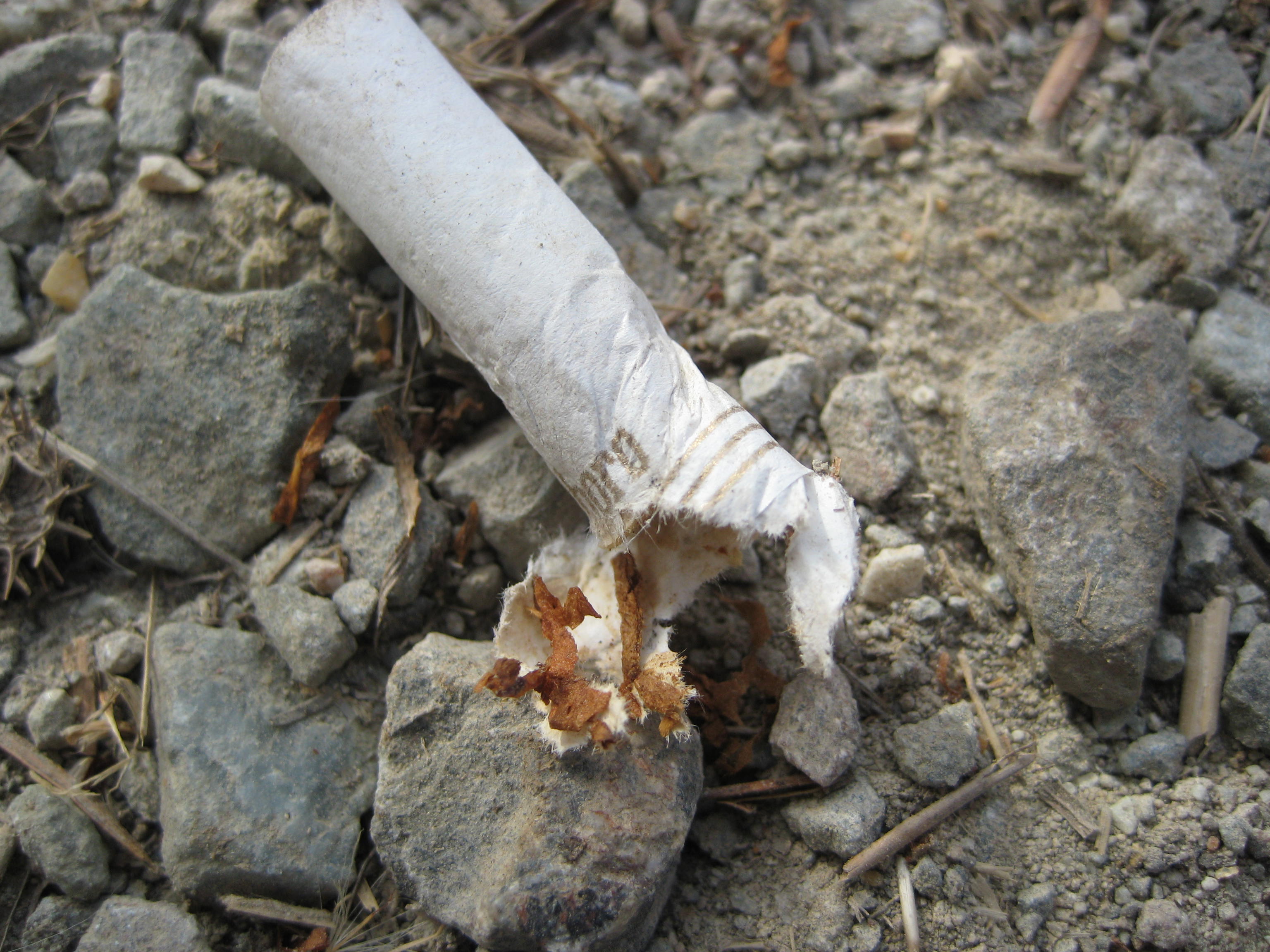
Cigarette butts are the most littered anthropogenic (man-made) waste item in the world. Approximately 5.6 trillion cigarettes are smoked every year worldwide. Of these, it is estimated that 4.5 trillion cigarette butts become litter every year. The plastic cellulose acetate in cigarette butts biodegrades gradually, passing through the stage of microplastics. The breakdown of discarded cigarette butts is highly dependent upon environmental conditions. A 2021 review article cites an experiment where 45–50% of cellulose acetate mass was fully degraded to CO2 after 55 days of controlled composting and another where negligible degradation took place after 12 weeks in pilot-scale compost.
During the act of smoking, plastic cellulose acetate fibers and tipping paper absorb a wide range of chemicals that are present in tobacco smoke. After cigarette butts are discarded, they can leach toxins including nicotine, arsenic, polycyclic aromatic hydrocarbons and heavy metals into the environment. Smoked cigarette butts and cigarette tobacco in butts have been shown to be toxic to water organisms such as the marine topsmelt (Atherinops affinis) and the freshwater fathead minnow (Pimephales promelas). Moreover, cigarette filters enriched in toxic substances that enter environmental waterbodies have been shown to be increasingly colonized by potentially pathogenic bacteria including those displaying antibiotic resistance, as these are particularly well adapted to the adverse conditions on the filters. [[File:Ashtray full of Cigarette butts.png|alt=Ashtray full of Cigarette butts|thumb|Ashtray full of cigarette butts]] Many governments and local authorities have imposed stiff penalties for littering of cigarette filters; for example Washington State imposes a penalty of $1,025 for littering cigarette filters.{{cite web | access-date = 2016-09-19 | archive-url = https://web.archive.org/web/20161017024347/http://listserv.wa.gov/cgi-bin/wa?A2=ind0406A&L=ecology-news&F=&S=&P=643 | archive-date = 2016-10-17 | url-status = dead
Recent research has been put into finding ways to use the filter waste in order to develop other products. One research group in South Korea have developed a one-step process that converts the cellulose acetate in discarded cigarette filters into a high-performing supercapacitor electrode material. These materials have demonstrated superior performance as compared to commercially available carbon, graphene and carbon nanotubes.
Another group of researchers has proposed adding tablets of food grade acid inside the filters. Once wet enough the tablets would release acid that accelerates degradation to around two weeks, instead of using cellulose triacetate and besides of cigarette smoke being quite acidic.
Activated charcoal filtration
Cigarette filter can incorporate an activated charcoal filtration system. Instead of acetate or cardboard filters, it consists of two ceramic caps on either sides containing activated charcoal, which reduces tar and other toxins in the smoke.
References
References
- Kennedy, Pagan. (2012-07-08). "Who Made That Cigarette Filter?". [[The New York Times]].
- Harris, Bradford. (2011-05-01). "The intractable cigarette 'filter problem'". Tobacco Control.
- "Construction of cigarettes and cigarette filters".
- (2007). "Ullmann's Encyclopedia of Industrial Chemistry". Wiley.
- Seymour S. Chissick. (2007). "Ullmann's Encyclopedia of Industrial Chemistry". Wiley.
- T. C. Tso. (2007). "Ullmann's Encyclopedia of Industrial Chemistry". Wiley.
- Robert Kapp. (2005). "Encyclopedia of Toxicology". Elsevier.
- "The History of Filters". tobaccoasia.com.
- "Cigarette with Filter tip".
- Leonard M. Schuman. (1977). "Research on Smoking Behavior".
- Lynn T. Kozlowski. (1983). "Measurement in the Analysis and Treatment of Smoking Behavior". U.S. Dept. of Health and Human Services.
- "Construction of cigarettes and cigarette filters".
- "Cigarette Filters".
- (2007). "Ullmann's Encyclopedia of Industrial Chemistry". Wiley.
- F. L. Marten. (2002). "Kirk-Othmer Encyclopedia of Chemical Technology". Wiley.
- Robert N. Proctor. (2012). "Golden Holocaust: Origins of the Cigarette Catastrophe and the Case for Abolition". [[University of California Press]].
- (2001). "Monograph 13: Risks associated with smoking cigarettes with low tar machine-measured yields of tar and nicotine". [[United States Department of Health and Human Services]].
- (2009). "Cigarettes butts and the case for an environmental policy on hazardous cigarette waste". International Journal of Environmental Research and Public Health.
- (2010-05-12). "The world litters 4.5 trillion cigarette butts a year. Can we stop this?". [[The Houston Chronicle]].
- Frederic Beaudry. (3 July 2019). "Are Cigarette Butts Biodegradable?". treehugger.com.
- (2021). "Degradable or not? Cellulose acetate as a model for complicated interplay between structure, environment and degradation". Chemosphere.
- Cantú, Aaron. (February 12, 2014). "New 'Green' Cigarette Butts Biodegrade Within Days—And Can Even Sprout Into Grass - The company Greenbutts is manufacturing a new filter to address most common litter problem.". [[AlterNet]].
- (2020). "Degradation Rates of Plastics in the Environment". ACS Sustainable Chemistry & Engineering.
- (2009). "Waste on the roadside, 'poi-sute' waste: Its distribution and elution potential of pollutants into environment". Waste Management.
- (2011). "Toxicity of cigarette butts, and their chemical components, to marine and freshwater fish". Tobacco Control.
- (2025). "Effects of cigarette-derived compounds on the spread of antimicrobial resistance in artificial human lung sputum medium, simulated environmental media and wastewater". Environmental Health Perspectives.
- (2014). "Preparation of energy storage material derived from a used cigarette filter for a supercapacitor electrode". Nanotechnology.
- (2012-08-14). "No more butts: biodegradable filters a step to boot litter problem". Environmental Health News.
- (2018). "Effect of Charcoal in Cigarette Filters on Free Radicals in Mainstream Smoke". Chemical Research in Toxicology.
This article was imported from Wikipedia and is available under the Creative Commons Attribution-ShareAlike 4.0 License. Content has been adapted to SurfDoc format. Original contributors can be found on the article history page.
Ask Mako anything about Cigarette filter — get instant answers, deeper analysis, and related topics.
Research with MakoFree with your Surf account
Create a free account to save articles, ask Mako questions, and organize your research.
Sign up freeThis content may have been generated or modified by AI. CloudSurf Software LLC is not responsible for the accuracy, completeness, or reliability of AI-generated content. Always verify important information from primary sources.
Report