From Surf Wiki (app.surf) — the open knowledge base
Church of St John the Baptist, Yeovil
Parish church in Somerset, England
Parish church in Somerset, England
| Field | Value | |
|---|---|---|
| name | Church of St John the Baptist | |
| image | Church of St John the Baptist, Yeovil - Mike Smith.jpg | alt=Stone building with arched windows and square tower. |
| locmapin | Somerset | |
| coordinates | ||
| location | BA20 1HE, Yeovil, Somerset, England | |
| built | Late 14th century | |
| designation1 | Grade I Listed Building | |
| designation1_offname | Church of St John the Baptist | |
| designation1_date | 19 March 1951 | |
| designation1_number | 1055713 |
The Church of St John the Baptist in Yeovil, Somerset, is a Church of England parish church.
The church was built between 1380 and 1405, but was renovated in the 1850s. It has been designated as a Grade I listed building. The tower, which was built around 1480, is 92 ft high, in four stages with set-back offset corner buttresses. It is thought that the work was supervised by William Wynford, master mason of Wells Cathedral. To meet the growing size of Yeovil and the increased population, work on a second church, Holy Trinity, began on 24 June 1843, and this relieved the pressures on St John's. In 1863, shortage of space in the graveyard was alleviated by the opening of the Preston Road cemetery.
The church is capped by openwork balustrading matching the parapets which are from the 17th century. Major reconstruction work was undertaken from 1851 to 1860. The tower has two-light late 14th century windows on all sides at bell-ringing and bell-chamber levels, the latter having fine pierced stonework grilles. There is a stair turret to the north-west corner, with a weather vane termination. Among the fourteen bells are two dating from 1728 and made by Thomas Bilbie of the Bilbie family in Chew Stoke. Another from the same date, the "Great Bell", was recast in 2013,
Because of the state of some of the external masonry the church has been added to the Heritage at Risk Register.
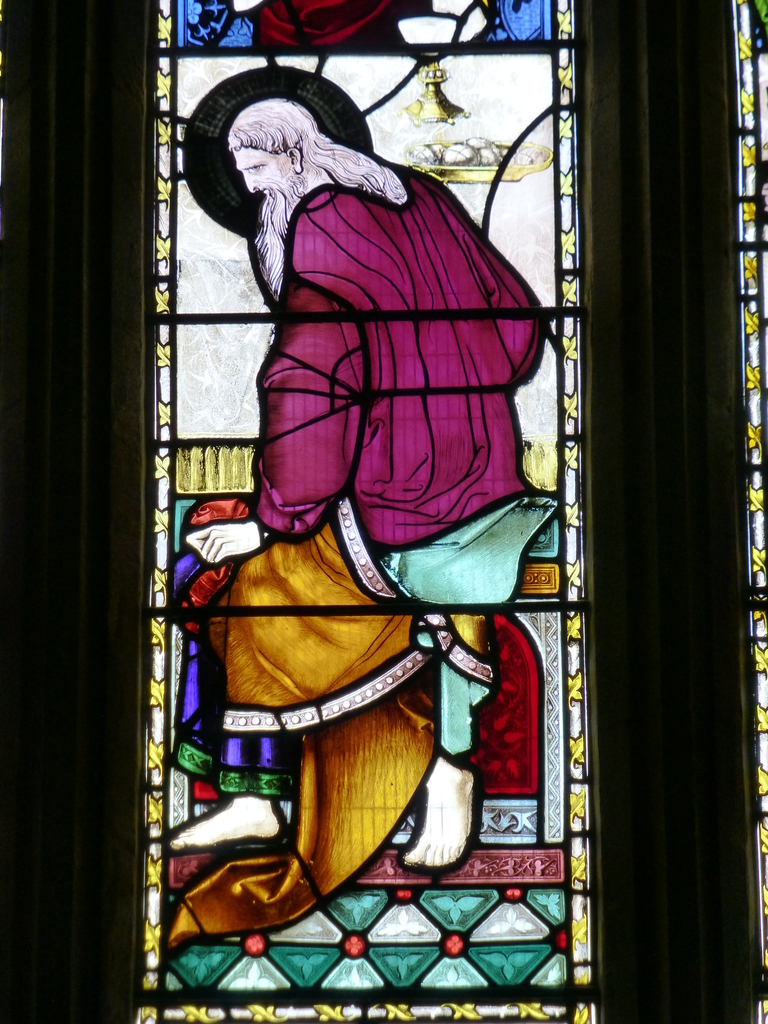
Unusually, the stained glass windows include a depiction of a lone Judas Iscariot with a dark halo. Inside the church is a brass reading desk originally made in East Anglia.
The parish is part of a benefice with St Andrew, Yeovil, in the Diocese of Bath and Wells. A Member of the South West Gospel Partnership, it has an evangelical character.
The Chantry

In 1573, the Chantry of St Mary the Virgin in the churchyard of the parish church was fitted out as a schoolroom by the parish. This developed into a charity school. In 1855, the schoolroom was demolished and replaced by a new building next to the churchyard, also called the Chantry, which had feoffees who appointed a schoolmaster. When the old schoolroom was demolished, it was estimated to date from the reign of Richard III, and some of its features, including two chimneypieces, were salvaged and built into the new Chantry, while the roof structure was copied.
References
References
- "Church of St John The Baptist". English Heritage.
- Poyntz Wright, Peter. (1981). "The Parish Church Towers of Somerset, Their construction, craftsmanship and chronology 1350 - 1550". Avebury Publishing Company.
- "St John the Baptist Church". Yeovil History.
- "Yeovil, S John Bapt".
- (1995). "Bilbie and the Chew Valley clock makers". The authors.
- "Church of St John the Baptist, Church Path, Yeovil — South Somerset". English Heritage.
- "The Church of St John Baptist". Yeovil History.
- (1996). "Fifty Somerset Churches". Somerset Books.
- "St John the Baptist, Yeovil". Church of England.
- [https://www.swgp.org.uk/churches/ South West Gospel Partnership: churches], swgp.org.uk
- Daniel Vickery, ''A Sketch of the Town of Yeovil'' (1856), [https://books.google.com/books?id=SHNbAAAAQAAJ&pg=PA35 pp. 35–40]
- "Yeovil — Free School", in ''Schools Inquiry Commission'', vol. XIV (1868), [https://books.google.com/books?id=aN5MAAAAcAAJ&pg=PA243 pp. 243–247]
- [[Ordnance Survey]], [https://maps.nls.uk/view/122163842 "Somerset LXXXIII.13"] (surveyed 1886, published 1889), see "Grammar School, School (Girls & Infts)" immediately to the west of "St. John the Baptist's Ch."
- By stages, the charity school morphed into [[Yeovil Grammar School]], which closed in 1907 with the retirement of its schoolmaster.L. C. Hayward, [https://www.yalhs.org.uk/1987-apr-pg134-136_the-charity-school-part-3of3/ THE YEOVIL CHARITY SCHOOL – (PART 3 OF 3)] in ''Chronicle: Yeovil Archaeological and Local History Society'', April 1987, pp. 134-136
This article was imported from Wikipedia and is available under the Creative Commons Attribution-ShareAlike 4.0 License. Content has been adapted to SurfDoc format. Original contributors can be found on the article history page.
Ask Mako anything about Church of St John the Baptist, Yeovil — get instant answers, deeper analysis, and related topics.
Research with MakoFree with your Surf account
Create a free account to save articles, ask Mako questions, and organize your research.
Sign up freeThis content may have been generated or modified by AI. CloudSurf Software LLC is not responsible for the accuracy, completeness, or reliability of AI-generated content. Always verify important information from primary sources.
Report