From Surf Wiki (app.surf) — the open knowledge base
Chukar partridge
Species of bird

Species of bird
- A. c. chukar
- A. c. cypriotes
- A. c. dzungarica
- A. c. falki
- A. c. kleini
- A. c. koroviakovi
- A. c. kurdestanica
- A. c. pallescens
- A. c. pallida
- A. c. potanini
- A. c. pubescens
- A. c. sinaica
- A. c. subpallida
- A. c. werae}}
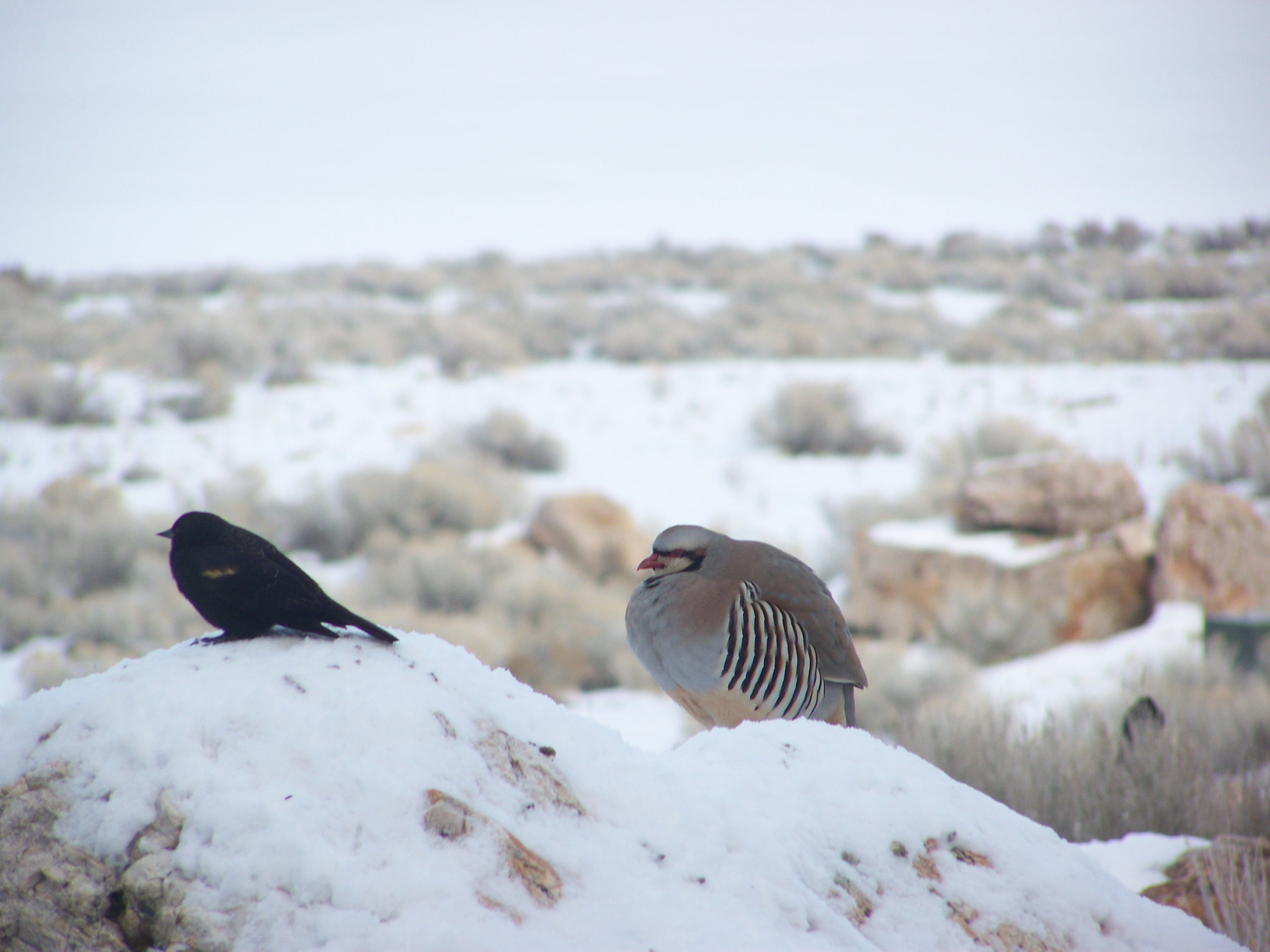
The chukar partridge (Alectoris chukar), or simply chukar, is a Palearctic upland gamebird in the pheasant family Phasianidae. It has been considered to form a superspecies complex along with the rock partridge, Philby's partridge and Przevalski's partridge and treated in the past as conspecific particularly with the first. This partridge has well-marked black and white bars on the flanks and a black band running from the forehead across the eye down the head to form a necklace that encloses a white throat. Native to Asia, the species has been introduced into many other places and feral populations have established themselves in parts of North America, Malta and New Zealand. This bird can be found in parts of Middle East and temperate Asia.
Description

The chukar is a rotund 32 - long partridge, with a light brown back, grey breast, and buff belly. The shades vary across the various populations. The face is white with a black gorget. It has rufous-streaked flanks, red legs and coral red bill. Sexes are similar, the female slightly smaller in size and lacking the spur. The tail has 14 feathers, the third primary is the longest while the first is level with the fifth and sixth primaries.
It is very similar to the rock partridge (Alectoris graeca) with which it has been lumped in the past but is browner on the back and has a yellowish tinge to the foreneck. The sharply defined gorget distinguishes this species from the red-legged partridge which has the black collar breaking into dark streaks near the breast. Their song is a noisy chuck-chuck-chukar-chukar from which the name is derived. The Barbary partridge (Alectoris barbara) has a reddish-brown rather than black collar with a grey throat and face with a chestnut crown.
Other common names of this bird include chukker (chuker or chukor), Indian chukar and keklik.
Distribution and habitat

This partridge has its native range in Asia, including Israel, Jordan, Palestine, Lebanon, Syria, United Arab Emirates, Saudi Arabia, Oman, Turkey, Kurdistan, Iran, Afghanistan, Tajikistan, Pakistan and India, along the inner ranges of the western Himalayas to Nepal, as well as southeasternmost Europe in Bulgaria and Greece. Further west in southeastern Europe it is replaced by the rock partridge, Alectoris graeca. It barely ranges into Africa on the Sinai Peninsula. The habitat in the native range is rocky open hillsides with grass or scattered scrub or cultivation. In Israel and Jordan it is found at low altitudes, starting at 400 m below sea level in the Dead Sea area, whereas in the more eastern areas it is mainly found at an altitude of 2000 to except in Pakistan, where it occurs at 600 m. They are not found in areas of high humidity or rainfall.
It has been introduced widely as a game bird, and feral populations have become established in the United States (Rocky Mountains, Great Basin, high desert areas of California), Canada, Chile, Argentina, New Zealand and Hawaii. Initial introductions into the US were from the nominate populations collected from Afghanistan and Nepal. The birds are hunted across the dry, rocky Columbia Basin, especially in the vicinity of the Snake River in Washington and Oregon. It has also been introduced to New South Wales in Australia but breeding populations have not persisted and are probably extinct. A small population exists on Robben Island in South Africa since it was introduced there in 1964.
The chukar readily interbreeds with the red-legged partridge (Alectoris rufa), and the practice of breeding and releasing captive-bred hybrids has been banned in various countries including the United Kingdom, as it is a threat to wild populations.
Systematics and taxonomy

The chukar partridge is part of a confusing group of "red-legged partridges". Several plumage variations within the widespread distribution of the chukar partridge have been described and designated as subspecies. In the past the chukar group was included with the rock partridge (also known as the Greek partridge). The species from Turkey and farther east was subsequently separated from A. graeca of Greece and Bulgaria and western Europe.
Subspecies
The chukar has 14 recognized subspecies:
- A. c. chukar (nominate species) (J. E. Gray, 1830) - eastern Afghanistan to eastern Nepal
- A. c. cypriotes (Hartert, 1917) - southeastern Bulgaria to southern Syria, Crete, Rhodes and Cyprus
- A. c. dzungarica (Sushkin, 1927) – northwestern Mongolia to Russian Altai and eastern Tibet
- A. c. falki (Hartert, 1917) – north central Afghanistan to Pamir Mountains and western China
- A. c. kleini (Hartert, 1925) – northern Greece through Bulgaria and north Turkey to the Caucasus
- A. c. koroviakovi (Zarudny, 1914) – eastern Iran to Pakistan
- A. c. kurdestanica (Meinertzhagen, 1923) – Caucasus Mountains to Iran
- A. c. pallescens (Hume, 1873) – northeastern Afghanistan to Ladakh and western Tibet
- A. c. pallida (Hume, 1873) – northwestern China
- A. c. potanini (Sushkin, 1927) – western Mongolia
- A. c. pubescens (R. Swinhoe, 1871) – inner Mongolia to northwestern Sichuan and eastern Qinghai
- A. c. sinaica (Bonaparte, 1858) – northern Syrian Desert to Sinai Peninsula
- A. c. subpallida (Zarudny, 1914) – Kyzyl Kum and Kara Kum Mountains (Tajikistan)
- A. c. werae (Zarudny and Loudon, 1904) – eastern Iraq and southwestern Iran
Population and status
This species is relatively unaffected by hunting or loss of habitat. Its numbers are largely affected by weather patterns during the breeding season. The release of captive stock in some parts of southern Europe can threaten native populations of rock partridge and red-legged partridge with which they may hybridize.
British sportsmen in India considered the chukar as good sport although they were not considered to be particularly good in flavour. Their fast flight and ability to fly some distance after being shot made recovery of the birds difficult without retriever dogs. During cold winters, when the higher areas are covered in snow, people in Kashmir have been known to use a technique to tire the birds out to catch them.
Behaviour and ecology
In the non-breeding season, chukar partridge are found in small coveys of 10 or more (up to 50) birds. In summer, chukars form pairs to breed. During this time, the cocks are very pugnacious in their calling and fighting. During winter they descend into the valleys and feed in fields. They call frequently during the day and especially in the mornings and evenings. The call is loud and includes loud repeated chuck notes and sometimes duetting chuker notes. Several calls varying with context have been noted. The most common call is a "rallying call" which when played back elicits a response from birds and has been used in surveys, although the method is not very reliable. When disturbed, it prefers to run rather than fly, but if necessary it flies a short distance often down a slope on rounded wings, calling immediately after alighting. In Utah, birds were found to forage in an area of about 2.6 km2 and travel up to 4.8 km to obtain water during the dry season. The home range was found to be even smaller in Idaho. The breeding season is summer. Males perform tidbitting displays, a form of courtship feeding where the male pecks at food and a female may visit to peck in response. The males may chase females with head lowered, wing lowered and neck fluffed. The male may also perform a high step stiff walk while making a special call. The female may then crouch in acceptance and the male mounts to copulate, while grasping the nape of the female. Males are monogamous. The nest is a scantily lined ground scrape, though occasionally a compact pad is created with a depression in the centre. Generally, the nests are sheltered by ferns and small bushes, or placed in a dip or rocky hillside under an overhanging rock. About 7 to 14 eggs are laid. The eggs hatch in about 23–25 days. In captivity they can lay an egg each day during the breeding season if eggs are collected daily. Chicks join their parents in foraging and will soon join the chicks of other members of the covey.[[File:Chukar from Jebel Al Lawz, Saudi Arabia.jpg|left|thumb|Chukar from Jebel Al Lawz, Saudi Arabia]]As young chukars grow, and before flying for the first time, they utilize wing-assisted incline running as a transition to adult flight. This behaviour is found in several bird species, but has been extensively studied in chukar chicks, as a model to explain the evolution of avian flight.

Chukar will take a wide variety of seeds and some insects as food. It also ingests grit. In Kashmir, the seeds of a species of Eragrostis was particularly dominant in their diet while those in the US favoured Bromus tectorum. Birds feeding on succulent vegetation make up for their water needs but visit open water in summer.
Chukar roost on rocky slopes or under shrubs. In the winter, birds in the US selected protected niches or caves. A group may roost in a tight circle with their heads pointed outwards to conserve heat and keep a look out for predators.
Chukar are sometimes preyed on by golden eagles.
Birds in captivity can die from Mycoplasma infection and outbreaks of other diseases such as erysipelas.
In culture
The name is onomatopoeic and mentions of chakor in Sanskrit, from northern Indian date back to the Markandeya Purana (c. 250–500 AD). In North Indian and Pakistani culture, as well as in Hindu mythology, the chukar (referred as Chakor) sometimes symbolizes intense, and often unrequited, love. It is said to be in love with the moon and to gaze at it constantly. Because of their pugnacious behaviour during the breeding season they are kept in some areas as fighting birds.
Gallery
File:Alectoris chukar MHNT.ZOO.2010.11.6.11.jpg|Eggs File:Chukar chick-HVC parking lot HNP (9285063049).jpg|Juvenile File:Datia State CoA.png|Chukar in Indian heraldry File:Alectoris chukar (AM LB4107-2).jpg|Taxidermy File:Chukar partridge near Haleakala summit Maui.jpg|Near Haleakala summit, Maui
References
References
- BirdLife International. (2019). "''Alectoris chukar''".
- Rasmussen, Pamela C.. (2005). "Birds of South Asia: The Ripley Guide". Smithsonian Institution & Lynx Edicions.
- Blanford. (1898). "Fauna of British India. Birds. Volume 4". Taylor and Francis, London.
- Watson GE. (1962). "Three sibling species of ''Alectoris'' Partridge". Ibis.
- Baker ECS. (1928). "Fauna of British India. Birds. Volume 5". Taylor and Francis, London.
- Long, John L. (1981). Introduced Birds of the World. Agricultural Protection Board of Western Australia, 21–493
- (2009). "The Birds of the Hawaiian Islands: Occurrence, History, Distribution, and Status". B.P. Bishop Museum, Honolulu, HI, U.S.A..
- Luke Thompson. (October 23, 2019). "Tough hunting: The challenge of chukar hunting brings its own rewards". Yakima Herald-Republic.
- "Hunting chukar partridge". [[Washington Department of Fish and Wildlife]].
- (2008). "Systematics and Taxonomy of Australian Birds". CSIRO.
- [http://www.biodiversityexplorer.org/birds/phasianidae/alectoris_chukar.htm ''Alectoris chukar'' (Chukar partridge)] {{Webarchive. link. (2018-09-04 . Biodiversityexplorer.org. Retrieved 2011-11-28.)
- "Red-legged partridge". Game & Wildlife Conservation Trust.
- Hartert. (1925). "A new form of Chukar Partridge ''Alectoris graeca kleini'' subsp.nov.". Novitates Zoologicae.
- Christensen GC. (1970). "The Chukar Partridge. Biological Bulletin No. 4". Nevada Department of Wildlife.
- "DOI – IOC World Bird List". www.worldbirdnames.org.
- (2007). "Aerodynamics of wing-assisted incline running in birds". The Journal of Experimental Biology.
- (2006). "What Use Is Half a Wing in the Ecology and Evolution of Birds?". BioScience.
- Dial, K.P.. (2003). "Wing-Assisted Incline Running and the Evolution of Flight". Science.
- (2003). "Mechanics of wing-assisted incline running (WAIR)". The Journal of Experimental Biology.
- Ticehurst. (1927). "The Birds of British Baluchistan. Part 3". Journal of the Bombay Natural History Society.
- Dowson, John. (1879). "A Classical Dictionary of Hindu Mythology and Religion, Geography, History and Literature". Trübner & Co..
- Pargiter. (1904). "The Markandeya Purana. Translated with Notes". The Asiatic Society.
- "Translation of the Songs of Harkh Na'Th". Asiatic Society of Bengal.
- Balfour. (1871). "Cyclopædia of India and of eastern and southern Asia, commercial, industrial and scientific: products of the mineral, vegetable and animal kingdoms, useful arts and manufactures". Scottish & Adelphi Presses.
- Stuart Baker EC. (1922). "The game birds of India, Burma and Ceylon, part 31". Journal of the Bombay Natural History Society.
- Barilani, Marina. (2007). "Hybridisation with introduced chukars (''Alectoris chukar'') threatens the gene pool integrity of native rock (''A. graeca'') and red-legged (''A. rufa'') partridge populations". Biological Conservation.
- Bohl, Wayne H.. (1956). "Experiments in Locating Wild Chukar Partridges by Use of Recorded Calls". The Journal of Wildlife Management.
- Bump G. (1951). "The chukor partridge (''Alectoris graeca'') in the Middle East with observations on its adaptability to conditions in the southwestern United States". US Fish and Wildlife Service.
- (1984). "Must desert Chukars (''Alectoris chukar sinaica'') drink water? Water influx and body mass changes in response to dietary water content". The Auk.
- (2004). "Field inbreeding of released farm-reared Red-legged Partridges (''Alectoris rufa'') with wild ones". Game and Wildlife Science.
- (1995). "Experimental toxoplasmosis in chukar partridges (''Alectoris graeca'')". Avian Pathology.
- Finn, Frank. (1915). "Indian Sporting Birds". Francis Edwards, London.
- (1980). "Handbook of the birds of India and Pakistan. Volume 2". Oxford University Press.
- Johnsgard PA. (1973). "Grouse and Quails of North America". University of Nebraska, Lincoln.
- Hume AO. (1890). "The nests and eggs of Indian Birds. Volume 3". R H Porter, London.
- (1880). "The Game birds of India, Burmah and Ceylon". Self published.
- (2006). "Outbreak of respiratory syndrome in Chukar Partridge (''Alectoris chukar'')". The Journal of Animal and Plant Sciences.
- Ludlow, Frank. (1934). "Catching of Chikor [''Alectoris graeca chukar'' (Gray)] in Kashmir". Journal of the Bombay Natural History Society.
- (1971). "Fall Food Items Utilized by Chukars in Kashmir, India". The Journal of Wildlife Management.
- Oates EW. (1898). "A manual of the Game birds of India. Part 1". A J Combridge, Bombay.
- Phelps JE. (1955). "The adaptability of the Turkish Chukar partridge (''Alectoris graeca'' Meisner) in central Utah". Unpublished MS Thesis, Utah State Agricultural College, Logan, Utah, USA.
- (1976). "''Erysipelothrix rhusiopathiae'' infection in Chukar Partridge (''Alectoris graeca'')". Journal of Wildlife Diseases.
- Stokes, Allen W. (1961). "Voice and Social Behavior of the Chukar Partridge". The Condor.
- Temple, Richard Carnac. (1884). "The legends of the Panjâb. Volume 2". Education Society's Press, Bombay.
- Walter, Hanspeter. (2002). "Natural history and ecology of the Chukar (''Alectoris chukar'') in the northern Great Basin". Great Basin Birds.
- Whistler, Hugh. (1949). "Popular Handbook of Indian Birds. Edition 4". Gurney and Jackson, London.
- (1965). "Factors Affecting the Incidence of Rally Calling in the Chukar Partridge". The Condor.
- Woodard AE. (1982). "Raising Chukar Partridges". Cooperative Extension Division of Agricultural Sciences, University of California. Leaflet 21321e.
This article was imported from Wikipedia and is available under the Creative Commons Attribution-ShareAlike 4.0 License. Content has been adapted to SurfDoc format. Original contributors can be found on the article history page.
Ask Mako anything about Chukar partridge — get instant answers, deeper analysis, and related topics.
Research with MakoFree with your Surf account
Create a free account to save articles, ask Mako questions, and organize your research.
Sign up freeThis content may have been generated or modified by AI. CloudSurf Software LLC is not responsible for the accuracy, completeness, or reliability of AI-generated content. Always verify important information from primary sources.
Report