From Surf Wiki (app.surf) — the open knowledge base
Chroococcidiopsis
Genus of bacteria
Genus of bacteria
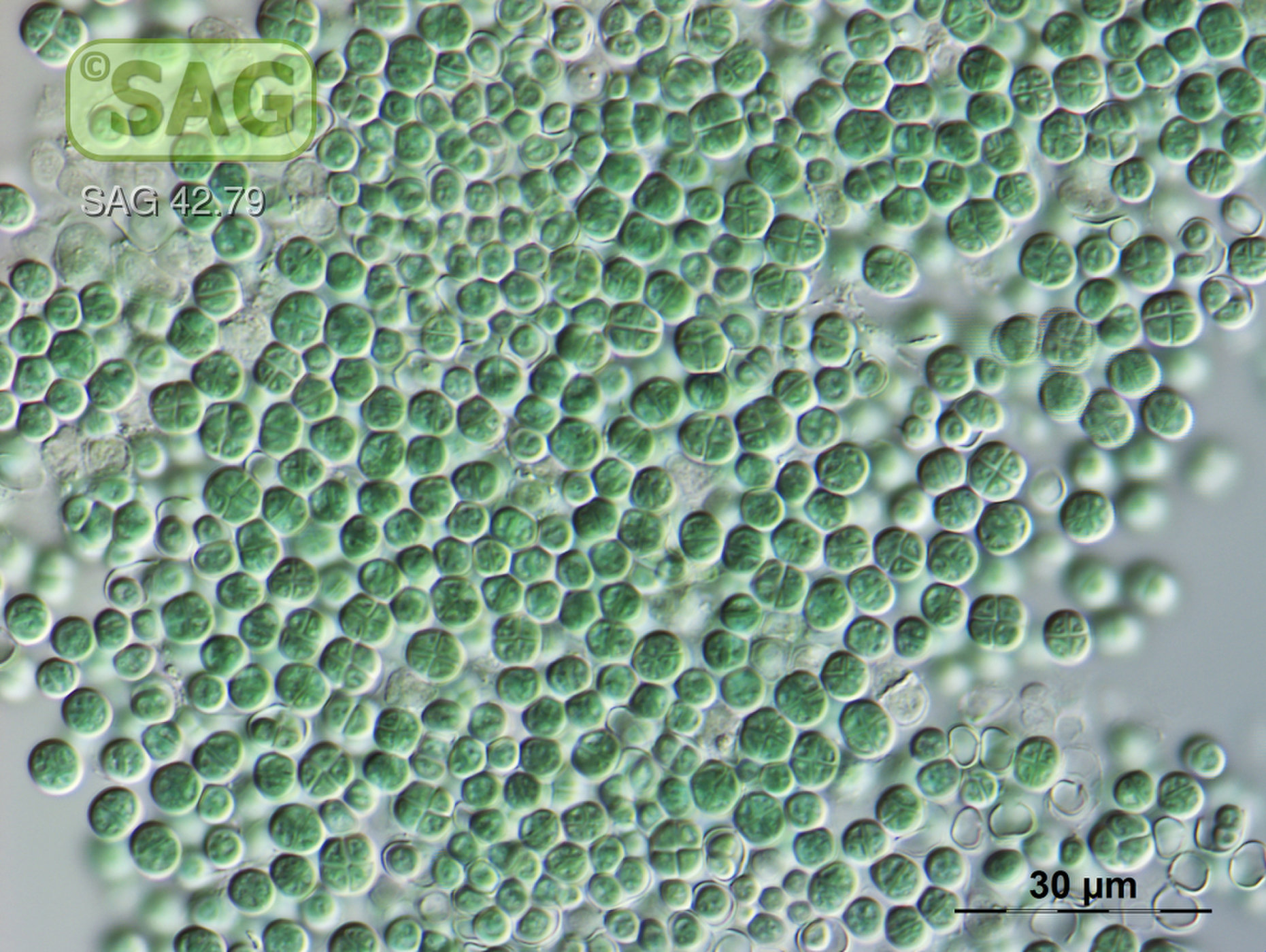
Chroococcidiopsis is a photosynthetic, coccoidal bacterium, and the only genus in the order Chroococcidiopsidales and in the family Chroococcidiopsidaceae. A diversity of species and cultures exist within the genus, with a diversity of phenotypes. Some extremophile members of Chroococcidiopsis are known for their ability to survive harsh environmental conditions, including both high and low temperatures, ionizing radiation, and high salinity.
Chroococcidiopsis are able to survive in a dormant state for at least 13 million years, with the ability to reactivate after this time.
Desiccation resistance
The ability of Chroococcidiopsis to resist desiccation in arid environments is due in part because it colonizes the underside of translucent rocks. The underside of these rocks provides enough condensed moisture for growth while the rock's translucent nature allows just enough light to reach the organism for photosynthesis to occur.
A 2023 study found Chroococcidiopsis is able to survive for long periods in a desiccated state on solar panels, under irradiated conditions. The samples were able to be genetically altered, proving potential future uses, but no specific task was coded into the samples used.
UV and desiccation resistance
Biofilms of Chroococcidiopsis were exposed to Mars-like UV-flux and desiccation for up to seven years. Biofilms that were either (1) dried or (2) both dried and UV irradiated were able to recover. When these biofilms were rewetted the nucleotide excision repair genes encoding UvrA, UvrB and UvrC were over-expressed. This suggests that nucleotide excision repair of accumulated DNA damages contributed to the recovery.
Mars colonization
Due to its resistance to harsh environmental conditions, especially low temperature, low moisture, and radiation tolerance, Chroococcidiopsis has been thought of as an organism capable of living on Mars. Scientists have speculated about the possibility of introducing Chroococcidiopsis to the Martian environment to aid in the formation of an aerobic environment. In addition to oxygen production, Chroococcidiopsis could aid in the formation of soil on the Martian surface. On Earth, soil is formed by plant, microbial, and geophysical activity on a mineral substrate. The soil produced by chemical weathering of rocks and oxygen produced by photosynthesis could one day provide the conditions necessary for humans to grow food on Mars, possibly allowing for permanent human civilizations on the planet. On a shorter time scale, cyanobacteria such as Chroococcidiopsis could be used in closed systems to produce resources for human-occupied outposts on Mars without altering the planet's surface or atmosphere.
A space mission called EXPOSE-R2 was launched on 24 July 2014 aboard the Russian Progress M-24M, and was attached on 18 August 2014 outside the ISS on the Russian module Zvezda. The experiment included samples of Chroococcidiopsis that were exposed to simulated Martian atmosphere, UVC radiation and temperature extremes. In 2022, the findings of the experiments were published.
Species
The Catalogue of Life includes 16 species of Chroococcidiopsis:
- Chroococcidiopsis bourrellyana
- Chroococcidiopsis codiicola
- Chroococcidiopsis cubana
- Chroococcidiopsis doonensis
- Chroococcidiopsis edaphica
- Chroococcidiopsis fissurarum
- Chroococcidiopsis indica
- Chroococcidiopsis karnatakensis
- Chroococcidiopsis kashayi
- Chroococcidiopsis lichenoides
- Chroococcidiopsis muralis
- Chroococcidiopsis spinosa
- Chroococcidiopsis supralittoralis
- Chroococcidiopsis thermalis
- Chroococcidiopsis umbratilis
- Chroococcidiopsis versatilis
References
References
- Bahl, Justin. (2011-01-25). "Ancient origins determine global biogeography of hot and cold desert cyanobacteria". Nature Communications.
- (2014). "Taxonomic classification of cyanoprokaryotes (cyanobacterial genera) 2014, using a polyphasic approach". Preslia.
- [https://www.space.com/40898-low-light-bacteria-mars-colonization.html Weird Low-Light Bacteria Could Potentially Thrive on Mars], Space.com, accessed 6/18/2018
- (June 2014). "Salt tolerance and polyphyly in the cyanobacterium ''Chroococcidiopsis'' (Pleurocapsales)". Journal of Phycology.
- (28 July 2020). "Aerobic microbial life persists in oxic marine sediment as old as 101.5 million years". Nature Communications.
- (17 February 2023). "First characterization of cultivable extremophile ''Chroococcidiopsis'' isolates from a solar panel". Frontiers in Microbiology.
- (2019). "Over-Expression of UV-Damage DNA Repair Genes and Ribonucleic Acid Persistence Contribute to the Resilience of Dried Biofilms of the Desert Cyanobacetrium ''Chroococcidiopsis'' Exposed to Mars-Like UV Flux and Long-Term Desiccation". Frontiers in Microbiology.
- "Greening of the Red Planet". [[NASA]].
- (April 2000). "Ionizing-radiation resistance in the desiccation-tolerant cyanobacterium Chroococcidiopsis". Applied and Environmental Microbiology.
- (2015-08-01). "Sustainable life support on Mars – the potential roles of cyanobacteria". International Journal of Astrobiology.
- (31 July 2014). "Exploring Mars in low Earth orbit". NASA's Astrobiology Magazine.
- (18 August 2014). "Russian Cosmonaut Tosses Satellite for Peru During Spacewalk". [[Space.com]].
- (20 August 2013). "The BOSS and BIOMEX space experiments on the EXPOSE-R2 mission: Endurance of the desert cyanobacterium ''Chroococcidiopsis'' under simulated space vacuum, Martian atmosphere, UVC radiation and temperature extremes.". Acta Astronautica.
- (May 2022). "Absence of increased genomic variants in the cyanobacterium Chroococcidiopsis exposed to Mars-like conditions outside the space station". Scientific Reports.
- "''Chroococcidiopsis'' Geitler".
This article was imported from Wikipedia and is available under the Creative Commons Attribution-ShareAlike 4.0 License. Content has been adapted to SurfDoc format. Original contributors can be found on the article history page.
Ask Mako anything about Chroococcidiopsis — get instant answers, deeper analysis, and related topics.
Research with MakoFree with your Surf account
Create a free account to save articles, ask Mako questions, and organize your research.
Sign up freeThis content may have been generated or modified by AI. CloudSurf Software LLC is not responsible for the accuracy, completeness, or reliability of AI-generated content. Always verify important information from primary sources.
Report